
Setting up a patio umbrella base comes down to three things done in the right order: picking a base heavy enough for your umbrella size, measuring your pole so the fit is snug, and filling or anchoring that base so it stays put when the wind picks up. For most 9-foot market umbrellas, you need at least 50 pounds of ballast. For 11-foot models and offset/cantilever umbrellas, that number jumps to 80 pounds and often well past 200 pounds. Get the weight right first, then follow the steps below and you will have a stable, safe setup in under an hour.
How to Set Up Patio Umbrella Base: Step-by-Step Guide Tips.

Luca Morrison
30 Jul 2026
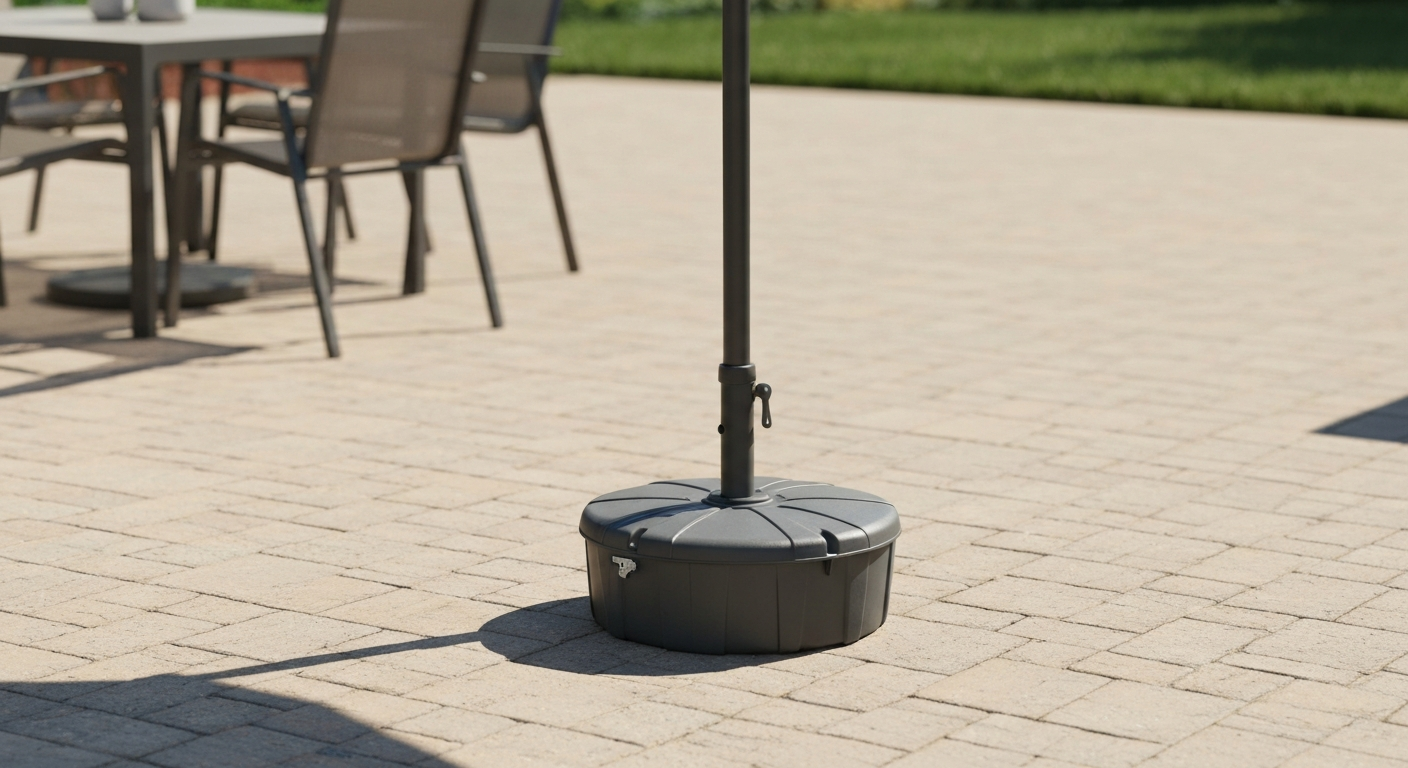
What you are deciding before you buy anything
Before you order a base or drag one home from the store, there are four decisions that shape everything else. Umbrella size is the first: a 7.5-foot umbrella sitting on a deck table behaves very differently than a 13-foot cantilever on an exposed patio. Pole diameter is the second: most residential market umbrellas use a 1.5-inch or 2-inch pole, but some brands run 1.9 inches or other odd sizes, and a base hub that is even a quarter-inch too large will wobble. Wind exposure is the third factor, and it is the one most homeowners underestimate. A patio that is open on three sides in a region that sees summer thunderstorms needs a meaningfully heavier base than an umbrella sitting in a sheltered courtyard. The National Weather Service recommends securing or closing outdoor items when sustained winds reach 40 to 50 mph, the range where wind damage becomes possible, so your base needs to handle gusts above that. Finally, location determines whether you need a wheeled, portable base, a fixed ground anchor, a deck-mount sleeve, or a weighted base that doubles as furniture. Sorting out those four points first saves you from buying the wrong thing twice.
How much weight you actually need
Manufacturers like Treasure Garden publish specific minimum base-weight figures, and they are worth taking seriously because those numbers come from real wind-load testing. The general rule of thumb: the bigger and more exposed the umbrella, the more ballast you need, and cantilever (offset) umbrellas need dramatically more than straight-pole market umbrellas because the lever arm is much longer. Here is a practical reference table.
| Umbrella Type / Size | Minimum Base Weight | When to Upsize |
|---|---|---|
| 7.5 ft market umbrella (in-table use) | 20–30 lb | Rarely needed; table itself adds stability |
| 9 ft market umbrella (freestanding) | 50 lb | Upsize to 75+ lb in windy or open locations |
| 11 ft market umbrella (freestanding) | 80 lb | Upsize to 100+ lb on exposed patios |
| 10–11 ft offset / cantilever | 150–200 lb | Upsize to 250+ lb for large canopies or high-wind areas |
| 11.5–13 ft rectangular cantilever | 200–400 lb | Use stacked weighted modules or concrete anchor for exposed sites |
These weights align with Treasure Garden's published catalog minimums and Sunnyglade's manual guidance, which specifies 200 to 220 pounds of equivalent ballast for their 10-by-10 and 10-by-13 cantilever models. If your patio is open, elevated, or in a region with frequent afternoon thunderstorms, treat the minimums as a floor, not a target. It is always safer to go heavier than the minimum. Tropitone's safety documentation also reinforces using a manufacturer-specified freestanding base rather than repurposing an in-table base for freestanding applications, because the geometries are simply not the same.
Tools and materials checklist
Most base setups do not require specialized tools, but having the right items on hand before you start saves a lot of back-and-forth trips to the garage.
- Tape measure (for pole diameter and hub opening)
- Adjustable wrench or socket set (for tightening set-screws and bolt-together base sections)
- Rubber mallet (for seating plug caps and snugging pole into tight hub openings)
- Flathead and Phillips screwdrivers
- Garden hose or large funnel (for water-fill bases)
- 50 lb bags of play sand or coarse sand (for sand-fill bases)
- Small hand trowel or scoop (for directing sand into narrow fill ports)
- Large bucket or tarp (for catching overflow and cleanup)
- Waterproof silicone sealant or plumber's Teflon tape (to seal fill caps against leaks)
- Work gloves
- Level (to confirm the base is sitting flat before inserting the pole)
For in-ground sleeve or concrete anchor installations, you will additionally need a post-hole digger or rented power auger, a bag or two of 60-pound ready-mix concrete (rated 2,500 to 4,000 psi is standard for small footings), a mixing bucket or wheelbarrow, and a wood or metal stake to hold the sleeve plumb while the concrete sets. Concrete reaches working strength in 24 to 48 hours but does not hit full design strength until 28 days, so avoid loading the sleeve under a large canopy in wind until it has cured properly.
Measuring your umbrella pole before you buy a base
This step stops the single most common mistake I see: buying a base whose hub opening does not match the pole. Start by measuring the outside diameter of the pole at its base, not the top. Use a tape measure wrapped around the pole to get the circumference, then divide by 3.14 to get the diameter. Or just use calipers if you have them. Most residential market umbrellas land at 1.5 inches or 2 inches, but some brands use 1.9 inches, 38 mm (roughly 1.5 in), 48 mm (roughly 1.9 in), or other metric sizes. Write that number down and check it against the base's listed hub diameter before purchasing.
Next, check the pole shape: most are round, but some budget umbrellas ship with an octagonal or hexagonal pole section near the base, which will rock inside a round hub. If that is your situation, look for a base that includes an adapter insert or plan to shim the gap with a rubber bushing. Finally, note whether your umbrella has a tilt mechanism (push-button, collar, or crank tilt) and whether the crank handle will clear the base hub when in use. A hub that rides too high on a crank-style umbrella can jam the crank or prevent the pole from seating fully.
Choosing the right commercial umbrella base
Commercial fillable bases are made from cast iron, steel, concrete, or HDPE plastic (high-density polyethylene). Each material has trade-offs worth knowing.
| Base Material | Typical Filled Weight | Best For | Watch Out For |
|---|---|---|---|
| Cast iron / steel | 30–50 lb (unfilled, solid) | Permanent or semi-permanent setups; classic look | Rust if coating chips; very heavy to move |
| HDPE plastic (fillable) | Up to 260+ lb when sand-filled | Portability; modularity; budget-friendly | Shell can crack if overfilled or impacted; degrades in UV over years |
| Concrete / stone | 40–80 lb solid cast | Stability without filling; clean aesthetic | Difficult to move; can chip; fixed hub diameter |
| Multi-plate fillable modules | Up to 240–280 lb (4-plate stacked) | Large cantilever umbrellas; adjustable ballast | Takes time to fill/empty; floor space footprint |
On mobility: if you need to move the umbrella between a dining area and a lounge area seasonally, a fillable HDPE base on a wheeled dolly is the practical choice. You fill it in place, and when you need to relocate it, you drain it, wheel it, and refill. A Westminster Teak-style solid steel parasol base (typically around 42 pounds unfilled at 16 by 16 by 16 inches) is handsome and stable for smaller umbrellas but becomes a two-person lift the moment you need to shift it. Westminster Teak, Parasol Base product page (specs & weight) lists a steel parasol base with dimensions 16×16×16 inches and a unit weight of about 42 lb Westminster Teak — Parasol Base product page (specs & weight). For aesthetics, cast-iron and concrete bases blend better with high-end furniture; plastic fillable bases can look utilitarian unless you choose a dark color that recedes visually under the umbrella canopy.
Fill options within fillable bases: water is convenient and easy to drain for off-season storage, but it provides less weight per volume than sand. A 21.2-gallon fill volume of water weighs about 177 pounds (at 8.34 lb per gallon). The same 21.2-gallon volume filled with dry compacted sand at 100 lb per cubic foot yields roughly 283 pounds, which is why manufacturers like Abba Patio advertise sand-filled capacities of 260-plus pounds for bases that hold only about 177 pounds of water. If you are near the minimum weight threshold for your umbrella size, sand is almost always the better choice.
Step-by-step: assembling and installing a factory umbrella base
Most commercial fillable bases arrive as a flat-pack: a hub section, two to four shell halves or plates, and a hardware bag. Here is exactly how to put one together and get the umbrella pole in safely. For step-by-step photos and a downloadable checklist on how to install a patio umbrella in a base, see our separate installation guide.
- Lay out all parts on a flat surface and confirm you have the hardware bag. Count the bolts and nuts before you start; missing fasteners are easier to chase down before assembly than after.
- If your base is a two-piece clamshell design, mate the two halves together and hand-thread the bolts through the pre-drilled flanges. Do not fully tighten yet.
- For multi-plate stacking bases, begin with the bottom plate and thread the center post or hub tube through each plate in sequence. Plates typically have a keyed tab or directional arrow; orient them so fill ports are accessible from the side.
- Once all plates or shell halves are assembled, snug the bolts in a cross pattern (like lug nuts on a tire) to ensure the shell seats evenly. Torque only hand-tight plus a quarter turn with a wrench. Overtightening plastic flanges will crack them.
- Place the assembled base on flat, level ground. Use your level to confirm it is not rocking. If the patio surface is uneven, slide a rubber furniture pad under the low side rather than shimming with wood, which can shift.
- Insert the umbrella pole into the hub opening. The pole should drop in smoothly without forcing. If it hangs up, check for a shipping plug in the bottom of the hub and remove it.
- Tighten the set-screw (or set-screws) against the pole using the provided hex key or the knob if your base uses a clamping knob. The screw should contact the pole firmly but should not deform the pole surface. On aluminum poles, one firm hand-tightening of the knob is usually enough; on steel poles you can go slightly firmer.
- Open the umbrella canopy halfway and check that the pole is plumb (straight up) by eye from two perpendicular directions. If the pole leans, the hub may be sitting on uneven ground or the set-screw may be pushing the pole off-center. Loosen, reposition, and re-tighten.
- Open the canopy fully, then give the pole a firm push from each side at mid-height. The base should not skid or tip. If it moves, you need more ballast (fill the base before regular use).
Filling a factory base with water
Water fill is the fastest and cleanest method. The downside is weight: water gives you about 8.34 pounds per gallon, so a four-plate base with a 21.2-gallon capacity tops out around 177 pounds. For a 9-foot market umbrella that meets the 50-pound minimum, even a modest water fill is sufficient. For large cantilever umbrellas, water alone may fall short of the recommended minimum and you may need to consider sand instead.
- Confirm the drain plug (usually a threaded plastic or rubber cap at the base of the shell) is firmly seated before you add any water.
- Locate the fill port, typically a screw cap or push-in bung on the top or side of the base. Remove it.
- Insert a garden hose nozzle or a funnel into the fill port. Fill slowly to avoid trapped air pockets that reduce total fill capacity.
- Stop filling when water reaches the bottom of the fill port opening, or when the manufacturer's fill-line indicator is reached. Do not overfill; leaving a small air gap allows for thermal expansion on hot days.
- Replace and tighten the fill cap. Wrap the threads with one layer of plumber's Teflon tape if the cap leaks when you lay the base on its side during storage.
- Wipe down the exterior and check that no water is seeping from the shell seams or drain plug.
Pros of water fill: fast, no mess, easy to drain for off-season storage. Cons: lower weight per volume than sand, freezes in winter. This is the critical winter gotcha: if you leave a water-filled base outside in freezing temperatures, the expanding ice can crack the plastic shell from the inside. Before your first hard freeze, drain the base completely. Remove the drain plug, tip the base to purge any remaining water, and leave the fill cap off so residual moisture can evaporate.
Filling a factory base with sand
Sand fill is the right choice when you need maximum weight from a given shell volume. For step-by-step instructions, tools, and cleanup tips, see our guide on how to fill a patio umbrella base with sand. At roughly 90 to 110 pounds per cubic foot (dry bulk density), sand provides roughly 60 percent more weight than the same volume of water. The National Engineering Handbook (USDA NRCS), soil density references lists typical loose sand bulk densities in the 90–110 lb/ft³ range blank" rel="noopener noreferrer">National Engineering Handbook (USDA NRCS) — soil density references. Using the same 21.2-gallon example base, sand fill reaches roughly 240 to 283 pounds depending on compaction and moisture, which is why Abba Patio's spec sheets quote sand-filled weights of 260-plus pounds for bases that hold only 177 pounds of water.
- Set the assembled base on a tarp or in a spot where spilled sand is easy to sweep up.
- Confirm the drain plug is installed and the shell halves are fully bolted together before adding sand. Sand that leaks through an unsealed seam is a headache to clean up.
- Open the fill port. Pour or scoop dry play sand or coarse sand into the port. Use a small hand trowel or a wide funnel to direct sand into narrow openings on multi-plate bases.
- After adding about 4 to 5 pounds of sand, tap the sides of the shell firmly with your hand or a rubber mallet. This compacts the sand and settles it into corners, creating more room for additional sand. Skip this step and you will under-fill by 10 to 20 percent.
- Continue filling and tapping in layers until sand reaches the top of the fill cavity.
- Replace the fill cap and tighten it. Sand-filled bases do not need a watertight seal on the cap, but finger-tight is sufficient to keep insects and debris out.
- Wipe sand off the exterior and sweep the surrounding area. Fine sand tracked across a patio or deck scratches surfaces.
Pros of sand fill: significantly heavier than water for the same volume, does not freeze, stays in place year-round in most climates. Cons: messy to fill and extremely difficult to empty if you ever need to move or store the base. Wet or damp sand compacts harder and is nearly impossible to pour back out through a small fill port. If you go with sand, think of it as a semi-permanent choice. Do not use wet beach sand or sand with a high clay content; fine dry play sand or bagged coarse sand flows best and compacts predictably.
One cleanup tip I have learned from doing this on my own patio: lay down a piece of cardboard under the fill port before you start. Sand that misses the funnel falls on cardboard that you can fold up and pour back into the bag rather than chasing grains across pavers.
Keeping the base secure once it is set up
A properly weighted base is your first line of defense, but there are additional steps that make a real difference in windy conditions. Always close the umbrella canopy when you are not using it and especially before storms. An open 9-foot canopy acts as a sail, and even a well-ballasted base can tip under a strong gust. The NWS wind-damage threshold of 40 to 50 mph sustained is a good mental trigger: if a storm is forecast with gusts in that range, close and tilt or remove the umbrella. Some homeowners also use base anchor straps or threaded rods through deck boards to add a secondary connection point for the base. For more detail on anchoring options and anti-tip strategies, the companion guide on how to secure a patio umbrella base covers those methods in depth. See the companion guide on how to secure a patio umbrella base for detailed anchoring options and anti-tip strategies. For tips on alternatives and safe setups when you don't have a heavy base, see our guide on how to use a patio umbrella without a base. For step-by-step instructions on anchoring an umbrella in soil, see how to put patio umbrella in ground. See our guide on how to make a base for patio umbrella for step-by-step DIY instructions and base-building plans. See our guide on how to fix patio umbrella base for step-by-step anchoring and anti-tip repairs.
Quick troubleshooting for common base problems
The pole wobbles in the hub
A loose pole is almost always one of three things: the set-screw is not tightened, the hub opening is larger than the pole diameter, or the hub threads are stripped. Start by tightening the set-screw with a hex key rather than just the knob. If the hub is genuinely oversized, a rubber bushing or wrap of self-amalgamating tape around the pole (at the hub contact point) will fill the gap without damaging the pole. If the threads on the set-screw hole are stripped and the screw just spins, you will need to replace the hub section or the whole base depending on the design.
The shell is cracked
Hairline cracks in an HDPE plastic shell often form from over-tightened bolts, impact (someone knocked it with a mower), or freeze damage from a water-filled base left out in winter. For cosmetic cracks that do not affect structural integrity, a patch of waterproof epoxy applied to the inside surface will slow any water infiltration. For cracks that run through the load-bearing flange or the hub seat, the base is functionally compromised and replacement is the safer call. A cracked hub under a loaded umbrella pole is a tip-over waiting to happen.
The base keeps skidding on tile or smooth concrete
This is a surface-friction problem, not a weight problem. Self-adhesive rubber furniture pads or a dedicated rubber anti-slip mat cut to the base footprint solve this immediately and cost almost nothing. If the base is heavy enough but still moves, the surface may be slightly sloped; a rubber pad plus a thin shim on the uphill side will hold it.
When to repair versus replace a base
Replace a base outright when: the hub is cracked through its load-bearing wall, the shell is cracked across a main structural rib, or the base was freeze-damaged so badly that the halves no longer seat together. Repair or adjust when: the set-screw is stripped but the hub is intact (replacement set-screws cost under two dollars at any hardware store), the fill cap leaks (Teflon tape or a new rubber bung fixes it), or the base skids on a slick surface (rubber pads solve it). Honest assessment: most HDPE fillable bases cost $30 to $80, so if a repair requires sourcing specialty parts or more than an hour of labor, replacement usually makes more financial sense.
Maintenance and seasonal storage
At the end of each season, drain all water from the base before the first freeze, as described above. If your base is sand-filled and permanent, leave it in place but remove the umbrella pole and store the canopy indoors. Inspect the shell every spring for UV degradation (chalky, brittle surface texture), loose bolt flanges, and hub wear. Tighten any loose bolts, re-apply a UV-protectant spray to plastic surfaces, and check the set-screw for corrosion. A five-minute inspection at the start of each season catches small problems before they become tip-over risks. For full off-season storage, empty, dry, and store the base in a shed or garage; UV and freeze-thaw cycles are the two fastest ways to shorten a plastic base's life.
FAQ
How do I choose the right umbrella base for my patio umbrella size?
Match base weight to umbrella size and type: small 6–7' market umbrellas: ~20–40 lb; 8–9' market umbrellas: ~40–80 lb; large 9'–11' market or table umbrellas: ~50–100 lb; cantilever/offset and large rectangular umbrellas: 200–400+ lb (or manufacturer-specified ballast). Also match pole diameter (common sizes: 1"–1.5", 1.5", 2") — the base’s collar must accept the pole or adapters. If manufacturer specifies a minimum base weight, follow that. When in doubt, choose the heavier option, especially for freestanding or cantilever umbrellas.
What tools and materials do I need to install a factory, fillable umbrella base?
Typical tools: wrench or Allen key for set screws, adjustable wrench, funnel and hose (for water filling), scoop or funnel for sand filling, measuring tape, level, gloves, and a hand truck or dolly for moving filled base. Materials: water or clean sand (or pea gravel), anchors/adapters for pole diameter, silicone or waterproof tape (optional for seams), and a tarp for workspace. For concrete pours: concrete mix, bucket, water, mixing tool, and safety gear.
How do I fill a plastic/HDPE factory base with water safely and correctly?
1) Assemble plates per manufacturer instructions and seat collars/set screws. 2) Place base where it will stay (filling makes it heavy). 3) Use a hose and funnel for controlled filling; fill slowly to avoid splashing. 4) Bleed trapped air by slightly tilting or by opening any bleed plugs while filling. 5) Tighten set screws securely on the pole. 6) Add water-proofing (silicone) on seams only if leaking. Note: water-filled bases are easier to move but provide less ballast than sand or concrete — use sand or additional anchoring for windy locations.
How do I fill a base with sand (and how much will it weigh)?
Use clean, dry play or masonry sand for easiest handling. Calculate approximate weight: 1 US gallon of water ≈ 8.34 lb; sand bulk density varies but industry calculators commonly use ~90–110 lb/ft³ (100 lb/ft³ is a convenient estimate). Convert shell gallons to cubic feet (1 gallon ≈ 0.13368 ft³). Example: a 21.2-gallon capacity = 2.833 ft³ × 100 lb/ft³ ≈ 283 lb of sand. Because sand packs denser than water, sand-filled weights are substantially higher than water-filled. Fill slowly, tamp lightly, and seal any fill caps to prevent washout.
Can I use gravel or pebbles instead of sand or water?
Yes — pea gravel or crushed stone is an acceptable ballast and tends to be heavier per shell volume than water but similar to sand in effect. Typical decorative gravel bulk density ~95–105 lb/ft³; use the same volume-to-weight conversions as for sand. Gravel drains and won’t compact like sand, which can make disassembly easier. Avoid lightweight mulch or materials that absorb water or rot.
How do I make a DIY concrete umbrella base?
Option A — pour-in-place slab base: 1) Dig/form a mold sized for the design (typically 12–18" diameter, 6–12" deep for medium umbrellas; larger for big/cantilever models). 2) Place a steel or PVC sleeve centered to accept the pole (use a removable inner sleeve if you want the pole non-permanent). 3) Mix concrete per manufacturer directions and pour, embedding the sleeve plumb and braced. 4) Cure per guidance (keep moist, avoid heavy loads for 3–7 days; full design strength at 28 days). Option B — precast concrete pavers stacked inside a base shell: stack and grout or secure them together to reach desired weight. For cantilevers or very large umbrellas, use a larger engineered footing and/or consult a professional.
Next Articles
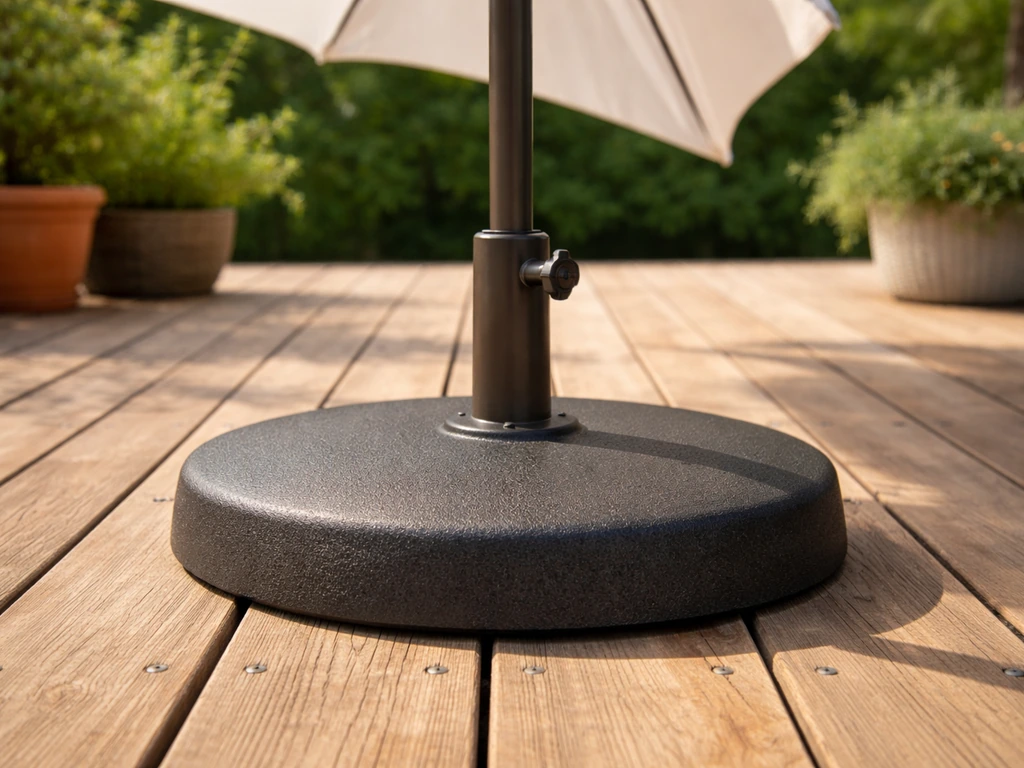
How to Secure a Patio Umbrella Base and Anchor
Step-by-step ways to secure patio umbrella bases or anchor poles without bases to stop wobble, tilt, and wind shift.
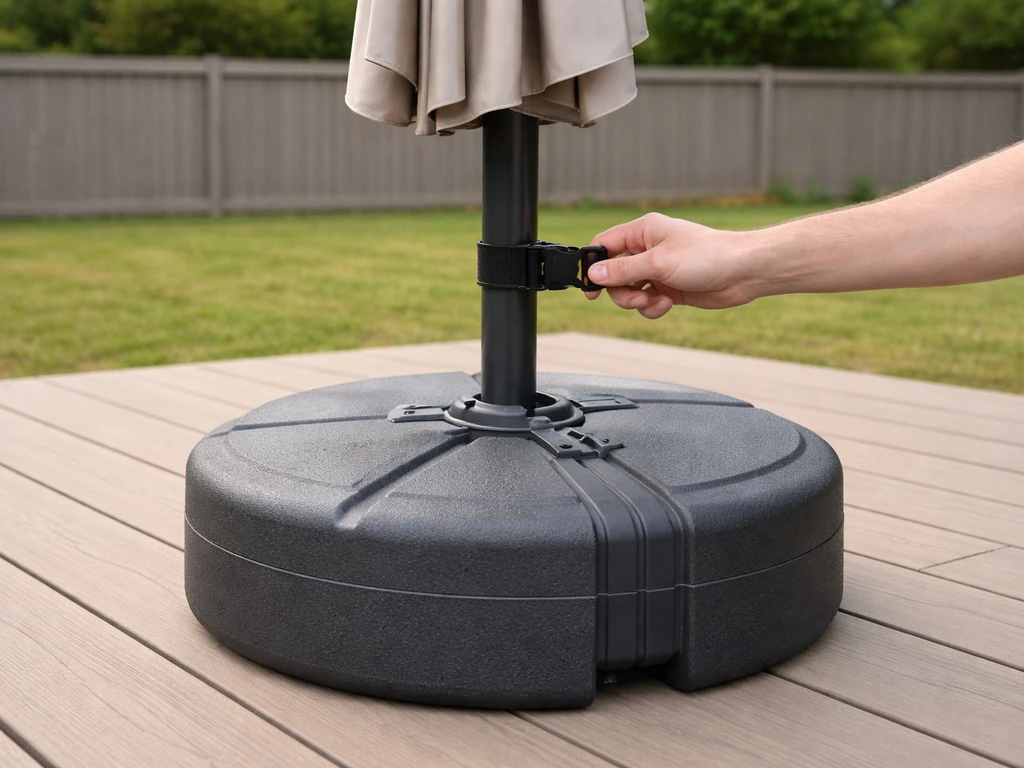
How to Use a Patio Umbrella Without a Base Safely
Step-by-step ways to secure a patio umbrella without a base, with safe weight needs, setup steps, and wobble fixes.
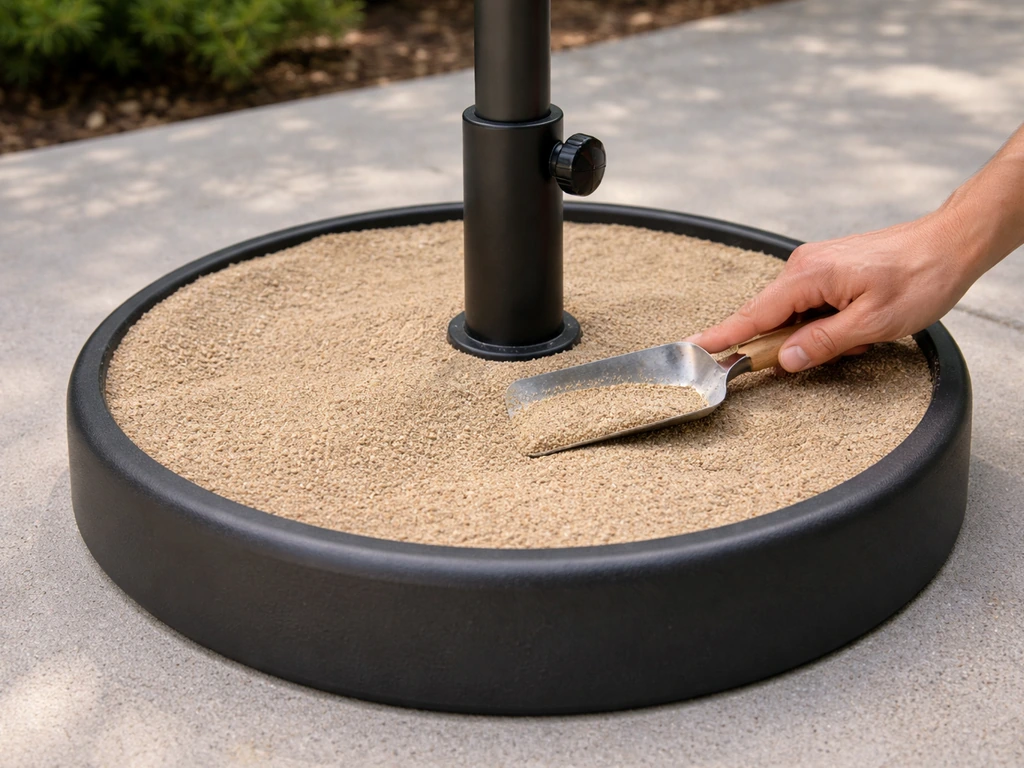
How to Fill a Patio Umbrella Base With Sand
Step by step guide to fill a patio umbrella base with sand for solid stability, no leaks, plus leveling and maintenance