
To secure a patio umbrella from wind, you need three things working together: a base that's heavy enough for your canopy size, a pole that's locked tight in the stand, and a habit of closing the umbrella the moment sustained winds hit around 15–20 mph. Get those three right and you'll stop most wind damage before it starts. Everything else, straps, anchors, tie-downs, is extra insurance on top of that foundation.
How to Secure a Patio Umbrella From Wind
Luca Morrison
19 May 2026
Why patio umbrellas fail in wind
Most umbrella wind failures aren't random bad luck. They happen because of a specific mechanical weak point, and once you know what to look for, they're almost always preventable.
The biggest culprit is an undersized or underfilled base. An open canopy acts like a sail, and even a modest 9-foot umbrella puts serious lateral force on the pole when a gust hits. If the base can't resist that force, the whole thing tips. A common rule of thumb is blank" rel="noopener noreferrer">10 pounds of base weight per foot of canopy diameter in calm-to-moderate conditions, so a 9-foot umbrella needs at least 90 pounds of base. Many people buy a 50-pound base and wonder why their umbrella falls over.
The second most common issue is a loose or partially engaged locking mechanism. Tilt buttons, crank locks, and pole collars that aren't fully tightened allow the pole to rotate, wobble, or lean, which dramatically increases the wind load on the base. As one manufacturer's manual puts it: never allow the canopy to flap in the wind. Flapping creates lift and destabilizes the whole setup fast.
Cantilever umbrellas are especially vulnerable because the canopy is offset from the base, creating a long lever arm. Any looseness in the base hardware or frame joints gets amplified. A loose cap screw or missing lock washer at the base joint, exactly the kind of detail that's easy to skip during assembly, can cause serious movement under load.
Placement matters too. An umbrella set up in a wind tunnel between two walls or at the corner of a deck where gusts change direction is in a much worse position than one in a sheltered spot. And finally, a rubber or protective pad under the base is not optional on smooth surfaces like tile, wood decking, or polished concrete. Without it, the base vibrates and walks across the surface until the umbrella tips.
Get the stand and base setup right
Before you add any straps or anchors, the base itself has to be correct. Everything downstream depends on this.
Match base weight to canopy size
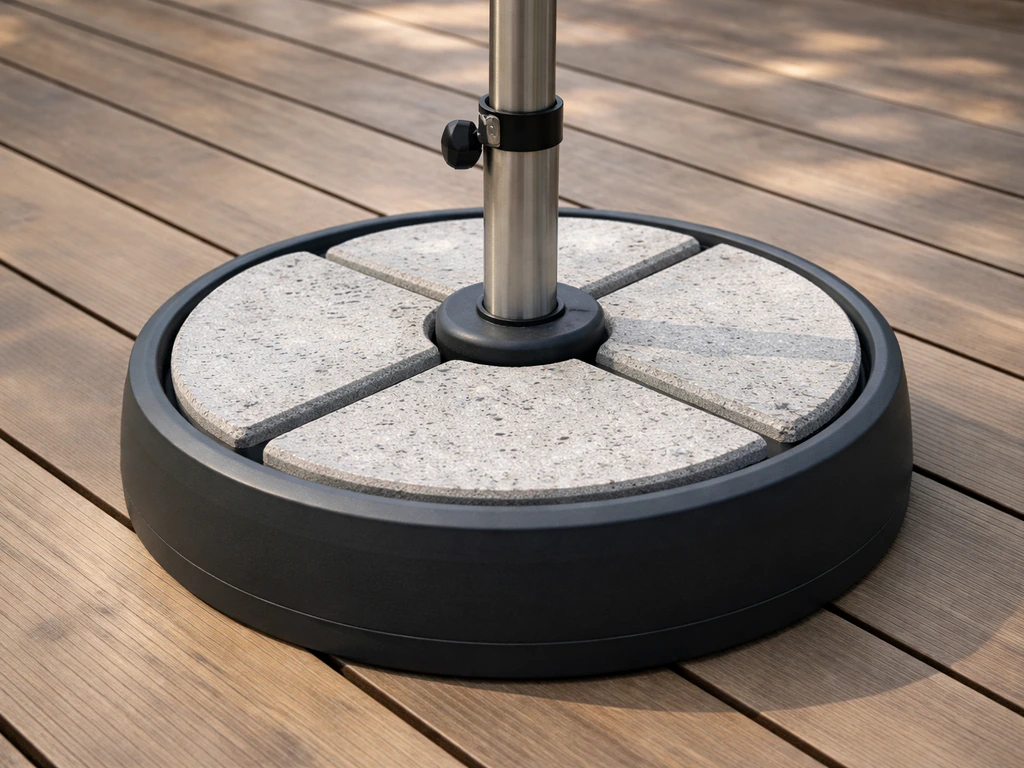
Use the 10-pounds-per-foot rule as your starting point for low-to-moderate wind exposure. If you're in a consistently windy area, exposed on a rooftop deck, or using a cantilever design, go heavier. A 10-foot cantilever umbrella needs significantly more base weight than a 10-foot center-pole umbrella because the offset load multiplies the overturning force. A 60–100 kg (roughly 130–220 pound) base is not unusual for a large cantilever in exposed conditions. If your current base feels light when you try to slide it, it probably is.
Fill a hollow base with the right material
Many resin bases have hollow centers designed to be filled. Water is the most common filler, but sand adds more weight per volume, and concrete adds the most. One 90-pound fiberglass stand, for example, can be filled with concrete to maximize stability. If you've been using water and the base still moves in wind, drain it and refill with dry sand or pour a concrete mix. Just make sure the base is rated for that kind of fill before you do it.
Use a rubber pad under the base
Place a rubber non-slip pad between the base and the surface it sits on. This prevents vibration from gradually moving the base during sustained wind. It also protects deck boards and tile from scratching. This is a $10–$15 fix that eliminates a real failure mode, so don't skip it.
Position the umbrella strategically
Put the umbrella where it has some natural shelter, near a wall, fence, or pergola post, rather than fully exposed on the open edge of a deck. Avoid corners where wind swirls and changes direction unpredictably. If you're on a rooftop or elevated deck with consistent wind exposure, a surface-mounted or in-ground stand is a much better choice than a freestanding weighted base.
How to lock the umbrella securely in the stand
This is where most people lose wind resistance they already paid for. The base might be heavy enough, but if the pole isn't locked into it correctly, the umbrella will still spin, tilt, or pull out.
- Insert the pole fully into the stand sleeve. It should drop to the bottom of the socket, not rest partway down. If the pole stops early, check for debris in the sleeve.
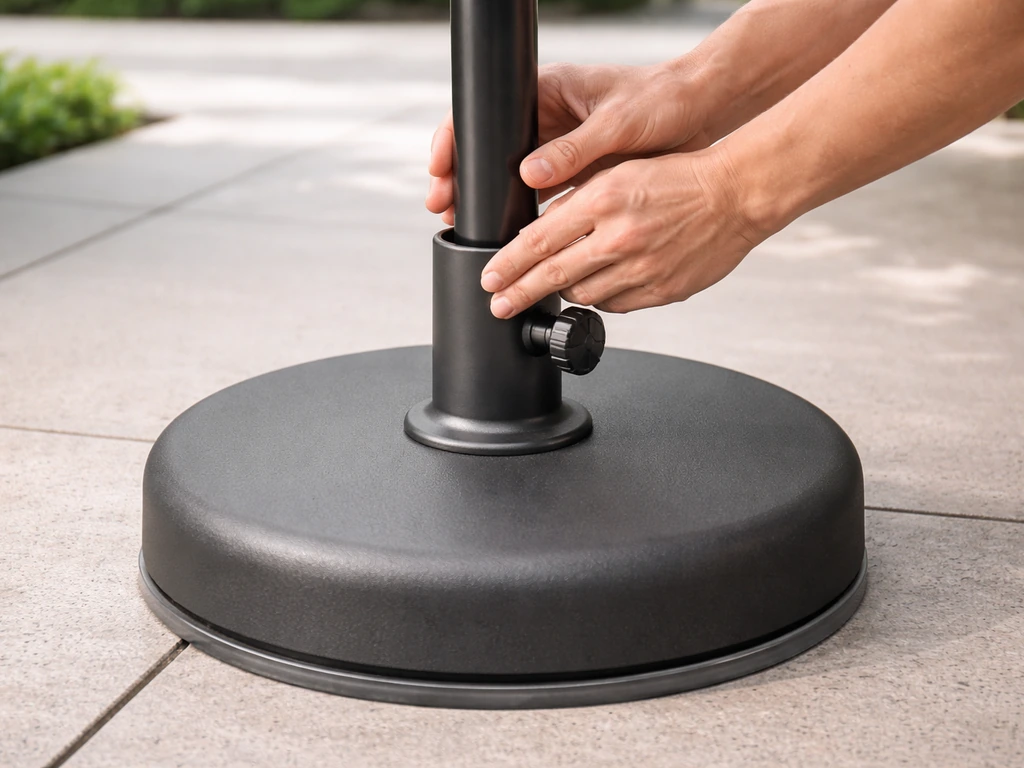
- Tighten the thumb screw, collar nut, or set screw at the top of the base sleeve until it bites into the pole. Don't just snug it, tighten it firmly. If it strips easily, the hardware may be worn and should be replaced.
- Check for a secondary locking pin or cross-bolt on the base. Many stands have one. If yours does, engage it. This is often the only thing preventing the pole from being lifted straight out by an upward gust.
- If your umbrella has a tilt mechanism (push-button, collar tilt, or Glide Tilt style), confirm it's in the straight-up, locked position when the umbrella is deployed. A partially engaged tilt button is one of the most common reasons an umbrella leans and catches more wind than it should.
- For systems like Revolvashade that use a winding handle to lock rotation, insert the handle into the lower hex nut and rotate clockwise until the umbrella is firmly seated. You should feel resistance stop and the umbrella should not rotate when you push on the canopy.
If your pole wobbles noticeably in the sleeve even after tightening, the sleeve diameter may be too large for your pole. A rubber pole sleeve insert or foam wrap around the pole can take up the gap. This is a simple fix that makes a real difference in both stability and spin prevention.
Best tie-down and anchoring methods for gusts
Once the base and lock are sorted, you can add mechanical anchoring to handle stronger gusts. If your patio umbrella also attracts bats, add secure tie-downs and cover or relocate it so there is no sheltered roosting spot near the canopy how to keep bats out of patio umbrellas. The method you choose depends on your setup and how permanent you want the solution to be.
| Method | Best For | Effort Level | Wind Resistance |
|---|---|---|---|
| Weighted sandbags on base legs | Any portable stand | Low | Moderate |
| Ratchet straps to deck/fence anchors | Decks with solid structure | Low-Medium | High |
| Bolt-down surface plate | Permanent patio location | Medium | Very High |
| In-ground concrete sleeve | Permanent installation, large umbrellas | High | Maximum |
| Deck-mount anchor above joists | Wood decks | Medium | Very High |
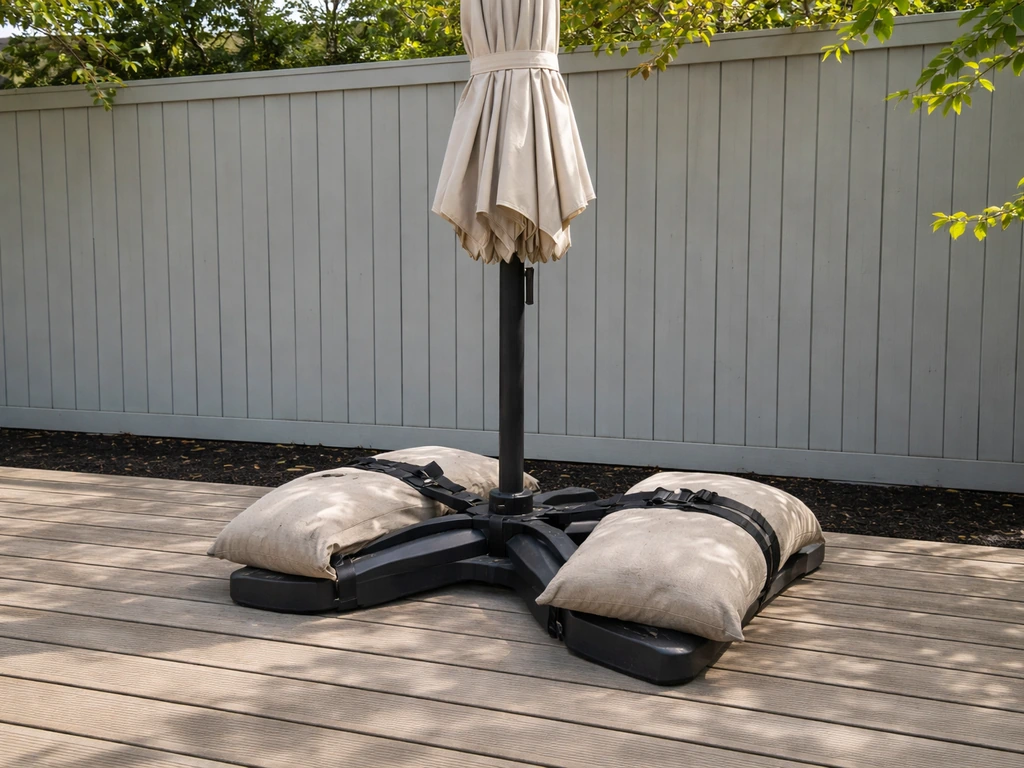
Sandbags or weight bags on the base
If your stand has cross legs or a ring base, draping filled sandbags or purpose-made weight bags over the legs adds meaningful downward force without permanent installation. This is the easiest upgrade and costs almost nothing if you already have sand or gravel available.
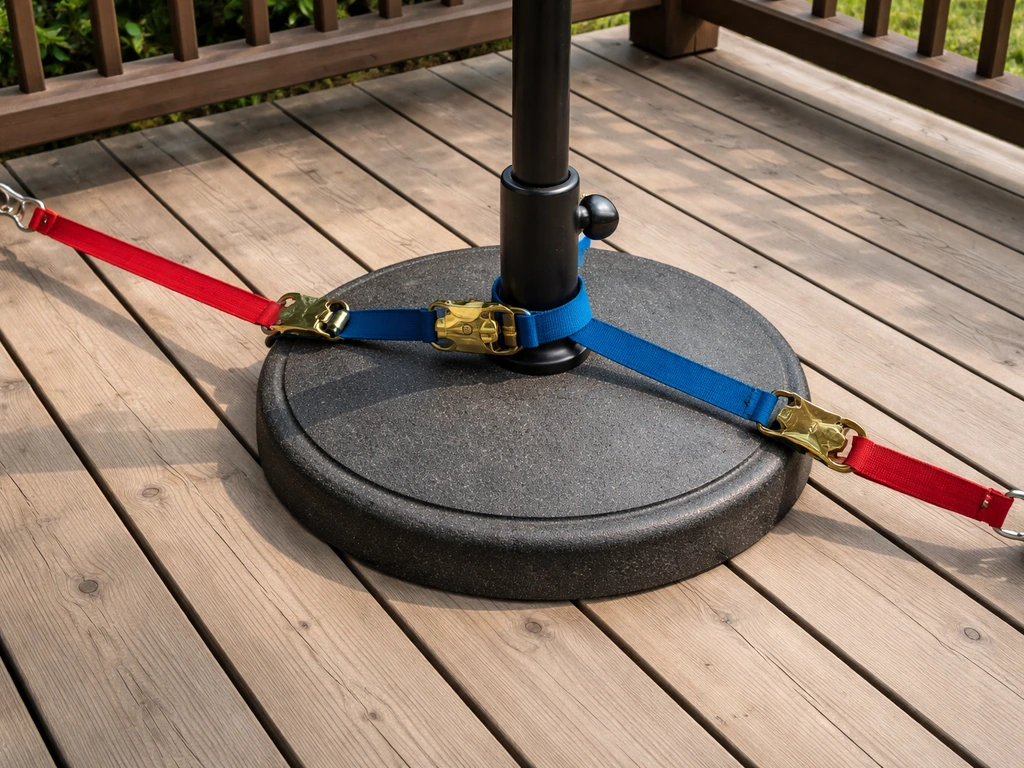
Ratchet straps to a fixed anchor point
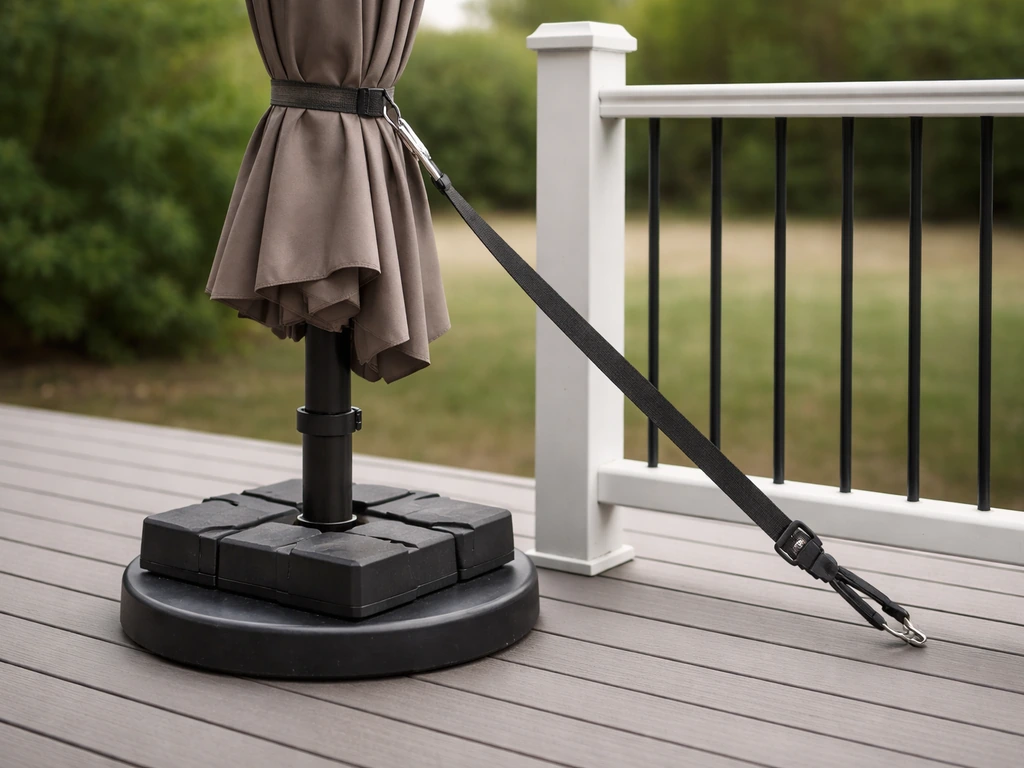
Ratchet straps give the strongest mechanical hold for a non-permanent setup. Run one or two straps from the pole (below the canopy, above the base) to a deck post, railing anchor bolt, or a ground stake driven at an angle. Ratchet them down until there's no play in the pole. This is the go-to approach for a deck umbrella you want to leave up through moderate wind events. Bungees are too elastic for this job. They'll stretch and allow movement rather than preventing it.
Bolt-down surface plate
A bolt-down base plate anchors the umbrella stand directly to the patio surface. For a wood deck, mark the hole positions above the joists, drill pilot holes, and bolt through the deck into the joist structure, not just into the decking boards. For a concrete patio, use concrete anchor bolts. The key here is that the bolts need to land over structural members, not just in surface material, otherwise the anchor pulls out under load.
In-ground concrete sleeve
This is the most permanent and most wind-resistant option. A steel sleeve is set in a concrete footing, and the umbrella pole slides into it. The footing size and depth matter a lot: manufacturers specify minimum concrete dimensions for a reason, and going smaller than spec directly increases wind failure risk. If you go this route, follow the footing specifications exactly. Under-sizing the footing is one of the most common reasons permanent installations still fail in storms.
How to secure a large patio umbrella
A large umbrella, anything 11 feet or wider for a center-pole, or any cantilever over 10 feet, needs more than a standard portable base. The canopy area creates too much wind load for a typical 50–60 pound base to hold, and the physics of a cantilever design make the problem even more pronounced.
For large center-pole umbrellas, start with a minimum 100-pound base and consider a surface-mount or in-ground sleeve installation if the umbrella will stay in one spot. Umbrella Source recommends surface-mount stands for large umbrellas specifically because the anchor to the deck structure replaces the need for extreme base mass.
For large cantilever umbrellas, the base weight requirement is substantial. A 10-foot cantilever typically needs base weight equivalent to what you'd use for a 13-foot center-pole umbrella. Many cantilever bases have provisions for adding weight plates. Fill those slots. Then add a secondary anchor point: either bolt the base feet to the patio surface or stake them using purpose-made anchor brackets. As one source puts it directly, errant gusts can quickly destroy a cantilever umbrella that isn't fully secured. This isn't being overcautious, it's the reality of the offset load design.
- Verify your base is rated for the canopy size. Check the manufacturer spec sheet, not just the weight listed on the box.
- Fill all available weight chambers in the base completely, using sand or concrete rather than water for maximum density.
- Anchor the base to the surface using bolt-down feet or a surface plate if the umbrella will be used regularly in that spot.
- Add a secondary pole anchor (ratchet strap or dedicated pole clamp) to a fixed structure if strong winds are possible.
- Tilt the canopy to a low angle or close it entirely when winds pick up, even if the anchor setup is solid. No anchor compensates for a fully open 13-foot canopy in a 30 mph gust.
Troubleshooting common wind-related problems
The umbrella spins in the base
This almost always means the collar or set screw isn't engaging the pole tightly enough. Tighten it more firmly, and check whether the screw tip is worn smooth. If the screw has been overtightened repeatedly, the tip rounds off and loses its grip. Replacing a worn set screw costs under $5. You can also wrap the pole with a thin layer of rubber grip tape at the contact point to increase friction. Stopping umbrella spin is worth addressing directly, since a spinning canopy redirects wind load constantly and creates unpredictable stress on the base.
The umbrella tilts on its own in wind
If your umbrella has a tilt feature and it's drifting in wind, the tilt mechanism isn't fully locked. For push-button tilt, make sure the button clicks fully into its detent position with the pole straight. For collar-tilt designs, the collar needs to be rotated to the lock position, not left in a partial-tilt spot. For Glide Tilt systems, follow the manufacturer's locking procedure to confirm the tilt is engaged, not just resting at an angle.
Treasure Garden’s Glide Tilt manual provides manufacturer-specific locking procedure guidance to confirm the tilt is engaged (not just resting at an angle) and includes wind-related safety instructions Glide Tilt systems, follow the manufacturer's locking procedure to confirm the tilt is engaged.
Revolvashade’s installation guide describes engaging the locking mechanism by placing the winding handle into a lower hex nut and rotating it clockwise until it is firmly secure follow the manufacturer's locking procedure to confirm the tilt is engaged, not just resting at an angle. A tilt mechanism that won't stay locked is usually either worn (replace the button or collar hardware) or has a broken detent spring.
The base rocks or shifts on a smooth surface
Add a rubber non-slip pad if you haven't already. If the base still rocks, check whether it's sitting level. On uneven surfaces, the base will always want to slide toward the low side. Use rubber shims or a patio tile to level the contact surface. If the base has cross legs that flex, check whether any mounting bolts at the leg joints are loose. Tighten all hardware at the leg-to-center-hub connection.
The pole feels loose even after tightening the collar
The sleeve diameter may be too large for your specific pole. This happens when you replace an umbrella without matching the pole diameter to the original stand. Measure the pole diameter and sleeve ID. If there's more than about 3mm of gap, the stand isn't the right fit. A rubber sleeve insert is a workable short-term fix. Long-term, matching the pole to the stand (or replacing the stand) is the right answer.
Cantilever arm droops or swings in wind
This usually points to a loose joint in the cantilever arm assembly. Check every pivot point and cross-bolt in the arm, especially the main joint where the arm meets the upright pole. Tighten any cap screws or lock nuts. If lock washers are missing or compressed flat, replace them. A drooping or swinging cantilever arm in wind is a safety concern, not just a comfort issue, because it can swing into people or structures.
Quick safety checks and when to close or remove the umbrella
Every manufacturer that publishes wind guidance says roughly the same thing: close the umbrella in strong winds, and never leave it open in a thunderstorm. This isn't just liability language. An open canopy in a 30 mph gust generates enough lift to send it airborne, and the CPSC has documented beach umbrella injuries from exactly that scenario. The same physics apply to patio umbrellas, especially large ones.
Use these wind speed thresholds as your practical guide: close a standard center-pole umbrella when sustained winds reach 15–20 mph, close a cantilever when sustained winds hit 10–15 mph (they catch wind earlier because of the offset design), and close any umbrella immediately when gusts reach 30 mph regardless of type. If you're hearing thunder, close and secure the umbrella before seeking shelter. Lightning risk near a tall metal pole is real, and no shade is worth that tradeoff.
Run through this quick check before leaving any umbrella unattended, even overnight:
- Is the base the right weight for the canopy size? If you're not sure, check the manufacturer spec or use the 10 lb/ft rule.
- Is the pole collar or set screw tight? Try rotating the pole by hand. It should not move.
- Is the tilt mechanism in the locked, straight-up position if the umbrella is open?
- Is there a rubber pad under the base on any smooth surface?
- Are any straps or anchor points connected and tensioned?
- Is the canopy closed or at minimum tilted to reduce wind profile if you're stepping away for more than a few minutes in breezy conditions?
- Does the weather forecast show wind gusts above 20 mph in the next few hours? If yes, close it and store it or tie it down in the closed position.
If you plan to store the umbrella for extended periods or are heading into a storm, close the canopy fully, secure it with the velcro or tie straps on the canopy sleeve, and either lay the pole horizontal or remove it from the base entirely. You can also deter wasps by keeping the umbrella area clean and using wasp-specific deterrents or traps if they show up near the patio close the canopy fully. A closed and strapped canopy in a stand can still catch wind through the fabric and act like a narrow sail. Taking the pole out eliminates the risk completely. For seasonal storage and winterizing, the same close-and-remove approach protects both the mechanism and the canopy fabric.
FAQ
Is there a safe way to leave a patio umbrella open during light wind without it turning into a kite?
Only if it is engineered for that, but as a rule, you should still close it at the article’s thresholds because an open canopy can create lift even before it fully tips. If you must keep shade, reduce wind load by positioning the canopy as flat as possible (upright is worst) and keep the base locked, level, and padded, then plan to close immediately when sustained winds climb.
How do I tell whether my base weight is enough before the first real storm?
Try the “move test” after locking everything: with the canopy closed and then gently lifting the canopy edge (or applying light lateral pressure to the pole), the stand should not rock, slide, or rotate. If the base shifts on smooth tile or concrete during that test, the issue is not just “maybe the wind is strong,” it means your base plus friction interface is insufficient for your conditions.
Can I use water instead of sand or concrete to fill a hollow base and still be wind safe?
Water is acceptable only if it stays in place and the base is correctly sized, but it’s usually less effective than sand or concrete because water can slosh and uneven fill can reduce stability. If you already filled with water and the umbrella still moves in wind, drain it and refill with dry sand (more weight per volume) or use a concrete fill if the base is rated for it.
What’s the best anchoring method for a deck umbrella when I do not want permanent drilling?
Ratchet straps are the strongest non-permanent approach. Anchor the strap to a structural deck post or a properly rated railing anchor point, or to a ground stake driven at an angle. Tighten until there is zero play in the pole, then re-check after the first gust day because straps can settle slightly.
Are bungee cords ever appropriate to stop umbrella movement in wind?
No. Their elasticity is the problem, they stretch and let the pole keep moving, which keeps cycling the wind load and increases the chance of tipping or loosening the locking parts. If you want a non-permanent option, use ratchet straps, not bungees.
How tight should the set screw or collar be, and what if it keeps loosening?
Tighten until the pole will not wobble when you try to rotate it by hand. If it loosens repeatedly, inspect for a worn screw tip, a missing or flattened lock washer, or a pole-to-sleeve gap that prevents full friction contact. Replacing a worn set screw is usually cheaper than repeatedly overtightening and rounding the tip.
My umbrella pole wobbles even after tightening, could the stand be the wrong size?
Yes. A common cause is a sleeve or stand diameter mismatch, often from swapping to a different pole. Measure the pole diameter and the sleeve inside diameter, if the gap is more than a few millimeters, add a rubber sleeve insert for a temporary fix, but plan to match the pole to the stand (or replace the stand) for long-term stability.
What should I check on a cantilever umbrella that droops or swings during wind?
Focus on every cantilever pivot point, especially the main joint where the arm meets the upright, and confirm lock nuts, cap screws, and lock washers are present and not compressed flat. Missing or loose hardware lets the long lever arm amplify movement, which can also become a safety hazard if it swings into people or structures.
How should I secure the umbrella before storing it for the season or during a storm?
Close the canopy fully, then secure the closed position using the canopy sleeve’s Velcro or tie straps. For maximum safety, remove the pole from the base or lay it horizontal during storage, because even a closed fabric canopy can catch wind and the pole can loosen if left under load.
Is it okay to leave a closed umbrella outdoors overnight during moderate wind?
Usually not, especially in areas with recurring gusts. A closed and strapped umbrella in a heavy base may survive moderate winds, but it can still act like a narrow sail through fabric permeability. If wind is rising overnight, remove the pole from the base or bring the whole umbrella inside.
Where should I place the umbrella if my patio is in a corner or between two walls?
Avoid corners and wind tunnels where gusts change direction rapidly. Place it closer to a wall, fence, or pergola post to get natural shelter, and if you are on a rooftop or elevated deck, use a surface-mounted or in-ground sleeve stand rather than relying only on a freestanding weighted base.
Do I need special steps if bats are using my umbrella area?
Yes, because adding tie-downs alone may not solve the hazard. If bats are roosting near the canopy, cover the roosting area or relocate the umbrella so there is no sheltered spot by the fabric, and then apply the same mechanical securing steps for wind since roosting and open-canopy behavior can coincide during windy periods.
What should I do if the tilt feature keeps drifting in wind?
Confirm the tilt locks into its detent, not a partial position. For push-button tilt, ensure the button clicks fully while the pole is straight, for collar-tilt confirm the collar rotation is in the locked index, and for Glide Tilt follow the exact locking procedure. If it still won’t stay locked, you likely have worn detent hardware or a failing detent spring, which is usually replaceable.
What is the correct action if I hear thunder or see lightning near the umbrella?
Close and secure the umbrella immediately, then seek shelter right away. Even if the umbrella is the shade you are using, lightning risk near tall metal poles and the inability of an umbrella to protect from strikes make this a hard rule, not a preference.
Next Articles
How to Keep Patio Umbrella From Spinning in Wind
Fix a patio umbrella that keeps spinning in wind: tighten hardware, adjust base weight, replace worn parts, verify locks
How to Fix a Patio Umbrella That Won't Open or Close
Step-by-step fixes for patio umbrellas that won’t open or close, with checks for jams, cords, latches, and lubricating t
How Does a Patio Umbrella Work? Components, Use, and Fixes
Learn how patio umbrellas work: components, open close tilt, stability, and step by step troubleshooting common mechanic