
The most reliable way to hold a patio umbrella in place is to pair the right-weight base with a pole that's locked in tight, then use anchoring accessories like straps, in-ground sleeves, or bolt-down plates for any situation where gusts routinely hit 15 mph or more. For a standard 9-foot umbrella, that means at minimum a 50-pound base on a calm patio or 75 to 100 pounds in a windier spot. Get those two things right and most tipping, drifting, and wobble problems disappear.
How to Hold Patio Umbrella in Place in Wind

Luca Morrison
6 Jun 2026
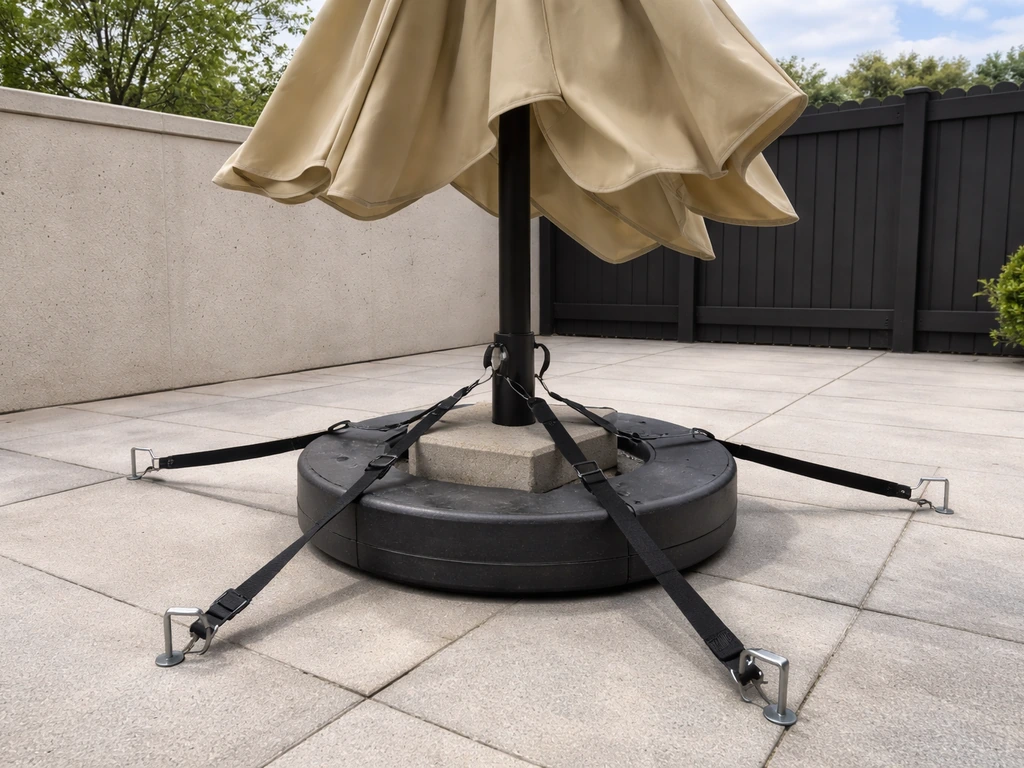
Why your patio umbrella keeps moving
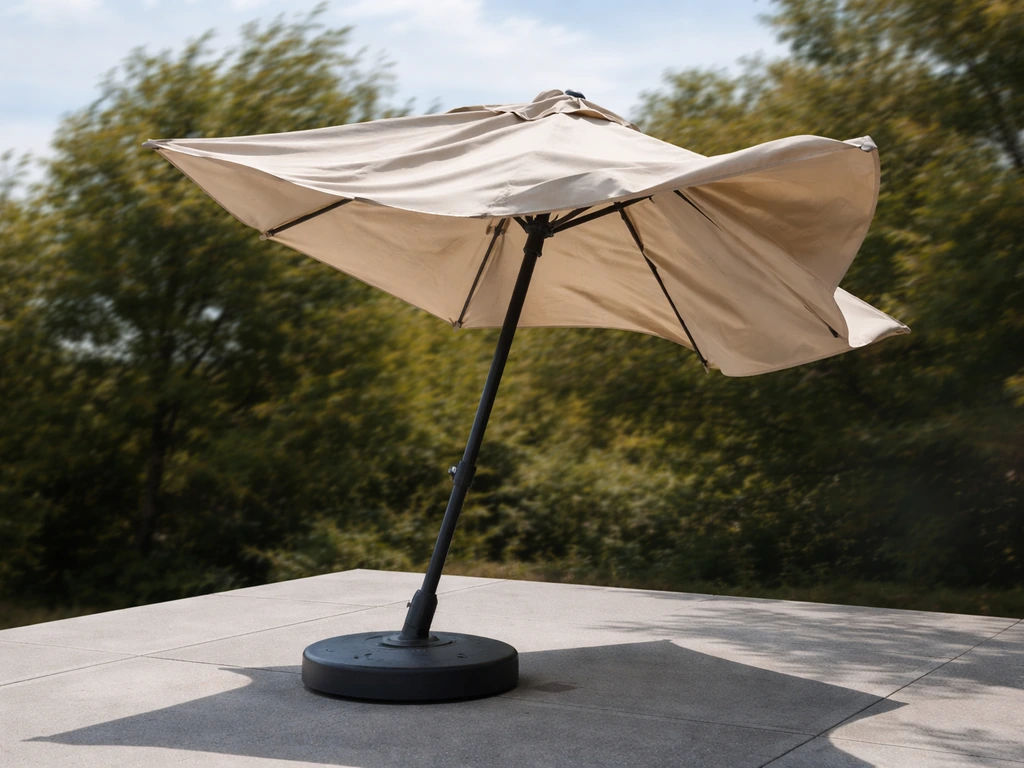
The canopy acts exactly like a sail. When a gust hits, it creates lift that tries to pop the whole umbrella upward, and if it can't go straight up, it tips or rotates the base. That's the root cause of almost every shifting and tipping complaint I hear about.
Here are the most common reasons an umbrella won't stay put, beyond just 'the wind was too strong':
- Base is too light for the umbrella size or wind exposure, so it gets pushed or rotated even by moderate gusts.
- The pole isn't locked into the base properly. If the stem clamp knob isn't tightened all the way down, the pole wobbles under load and the whole setup becomes a lever against itself.
- Uneven patio or deck contact. If the base is rocking even slightly on an uneven surface, it loses meaningful contact area and tips much more easily.
- Loose hardware at the tilt joint or hinge. A worn or loose tilt mechanism adds play to the top half of the umbrella, which amplifies wind movement and can eventually work the base loose too.
- Wrong base type for the umbrella style. A standard center-pole base under an offset or cantilever umbrella is almost guaranteed to fail because the load geometry is completely different.
Offset umbrellas deserve a special mention here because they're a frequent offender. The arm extending out from the post creates a massive leverage effect on the base, and manufacturers explicitly warn that using less than the minimum rated base weight will damage the umbrella, not just tip it over.
Choose the right base and weight for your umbrella
Getting the base right is the single biggest factor in keeping an umbrella in place. More weight isn't always the answer if you're using the wrong style of base for your umbrella type, but weight does matter a lot.
Weight guidelines by umbrella size and wind exposure
| Umbrella Size | Calm/Sheltered Patio | Moderate Wind | High Wind or Coastal |
|---|---|---|---|
| Up to 9 ft center-pole | 35–50 lb | 50 lb | 75–100 lb |
| 10–11 ft center-pole | 50 lb | 75 lb | 100 lb+ |
| Offset/cantilever (any size) | Per manufacturer minimum (often 100–150 lb) | Per manufacturer minimum | In-ground or deck-bolt mount recommended |
These are practical rules of thumb. Always check your umbrella manufacturer's minimum base weight requirement first, because it overrides any general guideline. Many offset umbrella manuals list a specific minimum weight and state clearly that using anything lighter voids the warranty and risks damage.
Base fill options: sand vs. water
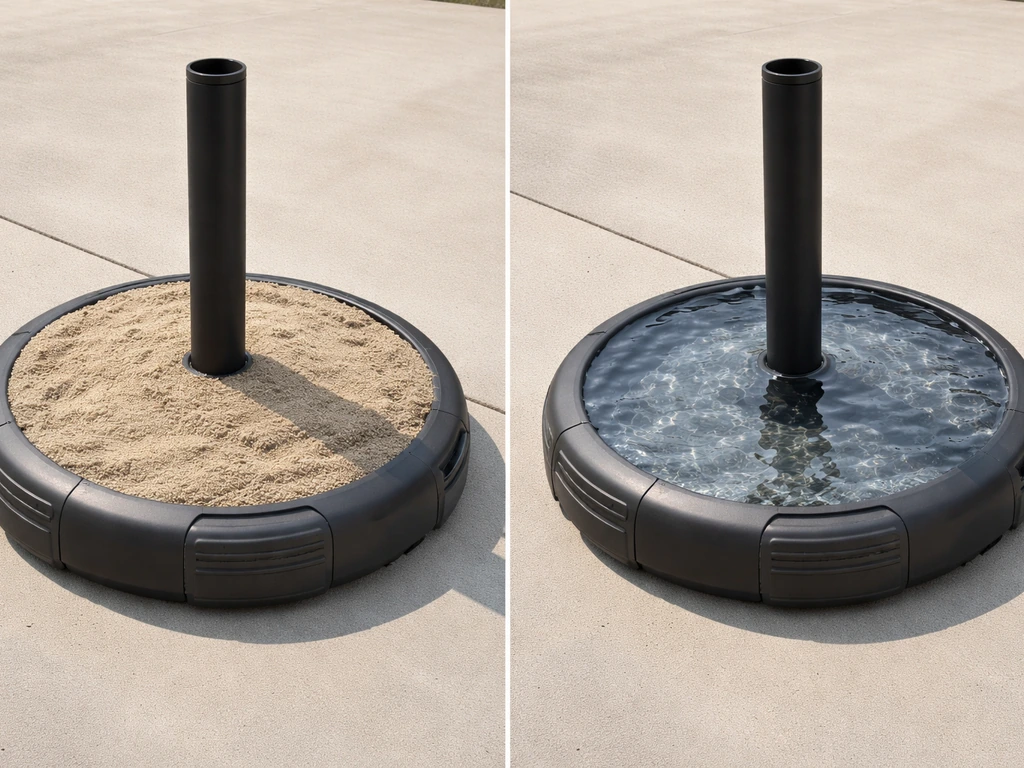
Most freestanding bases are hollow and designed to be filled on-site. Sand is heavier than water by volume (packed sand runs about 100 lb per cubic foot vs. roughly 62 lb for water), so a sand-filled base gives you more holding weight for the same size base. Water is easier to dump out and move at the end of season, but it's noticeably lighter. If you're in a windy spot, fill with sand. If portability matters more, water works but you'll need a larger or heavier base to compensate.
Center-pole vs. offset: different problems, different solutions
A standard center-pole umbrella sits vertically over the base, which means the load transfers straight down. That's the easiest geometry to stabilize with a heavy freestanding base. An offset or cantilever umbrella has a horizontal arm extending several feet out, so the load pulls sideways and creates a tipping moment far greater than the umbrella's weight alone. For cantilever setups, a heavy rolling base is a starting point, not the endpoint. In truly windy environments or for large cantilever umbrellas, the right answer is an in-ground mount or a deck-bolt system. Dedicated offset umbrella stabilization is a deep enough topic that it has its own set of considerations worth looking into separately.
Step-by-step: setting up your umbrella stand the right way
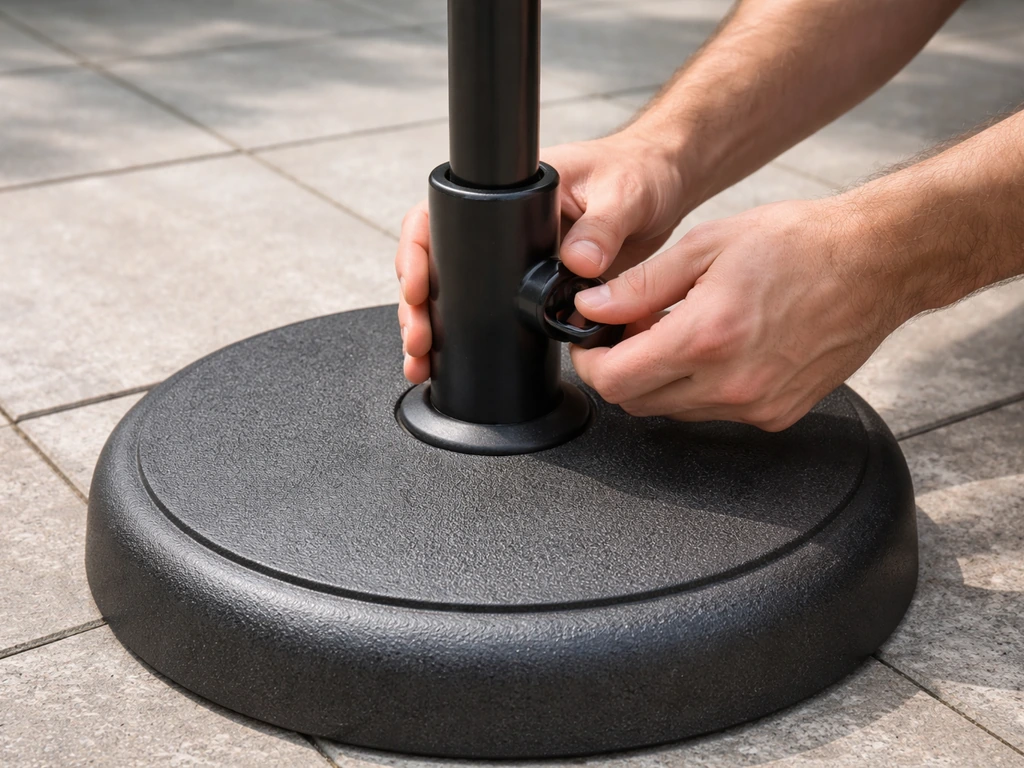
Even a heavy base won't hold an umbrella securely if the pole isn't locked in correctly. Here's how to set the whole thing up properly from the ground up.
- Pick a flat, stable surface. Before you even put the base down, check that your patio, deck, or ground surface is level. A rocking base is a tipping base. If you're on pavers that aren't perfectly flush, move the base to a flatter spot or shim the low side.
- Fill the base before inserting the pole. If your base uses sand or water fill, do that first. A filled base is much more stable during setup and you won't accidentally tip it over with an open umbrella on top of an empty base.
- Check the pole-to-base adapter fit. Many bases include an adapter sleeve or spacer for different pole diameters (common sizes are 1.5 inch and 1.75 inch). Use the correct adapter so the pole fits snugly with minimal side-to-side play. A sloppy fit here is a wobble source even with a heavy base.
- Insert the pole fully. Lower the pole straight down into the base until it seats at the bottom. Don't angle it in and assume it'll settle.
- Tighten the stem clamp knob(s) clockwise until firm. Most bases have one or two knobs at the collar. Turn them clockwise until they're snug. This is one of the most overlooked steps. A knob that's finger-loose will let the pole spin and wobble under any real gust.
- If your base has locking wheels, lock them now. Some rolling bases have a brake mechanism on the casters. Engage every wheel lock before opening the umbrella.
- Open the umbrella slowly and check for lean. Once open, step back and look at the umbrella from two directions. If it's leaning noticeably to one side, the surface isn't flat enough or the pole isn't fully seated. Close it, adjust, and recheck.
- Tighten any tilt joint hardware before use. If your umbrella has a push-button or collar tilt, make sure the tilt mechanism is either locked in the straight-up position or locked at your chosen angle. A half-engaged tilt joint flops in the wind.
Best ways to anchor and hold down a patio umbrella
A properly set-up freestanding base handles moderate conditions for most people. But if you're in a windier environment, on a rooftop, near the coast, or just tired of adjusting things after every storm, you need a secondary anchoring method. To support a patio umbrella safely, match the base weight and anchoring method to your umbrella type and local wind exposure support patio umbrella. If you are looking for a step-by-step way to anchor a patio umbrella, the next sections walk through the most reliable options, from straps to in-ground mounts secondary anchoring method. Here are the options that actually work, from least involved to most permanent. For a complete walkthrough of how to stabilize a patio umbrella, start with the right base weight and then add an anchoring method for your wind exposure.
Umbrella base straps and tie-downs
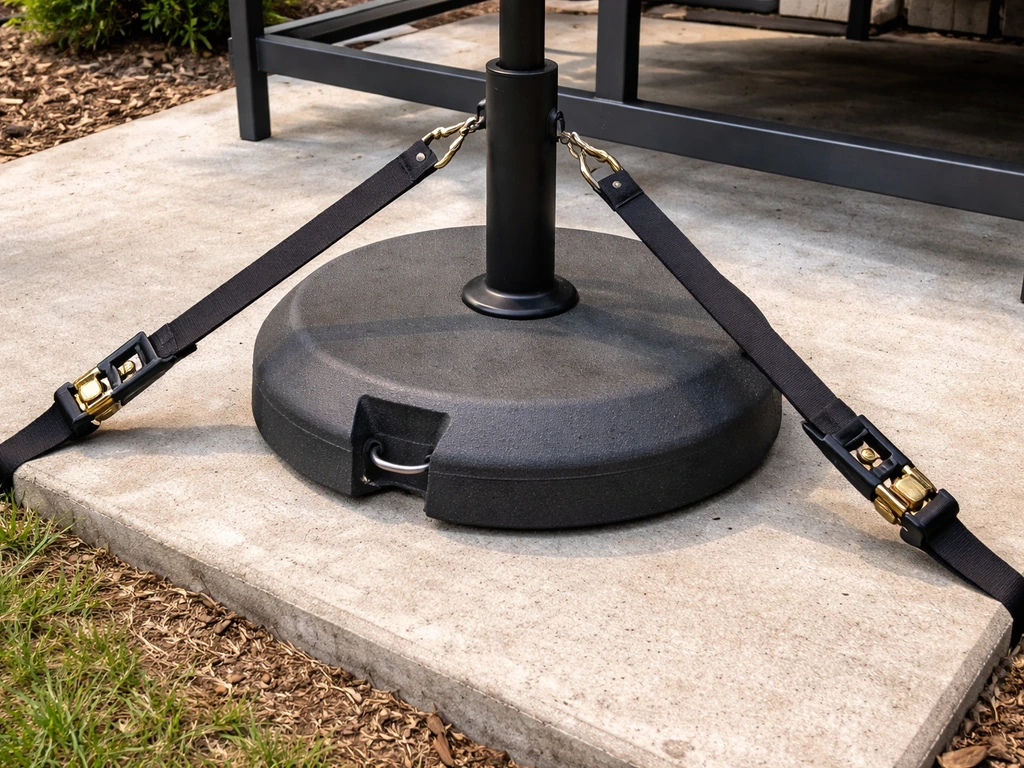
Straps that connect the base to a heavy piece of furniture are a quick and reversible fix. Use ratchet tie-down straps or heavy-duty bungee cords to link the base to a concrete bench, a heavy dining table, or other substantial outdoor furniture. This limits how far the base can shift or rotate without adding permanent hardware. It's not the strongest solution, but it takes five minutes and works better than just hoping.
Weighted base plate add-ons
If your current base is undersized but you're not ready to replace it, stacking additional plate weights over the base collar is a common workaround. Many manufacturers sell cast-iron or concrete ring weights designed to stack over their bases. Just make sure the stacked weight doesn't interfere with the stem clamp or create instability by raising the center of gravity too much.
Bolt-down deck mounts
For a deck surface, a bolt-down base plate is a massive upgrade in holding power. The basic process: locate a deck joist below the installation spot (this is critical for structural strength), mark your bolt hole positions over the joist, drill pilot holes slightly smaller than your bolt diameter to avoid splitting the decking, and bolt the surface plate down using the hardware specified by the mount manufacturer. The umbrella pole then drops into the plate and locks. This setup eliminates base drift entirely and handles serious wind because the load transfers directly into the deck structure. For offset umbrellas on decks, this approach or an in-ground system is really the only responsible long-term answer.
In-ground concrete sleeve anchors
An in-ground sleeve is the most permanent and most wind-resistant option for ground-level patios. The sleeve gets set into a concrete footing so the top is flush with the patio surface. When you want the umbrella, the pole drops into the sleeve and locks. When you don't, the sleeve cap sits flush and nearly invisible. The installation process involves digging a hole to the sleeve manufacturer's specified depth, mixing and pouring concrete, and setting the sleeve level before the concrete cures. After curing (typically 24 to 48 hours), you trowel the surface smooth and flush with the surrounding patio. It's a half-day project but it's one-and-done, and it handles conditions that would throw any freestanding base across the yard.
Concrete surface mount kits
If you have a concrete patio and don't want to break it up for an in-ground sleeve, a surface-mount kit is a solid compromise. These use concrete sleeve bolts hammered into drilled holes in the slab, with a mounting spigot that accepts your umbrella pole. Installation involves drilling appropriately sized holes in the concrete, hammering the sleeve bolts in flush, then using an Allen wrench to attach the spigot hardware to the bolts. It's more involved than a freestanding base but far less disruptive than a full in-ground pour.
Wind-proofing tips and adjustments
Hardware is only part of the equation. How you operate the umbrella matters as much as what it's sitting in. Some reputable umbrella manufacturers also recommend wind-management designs like vented or double-vent canopies because they allow gusting wind to pass through and reduce trapped wind pressure How you operate the umbrella matters as much as what it's sitting in..
- Close the umbrella when you're not using it. This is the single most consistent recommendation from every umbrella manufacturer I've encountered, regardless of base quality or weight. A closed umbrella catches almost no wind. An open but unattended umbrella can tip or walk even in a base rated for it.
- Avoid tilting in any wind over about 15 to 20 mph. Tilting turns the canopy into an angled sail and dramatically increases lateral force on the base. If gusts are picking up, tilt the umbrella back to vertical or close it entirely.
- Choose a vented canopy if you're replacing or buying new. Vented and double-vented canopy designs let wind pass through instead of lifting the whole umbrella. This isn't a retrofit option for most umbrellas, but it's worth factoring into your next purchase if you're in a consistently breezy spot.
- Position the umbrella so the pole side faces the prevailing wind direction. This puts the solid pole between the wind and the canopy rather than the open underside, which slightly reduces the sail effect.
- Don't over-tilt. Some tilt mechanisms can only safely hold a certain angle. Exceeding that angle both increases wind load and puts mechanical stress on the tilt joint that can accelerate wear.
If your umbrella still won't stay put after all this
You've filled the base, locked the pole, set everything level, and the umbrella still tilts, wobbles, or walks. Here's how to troubleshoot it systematically.
- Check the pole-to-base connection first. Grab the pole near the base and try to rock it side to side. Any movement at all means the stem clamp knob isn't tight enough, the adapter sleeve is the wrong size, or the knob threads are stripped. Re-tighten the knob. If it spins without grabbing, the threads are gone and you need a replacement base or collar.
- Check the tilt joint for looseness. Grab the upper pole section and try to wiggle it relative to the lower pole. Wobble here points to a loose or worn tilt mechanism. For push-button tilts, check that the button is fully engaging its notch. For collar tilts, tighten the collar hardware. If the joint is cracked or broken internally, that's a repair job involving replacing the tilt mechanism.
- Look for visible cracks or deformation on the base. A cracked freestanding base that's been overfilled or dropped won't hold weight correctly even if it looks intact. Water can leak out of small cracks and reduce your effective base weight significantly.
- Confirm you're meeting the minimum base weight. Weigh your filled base if you're not sure. A base that's supposed to hold 50 lb of sand but was only half-filled is effectively a 25-pound base. Fill it completely.
- Check that all base hardware is tight. Some bases have assembly bolts or frame connections beyond just the stem knob. Look at the base frame itself and tighten any visible fasteners.
- If you're using a rolling base, make sure every wheel is locked. A single unlocked caster can let the whole base rotate or drift.
- Reassess the base type for your umbrella. If you've done everything above and a large or offset umbrella is still moving, the freestanding base is simply not the right tool for the job. The next step is a bolt-down deck mount or an in-ground sleeve. This is especially true for offset and cantilever umbrellas, which carry specific anchoring requirements that go beyond what a standard base can provide.
The good news is that most stability problems come down to one of those checkpoints, and most of them are fixable in an afternoon without replacing the umbrella itself. If you've ruled out every hardware and setup issue and the umbrella is still being thrown around, the honest answer is that either the umbrella canopy is too large for the wind exposure on that particular spot, or you need a more permanent anchor solution like an in-ground sleeve or deck-bolt mount. For offset patio umbrellas, the best approach is to secure the setup with the right base weight and a secondary anchoring method like an in-ground sleeve or deck-bolt mount secure offset patio umbrella. Those options do exactly what they sound like: they eliminate the possibility of drift entirely.
FAQ
Can I just use a heavier base to stop my patio umbrella from moving in wind?
You can, but it is not always enough. If the pole is not clamped tightly or your umbrella is offset, the wind loads create leverage that heavier weight alone may not counter. First verify the umbrella manufacturer’s minimum base requirement, then add a secondary anchor (strap to a heavy object, bolt-down plate, or in-ground sleeve) if gusts hit regularly.
What is the safest base choice for an offset or cantilever umbrella on a deck?
For offset umbrellas, a freestanding weighted base is usually a starting point, not a final solution, especially on decks. The more stable long-term options are a deck-bolt base plate that transfers load into the joist, or an in-ground sleeve if compatible with your setup.
How do I know if my umbrella pole is locked correctly in the base?
After tightening the clamp, try to rotate the pole by hand and check for any visible gap between the pole and the clamp area. If you can move it with moderate effort, the clamp is not secure, and wind will amplify that looseness into wobble and walking. Re-tension and confirm the base collar is seated as intended before assuming the problem is the base weight.
Should I fill my umbrella base with sand or water?
Sand is heavier per volume and tends to perform better in consistently windy spots, especially if your base is limited in size. Water is easier to empty seasonally and clean out, but it is lighter, so you may need a larger or heavier base to achieve the same stability.
Will stacking extra plate weights always help, or can it make things worse?
Stacking can help if the extra weights are designed for your base model and do not interfere with the stem clamp. Avoid stacking that raises the effective center of gravity too high, since that can increase tipping tendency even if total weight goes up.
Do straps to patio furniture count as a real fix, or are they just temporary?
They are a quick and reversible secondary measure, and they can reduce drift and rotation without drilling or permanent hardware. However, they are not as wind-proof as a bolt-down plate or in-ground sleeve, so consider them best for moderate gusts or as a stopgap until you can install a more permanent anchor.
What should I do if my umbrella moves even after everything is tightened and level?
Go back to basics in order: confirm you are using at least the manufacturer’s minimum base weight, ensure the pole is fully clamped without looseness, and check that the canopy size matches the wind exposure of your location. If those are correct, it often means you need a more permanent anchor like a sleeve or deck-bolt mount.
How do I decide between a deck-bolt plate and an in-ground sleeve?
Choose deck-bolt for decks where you can anchor into a joist and want to eliminate drift without breaking up the patio, and choose an in-ground sleeve for ground-level patios when you want maximum wind resistance and a near-invisible setup. If you cannot reliably hit structural framing for a bolt-down, an in-ground sleeve is typically the safer long-term option.
Can I anchor a patio umbrella during freezing weather?
It depends on the anchor type. Freestanding bases and straps can be adjusted immediately, but concrete-related installs (sleeves, bolt-down plates with slab work) require temperatures that allow curing. If you are planning a sleeve or bolt-down kit, schedule installation so the concrete can cure properly, typically avoiding cold snaps right after the pour.
Are there common mistakes with sand-filled bases that reduce stability?
Yes. Do not overpack in a way that prevents the base from sitting flush and fully seating the pole, and make sure the base is designed to be filled on-site. Also confirm sand is not getting shifted into a way that leaves voids, since a partially settled fill can lower effective holding weight during repeated gusts.
When should I take the umbrella down instead of trying to anchor it?
If gusts are unusually extreme for your setup, consider taking it down rather than relying on hardware. Even with correct anchoring, oversized canopies in severe wind exposure can exceed what the structure is designed to handle. If you routinely see the umbrella being forced to rotate despite anchors, it is a sign to downsize or move to a more permanently anchored solution.
Next Articles
How to Stabilize a Patio Umbrella in Wind
Step-by-step ways to stabilize a patio umbrella in wind, fix wobble causes, and choose the right base and tie-downs.
How to Anchor a Patio Umbrella: Secure Against Wind
Step-by-step ways how to anchor a patio umbrella, secure bases, ground anchors, and wind troubleshooting for stable outd
How to Weigh Down Patio Umbrella for Wind Stability
Step-by-step ways to weigh down a patio umbrella for wind stability, including base setup, add-on weights, and fixes.