Most patio umbrella arm problems come down to one of three things: a bent or snapped rib (the arms that fan out from the hub), a damaged pole section, or a failing tilt or crank mechanism connected to those parts. Before you order anything or take the whole umbrella apart, you can usually figure out exactly what broke in about five minutes with a visual inspection, and most of these repairs are genuinely DIY-able for under $20 in parts.
How to Fix a Patio Umbrella Arm: Repair or Replace
Luca Morrison
4 Jun 2026
Safety checks first: what's actually broken?
Before you touch anything mechanical, close the umbrella fully if it's still open. Moving parts like the crank housing and tilt mechanism are pinch points, fingers and loose fabric get caught more easily than you'd think. Once it's closed, lay the whole umbrella on a flat surface so you can inspect it without it toppling over.
Now work through this quick visual check. The goal is to locate the failure before you start loosening anything.
- Look at the ribs (the arms that extend outward and hold the canopy). Are any visibly bent, kinked, or snapped at the hub connection or somewhere along their length?
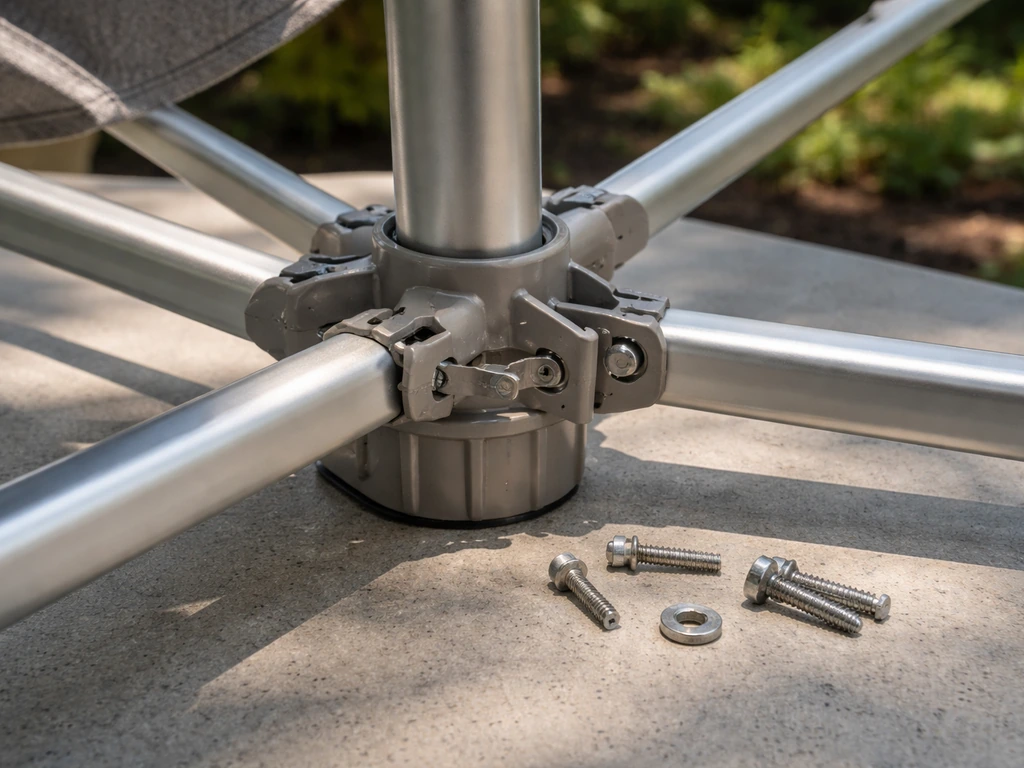
- Check the runner hub — the sliding ring on the pole that pushes the ribs up. Is it cracked, stuck, or seated unevenly?
- Inspect the upper hub at the very top of the pole. Do all the ribs connect cleanly, or is one popped out of its slot?
- Look at the main pole itself. Is it straight, or does it have a visible bend or crack — especially near the tilt mechanism?
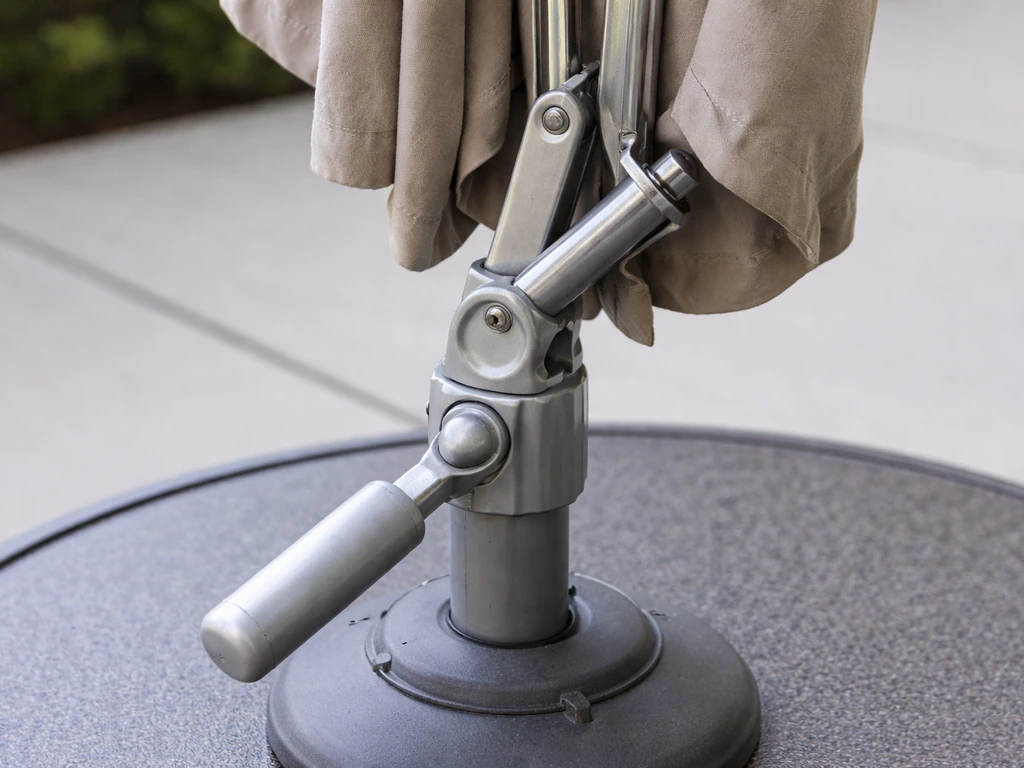
- If your umbrella has a tilt function, check the tilt joint area (usually just below where the ribs meet the hub). Does the joint look deformed, cracked, or loose?
- Try the crank handle slowly. Does it spin freely without moving the canopy? Does it grind or resist partway? Does the umbrella open unevenly on one side?
Your answers here tell you which subsystem failed. A rib that's bent or snapped is a rib repair. A pole that's cracked or badly kinked near the tilt joint is a pole replacement job. A crank that spins without moving anything means you're dealing with the drive mechanism, not the arm itself. Diagnosing it correctly now saves you from taking apart the wrong section entirely.
Center-pole vs. offset/cantilever umbrellas
The repair process varies depending on your umbrella style. On a center-pole umbrella, the main pole runs straight through the middle, and the ribs connect at a hub at the top. On an offset or cantilever umbrella, the arm extends from a side post, and the tilt/rotation hardware is built into that offset joint, which means the "arm" most likely to fail is that lateral extension, not a rib. If you have a cantilever and it's spinning loosely or won't lock in position, the issue is usually the rotation lock hardware, not a rib at all. That's a slightly different repair path, and I'll flag the differences as we go.
Tools and parts you'll need (and what's worth buying)
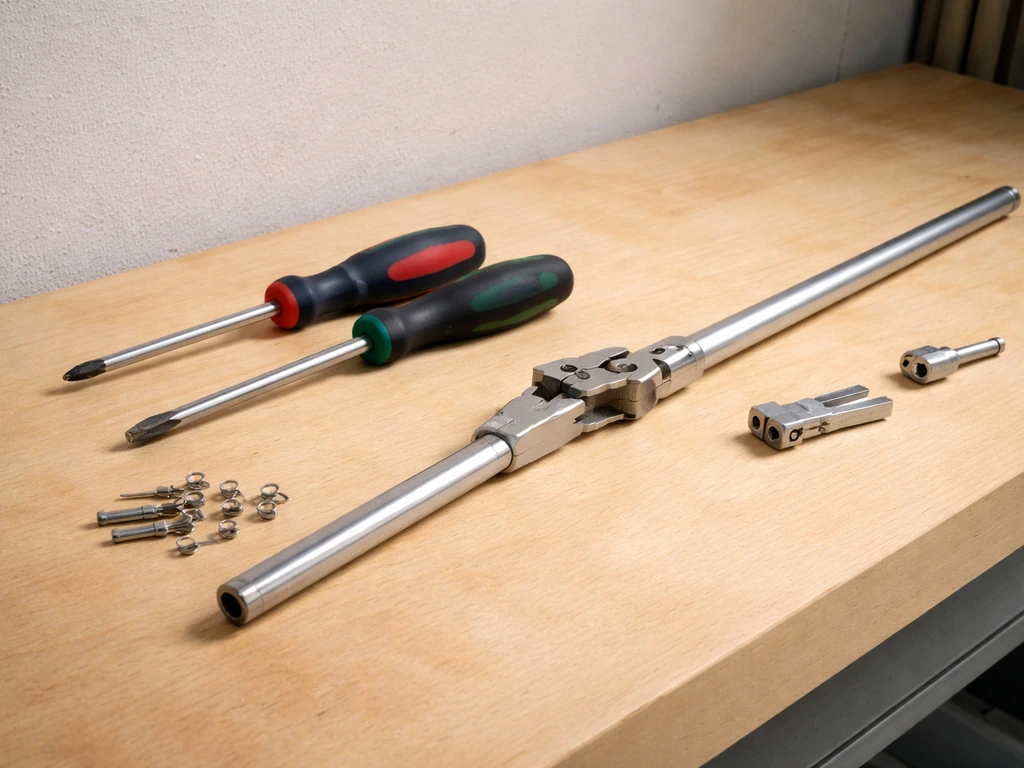
Gather these before you start. Having everything on hand means you won't be holding a half-disassembled umbrella while hunting for a screwdriver.
- Phillips head and flathead screwdrivers
- Needle-nose pliers (for disconnecting rib pins and routing cords)
- Adjustable wrench or pliers for hub bolts
- Replacement rib(s) matched to your umbrella's hub-to-tip measurement — measure the broken one before ordering
- Replacement cord or strap if the tilt is cord-driven and the cord looks frayed or snapped
- Zip ties or thin wire for temporary fixes while waiting for parts
- Metal epoxy or strong adhesive if you're attempting a temporary straightened-rib repair
- Manufacturer's model number (check the label on the pole or underside of the canopy) for ordering exact parts
On the repair vs. replace question: a single bent or snapped rib is almost always worth fixing, rib kits run $10 to $30 depending on material, and fiberglass ribs are worth the extra few dollars over steel replacements since they're more flexible and less prone to re-bending. A cracked or badly bent pole section, especially near the tilt mechanism, usually tips toward full pole replacement rather than a patch, a repaired structural crack in the pole is a weak point that will fail again under load or wind. If the blank" rel="noopener noreferrer">crank mechanism is stripped or the drive shaft is broken, you'll need a matching replacement crank assembly, and cranks are not universal, so getting the model number off your umbrella first is non-negotiable.
How to disassemble the umbrella to access the arm, pole, or spoke
The disassembly sequence below works for most center-pole umbrellas. The core idea is to work from the canopy inward, remove the fabric first, then access the hub and ribs.
- Close the umbrella fully and lay it on a clean, flat surface. Have a small container nearby to hold screws and pins so nothing rolls away.
- Remove the finial cap at the very top of the hub. It usually unscrews counterclockwise or pries off with a flathead screwdriver. Set it aside — you'll need it for reassembly.
- Detach the canopy. Most canopies attach with fabric loops or ties to each rib. Untie or unhook each one and slide the canopy off. Some canopies also have a velcro or snap connection at the hub.
- With the canopy off, you can now clearly see all rib connection points at the upper hub and the runner hub. Note how each rib's pin or tab seats into the hub slots — take a photo with your phone before disconnecting anything.
- To remove a rib: use needle-nose pliers to push or lift the pivot pin at the upper hub and unhook the rib's lower strut from the runner. The rib should slide free. On models with a retaining ring at the top hub, you may need to loosen a set screw or ring first.
- For pole access: once the ribs are disconnected, the hub assembly at the top can usually be lifted off the pole. The crank housing lower on the pole is typically held by a pin or screw — remove it to slide the housing off if you need to access the internal pole sections.
- On offset/cantilever umbrellas, the arm joint is accessed differently. Look for a bolt or pin at the pivot point where the arm extends from the main post. Removing that bolt lets you swing the arm free.
One important caution: don't force anything. If a hub ring won't slide or a crank housing seems stuck, look for a secondary set screw or retaining clip you may have missed. Forcing a plastic gear assembly or a stuck runner can strip the threads or crack the housing and turn a simple repair into a parts-replacement job.
Fixing a broken or bent arm (rib or pole section)
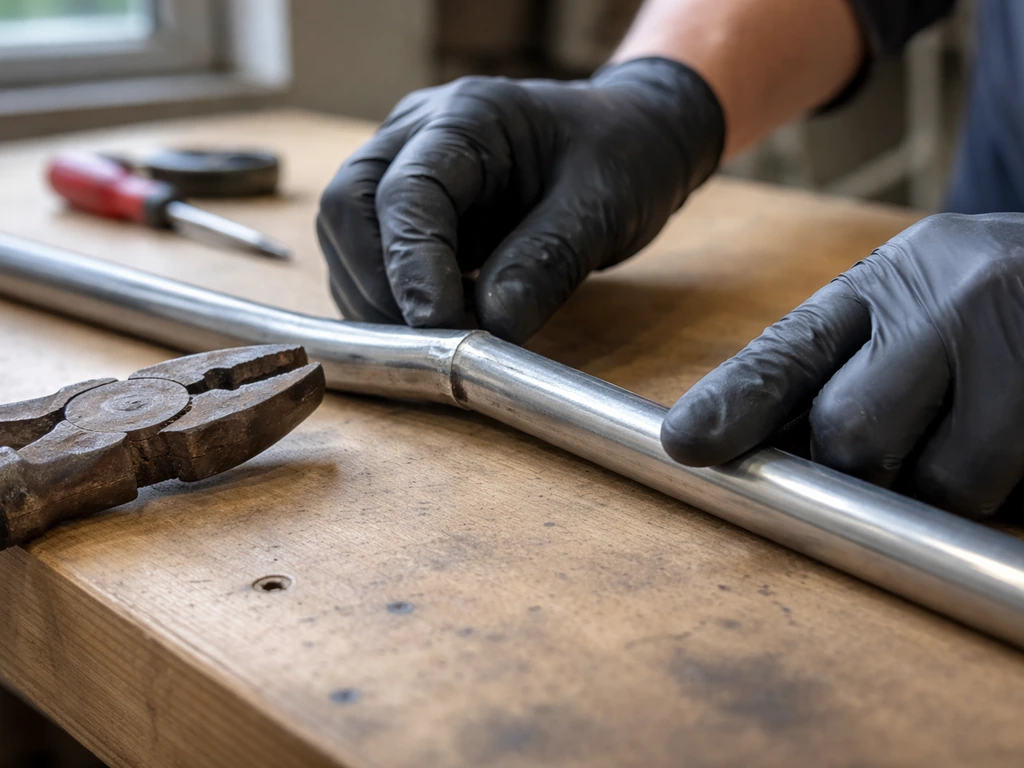
Bent rib: can you straighten it?
If a rib is slightly bent but not cracked, you can try straightening it, but go in with realistic expectations. Using pliers to force metal back into shape often leaves micro-deformations that weaken the rib further, and a re-bent rib in the same spot usually snaps the next time the umbrella takes any wind load.
If the bend is minor and near the middle of the rib, carefully work it back with your hands rather than a tool, applying gradual pressure. If you can get it reasonably straight and there's no cracking sound, you can reinforce the area temporarily with a thin wrap of metal-reinforced tape or a short sleeve of tubing slid over the rib. This buys you time but isn't a permanent fix.
If the rib is snapped, kinked badly, or bent at the hub connection point, don't bother straightening it. Just replace it. If you find the fix you need is for a bent or snapped rib, a rib replacement is the most reliable way to get your patio umbrella back to proper extension and tension Just replace it. .
A warped rib won't seat properly in the hub, and the whole canopy will sag or tilt unevenly on that side, which is also a sign the runner connection isn't right.
If the ribs are bent, they may not extend properly, which can show up as ribs that do not straighten outward evenly and a canopy that sags or does not reach its full span A warped rib won't seat properly in the hub, and the whole canopy will sag or tilt unevenly on that side.
Bent or cracked pole: repair vs. replace
A bent pole below the hub, away from any tilt joint, can sometimes be worked back into alignment if the bend is minor and the material isn't cracked. Lay the pole flat, find the apex of the bend, and apply firm, even pressure against a solid surface. Check alignment frequently; you're aiming to restore straight orientation, not just reduce the angle. If you hear any cracking or see white stress marks in the metal, stop, the pole is compromised and needs to be replaced.
A pole that's cracked, snapped, or bent at the tilt mechanism joint is a different story. That section bears the full load and torque of the canopy, especially in any wind. Patching it with epoxy or tape is a temporary measure at best and can be a safety hazard if the umbrella is used in anything above a light breeze. In that case, replace the pole.
Tilt mechanism issues (arm won't hold position or won't tilt)
If the problem is that the tilt arm won't move or won't hold position, start by checking whether the tilt button or release lever is fully disengaged before trying to tilt. On many models this is a push-button near the hub area, and the canopy literally cannot tilt until you hold it in. If the button is fine but the tilt still doesn't work, the issue is usually one of these: loose screws or a worn pivot joint at the tilt point, a broken internal spring, or (on cord-driven auto-tilt models) a snapped internal cord.
For loose tilt joint screws: open the housing near the tilt section, identify the pivot bolt, and tighten it. Don't overtighten to the point where it won't move at all, you want snug but still articulating. For a broken internal spring on a linkage-style tilt, you'll need the manufacturer's replacement part. For a cord-driven tilt with a snapped cord, open the access panel on the crank housing, find the cord routing over its internal pulley, and replace the cord with matching diameter cord from the manufacturer. Threading it back through the internal pulley routing is fiddly but doable, go slowly and use the needle-nose pliers to guide the cord end.
Replacing the patio umbrella pole when repair won't hold
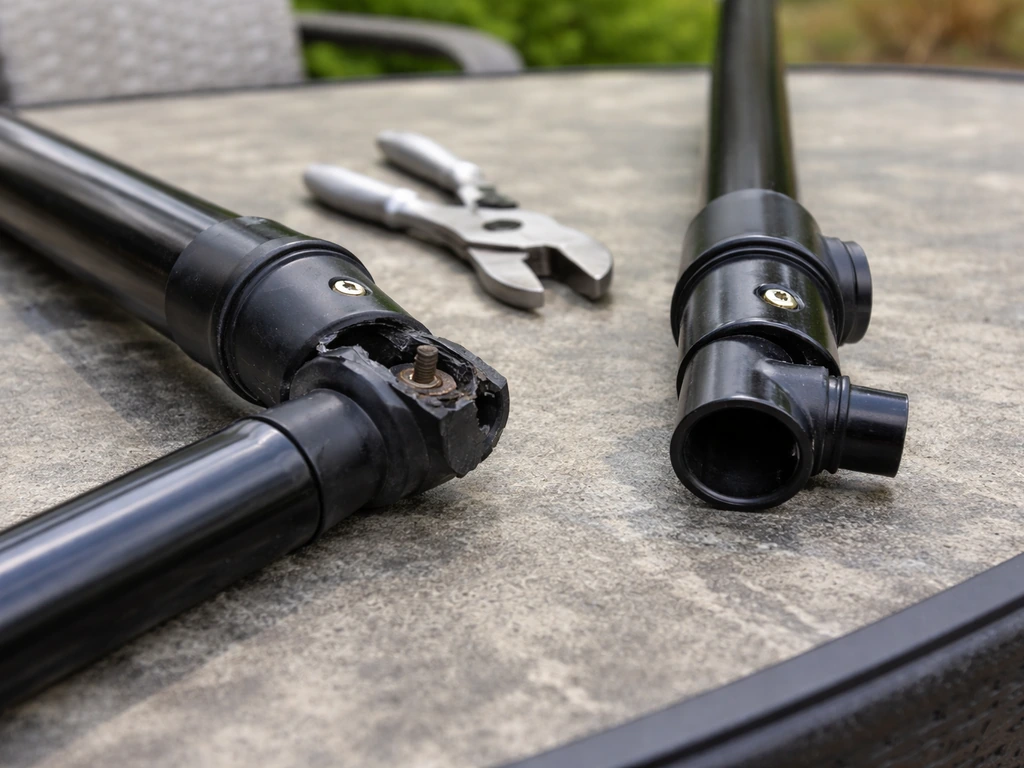
If the pole itself is cracked, structurally compromised at the tilt joint, or bent beyond what safe straightening can fix, replacement is the right call. If your patio umbrella has a broken arm or pole, the safest option is often to replace the pole rather than rely on temporary fixes broken patio umbrella pole. A failing pole is a genuine safety risk, it can give way suddenly under wind load. Here's how to approach it.
- Get the manufacturer name and model number from the label on the pole or the underside of the canopy. Poles are not universal — diameter, length, hub connection style, and tilt mechanism compatibility all vary by brand and model.
- Order a matching replacement pole from the manufacturer or a reputable parts supplier. If the umbrella included a tilt function, confirm the replacement pole also includes compatible tilt hardware — dropping in a non-tilt pole into a tilt umbrella leaves the mechanism unusable.
- With the canopy and ribs removed (as in the disassembly steps above), pull the old pole out of the base tube. The pole usually rests in the base and is held in by gravity plus a security pin or collar at the top of the base tube. Remove the pin, lift out the old pole.
- Transfer any hardware from the old pole that isn't included with the new one — this sometimes includes the crank housing, runner hub, or upper cap, depending on what the replacement kit contains.
- Slide the new pole into the base tube, reinsert the security pin or tighten the collar, and reassemble the hub, runner, and ribs onto the new pole.
- Before reattaching the canopy, manually test the crank and tilt operation to confirm everything moves freely and holds position correctly.
One real-world note: if the umbrella is more than 7 to 10 years old and the pole is damaged, it's worth checking whether the canopy fabric is also showing significant UV degradation. If both are in rough shape, replacement of the whole umbrella may make more financial sense than sourcing an older model's pole.
Fixing broken spokes and internal support issues
The spokes or ribs are the arms most people are actually referring to when they say the "umbrella arm" is broken, they're the most common failure point in the whole frame. Each rib connects at two points: its inner end pins into a slot on the upper hub at the top of the pole, and a secondary strut connects the rib's mid-point down to the runner hub (the sliding ring). If either connection fails, or if the rib itself cracks, the canopy won't extend evenly.
When you're replacing a rib, the most important measurement is hub-to-tip length, measure the broken rib before you throw it away, or measure an intact rib on the same umbrella. A rib that's even half an inch too short or too long won't seat properly and will cause the same uneven-canopy problem you started with.
- With the canopy removed and the broken rib identified, use needle-nose pliers to lift or compress the pivot pin at the upper hub and unhook the rib end from its slot.
- Disconnect the lower strut from the runner hub — this is usually a simple hook or pin connection.
- Slide the old rib out and set the new rib in its place, seating the inner end into the hub slot first.
- Reconnect the lower strut to the runner hub, making sure it clicks or seats fully.
- After all ribs are in place, tighten the upper hub ring or set screw. A loose hub ring means ribs will wobble and eventually pop out again.
- Before reattaching the canopy, manually push the runner up the pole by hand to open the umbrella partially and confirm every rib extends evenly to its full position.
If you notice the runner hub itself is cracked or has broken connection slots, that's the actual source of uneven extension, replacing the rib won't fix it. A cracked runner hub needs to be replaced as its own part.
Putting it back together, testing it, and keeping it from breaking again
Reassembly steps
- Confirm all ribs are seated in the upper hub and their struts are connected to the runner. The runner should slide freely up and down the pole before you add the canopy.
- If you used any adhesive during a repair, give it the full cure time specified on the product before loading the joint — typically 24 hours for structural epoxy.
- Reattach the canopy by threading each rib through its corresponding fabric loop or tie. Start at one side and work in alternating pairs to keep tension even.
- Replace the finial cap at the top hub and make sure it's snug.
- Set the umbrella upright in its base and extend it slowly using the crank or push-pull mechanism. Watch all ribs as they extend — they should all reach full extension at the same time and hold evenly.
- Test the tilt function if your umbrella has one: engage the tilt button, apply light pressure, and confirm it holds in each position without slipping.
What to check for alignment
Stand back and look at the open canopy from the side and then from below. The canopy should be symmetrical, no side should sag lower than the others. If one section droops, the rib on that side isn't fully extended or its hub connection isn't seated. Close the umbrella, find the problematic rib, and check that both connection points (hub and runner) are fully engaged. Uneven tilt after reassembly almost always traces back to one rib that's slightly out of its slot.
How to prevent this from happening again
Most broken-arm failures I've seen come from two causes: wind events and forcing a stuck crank. On the wind side, close and secure your umbrella any time sustained winds are above about 20 mph, and always close it overnight if there's any weather uncertainty. Wind doesn't just snap ribs; it tips the whole umbrella, which bends the pole at the worst possible point near the tilt joint. A weighted or properly anchored base is the first line of defense.
On the mechanical side, never crank past resistance. If the crank stops moving smoothly, stop and investigate before applying more force. Stripped crank gears and bent drive shafts almost always come from forcing a mechanism that had a small blockage or cord tangle. A 30-second check saves a $40 replacement part.
For seasonal maintenance, once or twice a year check all hub set screws and tighten anything that's vibrated loose. Lubricate the runner hub and crank housing with a light spray lubricant to keep them moving freely. Before winter storage, clean and dry the canopy, then store the umbrella either indoors or in a weather-resistant cover in a closed position, a canopy left open in fall and winter is one that comes back out in spring with cracked or deformed ribs from the weight of snow or ice.
| Problem | Most Likely Cause | Fix | Replace Instead? |
|---|---|---|---|
| Canopy sags on one side | Bent or disconnected rib | Reseat or replace the rib | Only if hub slots are broken |
| Umbrella won't open evenly | Runner hub stuck or broken rib strut | Free the runner, reconnect strut | If runner hub is cracked |
| Tilt won't hold position | Loose pivot bolt or broken tilt spring | Tighten bolt or replace spring | If tilt housing is cracked |
| Crank spins without raising canopy | Stripped gears or broken drive shaft | Replace crank assembly (model-matched) | Yes, repair rarely holds |
| Pole visibly bent near tilt joint | Wind damage or overtorquing | Minor bend only: careful realignment | Yes, if cracked or severely bent |
| Canopy tilts unevenly after tilt engaged | One rib not fully seated in hub | Reseat the rib, tighten hub ring | No, usually a simple fix |
If you've worked through all of this and the frame is still giving you trouble, the problem may be more fundamental, a frame that's been knocked over hard enough to damage multiple ribs, the runner, and the pole at once is often more expensive to restore in parts and labor than a new mid-range umbrella costs. At that point it's worth doing an honest assessment. But in most cases, one broken or bent arm is a fixable problem, and fixing it yourself today is absolutely the right move.
FAQ
My canopy sags on one side after I reassemble the umbrella, is it the rib or something else?
If the arm extension is uneven, the most common overlooked cause is a runner hub problem, not a rib. Check whether the sliding runner hub is cracked or whether its connection slots fully catch, then verify the rib is seated at both the upper hub pin and the runner connection before you assume the rib length is wrong.
How do I know I’m ordering the correct replacement “patio umbrella arm” rib?
Rib hub-to-tip length matters, even if the rib looks close. Measure the broken rib (or an intact rib from the same umbrella), then match that length closely when ordering, because a rib that is noticeably too long or short will not seat properly in the hub and will recreate the same uneven extension.
The crank turns but the umbrella won’t extend, what should I check first?
Before ordering, confirm whether the “arm” issue is actually a crank or tilt drive. If the crank spins but nothing moves, focus on the crank assembly or drive shaft, because forcing the mechanism can strip gears and turn a manageable repair into a larger parts replacement.
Can I patch a cracked pole or tilt joint with epoxy or tape to save time?
Stop using epoxy or tape for anything structural at the tilt joint or for pole cracks. Those joints carry wind torque, and temporary patches can fail suddenly. If the pole is cracked, bent at the tilt joint, or structurally compromised, replace that pole section instead of patching it.
When should I stop trying to straighten a bent rib and just replace it?
Don’t try to straighten a rib that’s snapped or kinked at the hub connection point. Straightening can weaken the material and cause it to fail again under wind load, so the reliable path is replacing the rib or the runner hub if that connection is damaged.
My umbrella tilt won’t lock or won’t move, what are the likely causes?
If the tilt won’t release or won’t hold position, start with the tilt button or release lever fully disengaging. Then check the pivot hardware for looseness or wear, because worn pivot points and internal springs are a common reason the tilt cannot move smoothly or lock correctly.
What should I do if a hub ring or crank housing feels stuck and I’m tempted to force it?
When a rib connection feels stuck during inspection, first look for a retaining clip or set screw you may have missed, then use gentle alignment rather than force. Forcing a crank housing or hub assembly can crack plastic parts or strip threads, which raises the cost of the repair.
How do I avoid messing up an auto-tilt cord replacement?
For cord-driven auto-tilt units, use the same cord diameter and routing path when replacing the internal cord. If you guess on cord size or route it incorrectly over the pulley, the tilt button may feel off or the cord can snag and break again.
When does it make more sense to replace the whole umbrella instead of just the arm or pole?
If the umbrella is older (roughly 7 to 10 years) and you find pole damage along with significant fabric UV degradation, weigh total replacement cost instead of only sourcing parts. The canopy fabric may already be failing, and replacing only the arm/pole can leave you with a still-unsafe or short-lived umbrella.
What’s the safest way to test the umbrella after I repair the arm or tilt hardware?
Yes. Use a tarp or light strap to keep the umbrella stable while you’re working, especially if you lay it down for inspection. If you reassemble and then test-tilt with the umbrella anchored, you reduce the risk that a bent pole near the tilt joint will take a bad load during testing.
Next Articles
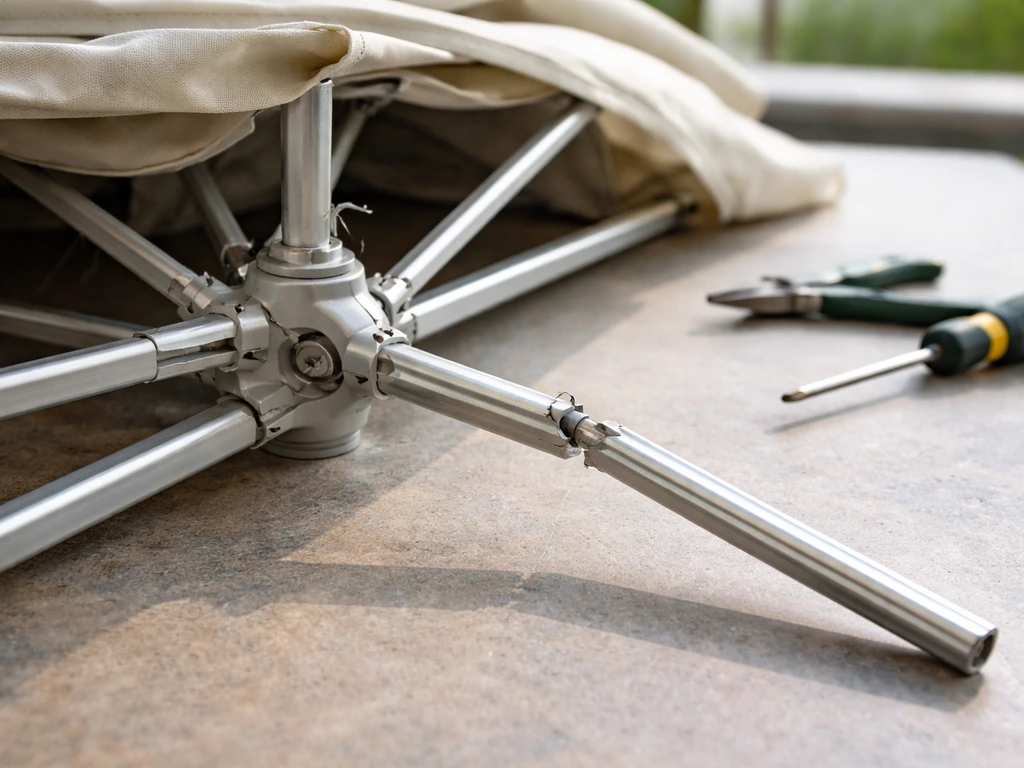
Fix Patio Umbrella Rib: Diagnose and Repair Step by Step
Step-by-step DIY guide to fix a broken or bent patio umbrella rib, aligning parts and restoring smooth opening
Broken Patio Umbrella Repair Guide: Diagnose and Fix Fast
Diagnose and repair a broken patio umbrella fast with step by step checks, fixes for common parts, and maintenance tips.
How to Fix a Patio Umbrella That Won't Open or Close
Step-by-step fixes for patio umbrellas that won’t open or close, with checks for jams, cords, latches, and lubricating t