
When you're staring at a sad, sun-bleached umbrella with a wonky crank and a torn canopy, you basically have four paths: fix it, repurpose it, sell or donate it, or break it down for recycling and disposal. Which one makes sense depends on a quick look at the damage, the age of the umbrella, and what a replacement would actually cost you. Most homeowners toss umbrellas too soon, a broken rib, a frayed cord, or a faded canopy are all fixable for $5 to $50 in parts, and the frame underneath is often rock solid for years more.
What to Do With Old Patio Umbrellas: Repair, Repurpose, Recycle
Luca Morrison
22 Jul 2026
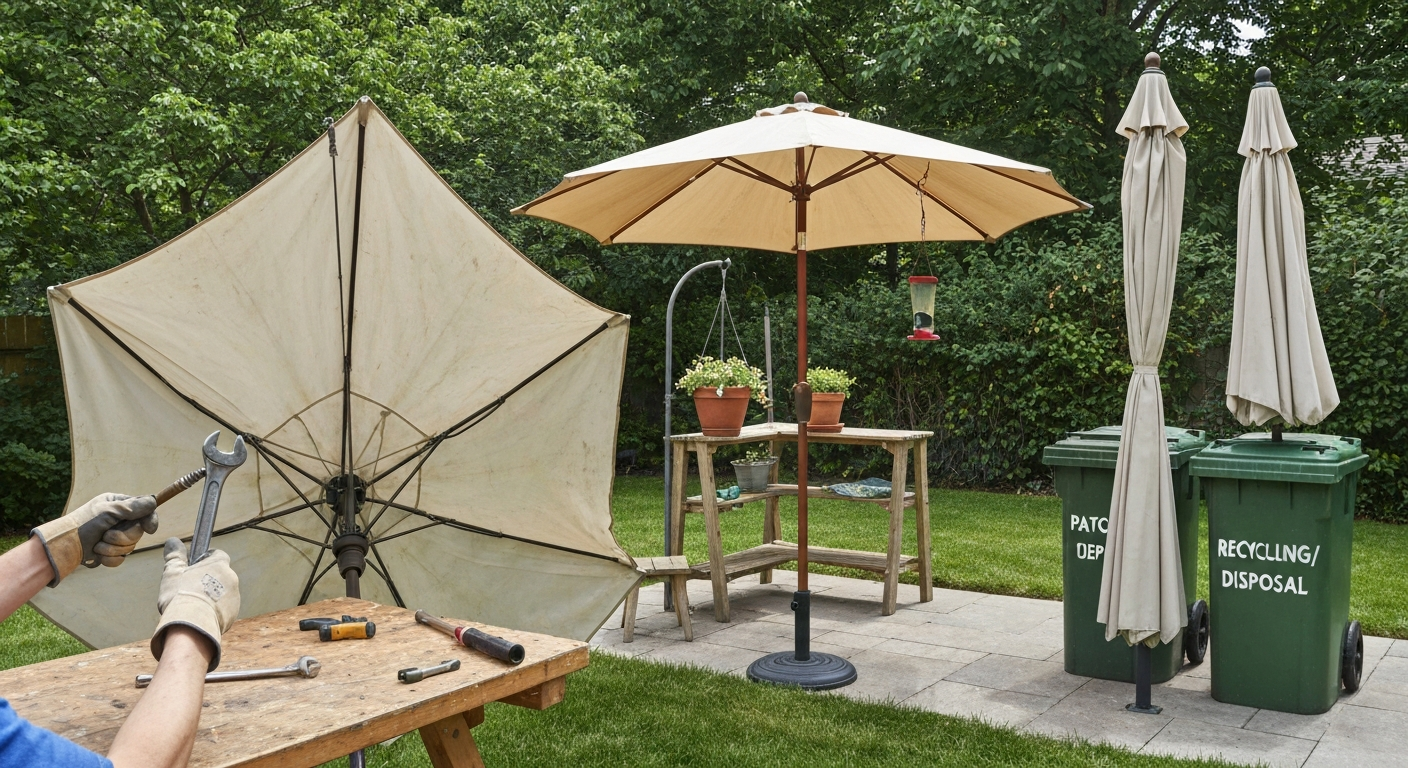
Quick decision checklist: repair, repurpose, sell/donate, or recycle
Run through this checklist before you do anything else. It takes about two minutes and will save you a lot of second-guessing.
- Is the main pole straight and free of cracks or severe corrosion? If yes, the frame is worth saving — move toward repair or resale.
- Is the hub (the central ring the ribs attach to) intact and still locking in the open position? If the hub is cracked, deformed, or won't lock, the umbrella is unsafe to use outdoors in any wind.
- Are there fewer than three broken or bent ribs? One or two broken ribs can be splinted or swapped out cheaply. More than that, and repair gets complicated fast.
- Does the canopy fabric have tears, mildew, or severe UV degradation? Fabric is the easiest thing to replace — this alone is not a reason to scrap the umbrella.
- Is the crank, tilt, or cord system jammed or broken? These are mechanical fixes, usually under $30 in parts.
- Is the umbrella under five years old and from a known brand (Treasure Garden, Abba Patio, or similar)? Manufacturer parts and replacement canopies are likely still available.
- Is the frame aluminum, steel, or fiberglass? Aluminum and steel frames have scrap and resale value. Fiberglass ribs do not recycle easily.
- Is the canopy clean, dry, and structurally intact even if faded? Donate or sell it. Charities and online buyers will take clean, complete umbrellas in working condition.
- Are multiple structural components failed at once — pole, hub, and several ribs? At that point, strip usable parts and send the rest to bulky-item pickup or scrap.
How to size up the damage and decide what it's worth
Damage assessment
Open the umbrella fully and walk a slow circle around it. Look at each rib from tip to hub, a clean single break in one spot is splintable; a rib that's crushed, kinked in two places, or missing chunks is done. Push gently up on the canopy to feel if the hub clicks and holds. Check the pole from top to bottom: minor surface rust on steel is cosmetic, but a pole with deep pitting, a visible bend, or cracked welds at the collar is a structural problem. Finally, pull the canopy back at a rib tip and look at the fabric pocket where it meets the rib, if the fabric is rotten or shredding at the seams, a full canopy replacement is needed.
Age and parts availability
An umbrella under about seven years old from a major brand is almost certainly repairable with off-the-shelf parts. Treasure Garden posts downloadable manuals and parts lists on its customer support site and recommends contacting an authorized dealer or CasualFS for model identification, you'll need the rib length or photos if you no longer have the receipt. Abba Patio provides model-specific manuals through Manuals.plus that name every replaceable part by position. For generic or store-brand umbrellas more than ten years old, parts sourcing gets harder and a simple cost comparison makes the decision easy.
Cost vs. replace math
| Repair type | Typical DIY cost | Replacement umbrella cost | Worth repairing? |
|---|---|---|---|
| Canopy only (replacement fabric) | $30–$120 | $80–$500+ | Usually yes, especially premium frames |
| One or two broken ribs | $10–$50 | $80–$500+ | Yes — straightforward fix |
| Crank/cord/pulley kit | $10–$35 | $80–$500+ | Yes |
| Full canopy + multiple ribs | $60–$150 | $80–$500+ | Yes on quality frames, borderline on cheap ones |
| Bent or cracked pole | $0 (straighten) to $60 (new pole) | $80–$500+ | Only if hub and ribs are solid |
| Cracked hub or runner | $15–$40 | $80–$500+ | Yes if part is available; skip if hub geometry is off |
| Multiple structural failures | $150+ | $80–$500+ | No — strip parts and dispose |
Safety and sentimental value
Any umbrella with a cracked main pole, deformed hub, or crushed tubing at multiple points should not be used outdoors again, full stop. The CPSC advises reporting any product that caused injury or presents a hazard through SaferProducts.gov, if your umbrella collapsed and hurt someone, document that before you dispose of it. If it's a sentimental or high-end piece (hand-sewn Sunbrella canopy, teak pole), that changes the math significantly and justifies more involved repair.
Tools and materials you'll want before you start
Most umbrella repairs need the same basic kit, with a few extras depending on what you're fixing. Gather these before you start so you're not making mid-project hardware runs.
- General kit: flathead and Phillips screwdrivers, adjustable wrench, needle-nose pliers, utility knife, masking tape, marker, and a clean flat surface (picnic table works great)
- Measuring tape: for canopy diameter, rib length, and pole diameter — critical for ordering correct replacement parts
- Rivets and rivet gun: a basic manual pop-rivet gun runs $10–$25 at Home Depot; stainless steel rivets resist rust better than aluminum
- Two-part epoxy or J-B Weld: for metal-to-metal bonding at joints; $4–$20 per kit depending on size
- Replacement ribs: $5–$25 each depending on brand, diameter, and material (fiberglass or aluminum); order by rib length and tip style
- Replacement cord/rope: 3mm to 6mm braided polyester is standard for pulley-style umbrellas; buy a couple of feet more than you think you need
- White lithium grease or silicone spray: for lubricating the crank mechanism, hub, and runner
- Sewing needle and UV-resistant outdoor thread: for minor canopy seam repairs before a full replacement is needed
- Replacement canopy: sized by canopy diameter and number of panels; always match the rib count before ordering
- Work gloves: cut fiberglass ribs and metal burrs are sharp — don't skip these
Step-by-step repair overview and safety first
Before you touch anything, close the umbrella fully and either lay it flat on a table or prop it securely against a wall so it can't tip. Independent DIY guides outline these steps, fully close and stabilize the umbrella; remove the canopy by freeing rib tips and detaching the finial; disassemble the hub/runner to replace broken ribs or cord/pulley; then reassemble and test, and report typical part costs of about $5–$30 per rib or cord kit and under $20 for splint repairs (How to Repair Patio Umbrellas: Step‑by‑Step Fixes, PatioUmbrellaRepairGuide.com) How to Repair Patio Umbrellas: Step‑by‑Step Fixes — PatioUmbrellaRepairGuide.com. Work in a calm day, even a light breeze can catch a half-open canopy and turn a simple fix into a hand injury. If your umbrella has a Lowe's-style repair guide warning that DIY work may void the warranty, note that using manufacturer-approved parts (as recommended by Treasure Garden and Abba Patio) generally preserves the warranty better than third-party substitutes.
- Close and secure the umbrella. Lock the runner at the bottom and, if possible, remove the umbrella from the base so it lies flat.
- Remove the canopy. Pull each rib tip free from its fabric pocket, working around the umbrella systematically. Unscrew or unclip the finial (the decorative cap at the top of the pole) to free the top of the canopy.
- Identify the failure point. With the canopy off, it's much easier to see cracked ribs, worn cords, and stiff or corroded hubs.
- Make the repair (see specific sections below for canopy, ribs, crank/cord, and frame).
- Reassemble in reverse order: reattach the canopy pockets to rib tips, refit the finial, then slowly open and close the umbrella several times under controlled conditions.
- Test outdoors only in calm conditions first. Do not use a freshly repaired umbrella in wind until you've confirmed the hub locks, all ribs seat properly, and the canopy is taut and even.
Replacing the canopy: measure twice, sew (or snap) once
Measure and source the right fabric
A replacement canopy is sized by overall diameter (tip to tip across the open umbrella) and the number of ribs, which equals the number of panels. Common sizes are 7.5 ft, 9 ft, 10 ft, and 11 ft. Measure your rib length from hub to tip while the umbrella is open, and count the ribs. Premium canopies use Sunbrella, a 100% solution-dyed acrylic (from Glen Raven) that resists UV fading, mildew, and moisture better than polyester. If you're replacing a Sunbrella canopy, it's worth matching the fabric, you can source replacement yardage through authorized Sunbrella dealers or buy a pre-sewn canopy from specialty parts dealers like The Patio Galaxy, which lists canopies and frames separately. Expect to pay $30–$120 for a replacement canopy depending on size and fabric quality.
Removing the old canopy
- Close the umbrella and remove it from the base if possible.
- Unscrew the finial at the top of the pole — this is usually a simple twist or a slotted screw.
- Starting at any rib, slide the fabric pocket off the rib tip. Work your way around, freeing all rib tips. The fabric may be stiff or cracked at the pockets if it's old — be firm but not aggressive.
- Slide the canopy off the top of the pole. Set the old canopy aside — even if it's too far gone for the umbrella, the fabric may be useful for upcycling projects.
Attaching the new canopy
- Thread the new canopy's center hole over the top of the pole before you reattach the finial.
- Open the umbrella to about halfway.
- Align one canopy panel with one rib and push the rib tip into the corresponding fabric pocket. Work around the umbrella, alternating opposite sides to keep the tension even.
- Once all rib tips are seated, fully open the umbrella and check that every panel is taut and the fabric hangs evenly.
- Screw the finial back on snugly. Open and close the umbrella three or four times to confirm the canopy seats properly throughout the motion.
Timing note: canopy replacement takes about 30 to 45 minutes if the hardware is cooperative. Budget an extra hour if any rib tips are corroded or the pocket stitching needs reinforcing with outdoor thread.
Fixing broken ribs and struts
Inspect the break first
Remove the canopy and open the umbrella frame fully so each rib is under normal tension. Look at every rib from hub end to tip: a single clean fracture about halfway along a rib is the most common and most fixable break. A rib with the tubing crushed flat, cracked near the hub ferrule, or broken in two separate spots is harder to save and may just need replacement. Also check the struts (the shorter support arms that connect the runner to the main ribs), these snap under wind load and are almost always replaceable.
Temporary splints for aluminum or fiberglass ribs
A splint sleeve is a short section of tubing or metal channel that slides over the break and is secured with pop rivets or epoxy. For aluminum ribs, use a sleeve of aluminum tubing that's the next size up in diameter, typically 1/4 inch to 3/8 inch over the rib's outer diameter. Slide it centered over the break, drill two small holes through sleeve and rib on each side of the break, and set stainless pop rivets. For fiberglass ribs, a J-B Weld epoxy wrap plus a fiberglass repair sleeve works, but honestly, at the cost of replacement fiberglass ribs ($10–$25), you're usually better off swapping the whole rib rather than fighting a fiberglass repair. Splints cost under $20 in materials and are a solid short-term fix, but they add weight to the rib tip and can affect canopy tension over time.
Full rib replacement
- With the canopy removed, close the umbrella and locate the hub attachment point for the broken rib — usually a rivet, bolt, or sliding socket.
- Drill out or unscrew the old fastener. Slide the broken rib out of the hub socket.
- Measure the old rib from hub attachment point to tip. Match this measurement exactly when ordering a replacement.
- Slide the new rib into the hub socket and secure it with a new rivet or the original bolt — use stainless hardware if you're replacing rivets.
- Repeat for struts, noting that strut length and angle vary by model. Check your manufacturer's manual (Treasure Garden, Abba Patio, etc.) for part numbers if available.
Reinforcement tips
After a rib repair, apply a thin bead of silicone sealant around any new rivet holes at the hub to prevent water intrusion and corrosion at the joint. If the same rib keeps breaking in the same spot, it's usually because the canopy fit is too tight, check that all panels are equally tensioned when you reinstall the fabric.
Repairing crank, tilt, pulley, and cord systems
Diagnosing the problem
Crank and cord systems fail in predictable ways. A crank that turns but doesn't open the umbrella usually means the cord or rope inside has frayed or slipped off a pulley. A crank that's stiff and grinding means corrosion or a bent gear, lubrication is the first fix. A tilt mechanism that won't hold the angle usually has a worn button or a cracked collar. For pulley-style umbrellas (those that open by pulling a cord through a loop), the most common failure is a frayed cord that snaps at the most-stressed point, usually right where it enters or exits the hub.
Crank mechanism: lubrication and gear fixes
- Remove the crank handle (usually one screw on the side of the collar).
- Spray white lithium grease or a silicone-based lubricant directly into the crank housing. Work the handle back and forth to distribute the lubricant. This fixes about 60% of stiff cranks.
- If the crank still slips or grinds after lubrication, remove the housing cover (two to four screws) and inspect the gear. Small plastic gear teeth that are chipped or missing require a replacement crank assembly — these are model-specific and cost $10–$30 from dealers or parts sites.
Cord and pulley replacement
- Remove the canopy and open the frame fully so you can see the cord path from the runner up through the pole to the top pulley.
- Tie a thin piece of string to the old cord before you pull it out — this 'guide string' will help thread the new cord through the pole without fishing around blind.
- Pull the old cord out from the runner, letting the guide string follow it through the pole.
- Thread the new cord (3mm–6mm braided polyester, cut to the same length as the old cord plus about 6 inches) by attaching it to the guide string and pulling it through.
- Tie or clamp the cord ends at the runner and at the top fitting per the original configuration. Knot style matters — a figure-eight knot is secure and doesn't slip.
- Test by slowly opening and closing the umbrella before reattaching the canopy.
Tilt mechanism
Push-button tilt mechanisms (the most common type) use a spring-loaded button that locks the tilting collar at specific angles. If the button depresses but the collar won't lock, the spring is likely worn or the button itself is cracked, replacement collar assemblies are available for most major brands for $15–$35. Collar-style tilt systems that use a twist-and-lock action usually just need cleaning: remove the collar, scrub out grit with a dry brush, and apply silicone spray before reassembling.
Frame straightening and metal repairs
When straightening helps and when to stop
A slightly bent aluminum pole, maybe 5 to 10 degrees off-true from a wind tip-over, can often be straightened by hand or with a rubber mallet against a flat surface, working gradually in small increments. Steel poles are less forgiving because they're harder to bend back without cracking the metal at the stress point. The rule I use: if you can see the bend clearly from 6 feet away, the metal has yielded significantly and straightening risks a fracture at that spot. A pole with a subtle lean from a manufacturing defect or minor impact is a much better candidate for straightening than one that took a hard hit.
Safe straightening technique
- Remove the umbrella from the base and lay the pole on a flat, firm surface like a workbench or driveway.
- Identify the bend location exactly by rolling the pole slowly — the high point of the bend will rock upward.
- Place a thick rubber pad or folded cloth under the bend point to protect the pole surface.
- Apply even, downward hand pressure on both sides of the bend. For stubborer bends, use a rubber mallet in short, light taps — not hard strikes.
- Roll and check after every few taps. Stop if you hear any cracking sound or see surface cracking at the bend — a cracked pole is unsafe and should not be used.
Weld and epoxy repairs for metal joints
MIG or TIG welding a cracked umbrella collar or joint is an option if you have access to equipment and the pole is steel, aluminum welding is more specialized and not worth it for a consumer umbrella part. For most homeowners, a two-part steel-reinforced epoxy like J-B Weld (available at Home Depot for $5–$20) is the practical choice for non-structural cosmetic cracks at joints or ferrules. It bonds well to both aluminum and steel and cures hard enough to prevent further splitting. That said, epoxy-repaired structural joints should not be trusted in high-wind conditions, if the hub collar or main pole joint is the problem, a replacement part is the right answer, not glue.
Hard stops: when to walk away from metal repairs
- Visible cracks at the hub or pole top collar — these are load-bearing points and a failure here drops the whole canopy
- Corrosion that has eaten through the pole wall (press a screwdriver gently against the surface — if it punches through, the metal is gone)
- A runner that won't slide smoothly past a deformed section of the pole — this is a bind waiting to trap your hand
- Any structural part with multiple failure points — compounding repairs on the same component compounds the risk
Salvaging parts: what's worth keeping and how to remove it safely
Even a patio umbrella that's too far gone to repair often has components that have real value, either for your next repair project, for resale, or for creative reuse. The old umbrella frame in particular is worth thinking through before you haul it to the curb, since the pole, hardware, and even bent ribs have downstream uses. For ideas on what to do with an old patio umbrella frame, see our guide what to do with old patio umbrella frame.
Components worth saving
| Component | Material | Salvage value | How to remove |
|---|---|---|---|
| Main pole | Aluminum or steel | Scrap metal value; reuse as garden stake or trellis post | Unthread from base fitting; most poles pull free or unscrew |
| Hub and runner | Cast aluminum or nylon | Resale if brand-matched; spare parts | Drill out rivets or unscrew bolts; keep attached to pole section if possible |
| Intact ribs | Aluminum or fiberglass | Resale for matching repairs; garden trellis stakes | Drill out hub rivets; slide ribs free from sockets |
| Crank assembly | Zinc/plastic housing | Resale if working; spare for matching model | Remove two to four housing screws; disconnect cord before pulling |
| Canopy fabric (intact sections) | Polyester or Sunbrella acrylic | Upcycle into bags, covers, shade cloth | Cut free from rib pockets with utility knife; wash before storing |
| Base hardware (bolts, collars, ferrules) | Stainless or galvanized steel | Reuse in next repair; low scrap value individually | Unscrew or drill out; keep sorted in a labeled bag |
| Finial | Resin, aluminum, or brass | Decorative reuse; low resale value | Unscrew from pole tip |
A note on canopy fabric before you toss it: some outdoor textiles, particularly those with stain-resistant or water-repellent coatings, may contain PFAS (per- and polyfluoroalkyl substance) fluorochemical finishes. EPA and state environmental agencies have documented PFAS in treated textiles, which has disposal implications. If you're cutting or sanding treated fabric, wear gloves and don't work in an enclosed space. For recycling the fabric rather than landfilling it, TerraCycle's Fabrics and Clothing Zero Waste Box is one documented mail-in option that accepts outdoor textiles, it's a paid program but it keeps fabric out of landfill.
Repurposing and upcycling your old umbrella
If the umbrella is past repair but the parts are structurally intact, there's a lot you can do before sending it to the curb. The old umbrella frame, in particular, opens up a handful of genuinely useful projects around the yard. If you want ideas, see a short guide on how to repurpose a broken patio umbrella for practical yard projects and crafts.
- Garden trellis: remove the canopy, plant the pole in a garden bed, and use the open rib frame to train climbing plants like beans or sweet peas
- Hanging planter frame: attach small hanging baskets to each rib tip for a tiered, 360-degree planter — works especially well with a smaller 7.5 ft offset frame
- Shade cloth structure: replace the canopy with shade cloth fabric (available at garden centers) for a veggie-garden sun screen that's easy to remove seasonally
- Canopy fabric tote bags: a single canopy panel is about the right size for a large reusable shopping bag — cut, fold, and sew with UV-resistant outdoor thread
- Cushion or pillow covers: Sunbrella canopy sections are durable enough for outdoor cushion covers; just clean the fabric thoroughly first
- Lampshade frame: stripped ribs and the hub make a surprisingly elegant lampshade skeleton for an outdoor string-light feature
- Metal scrap for projects: straight aluminum pole sections and straight ribs are useful as staking material for garden fences or temporary supports
Selling or donating your umbrella
A used patio umbrella in working condition, even one with a faded canopy, has real resale value, especially if it's from a recognized brand. Before you list it or drop it off, spend 20 minutes cleaning the canopy with mild soap and water, wiping down the frame, and checking that the crank or cord opens and closes the umbrella smoothly. That preparation is the difference between a quick sale and no interest.
Preparing for resale
- Clean and dry the canopy completely — mildew is the biggest turn-off for buyers
- Note the brand, model number, canopy diameter, and number of ribs in your listing
- Take photos of the open umbrella, the crank or tilt mechanism, any wear spots, and the base fitting
- Be honest about condition — list bent ribs or fading accurately; frame-only sales are totally acceptable for buyers who want to swap the canopy
- Price by condition: a clean, working 9 ft name-brand umbrella can sell for $40–$120 used; bent frame or missing hardware drops it to parts-only pricing ($10–$25)
Where to sell or donate
- Facebook Marketplace and Craigslist: the most active channels for local patio furniture; free to list
- eBay: worth it for premium or brand-name frames where buyers are actively searching by model
- Habitat for Humanity ReStores: many locations accept outdoor furniture and patio items in working condition
- Local charities, shelters, and community gardens: often grateful for functional outdoor shade structures
- Buy Nothing groups (Facebook or Nextdoor): fast and free; great for items that work fine but wouldn't sell for much
Recycling and disposing of what's left
Once you've stripped the useful parts, what remains is basically a metal pole, some ribs, a hub, and fabric scraps. How you handle each piece depends on the material and your municipality. For step-by-step guidance on how to dispose of a patio umbrella, see our guide on how to dispose of a patio umbrella.
Metal components: aluminum and steel
Aluminum poles, ribs, and fittings are highly recyclable. EPA technical discussion on aluminum recycling (historical EPA document) notes that aluminum is highly recyclable and commonly accepted by curbside and scrap‑metal programs, though acceptance varies by locality and may require separation and cleaning. Most municipal curbside programs accept clean aluminum and steel metal as either bulky metal recycling or scrap, but the rules vary. NYC's DSNY, for example, requires bulky items to be set out separately on the right day, and differentiates metal items from regular mixed recycling. San Francisco's Recology runs a Bulky Item Recycling pickup program with scheduling required. Your local program's website will tell you whether patio furniture goes to scheduled bulky pickup, the transfer station, or the curbside metal bin. If your municipality doesn't take it curbside, a local scrap metal dealer will take clean aluminum and steel, call ahead and ask if they accept consumer goods, since some only take commercial quantities.
Fiberglass ribs and composite parts
Fiberglass is the frustrating one. It's not accepted in curbside recycling anywhere in the US that I'm aware of, and most transfer stations direct it to landfill rather than specialty processing. A few commercial composite recycling facilities exist, but they're not practical for individual homeowners. If your ribs are fiberglass, the honest answer is that they're landfill unless you find a specialist industrial recycler in your area. This is one reason aluminum-rib umbrellas are a better long-term environmental bet.
Canopy fabric
Polyester and acrylic outdoor canopy fabric is not accepted in standard textile recycling bins at most donation centers, those are set up for clothing. TerraCycle's Fabrics and Clothing Zero Waste Box is the most accessible documented mail-in recycling option for this type of material. It's a paid service (you buy the box, fill it, and ship it back with a prepaid label), but it's the closest thing to a real recycling path for treated outdoor fabric. For canopies that are still clean and intact, upcycling into bags or covers, as described above, is a better first option.
Bulky item pickup: schedule before you drag it to the curb
Most US municipalities classify a patio umbrella as a bulky item, which means it can't just go in your regular trash bin. Many cities require you to schedule a pickup appointment, and some charge a fee for items above a certain size or quantity. Check your city's waste management or public works website before set-out day, putting a bulky item on the curb on the wrong day can result in a fine and the item sitting there for a week. If you've already stripped out the metal parts for scrap, the remaining canopy and any plastic components will most likely end up as general bulky waste.
FAQ
Quick decision checklist: should I repair, repurpose, sell/donate, or recycle/dispose my old patio umbrella?
Quick checklist: 1) Inspect structure: check pole, hub/runner, ribs, and canopy fabric for cracks, severe corrosion, crushed tubing, or many broken ribs. 2) Safety threshold: if main pole/hub is cracked, heavily deformed, or locking fails → replace/dispose (unsafe). 3) Cost check: if only fabric or 1–2 ribs/cable issues, repair is usually cheaper than replace. 4) Value check: name‑brand, intact frame or high‑quality Sunbrella‑type canopy → consider selling/donating. 5) Material check: mostly metal/aluminum parts → recyclable; fiberglass/composite ribs or PFAS‑treated fabric → harder to recycle. 6) Time/skill check: if you’re comfortable with basic hand tools and rivets/cord work → DIY repair; otherwise consider pro/authorized dealer parts. 7) Final choice: Repair (minor damage, safe frame), Repurpose/Upcycle (lots of fabric or unusable frame), Sell/Donate (good condition, clean), Recycle/Dispose (unsafe/unsalvageable; separate metals and textiles where possible).
Step‑by‑step DIY fixes: replacing the canopy (what to do and tools needed)
Steps and tools: Tools/materials — screwdriver set, needle‑nose pliers, seam ripper, heavy‑duty sewing machine or upholstery needle and UV/ outdoor thread, measuring tape, replacement canopy or outdoor fabric (Sunbrella for premium match), finial/wooden plug if needed. Steps — 1) Close umbrella and stabilize (lay flat or tie closed). 2) Remove finial/top cap and free rib tips from canopy pockets. 3) Unhook canopy from hub/runner (note any clips or friction fit). 4) Measure rib length, number of ribs and canopy diameter; buy matching replacement or cut new fabric to pattern. 5) Sew or assemble canopy: reinforce rib pockets and vent area; install center hole and finial opening. 6) Reattach canopy by sliding rib tips into pockets and reinstalling finial/runner. 7) Test open/close slowly; check for interference. Notes: follow manufacturer manual for brand‑specific steps (Treasure Garden, Abba Patio, etc.) and expect canopy replacement cost to vary (fabric yardage or pre‑made canopy pricing).
Step‑by‑step: fixing broken ribs (splinting or replacing)
Tools/materials — replacement ribs (if available), metal/fiberglass splint tube or carbon sleeve, epoxy or two‑part adhesive, pop rivets or small stainless screws, drill, file, clamps. Steps — 1) Close and stabilize umbrella. 2) Remove canopy to expose rib break. 3) If replacement rib is available, remove rivet or fastener at hub and swap in the new rib; secure with rivet/screw. 4) For splinting: align broken pieces, slip a slightly larger sleeve over the break (metal tube, brass sleeve or heat‑shrink with epoxy) and bond with epoxy; clamp until cured and optionally rivet at ends for mechanical support. 5) Reinstall canopy and test. Safety: multiple cracked ribs or crushed rib tubing → replace umbrella; repaired ribs weaken wind resistance.
Step‑by‑step: crank, tilt, cord or pulley problems (common fixes)
Tools/materials — replacement crank kit or cord kit (model‑specific if possible), lubricant (silicone), needle‑nose pliers, small screwdrivers, rivet gun, replacement cord or steel cable, safety glasses. Steps — 1) Close umbrella, tie it down and remove canopy if needed. 2) Open hub/runner cover per manual to access cord/pulley/crank. 3) Inspect for frayed cord, seized gears, missing pins or stripped teeth. 4) Lubricate moving parts; replace cord with same diameter/type and route through pulleys matching original path. 5) Replace crank assembly if gears stripped—many brands sell crank replacements (consult Abba Patio/brand manual). 6) Reassemble, test opening/closing slowly. Note: using manufacturer parts avoids mismatched loads and improves longevity; DIY gear replacement is feasible but requires careful matching of parts.
How to salvage useful parts from an old umbrella
Common salvageable parts — aluminum/steel poles, ferrules, hub/runner (if intact), ribs (if straight), crank assemblies (if functional), finials, canopy fabric (for upcycling), tilt mechanisms, bases or base adapters. How to harvest — 1) Fully close umbrella and stabilize. 2) Remove canopy and unfasten ribs at hub. 3) Unscrew rivets or cut rivets with drill where necessary (wear eye protection). 4) Label and store parts (note brand/model and measurements). Useable parts get reused or sold for parts online; metal parts can go to scrap if not reusable.
Specific options for an old umbrella frame (reuse, sell 'frame only', or upcycle)
Frame options — 1) Replace canopy and reuse frame (cost‑effective if hub and pole are sound). 2) Sell frame only: measure pole diameter, rib length, hub type and list brand/model; frames from premium brands fetch higher prices. 3) Donate frame for parts to local repair shops or community tool libraries. 4) Upcycle frame ideas: convert into a garden trellis, hanging plant structure, pergola accent, or yard art (cut and weld joints or use cable ties). 5) Recycle metal parts at scrap yard if structurally unsound. Note: list or sell 'frame only' with clear photos and measurements so buyers can source correct canopies or parts.
Next Articles
What Can I Do With an Old Patio Umbrella: Repair or Repurpose
Fix, repurpose, sell or recycle an old patio umbrella, DIY repairs, costs, and easy upcycle ideas.
How to Dispose of a Patio Umbrella: Repair, Reuse, Recycle Guide
Learn repair-first steps to fix, repurpose, or responsibly dispose of a patio umbrella, disassembly, recycling, donation,
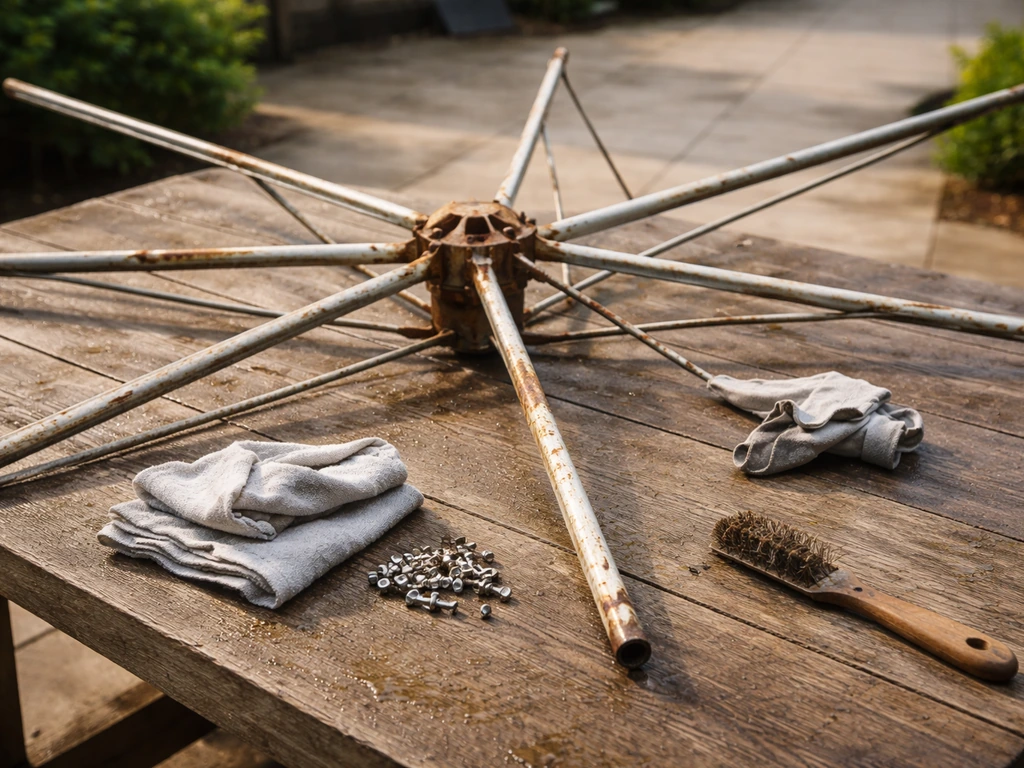
What to Do With Old Patio Umbrella Frames: Restore or Repurpose
Triage, clean, repair rust and joints, replace tilt or crank parts, then decide restore, repurpose, or recycle.