
Before you haul that umbrella to the curb, do a quick gut-check: if the problem is a torn canopy, a snapped cord, a broken crank, or a single bent rib, you can almost certainly fix it for under $30 and an afternoon of your time. If the pole is cracked, the hub is shattered, or multiple systems have failed at once, then disposal makes sense, but even then, the goal is to salvage usable parts, recycle by material type, and keep as much as possible out of the landfill. This guide walks you through that whole decision, from inspection to disassembly to material-by-material recycling, so you can take the smartest next step for your situation.
How to Dispose of a Patio Umbrella: Repair, Reuse, Recycle Guide
Luca Morrison
13 Jul 2026
Repair first: a quick decision framework
I always tell people to start here before doing anything else. The repair-first rule of thumb used by most umbrella repair guides is simple: if the failure is isolated to one system, the fabric, a single rib, the lift cord, or the crank, attempt the repair. Those jobs routinely cost less than $30 in parts and take one to two hours. Where disposal becomes the smarter call is when the structural stuff is compromised: a bent or cracked center pole, a fractured hub or cantilever arm, or when you're stacking up failures across multiple systems at the same time. Another honest trigger is price, if the parts and labor to fix it would run more than about 40 to 60 percent of what a comparable new umbrella costs, you're usually better off replacing it.
| Symptom | Likely repair | Estimated cost | Verdict |
|---|---|---|---|
| Torn or faded canopy fabric | Replace canopy panel or full canopy | $15–$60 | Repair |
| Broken or frayed lift cord | Restring with 3–5 mm polyester cord | $5–$15 | Repair |
| Crank won't turn / stripped gear | Replace crank assembly | $10–$25 | Repair |
| Single bent or snapped rib | Replace individual rib | $8–$20 | Repair |
| Tilt mechanism broken | Replace tilter cartridge | $10–$30 | Repair |
| Cracked or bent center pole section | Replace pole section if OEM part available | $20–$60+ | Repair if part available; dispose if not |
| Fractured hub or cantilever arm | OEM parts or professional service needed | $50–$150+ | Evaluate cost vs. new; safety risk |
| Multiple systems failed simultaneously | Not cost-effective | Exceeds 40–60% of new price | Dispose / salvage parts |
A note on cantilever (offset) umbrellas specifically: their main arm and pivot assembly carry a lot of stored energy when the canopy is extended. If you spot hairline cracks on the boom or arm, that's a retire-immediately situation, not a repair-later one. Structural failures on cantilevered frames can be genuinely dangerous, so I'd rather err on the side of disposal than risk a collapse.
How to assess your umbrella before deciding anything
Spend ten minutes doing a proper inspection before you commit to any path. Work through each component category below and note what you find. This checklist doubles as a parts-salvage inventory, even a beat-up umbrella usually has several components worth keeping.
| Component | What to look for | Salvageable if damaged? |
|---|---|---|
| Canopy fabric | Tears, seam separation, UV fading, mold, PVC coating cracks | Yes — cut panels into fabric scraps if not moldy |
| Ribs and stretchers | Bends, stress cracks, broken ferrule tips | Yes — straight ribs from a scrapped umbrella are useful spares |
| Finial / top cap | Cracks, missing screws | Yes — finials fit many standard poles |
| Hub / runner | Cracks, broken locking tabs, stripped rivet holes | Only if undamaged |
| Center pole (all sections) | Bends, cracks, corrosion, deformed push-button socket | Yes — straight sections work as replacement poles |
| Crank assembly | Stripped gears, cracked housing, jammed mechanism | Yes — cranks are one of the most-swapped spare parts |
| Tilt mechanism | Won't lock, collar cracked, lever snapped | Yes — tilter cartridges swap easily |
| Base (water/sand fill) | Cracks, faded plastic shell, fill still present | Yes — empty shell reusable; concrete base can be repurposed |
| Cantilever boom / arm | Hairline cracks, bent joints, worn pivot hardware | No — retire any structurally cracked boom |
Safety precautions and tools you'll need
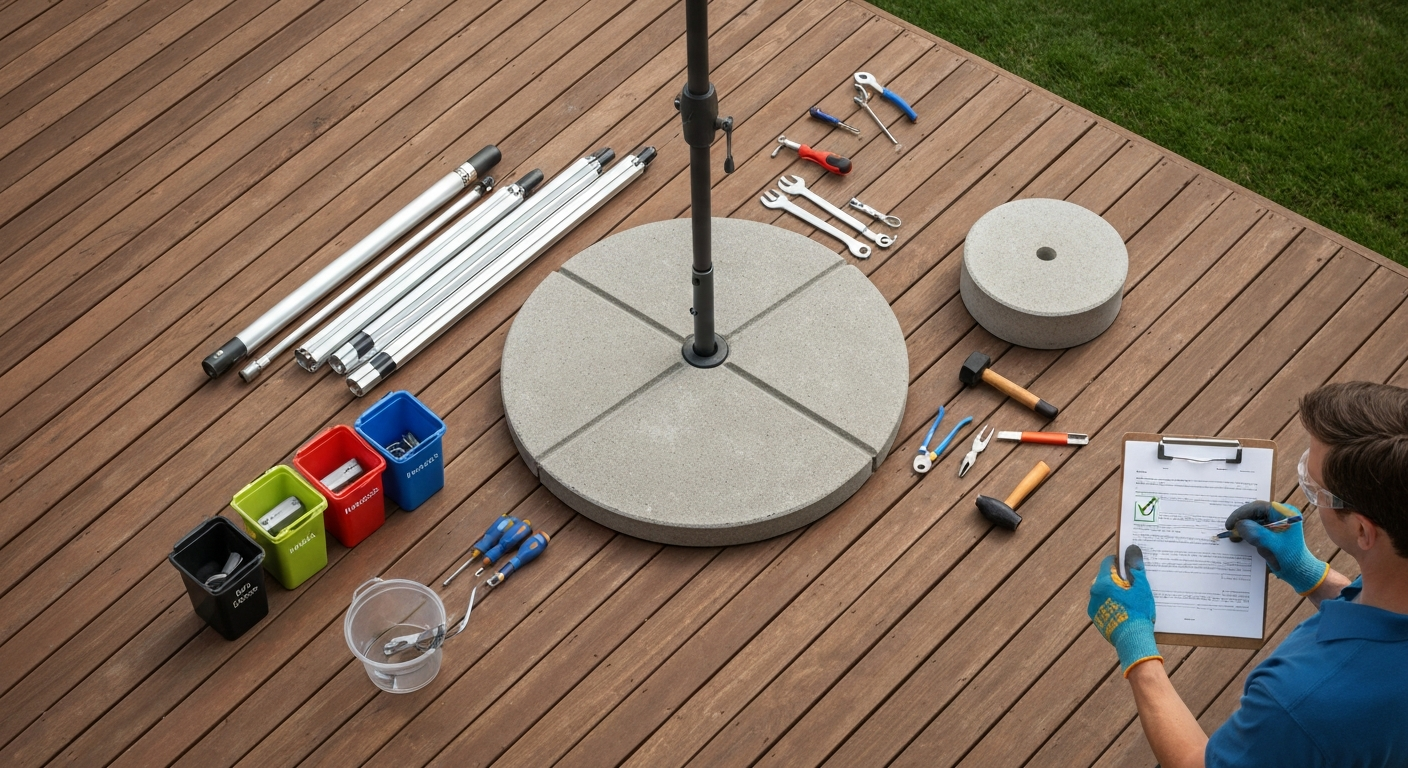
Disassembly sounds straightforward until you're wrestling a 60-pound concrete base or snapping fiberglass ribs that send splinters flying. These are the safety basics I follow every time, and they're consistent with OSHA's general PPE guidance for jobs involving sharp metal, concrete dust, and splintering composites.
- ANSI-rated safety glasses — required any time you're snapping ribs, chiseling concrete, or working with fiberglass
- Cut-resistant gloves — for sharp metal edges on poles and ribs
- Heavy work gloves for fiberglass ribs — fiberglass splinters are nearly invisible and very irritating
- Dust mask or N95 respirator — when breaking or grinding concrete or cutting fiberglass
- Closed-toe shoes with slip resistance — bases and pole sections are heavy and tend to roll
- Hand truck or furniture dolly — NIOSH and OSHA both recommend mechanical aids for loads over 50 lbs; most concrete and stone bases exceed this
- A second person — for moving heavy bases and for steadying cantilever frames during disassembly
Tools you'll want on hand: Phillips and flat-head screwdrivers (various sizes), needle-nose pliers, an adjustable wrench, a set of small hex keys (metric and SAE), a utility knife, an awl or pick tool, and a rubber mallet. For bases, add a bucket and a wet/dry vac for emptying sand or water, and a cold chisel plus a 3-pound hammer if you're dealing with a concrete fill.
Step-by-step disassembly
Standard center-pole umbrella (8 to 11 ft)
- Close the umbrella fully and engage any locking collar so it can't spring open during teardown.
- Unscrew or twist off the finial (top cap) at the peak of the canopy. Some finials have a small set screw — use your hex key.
- At each rib tip, remove the plastic tip cap or untie the cord loop that ties the canopy to the rib. A pair of needle-nose pliers makes quick work of stubborn cord knots.
- Slide the canopy fabric up and off the ribs, working from the top down. If seams are stitched to rib pockets, use a seam ripper or utility knife to free them.
- Locate the push-button spring pin or threaded collar where the upper pole section meets the lower. Press the button or unscrew the collar, then pull the upper section free.
- Open the crank housing by removing the 4 to 6 screws on its cover plate. Inside you'll find the lift cord, pulley, and gear assembly — this is the part most worth inspecting for salvage.
- To remove the ribs and hub, look for cotter pins or small machine screws at each rib-to-hub joint. Pull cotter pins with needle-nose pliers. On molded-plastic hubs, you may find plastic rivets that need to be drilled out.
- Slide remaining pole sections apart at their push-button joints. Label or bag fasteners by section so you don't lose them.
Cantilever (offset) umbrella, extra steps and cautions
Do not stand under the canopy when the boom is unsupported. Before you touch any fastener, brace the canopy with a helper or rest it on a table. Disconnect the crank gearbox cover by removing its bolts (usually 4 to 8 mm hex bolts) to access the drive cord or gear route. A standard stepwise disassembly for an 8–11 ft center‑pole crank umbrella (close and lock; remove finial; detach canopy from rib tips; slide canopy off; remove upper pole; open crank housing to access lift cord and pulleys; remove ribs/hub) is documented at Fix a Patio Umbrella: DIY Troubleshooting and Repair Steps, PatioUmbrellaRepairGuide.com Fix a Patio Umbrella: DIY Troubleshooting and Repair Steps — PatioUmbrellaRepairGuide.com. Remove the boom pin only when the canopy is fully supported. Inspect the boom and all arm joints for hairline cracks before salvaging, any structural crack means the piece goes in the metal recycling pile, not your parts bin.
Emptying and handling the base
Water-fill bases: unscrew the fill cap and tip the base to drain into a bucket, then pour the water down a sanitary drain. Don't dump it into a storm drain, especially if the water has algae treatment or soap residue in it. Sand-fill bases: use a wet/dry vac or scoop the sand into heavy-duty bags. Concrete bases: these typically weigh 50 to 100+ lbs. Use a hand truck to move them, never try to carry one solo. For guidance on assessing safe lifting practices, team lifts, and using mechanical aids for heavy or awkward loads consult the Applications Manual for the Revised NIOSH Lifting Equation (CDC/NIOSH). If you need to break a concrete fill for transport, use a cold chisel and hammer in short, controlled strikes while wearing eye protection and a dust mask.
Parts salvage and common repair guide
Even a structurally dead umbrella is a parts store. Here's what's worth pulling and how each piece gets used in a repair context.
| Salvaged part | Compatible repairs / reuse | Tips |
|---|---|---|
| Lift cord (polyester, 3–5 mm) | Restringing any crank or pulley umbrella | Only reuse if it shows no fraying; replace otherwise |
| Crank assembly | Direct swap on same-diameter pole; most cranks fit 1.5" or 1.75" poles | Check gear teeth for wear before reusing |
| Tilt cartridge / collar | Push-button or collar tilt replacement | Most tilters are universal fit on standard poles |
| Individual ribs | Single-rib replacements on same-span umbrella | Match rib length and hub-end fitting type |
| Finial / top cap | Direct replacement on matching pole diameter | Nearly universal — worth keeping |
| Pole sections | Replacement center pole or DIY projects | Test push-button socket before reusing |
| Canopy fabric panels | Patch material for other canopies, DIY fabric projects | Clean and dry before storing |
The crank and the lift cord are the two highest-value salvage items on most umbrellas because they're the parts that fail most often and are fiddly to source. If you're pulling apart an umbrella that died from a cracked pole, those components are often in perfect shape. Store them in a labeled zip-lock bag with the pole diameter and brand written on it, future-you will be grateful.
Material-by-material recycling: metals (aluminum and steel)
Aluminum and steel are the easiest materials to handle responsibly after disassembly. Most regional scrap yards accept clean extruded aluminum (poles, hubs) and steel (ribs, fasteners) and will pay you per pound, the rates fluctuate but aluminum typically earns more than steel. Before you haul anything, remove all non-metal attachments: fabric, plastic tip caps, rubber grommets, and any remaining concrete. Scrap yards want clean, separated metal and will reject or heavily discount contaminated loads. Call ahead to confirm what forms they accept, since some yards won't take short scrap pieces under a certain length.
Steel ribs and stretchers from cheaper umbrellas can be bundled and brought to a metals recycling drop-off even if the yard doesn't pay for small loads. Many municipal transfer stations and C&D recycling facilities also accept metal as a separate stream from general trash, EPA C&D guidance confirms that steel is commonly recyclable at designated facilities. Separate your aluminum from your steel before you go; mixing them reduces value and may get you rejected.
Material-by-material recycling: wood components
Wood-pole umbrellas (teak, eucalyptus, and hardwood center poles are most common) can follow a few different paths depending on condition. Solid hardwood pole sections in good shape are worth listing for free or cheap on local buy-nothing groups or Craigslist, woodworkers and DIYers will take them. Weathered or cracked wood poles can go to a C&D debris recycler if your local facility accepts untreated wood; many do, and it gets ground into mulch or biomass fuel. Check whether your poles have been treated with any stain, sealant, or preservative before dropping them off, treated wood is a separate waste stream at many facilities and may not be accepted in the general wood pile.
Material-by-material recycling: fiberglass poles and ribs
Fiberglass is the awkward one. It's common on mid-range umbrellas, especially for ribs and stretchers, and it has almost no municipal recycling pathway. Most curbside programs and standard scrap yards won't take it. The practical disposal route for small amounts is to wrap fiberglass pieces tightly in heavy plastic (contractor bags work well), seal them completely, and dispose of them in your regular landfill trash, check local rules first, but most jurisdictions allow this for residential quantities. The wrapping step is important: loose fiberglass shards are a skin and respiratory hazard for anyone handling the bag downstream.
During disassembly, wear your heavy gloves and safety glasses the entire time you're handling fiberglass ribs. Even apparently intact ribs shed micro-splinters when flexed. If you need to cut them to fit in a bag, use a utility knife with a new blade and do it outdoors, downwind. Wash your hands and forearms thoroughly afterward and launder any clothing that contacted the material.
Material-by-material recycling: plastics and plastic bases
Plastic components on patio umbrellas include the base shell (usually HDPE or ABS), hub runner, tip caps, and crank housing. Start by checking the base shell for a resin identification code, it's the number inside the recycling triangle, usually stamped on the underside. HDPE (code 2) and PP (code 5) are the most commonly accepted plastics at municipal recycling centers; ABS (code 7) is usually not accepted in curbside programs. A clean, empty HDPE base shell may be accepted at a plastics drop-off, but call ahead since large rigid plastics are inconsistently accepted across regions.
Small plastic parts like tip caps, hub runners, and crank housings generally go in the trash unless your municipality has a catch-all rigid plastics program. Don't toss mixed plastic-and-metal assemblies into a single recycling bin, separate them first. If you're unsure, Earth911.com's recycling locator (search by material and zip code) is one of the most reliable ways to find what your local options actually are.
Material-by-material recycling: fabric and textiles
The canopy is one of the trickier materials to handle correctly. The U.S. overall textile recycling rate sits around 14.7 percent (EPA 2018 data), and outdoor canopy fabrics are harder to place than clothing because of their coatings and size. Your options depend heavily on what the canopy is made of.
If your canopy is Sunbrella (solution-dyed acrylic), you're in luck: Sunbrella runs a 'Recycle My Sunbrella' take-back program that accepts their awning, marine, and upholstery fabrics for recycling. Check their website for current shipping instructions and eligible fabric types, this is by far the cleanest path for that material. For generic PVC-coated polyester canopies, the picture is different. PVC laminate and fluorinated stain-repellent coatings (the kind used on most budget canopies) make these fabrics ineligible for most conventional textile recycling. Check the product's Safety Data Sheet (SDS) if you have it, Section 13 covers disposal considerations, and contact your local hazardous-waste facility if the SDS flags any restricted coatings.
Clean, uncoated polyester or acrylic canopy fabric in decent shape may be accepted by textile recycling charities or thrift stores, particularly if it's been cut into usable pieces. Mold-contaminated fabric is generally not accepted anywhere for donation or recycling and should be bagged and landfilled. EU regulations on flame-retardant and coated fabric classifications are worth a look if you're in Europe, as treated textiles may have additional handling restrictions.
Disposing of concrete and sand bases safely
This is the part most people dread, and honestly it's the one step that will hold up your whole disposal project if you skip it. Many municipalities explicitly require you to empty or remove heavy fill (concrete, sand) from bases before curbside bulk pickup, Clay County, Florida's bulk waste rules, for example, specifically require removal of concrete from poles and posts before collection. Don't assume your municipality will take a 75-pound concrete-filled base on trash day.
For sand bases: drain or vacuum out the sand, bag it in heavy-duty construction bags, and check whether your local C&D facility, transfer station, or landscape material supplier will accept clean sand. Many will. For concrete bases: you have three practical options. First, haul the intact base to a C&D concrete recycling facility, concrete is commonly crushed and reused as aggregate or road base, and most regions have at least one facility within a reasonable drive. Second, break it into smaller pieces (cold chisel and hammer, eye protection mandatory) and mix it into a general demolition load at a transfer station. Third, repurpose it: a solid concrete umbrella base makes a perfectly functional landscape anchor, a step, or a weight for a DIY project. That last option is my personal preference, it's free, it's instant, and it keeps the material out of any waste stream entirely.
Donating or selling your old umbrella
A lot of umbrellas that get written off are still perfectly usable by someone else. For more ideas on what to do with old patio umbrellas, see this guide for donation, repurpose, and recycling options. The threshold for donation is pretty simple: the canopy should be clean and intact (no mold, no major tears), the pole should open and close without binding, and the base should be included or at least noted as absent. Mechanical issues like a sluggish crank or a sticky tilt are fine to disclose, thrift buyers and Craigslist buyers expect some wear.
Where to list and what to charge
- Facebook Marketplace: the most effective platform for bulky outdoor items locally; free to list, and buyers usually pick up
- Craigslist (free section or for-sale): still effective in most regions for patio furniture
- Nextdoor: good for free giveaways to immediate neighbors, and items move fast
- OfferUp: works well for mid-range umbrellas with photos
- Local thrift stores (Habitat for Humanity ReStores, Salvation Army, Goodwill): call ahead — many accept outdoor furniture and patio items but not all locations take large umbrellas
- Buy Nothing groups: ideal for umbrellas that aren't worth selling but still work fine
For pricing, a working 9-foot market umbrella in good condition typically sells locally for $15 to $40. A larger cantilever umbrella in solid shape might fetch $40 to $80. Price lower than you think it's worth if you want it gone in a week. Before listing, wipe down the pole and base, brush off the canopy, and take photos in natural light with the umbrella fully open, buyers want to see the canopy flat and the mechanism working.
Repurpose and upcycle ideas
If selling or donating isn't on the table, there's a lot you can do with the parts before anything hits a recycling bin. The frame and fabric combination that makes an umbrella useless as a shade structure often makes it highly useful for something else entirely. For step-by-step ideas for repurposing an old frame, see our guide on what to do with old patio umbrella frame. For more creative projects and step-by-step plans, see repurpose a broken patio umbrella.
| Component | Repurpose idea | DIY difficulty | Materials needed |
|---|---|---|---|
| Full frame (ribs + pole) | Garden trellis or bean/pea climbing frame | Easy | Twine or zip ties, garden stakes |
| Individual ribs | Plant stakes, bamboo-substitute supports, rod for hanging curtains | Easy | None additional |
| Center pole section (aluminum) | Flag pole, garden post, conduit for outdoor lighting | Easy to medium | Hardware fittings, ground anchor |
| Canopy fabric (clean, intact) | Hammock, shade sail, tarp, picnic blanket, dog bed cover | Easy to medium | Grommets, rope or webbing, sewing supplies |
| Canopy fabric (cut pieces) | Tote bag, market bag, patch material, outdoor cushion covers | Medium | Sewing machine, thread |
| Concrete base | Garden stepping stone, landscape anchor, pot pedestal | None — zero work | None |
| Sand base shell (empty, intact) | Planter pot, catch basin, storage container | Easy | Drainage holes (drill if needed) |
| Rib tips and finial | Drawer pulls, curtain rod finials, decorative hooks | Easy | Adhesive or small screws |
The garden trellis is my favorite quick win. Eight ribs zip-tied to a center pole gives you a ready-made climbing frame that costs nothing and is already the right height for most climbing vegetables. If you've got a broken canopy that's still mostly clean, cutting it into tote bag panels is genuinely useful, solution-dyed acrylic and coated polyester are extremely durable fabrics that most tote bags can't match.
Finding local resources: search phrases and tools
The fastest way to find out what your specific municipality allows is to search for your city or county name plus a few targeted phrases. Use these combinations to get to the right page quickly:
- "[your city] bulk waste pickup rules" or "[county] bulky item collection"
- "[your city] C&D recycling" or "[county] concrete disposal"
- "[your zip code] scrap metal yard" or "[city] scrap aluminum recycling"
- "[city] textile recycling drop-off" or "[county] fabric recycling"
- "Earth911 recycling locator" — enter your material type and zip code for the most comprehensive national database
- "iScrap App" — crowd-sourced scrap yard directory with current pricing and yard locations
- "[city] transfer station accepted materials" — usually lists whether large plastics, concrete, and bulky items are accepted
Municipal solid waste and bulky-item rules vary dramatically even between neighboring counties. Some places will pick up a disassembled umbrella at the curb with a 48-hour notice; others require you to haul everything to a transfer station. Call your waste hauler directly if the website isn't clear, most have a bulky-item hotline and the call takes about two minutes.
Contacting manufacturers and working with scrap yards
Manufacturer contact and warranty/parts support
Before you finalize a disposal decision, it's worth a five-minute call or web search to the manufacturer, especially for mid-range and premium brands. Many umbrella manufacturers sell replacement poles, hubs, crank assemblies, and canopies directly, which can flip a disposal decision back to a repair. Bring your model number (usually on a sticker at the base of the pole or on the original box) and describe the specific part that failed. Brands like Treasure Garden, California Umbrella, and Frankford often stock individual pole sections and canopies. Some offer limited warranties on structural components, a cracked pole on a two-year-old premium umbrella is worth a warranty inquiry before you do anything else.
Working with scrap yards
Call the yard before you load your vehicle. Ask these specific questions: Do you accept extruded aluminum (poles and frames)? Do you accept light steel (small-gauge ribs and hardware)? What preparation do you need, stripped of plastic and fabric? Is there a minimum weight for a paid load? Do you offer pickup, or drop-off only? Most residential umbrella disassembly will yield between 5 and 15 lbs of aluminum and a few pounds of steel, not a big haul, but enough that a scrap yard visit is worth combining with other metal you might have. If the yard doesn't pay for small loads, check whether your local municipal recycling program has a metals drop-off bin, which typically accepts small quantities for free.
Rough time and cost estimates for each path
| Path | Estimated time | Estimated cost | Notes |
|---|---|---|---|
| DIY repair (canopy or cord) | 1–2 hours | $5–$30 in parts | Best value if failure is isolated; parts often available same-day at hardware stores |
| DIY repair (crank or tilt) | 1–3 hours | $10–$30 in parts | Requires disassembly of crank housing; moderate skill level |
| Sell (local marketplace) | 30 min to list; 1–7 days to sell | $0 listing cost; earn $15–$80 | Requires cleaning and good photos |
| Donate | 30 min prep + drop-off | $0 (possible tax deduction) | Call ahead to confirm acceptance |
| Repurpose (basic project) | 1–3 hours | $0–$15 for hardware or fasteners | No specialized skills needed for most ideas |
| Disassemble and recycle by material | 2–4 hours | $0–$15 (transport fuel, bags) | May earn small scrap-metal payout; C&D drop-off may charge a gate fee |
| Curbside bulky-item pickup | 15 min to schedule | $0–$50 depending on municipality | Check rules; may require disassembly or empty base |
| Transfer station / landfill drop-off | 1–2 hours including drive | $0–$30 gate fee | Last resort; ensures disposal but no environmental benefit |
Your next steps: act on your decision today
Use this checklist to move forward based on whatever path you've chosen. Each action is something you can do today or this week without waiting on anyone else.
If you're repairing
- Identify the exact failed component from your inspection checklist above.
- Note your umbrella's brand, model, and pole diameter (measure with a tape — most are 1.5" or 1.75").
- Search the manufacturer's website for the specific replacement part; check Amazon and online umbrella parts suppliers as a backup.
- Order the part and lay out your tools so you're ready to work when it arrives.
- If the repair involves restringing the lift cord, see the step-by-step disassembly section above to access the crank housing.
If you're selling or donating
- Wipe down the pole, base, and canopy; let the canopy air-dry fully.
- Open the umbrella completely and photograph it in good light.
- List on Facebook Marketplace or Nextdoor with dimensions, brand, and an honest condition note.
- If donating, call the thrift store or ReStore first to confirm they accept large patio items.
If you're repurposing
- Choose one project from the upcycle table above based on what you actually need in your yard or home.
- Follow the disassembly steps to separate the components you need.
- Set aside salvageable spare parts (crank, cord, tilter) in a labeled bag before you start cutting or bending anything.
- Recycle leftover metal at a scrap yard or municipal metals bin.
If you're recycling or disposing
- Empty all fill from the base (water, sand, or concrete) before doing anything else.
- Disassemble by material: separate aluminum/steel, plastic, fabric, and fiberglass.
- Search Earth911 or iScrap App for local drop-off options for each material.
- Wrap fiberglass pieces tightly in heavy plastic bags before disposal.
- Check your municipality's bulky-item rules before scheduling curbside pickup.
- Haul metals to a scrap yard; confirm they accept your material type before loading your vehicle.
If your umbrella still has some life in it but just needs a new canopy or a fresh set of ribs, those are genuinely quick fixes that cost far less than a new umbrella, and the same parts you pull off a scrapped umbrella today might be exactly what saves the next one. For more ideas and step-by-step options, see what can I do with an old patio umbrella. The most useful thing you can take away from this guide is the habit of separating the question 'is this umbrella dead?' from 'is this specific part dead?' They're often very different answers.
FAQ
What's the quick decision framework: repair, repurpose, donate/sell, recycle, or dispose of a patio umbrella?
Use a repair-first checklist: (1) Identify the failure: fabric tear or single mechanical part (cord, one rib) — attempt DIY repair. (2) Structural/major failure: bent/cracked center pole, fractured hub/arm on cantilever, multiple systems failing — lean toward replacement or professional repair. (3) Cost rule of thumb: if repair parts + labor approach ~40–60% of a comparable new umbrella, replace. (4) Safety/red flags: hairline cracks in main booms (especially cantilever), fractured hubs, or any part that compromises structural integrity — do not DIY if safety risk exists. Time & cost rough guide: fabric/rib/cord fixes typically 0.5–2 hours and <$30 in parts; crank/gearbox work 1–3 hours and $20–$100+ depending on parts; professional or OEM repairs for cantilevers often cost more than replacement.
What tools and personal protective equipment (PPE) do I need to disassemble or repair a typical patio umbrella?
Basic tools: Phillips/flat screwdrivers, needle‑nose pliers, adjustable wrench, small hex keys, utility knife, awl, replacement cord (3–5 mm polyester/550 cord), wire cutters, and a small socket set. For heavy bases: hand truck or furniture dolly and pry bar. PPE: ANSI-rated safety glasses, cut‑resistant/abrasion gloves, stable closed‑toe shoes, and dust mask if cutting or breaking concrete; wear gloves when handling fiberglass ribs to avoid splinters. For heavy lifts, use team lifts or mechanical aids per NIOSH/OSHA guidance.
Step-by-step disassembly for a common center-pole crank umbrella (8–11 ft)
1) Close and lock the umbrella; brace it so it cannot reopen. 2) Remove finial/top cap. 3) Detach canopy from rib tips (untie cords, remove caps). 4) Slide canopy off ribs and set aside for repair or reuse. 5) Remove upper pole section (release push‑button or unscrew joint). 6) Open crank housing (4–6 screws) to inspect or replace lift cord/pulleys. 7) Remove ribs and hub components (note cotter pins, screws). 8) Separate pole sections and remove base insert or drain base. Keep fasteners in labeled bags. Typical time: 30–90 minutes for one person. Safety: keep hands clear of tensioned cords and use eye protection.
Extra cautions and steps for cantilever/offset umbrellas
Support the canopy before removing the boom pin; never stand under the unsupported canopy. Unbolt or remove the crank gearbox cover to inspect gear/drive/cords. Watch for stored energy in tensioned ribs and springs. Inspect booms and pivot points closely for hairline cracks — any structural cracks mean professional assessment or replacement. Disassembly often requires two people; time: 1–3 hours; parts cost: can exceed $100 for OEM gearboxes or booms.
How do I handle and empty weighted water or sand bases safely?
For water bases: drain into sanitary sewer or allowed on‑site vegetated area (check local rules); avoid storm drains and do not dump soapy/contaminated water outdoors. For sand bases: remove sand into heavy-duty bags; dispose per local landfill or landscape-material facility rules. Use a pump or siphon for water; for heavy filled bases, tip carefully using a dolly or two people to avoid injury. Many municipal bulk‑pickup programs require bases to be emptied before collection.
How do I dispose of concrete or solid-weight bases?
Options: (1) Take to a construction & demolition (C&D) recycling facility — concrete is often crushed and reused. (2) Break into smaller pieces (with chisel/hammer and PPE) and bring to a transfer station that accepts demolition debris. (3) Repurpose intact concrete slabs as pavers or landscape anchors. Use mechanical aids and team lifts; concrete bases often exceed safe single‑person lift limits. Time/cost: breaking + hauling 1–4 hours; disposal fees vary by facility ($10–$75+ depending on location/tonnage). Check local transfer station rules first.
Next Articles
What to Do With Old Patio Umbrella Frames: Restore or Repurpose
Triage, clean, repair rust and joints, replace tilt or crank parts, then decide restore, repurpose, or recycle.
Repurpose Broken Patio Umbrella: DIY Steps and Fix Paths
DIY guide to repurpose a broken patio umbrella: diagnose failures, salvage frame and hardware, rebuild a sturdy shade, w
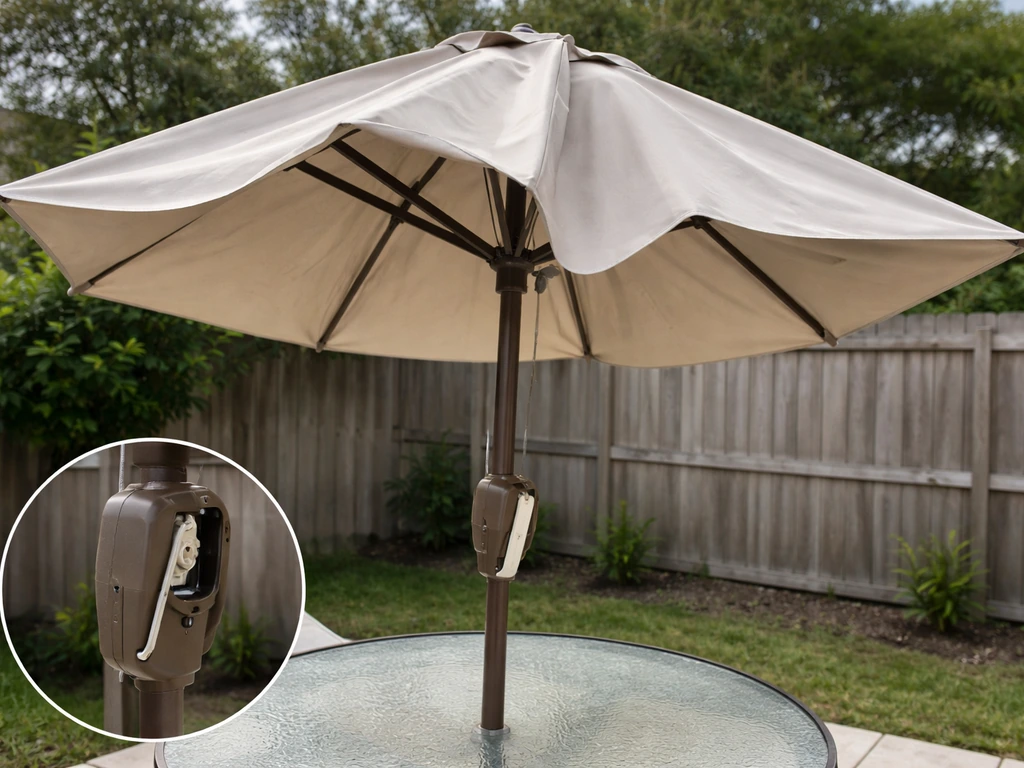
How to Fix a Patio Umbrella That Won't Open or Close
Step-by-step fixes for patio umbrellas that won’t open or close, with checks for jams, cords, latches, and lubricating t