Your Monmouth manual retraction patio awning is most likely stuck, retracting unevenly, or refusing to fully retract because of one of four things: a dirty or corroded crank gear interface, a torsion spring that's lost its tension balance, side arms that are slightly out of alignment, or fabric that has jumped off the roller seating. None of these are reasons to scrap the awning. Almost every retraction problem on a Monmouth-style manual unit can be fixed in an afternoon with basic tools, a good degreaser, and the right lubricant.
Monmouth Manual Retract Patio Awning Troubleshooting and Repair
Luca Morrison
30 Jun 2026
Stop here before you force anything
This is the most important section in the whole guide. Manual retractable awnings store a surprising amount of energy in their torsion springs and roller assembly. If the awning is jammed and you crank hard, force the arms, or try to yank the front bar by hand, you risk snapping the crank gear, bending an arm link, or triggering a sudden uncontrolled extension that can catch fingers and hands in pinch points. The Carefree service documentation, for example, specifically warns that when working near the roller tube you should never let it travel more than about an inch out of its housing unsupported, because the stored spring energy can cause it to spin or shift aggressively.
- Do not crank past the point of obvious resistance. Stop, diagnose, then fix.
- Keep hands and fingers away from the arm hinges and front bar when the awning is partially extended.
- If the awning is stuck mid-extension in wind, retract it fully or secure the front bar before troubleshooting.
- Never work on the roller tube or torsion assembly while the awning is fully extended and under load.
- Check for wasp or bird nests in the cassette housing or arm joints before touching anything, especially in spring.
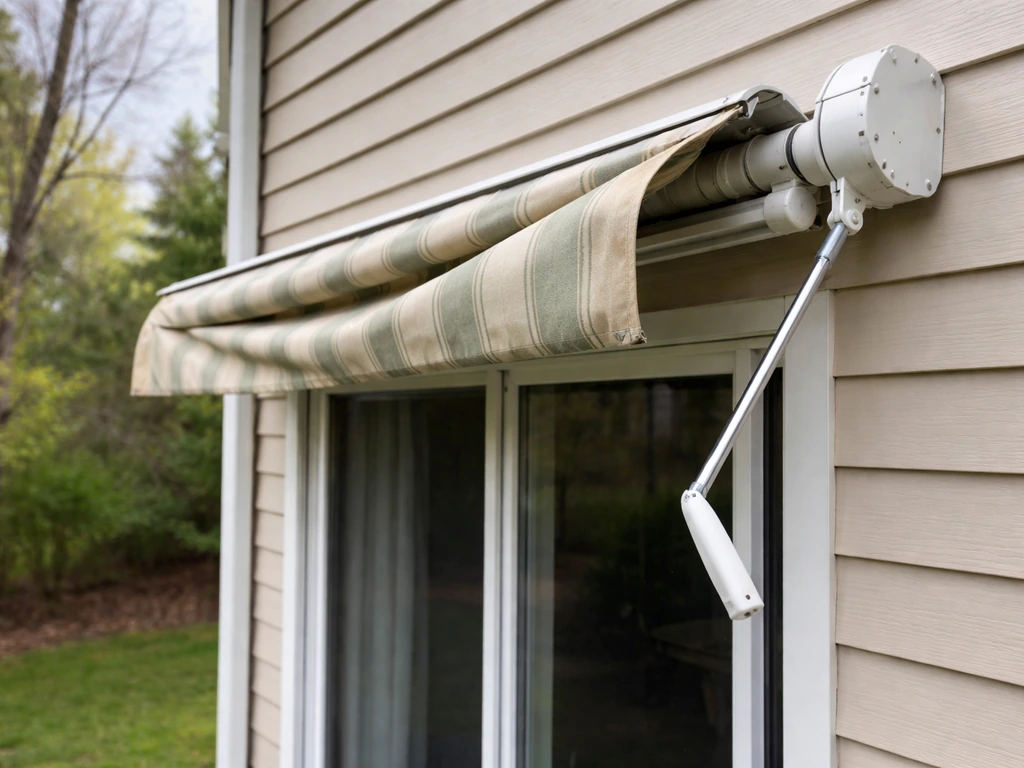
Before you touch a single fastener, do a visual walk-around. Look for: fabric bunched unevenly on the roller, one arm sitting lower than the other, visible rust or grime on the crank eyelet, any debris caught between the front bar and the housing, and whether the crank itself turns freely when disengaged from the roller. That 60-second inspection will tell you which section of this guide to go to first.
How the Monmouth manual retraction system actually works
Understanding the mechanism makes every diagnosis faster, so bear with a quick breakdown. The Monmouth manual retractable awning uses a classic articulated-arm system built around four interconnected components: the roller tube, the torsion assembly inside it, the side arms, and the hand crank. The MCombo 6055-4607 retractable awning manual lists the articulated-arm components, including the torsion bar or arms and the roller tube, showing how they work together with the front bar during extend and retract torsion bar/arms and roller tube.
The roller tube and torsion spring
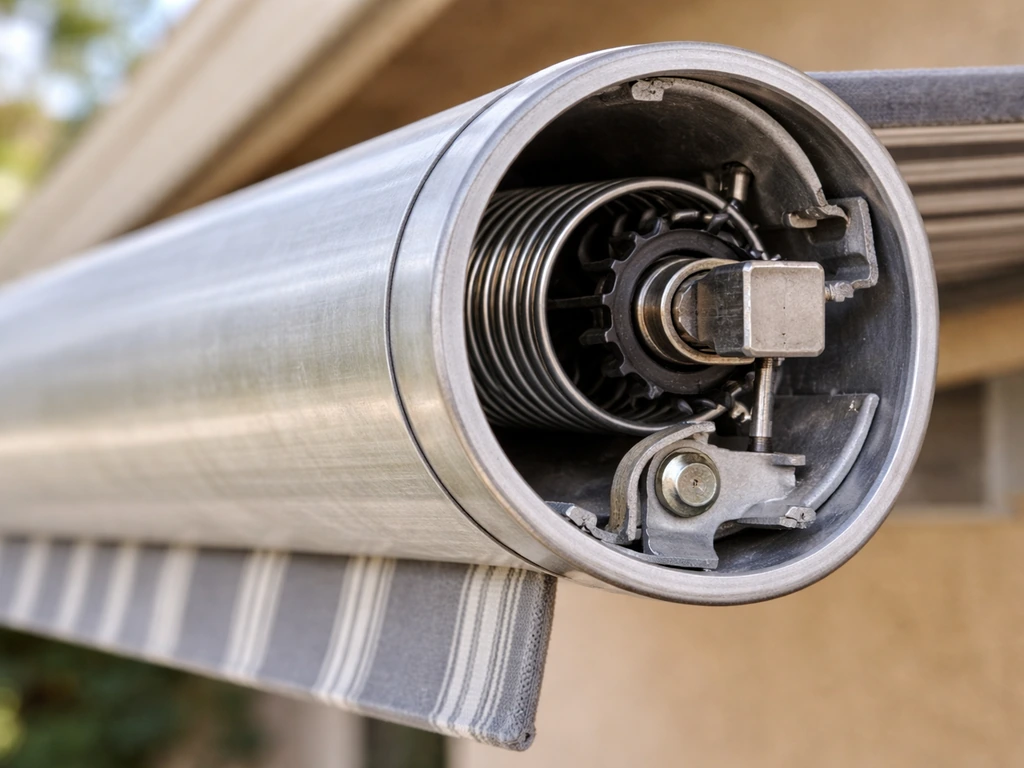
The roller tube is the horizontal cylinder at the top of the awning where the fabric winds up when you retract. Inside it sits a torsion bar or torsion spring assembly. When you extend the awning, you are unwinding that spring slightly. When you retract, the spring helps pull the fabric back. The key detail here, as described in crank-force patent documentation, is that the spring tension is directly related to how many turns the roller has been pre-wound. If that pre-tension is wrong, either from a previous incorrect adjustment or from the spring slipping, retraction will feel heavy, incomplete, or lopsided.
The crank and gear eyelet
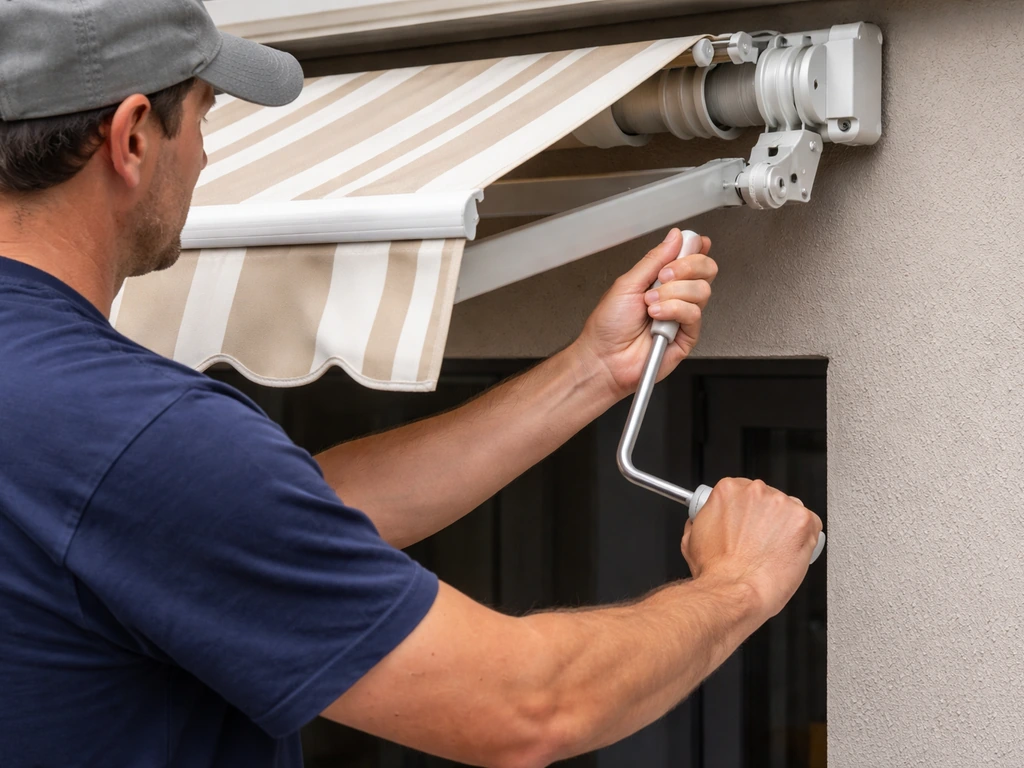
The hand crank inserts into a gear eyelet on the end of the roller tube. This same manual lift patio umbrella approach uses a hand-driven mechanism, so smooth operation depends on proper engagement and lubrication at the crank and linkage points hand crank. When you turn the crank, it engages the internal gear of the roller, winding or unwinding the fabric. The Artistic Awning operation manual describes this as a manual gear eyelet engagement: the crank has to seat properly in the eyelet or you get slippage, grinding, or no movement at all. This is one of the most common failure points on any manual awning, Monmouth included. The gear teeth wear down over seasons of use, or the crank tip deforms slightly, and suddenly the crank spins without moving the roller.
The articulated arms and front bar
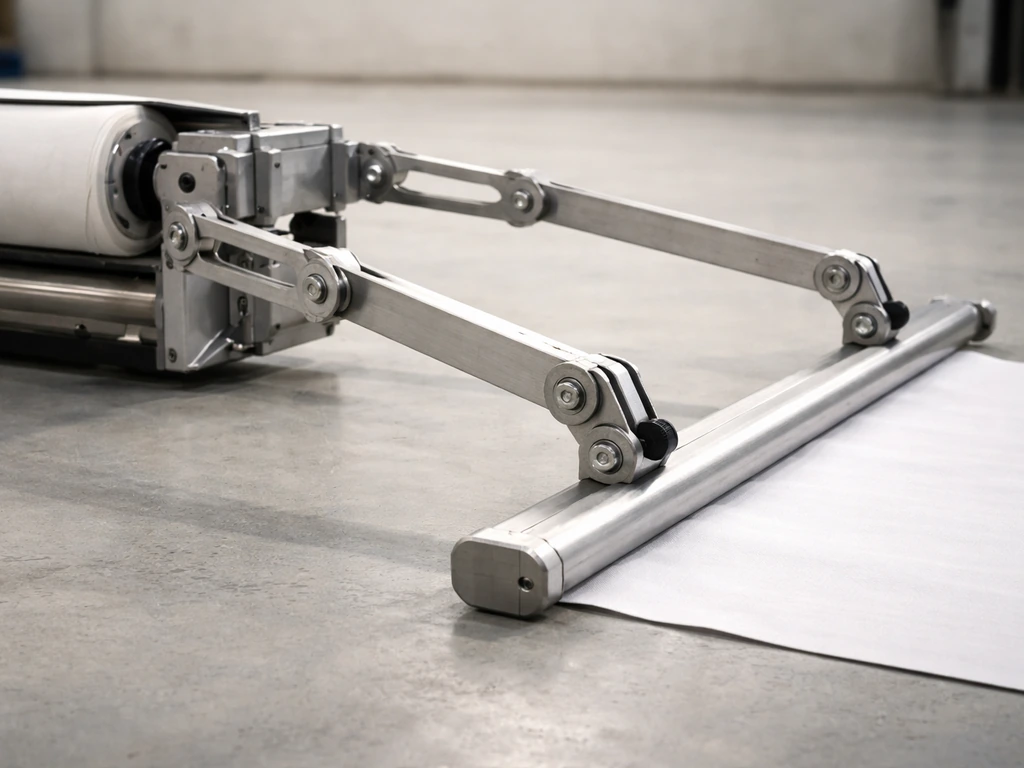
Two articulated arms connect the roller housing to the front bar (the weighted horizontal bar at the fabric's leading edge). Each arm has a hinge at the elbow and mounts to the wall bracket at one end and the front bar at the other. As you retract, the arms fold at the elbow and tuck against the housing. If one arm binds at the hinge, or the wall bracket shifts, one side of the awning retracts faster than the other, which is where that uneven or lopsided retraction comes from.
What your specific symptom is telling you
Retraction problems almost always fall into a recognizable pattern. Match your symptom below to zero in on the likely cause before you start disassembling anything.
| Symptom | Most Likely Cause | Where to Start |
|---|---|---|
| Crank turns but awning doesn't move | Stripped crank gear or worn roller eyelet | Inspect crank tip and gear eyelet (Section 5) |
| Awning retracts unevenly / one side leads | Arm misalignment or unequal spring tension | Check arm brackets and roller tension (Section 4) |
| Awning won't fully retract, stops short | Fabric off roller seating or obstruction in housing | Inspect roller seating and fabric track (Section 4) |
| Crank is very stiff / hard to turn | Dirty or corroded crank gear, stiff arm hinge | Clean and lubricate crank interface and arm hinges (Section 4) |
| Grinding or clicking noise during retraction | Debris in gear eyelet or worn gear teeth | Clear debris, inspect gear teeth (Section 5) |
| Awning fully stuck, won't move at all | Jammed arm hinge, debris in housing, or seized roller | Full inspection starting with visual walk-around (Section 4) |
| Fabric bunches unevenly on roller | Roller tube out of level or fabric off one end | Check roller seating and bracket alignment (Section 5) |
Step-by-step fixes: alignment, cleaning, lubrication, and freeing a stuck awning
Work through these in order. Start with the simplest fixes first. You will need: a ladder, a flathead and Phillips screwdriver, adjustable wrench, needle-nose pliers, a stiff brush, a degreaser (Simple Green or similar), clean rags, and a silicone-based or dry-PTFE lubricant. Avoid WD-40 as a lubricant here. It will clean temporarily but attracts grime and accelerates corrosion on gear components.
Step 1: Clear any obvious obstructions
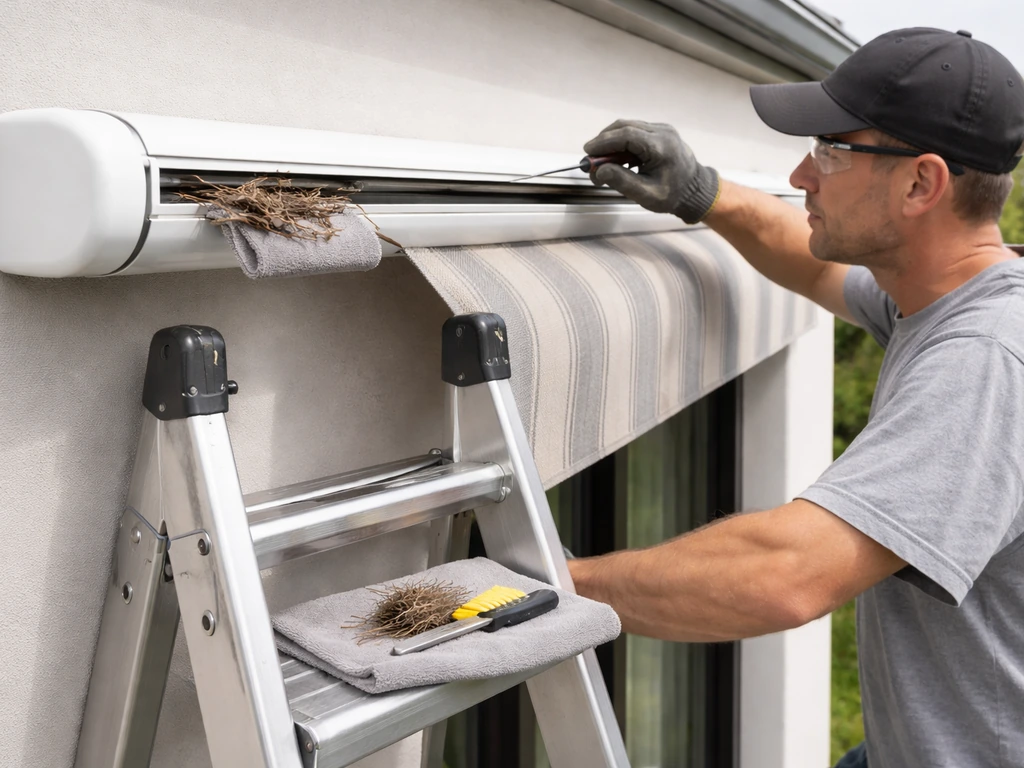
Extend the awning about halfway and look along the full length of the cassette housing. Check where the fabric enters the housing slot for bunched material, leaves, twigs, or anything caught in the front bar track. With the awning extended, also check each arm hinge for any debris packed into the joint. Use a stiff brush to clear it out. You would be surprised how often a stuck awning is nothing more than a twig jammed into the arm elbow joint.
Step 2: Clean and inspect the crank gear eyelet
- Remove the crank from the roller eyelet and look at the tip. The metal tip should have clean, defined edges. If it is rounded, worn, or visibly chipped, the crank itself needs replacing.
- Shine a flashlight into the roller eyelet. Look for packed dirt, rust, or broken gear teeth.
- Spray degreaser into the eyelet and work it in with a small brush. Let it sit for 2 minutes, then wipe out as much loosened grime as possible.
- Re-insert the crank and turn it slowly by hand. It should catch firmly and turn the roller with very little play. If it spins loosely, the gear is worn.
Step 3: Lubricate the crank interface and arm hinges
Once the gear eyelet is clean, apply a thin shot of silicone spray or dry PTFE lubricant directly into it. Do the same at each arm hinge, the pivot point where the arm meets the wall bracket, and the front bar end-caps where the arms connect. Work the crank back and forth several times to distribute the lubricant. You should feel an immediate improvement in smoothness. If the awning still doesn't move freely after lubrication, the problem is mechanical, not friction-based.
Step 4: Re-align a misaligned arm
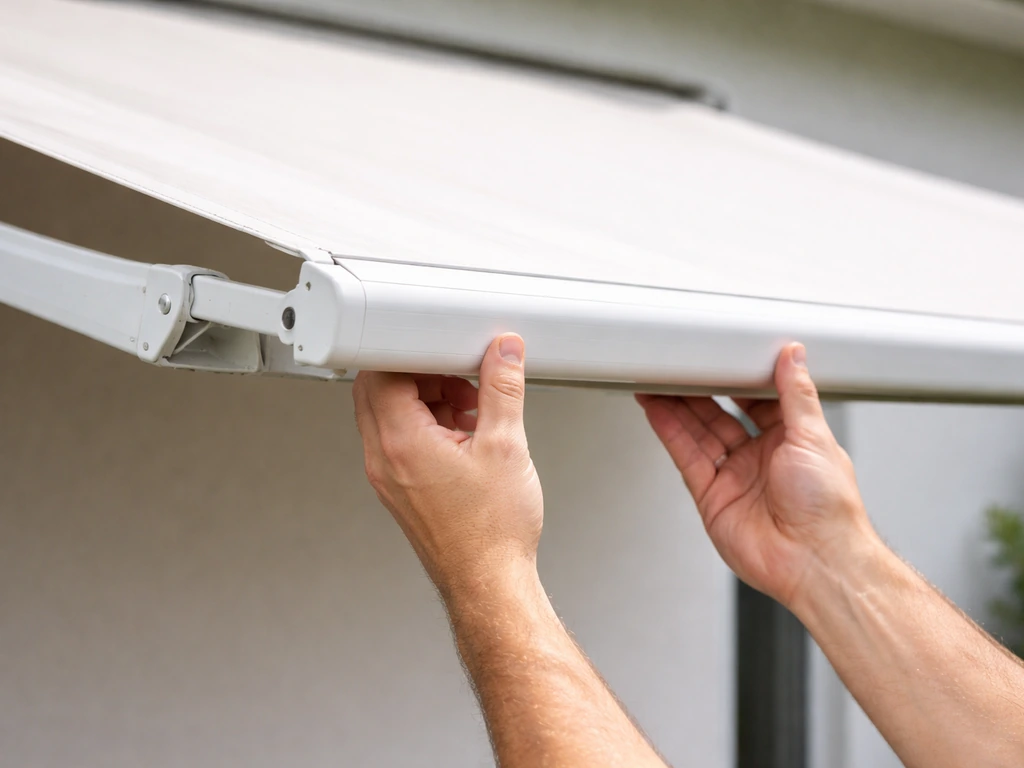
Extend the awning fully and stand back to look at both arms from the side. They should be at the same angle and the front bar should be level. If one arm hangs lower or the front bar tilts, the wall bracket on the low side has likely shifted or loosened. Loosen (do not remove) the bracket mounting bolts on the affected side, adjust the bracket until the arm is level with the opposite side, then retighten. With the bracket repositioned, try a slow retraction and watch whether both sides now travel in sync.
Step 5: Free a fully stuck awning
If the awning won't move at all, do not force the crank. Instead, manually push gently on the front bar to take tension off the arms, then try the crank again. For a manual push up patio umbrella, the same idea applies: reduce tension before trying any hand crank or push mechanism so you do not strain the hinge points. If the arm hinges are seized, apply lubricant directly to both pivot points, wait 5 minutes, then slowly attempt retraction while a second person applies light hand pressure on the front bar to help the arms fold. If it still won't move, the roller seating or torsion assembly may need hands-on inspection, covered in the next section.
Inspecting and replacing worn parts
If cleaning and lubrication didn't solve it, something has physically worn out or gone wrong with the mechanism itself. Here is how to inspect each likely culprit and decide whether to repair or replace.
Crank and gear
The crank is the most commonly replaced part on any manual awning. A good crank tip engages the roller eyelet with a solid, defined catch. If yours slips, grinds, or requires you to hold it at a weird angle to get it to bite, replace the crank. Monmouth replacement cranks are typically compatible with standard 7/16-inch or 1/2-inch eyelet sizes, but measure your roller eyelet diameter before ordering. If the eyelet gear inside the roller tube is stripped (you can see rounded-off teeth with a flashlight), the roller assembly itself may need replacement, which is a bigger job. At that point, weigh the cost of parts and your time against a new awning.
Clutch or ratchet behavior
Some Monmouth manual awnings use an internal clutch or ratchet mechanism in the roller to allow the crank to turn in one direction without the fabric rolling back. If the awning extends fine but won't hold tension (fabric slowly creeps back on its own after you remove the crank), the clutch is slipping or worn. A failing clutch usually means the roller assembly needs to be replaced. This is not a user-serviceable repair in most cases.
Torsion spring tension
If the awning retracts weakly or incompletely even when everything is clean and aligned, the torsion spring inside the roller tube may have lost pre-tension. Dometic's 8700-series documentation describes this as an adjustable number of spring turns, and the same principle applies here. Increasing spring tension means removing the roller end cap and carefully adding one or two pre-wind turns to the spring. This is a job that requires caution because of the stored energy. If you are not comfortable doing it, a local awning service shop can do it in under an hour. Do not attempt this step without having a helper hold the roller and understanding that the spring can release suddenly if you lose control.
Arm end-caps, pivot pins, and roller seating
Arm end-caps (the plastic or metal pieces at each end of the front bar where the arms connect) crack and wear over time. If the front bar wiggles or one arm feels sloppy at the connection point, check the end-cap. These are usually inexpensive and sold separately. Similarly, if the fabric is not rolling up evenly, check that the roller tube is sitting level in both wall bracket saddles. A roller that has popped even slightly out of its seating on one side will cause the fabric to bunch toward that side during retraction.
How to properly retract and extend after repair, and what normal feels like
Once repairs are done, run through a full extend-and-retract cycle before declaring victory. Here is the correct procedure and what to feel for.
- Insert the crank fully into the roller eyelet until it seats with a definite click or firm engagement. If it wiggles, it is not fully seated.
- Turn slowly for the first two or three rotations while watching both arms. They should begin to unfold in sync.
- Extend fully until the front bar reaches its natural stop. You should feel a slight increase in crank resistance at full extension as the torsion spring reaches its intended tension range.
- Remove the crank and check that the front bar stays in place without creeping back. If it moves, the clutch or spring tension needs attention.
- Re-insert the crank and retract, turning steadily. Normal retraction feels smooth with moderate resistance. Resistance should be roughly equal throughout the retraction arc.
- At full retraction, the front bar should seat evenly against the housing with no gap on either side. Both arms should be fully folded.
- Perform this cycle three times. Any grinding, uneven movement, or incomplete retraction that reappears after the first cycle indicates a problem that cleaning alone did not solve.
A note on user-caused issues: the most common self-inflicted problem is cranking the awning past its natural stop at full extension. This over-tensions the torsion spring and can strip the crank gear or cause the fabric to pull off the roller seating. Always stop cranking when you feel solid resistance at the end of the extension cycle. The same goes for retraction: stop when the front bar seats against the housing, not when your arm gets tired.
Keeping it from happening again: maintenance and seasonal care
A little routine attention goes a long way. Most of the problems covered in this guide are preventable with a simple seasonal routine.
Regular lubrication schedule
Lubricate the crank eyelet, arm hinges, bracket pivot points, and front bar end connections at the start of spring and again in late summer. Two applications a year is enough in most climates. More if you are in a coastal area with salt air, where corrosion moves faster. Use silicone spray or dry PTFE. If you hear any squeaking during operation between lubrication cycles, do not wait for the scheduled service. Squeaking is an early warning that friction is building up.
Keeping debris out of the mechanism
After any major storm or heavy wind event, retract the awning and inspect the cassette housing slot and arm hinges before the next use. For outdoor comfort, manual patio shades should also be inspected after storms so the mechanism stays clear and retracts smoothly patio awning. Leaf litter, seed pods, and grit accumulate fast in the housing opening and can pack into the gear eyelet over a season. A quick brush-out takes two minutes and prevents a much bigger problem in the spring. For a patio awning that spends time near trees, consider retaining the awning in its fully retracted position whenever it is not in use.
Wind security
Manual retractable awnings are not designed to stay extended in significant wind. Wind load on an extended awning puts enormous stress on the arm hinges and wall brackets. If your awning gets caught in an unexpected gust while extended, the arms can snap at the hinge, which is a costly repair. Get into the habit of retracting whenever you see weather coming, and always retract before leaving the house for any extended period. If you are comparing this to a manual push-up style setup, a retractable articulated-arm awning like the Monmouth is significantly more wind-vulnerable when extended because the arm geometry acts as a lever that multiplies wind force on the bracket mounts.
Winterizing and storage
Before the first hard freeze, clean the fabric thoroughly with a mild soap and let it dry completely before retracting. Storing wet or damp fabric leads to mildew inside the cassette that degrades the material and can cause the fabric to stick to itself, which makes the next spring's extension messy or damaging. Lubricate all moving parts after cleaning. If you are in a region with heavy snow load, consider whether the mounting brackets can handle that weight. Most residential manual awnings, Monmouth included, are not rated for snow accumulation, and a full retraction for the winter season is the safest approach. This aligns with what you would want to do with any manual retraction slope style awning: get the fabric fully protected before ice and snow arrive.
Annual bracket check
Once a year (spring is ideal), go along each wall bracket and check that every mounting bolt is tight. Brackets that are even slightly loose allow the roller tube to shift out of level, which starts the uneven retraction cycle all over again. Tighten anything that has worked loose and check the wall anchoring points for any cracking in the mounting surface. If the awning is mounted on stucco or wood siding, those surfaces can degrade over seasons and may need re-anchoring with larger hardware or a different anchor type.
When to call a pro or consider replacing the awning
Most retraction issues are DIY-fixable. But there are a few situations where the honest answer is to call an awning service company or start shopping for a replacement. If the roller tube gear is stripped and the part is no longer available, replacement is the path. If a wall bracket has failed or pulled away from the mounting surface, that is a structural issue that needs professional re-anchoring before the awning can be safely used again. And if the arms have bent or cracked at a hinge, arm replacement is possible but getting correctly sized replacement arms for an older Monmouth unit can be tricky. At some point, especially for awnings older than 10 to 12 years with multiple failing components, a new 12-foot manual retractable unit may cost less than the sum of repair parts and labor.
FAQ
How can I tell if my Monmouth manual retraction patio awning is binding from debris versus a worn gear or crank tip?
Do this with the awning extended about halfway. If you can feel the crank “bite” and then the movement stalls right as the roller tries to rotate, inspect the crank eyelet and clear the housing slot. If the crank spins freely or grinds with little fabric movement after cleaning, the gear engagement is likely worn and you should plan on inspecting or replacing the crank (and possibly the roller gear).
Should I lubricate with WD-40 if my awning is noisy or stiff?
Avoid it as your main lubricant. It can reduce friction briefly, but it attracts grit and speeds up corrosion on gear teeth and pivots over time. Use silicone spray or dry PTFE instead, and apply it only to the crank eyelet, arm hinges, bracket pivot points, and end connections.
What’s the safest way to “take tension off” the arms if the awning won’t retract?
Keep your hands away from pinch points near the roller and front bar. With a helper nearby, gently push on the front bar to reduce the load on the arms, then try the crank with steady, moderate turns. If you feel no controlled movement or resistance feels abnormal, stop and switch to inspecting arm hinge debris and alignment rather than forcing the mechanism.
My awning retracts unevenly, but both arms look mostly fine. What else should I check?
Verify the roller tube is seated level in both wall bracket saddles. A slight pop-out on one side can cause the fabric to bunch toward that side during retraction, even if the arms appear aligned. Re-seat the roller (if accessible) and check for loose bracket hardware before adjusting anything further.
How do I know whether the torsion spring tension is off versus a lubrication or alignment issue?
First confirm cleaning and lubrication did not restore smooth motion, then look for symptoms that persist evenly across turns. If retraction is weak or incomplete despite correct engagement and level arms, the spring pre-tension is a strong suspect. If the awning feels heavy from the start and never “catches” into a smooth pull-in, torsion tension or roller seating is more likely than friction alone.
Can I adjust the wall bracket to fix lopsided retraction, and how much adjustment is too much?
Yes, adjust the bracket on the low side by loosening the bolts (do not remove), repositioning until the arm matches the opposite angle, then retighten. Make small changes and re-test after each adjustment, because large shifts can mis-seat the roller tube and accelerate hinge binding.
If the crank spins but the awning doesn’t move, what’s the usual cause and what should I measure?
The crank tip may not be seating fully in the gear eyelet, or the eyelet/roller gear teeth may be rounded or stripped. Before ordering parts, measure the roller eyelet diameter (and note whether you see distinct tooth wear). A deformed crank tip often causes “no movement” even when the crank looks intact.
What should I do if the fabric has jumped off the roller seating?
Keep the awning controlled, then inspect the roller seating path and the housing slot for bunched material or obstructions first. Once cleared, re-seat the fabric evenly on the roller before testing retraction slowly. If the fabric repeatedly climbs off, it can be a sign of roller mis-leveling or worn end components (like cracked end-caps) rather than a one-time handling slip.
How often should I tighten mounting bolts, and what sign means I should do it sooner?
Check mounting bolt tightness at least once per year, spring is a good timing. Tighten sooner if you notice the roller tube shifting, new uneven retraction, or any visible gap changes around bracket mounts, because loose brackets are a common cause of repeated lopsided behavior.
Is it safe to manually retract my awning during bad weather to prevent wind damage?
Only retract in a controlled manner when it is safe to access the awning area, and avoid forcing the mechanism if it is already stuck. Wind can increase hinge and bracket stress, but forcing a jam can cause sudden motion. If the awning is caught in gusts, wait for calmer conditions, then retract slowly while keeping clear of pinch points.
Does the awning need to be fully dry before winter retraction, and what if it’s already damp?
For best results, retract only after the fabric is fully dry to prevent mildew and sticking in the cassette. If it’s already damp, extend and allow it to dry as much as practical before fully retracting for storage. After drying, lubricate the moving parts so next season’s operation is easier and the gear pivots stay protected.
When should I stop DIY troubleshooting and call a pro or plan replacement?
Call an awning service or plan for replacement if the roller tube gear is stripped and parts are not available, if a bracket has pulled away or the mounting surface is structurally failing, or if hinge points are bent or cracked. Also consider replacement if the awning is older (roughly a decade plus) and multiple components show wear, because parts plus labor can exceed the cost of a new unit.
Next Articles
Manual Push Up Patio Umbrella Repair Guide and Fixes
Step-by-step manual push up patio umbrella repair to fix stuck pole, misalignment, jams, hardware, and safe operation
12 ft Manual Patio Retractable Awning Troubleshooting Guide
Fix a 12 ft manual patio retractable awning with crank, fabric roll, and tension troubleshooting plus maintenance and re
Manual Retraction Slope Patio Awning Troubleshooting Guide
Fix a manual retraction slope patio awning: diagnose binding, uneven or slow travel, adjust alignment and crank operatio