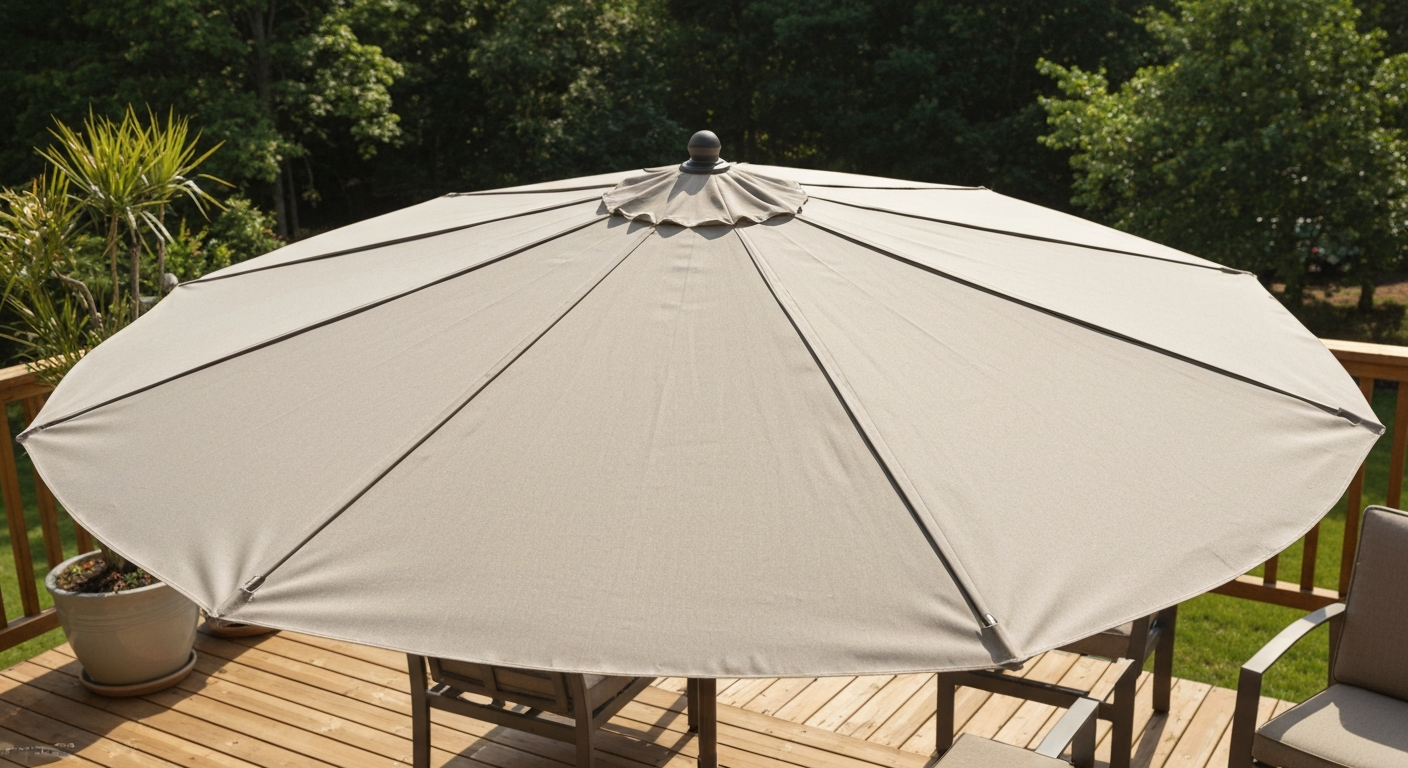
Yes, you can replace the fabric on most patio umbrellas without touching the frame. As long as the ribs are straight and intact, the hub (the central connector where ribs meet) is not cracked, and the pole is sound, a new canopy is a straightforward swap that costs a fraction of a full umbrella replacement. The catch is doing a bit of homework first: you need the right diameter, the right rib count, and the right attachment style before you order anything.
Can You Replace Fabric on Patio Umbrella: Complete DIY Guide
Luca Morrison
14 Jul 2026
Quick answer: can you replace fabric on a patio umbrella?
The short verdict is yes in the majority of cases. Canopy fabric is a wear item, sun, rain, and wind degrade it faster than they degrade aluminum or steel frames. Replacing just the canopy makes sense whenever the frame is structurally sound, the replacement canopy costs noticeably less than a new umbrella, and the rib count and diameter match available replacement options. It stops making sense when ribs are cracked, the hub is shattered, the pole is corroded through, or the frame is a non-standard geometry that makes sourcing a canopy impossible.
- Frame is solid and ribs open and close without binding: replacement is almost always worth it
- One or two ribs are bent but otherwise intact: repair the ribs, then replace the canopy
- Hub cracked or pole severely corroded: fix or replace those parts first, then assess the canopy
- Umbrella is more than 10–12 years old and showing multiple failures: full replacement may save money overall
- Canopy replacement cost exceeds 60–70% of a comparable new umbrella: reconsider the math
Is replacement feasible? Key criteria to check before you start
Before you spend a dollar, spend ten minutes inspecting the frame. I've seen people order a beautiful Sunbrella canopy only to discover a cracked hub halfway through installation. Here's what to check and what each failure actually means for your project.
The frame: ribs, hub, and pole
Open the umbrella fully and look down each rib from hub to tip. A healthy rib is straight, moves freely at its pivot pin, and holds its position under slight hand pressure. A fractured rib will show a visible crack, a kink, or will feel spongy when you press the midpoint downward. Treasure Garden's service documentation (which covers many OEM-branded umbrellas sold at big-box stores) explicitly classifies cracked or permanently bent ribs as part failures that need replacement before any canopy work. Replacing a rib typically costs $5–$20 per rib ordered from the manufacturer or a parts supplier, so one or two bad ribs shouldn't kill your project.
The hub is the spider-shaped casting at the center of the rib array. Squeeze it and look for hairline cracks, especially around the rib-socket openings. A cracked hub is a safety issue, under wind load it can fail and collapse the canopy suddenly. If you find hub damage, source a replacement hub from the brand (Treasure Garden, Abba Patio, and most major brands sell hubs separately) before proceeding. The hub also needs to be measured: its diameter and the number of rib sockets determines your rib count, which is critical for canopy fitment.
Check the pole for surface rust versus deep pitting. Light oxidation on a steel pole is cosmetic; deep rust that lets you dent the pole with a fingernail means structural wall loss. For aluminum poles, look for white powdery corrosion (oxidation) and any bending. A pole with a slight curve from being left unsecured in wind can usually still function, but it will stress the canopy unevenly.
Size and cost considerations
Standard market umbrellas come in nominal diameters of 7.5 ft., 9 ft., 10 ft., and 11 ft., and most replacement canopies are sold to match those sizes. Retail listings show pre-made replacement canopies sold by diameter and rib count, for example, Cubilan 9 ft. Patio Umbrella Replacement Canopy - The Home Depot (example listing) is offered as a 9 ft. replacement option. Off-the-shelf universal replacement canopies in polyester typically run under $100; OEM or Sunbrella-grade pre-made replacement canopies run roughly $150–$400 depending on size and fabric quality. Compare that against the cost of a new mid-range patio umbrella ($150–$350 retail) and the math usually favors replacement if your frame is good. For offset or cantilever umbrellas, factor in that canopy geometry is more complex and OEM replacement canopies are sometimes the only practical option.
Inspecting your umbrella, a step-by-step measurable checklist
Work through this checklist before ordering anything. Bring a tape measure, a flashlight, and a marker to tag any problem spots.
- Open the umbrella fully and lock it in the open position using the tilt collar or locking ring so it doesn't close on you while you're working
- Count the ribs: standard umbrellas have 6, 7, 8, or 9 ribs; write this number down — it's non-negotiable for canopy fit
- Measure tip-to-tip diameter across the widest span with the canopy open; record in inches and feet
- Measure each rib from hub pivot to tip; all ribs should be equal within 1/4 inch — a significantly shorter rib indicates a prior break and repair or a replacement that doesn't match
- Flex each rib gently downward at the midpoint; it should spring back; a rib that stays bent or makes a cracking sound is compromised
- Inspect hub sockets for cracks, especially on cast aluminum or plastic hubs; wiggle each rib pin to check for play indicating wear
- Check the runner (the sliding ring on the pole that pushes the lower spreaders up when you open the umbrella): it should slide without binding and lock positively
- Inspect the tilt mechanism if present: does it lock into position firmly? Does the collar crack or feel loose?
- Look at the existing canopy attachment points — note whether the canopy attaches by cord ties, grommets with ties, rib pockets (fabric sleeves sewn over ribs), Velcro tabs, or buttons at rib tips
- If the pole uses a crank, cycle it open and closed twice; grinding or skipping indicates cord or gear wear to address separately
- Note any visible corrosion on the main hub pin (the bolt through the top of the pole), as this pin takes the full canopy load in wind
Decide: patch, recover (resew), or full canopy replacement
Once you've inspected the frame, look at the canopy itself. The decision between patching a small tear, having the canopy professionally recovered (resewn in new fabric), or buying a full replacement canopy comes down to damage extent, your sewing skill level, and budget. Here's how I think about it.
| Situation | Best approach | Approx. cost | Skill needed |
|---|---|---|---|
| Small tear or hole under 2 inches, fabric otherwise sound | Patch with outdoor repair tape or iron-on patch | $5–$15 | None |
| Multiple small tears, fading but structurally intact fabric | Patch each tear; seal seams with seam sealer | $15–$30 | Low |
| Seam separation along one or two panel edges | Hand or machine resew with UV-resistant thread | $10–$20 in thread | Moderate |
| Widespread fading, brittleness, multiple seam failures, or more than 3–4 tears | Full canopy replacement (off-the-shelf or custom) | $50–$400 | Low to moderate |
| Non-standard size, unique shape, or owner wants premium fabric choice | Recover (cut and sew new panels from fabric yardage) | $80–$200 in materials | High (sewing required) |
A good rule of thumb: if the canopy has more than three seam separations or the fabric has become chalky and brittle (acrylic fabric that flakes when you bend it), stop patching and replace. Patching brittle fabric just shifts the failure point to the next weakest spot. If you're unsure whether a small repair is enough, check out the guidance on how to patch a patio umbrella for a closer look at what holds and what doesn't.
Tools, materials, and parts checklist
Gather everything before you start. Nothing kills momentum like a mid-project hardware run. The list below covers a full canopy replacement on a standard center-pole umbrella; cross off items that don't apply to your attachment style.
- Tape measure (25 ft. recommended for large umbrellas) — 1
- Seam ripper or sharp utility knife for removing the old canopy — 1
- Flathead and Phillips screwdrivers — 1 each
- Needle-nose pliers for removing cord knots and grommet ties — 1 pair
- Replacement canopy matched to your diameter and rib count — 1
- UV-resistant polyester or ePTFE (PTFE) thread for any hand stitching — 1 spool
- Heavy-duty hand sewing needle (size 16–18 for canvas weight fabric) — 3–4
- Outdoor fabric seam sealer (e.g., Gear Aid Seam Grip or similar) — 1 small tube
- Replacement tie cord: 3/16 inch braided polyester rope — 10–15 ft.
- Grommet repair kit with setting tool (if grommets are worn) — 1 kit
- Ladder (for cantilever/offset umbrellas) — 1, and a second person
- Marker or chalk for labeling panels during removal — 1
- Clean drop cloth or tarp to lay the canopy on — 1
- Zip ties (optional, for temporary rib alignment during installation) — 6–10
How to measure your umbrella for a replacement canopy
Measurements are the single most important step. An undersized canopy won't cover the rib tips and will look terrible; an oversized canopy will bunch, flap, and wear out faster. Take measurements with the umbrella fully open.
Overall diameter
Measure tip-to-tip in a straight line across the full span, passing through the center pole. Do this in two directions (as an X pattern) to confirm the umbrella is symmetrical. Record the smaller of the two numbers if they differ slightly, that's your working diameter. Round to the nearest half-foot for matching to commercial canopy sizes.
Rib count and rib length
Count every rib (not every spreader, just the main upper ribs that support the canopy). Then measure one rib from the center hub pivot point to the tip end. Rib length is not the same as radius; it follows the slight curve of the rib, so use a flexible tape measure or a piece of string laid along the rib, then measure the string. Sailrite's fabric calculator uses rib length (they call it the 'gore length') as the key input for estimating panel yardage when cutting custom fabric.
Panel (gore) dimensions
Each wedge-shaped panel between two adjacent ribs is called a gore. Measure the width of one gore at its widest point (typically near the outer edge) and at the hub end. For a standard 8-rib, 9 ft. umbrella, each gore is roughly 21–22 inches wide at the outer edge. These numbers are used if you're ordering custom fabric or cutting your own replacement panels.
Hub and sleeve measurements
Measure the diameter of the hub cap (the decorative cover at the top center of the canopy) and note the diameter of the pole at the top. If your canopy attaches via a sleeve (a fabric tube that slips over the top of the pole), measure the pole diameter at that point so your replacement sleeve isn't too tight to slip on or too loose to stay centered.
| Measurement | Where to take it | Why it matters |
|---|---|---|
| Tip-to-tip diameter | Across fully open canopy, through center | Determines nominal canopy size to order |
| Rib length (hub to tip) | Along the curve of one rib with flexible tape | Used for custom panel cutting and yardage calculation |
| Rib count | Count all upper support ribs | Non-negotiable for panel/gore count match |
| Gore width at outer edge | Straight across between two adjacent rib tips | Confirms fit of pre-made panels or guides custom cutting |
| Hub cap diameter | Across the top decorative hub cap | Ensures canopy center opening fits correctly |
| Pole diameter at top | At the point where sleeve canopy attaches | Prevents sleeve being too tight or too loose |
Identifying canopy attachment systems
Before you pull the old canopy off, take five minutes to document exactly how it attaches. Snap photos from multiple angles. Replacement canopies sold as 'universal fit' often specify which attachment styles they support, and if you order the wrong type you'll be improvising fasteners. If you prefer professional help, look up local specialists who fix patio umbrellas to ensure the attachment style matches and the canopy is installed correctly who fixes patio umbrellas. Here are the systems you're most likely to encounter. For a step-by-step walkthrough on how to replace patio umbrella canopy, see our detailed guide.
Cord ties at rib tips
The most common system on market umbrellas: a short length of braided cord passes through a small grommet or loop at the canopy tip and ties around a notch or hole at the end of each rib. To remove, cut the knot or untie it. To reinstall, thread the new cord through the canopy grommet, loop around the rib tip, and tie a square knot followed by an overhand locking knot. Use 3/16-inch braided polyester for replacements, don't use cotton, which rots outdoors.
Grommet holes with tie lines
Similar to cord ties but the canopy has a metal grommet (eyelet) reinforcing the hole. Grommets prevent tearing at the attachment point. If grommets are corroded or pulling through the fabric, replace them using a grommet kit before reinstalling. Match the grommet inner diameter to your cord diameter.
Rib pockets (sewn tube pockets)
Higher-end umbrellas and custom-sewn canopies often have a fabric tube sewn along each gore edge that slips over the rib like a sleeve. This gives a very clean look and holds the canopy tightly. Installation requires sliding each rib into its pocket before raising the umbrella, which means working with the umbrella partially collapsed. Sailrite's umbrella sewing tutorials show this system in detail, including how to sew the pocket seam allowances and leave the rib tip opening the right width.
Hub sleeve (center pole pocket)
The center of the canopy typically has a fabric sleeve or opening that fits over the top finial or pole tip. On some umbrellas, the canopy is threaded down the pole before the hub assembly goes on, meaning removal requires disassembling the top hub cap. On others, the canopy simply drapes over the top finial under a decorative cap. Know which type you have before ordering a canopy: a canopy with a small hub opening won't thread down a wide pole.
Velcro tabs and button loops
Some entry-level umbrellas use Velcro tabs that wrap around each rib and stick to themselves, or button loops that snap over a small plastic button at the rib tip. These are the easiest to remove and reinstall but also the first to fail, Velcro loses grip after repeated weathering cycles. If your replacement canopy uses Velcro, apply a UV protectant spray to the Velcro hook-and-loop strips at the start of each season to extend their grip life.
Cantilever and offset attachment specifics
Offset (cantilever) umbrellas mount the pole to the side rather than through the center, and the canopy is typically a rectangular or large round shape attached to an articulated rib frame. Treasure Garden's canopy replacement manual for cantilever models specifies that the canopy slips under the top cap and aligns with spring-loaded rib ends, a process that genuinely requires two people and a ladder for models above 10 ft. Treasure Garden, Assembly and Operation Guide (care & warranty notes) advises closing and covering canopies when not in use, warns that standing water or unattended wet canopies accelerate fabric and seam damage, and limits warranty coverage for damage caused by improper use or storage blank" rel="noopener noreferrer">Treasure Garden — Assembly and Operation Guide (care & warranty notes). Don't attempt cantilever canopy swaps solo; the assembled canopy is heavy, unwieldy, and can slip off the rib ends and cause injury. For more detail on offset models specifically, the guide on how to repair an offset patio umbrella walks through the frame quirks that affect canopy fitment. For step-by-step instructions on repairing canopy fabric, see how to repair patio umbrella fabric (09c2f1a9-a8e0-4d78-853b-5163b24ab794). See the guide on how to repair offset patio umbrella for detailed, step-by-step instructions specific to cantilever frames. For step-by-step instructions on replacing or repairing canopy fabric, see how to recover a patio umbrella. See our detailed guide on how to repair patio umbrellas for frame-specific fixes and step-by-step instructions.
Choosing fabric: what the specs actually mean
Fabric choice matters more than most people realize. A cheap 100% polyester canopy installed on a solid frame will fade and tear within two to three seasons in a sunny climate. Here's how to read the specs and match them to how you actually use your umbrella.
Solution-dyed acrylic
This is the gold standard for outdoor canopy fabric. In solution-dyed acrylic, the color pigment is added to the fiber before it's spun, meaning the color runs all the way through the fiber, not just on the surface. Sunbrella, the most recognized brand, publishes technical data sheets listing fabric weight around 365 g/m² (10.8 oz/yd²) for their heavier canopy fabrics. Solution-dyed acrylic resists UV fading, mildew, and most common stains, and typically carries a 5-year or longer fade warranty. It's the right choice for full-sun installations or if you want the canopy to last a decade.
Polyester
Polyester replacement canopies cost significantly less and can still perform adequately in moderate sun exposure. Look for solution-dyed polyester or high-denier polyester with a UV-inhibitor coating rather than basic dip-dyed or printed polyester. The coating degrades over time, so a coated polyester canopy in full sun will lose water and UV resistance faster than solution-dyed acrylic. For covered patios or seasonal use where the umbrella is stored away for winter, polyester is a reasonable cost-saving choice.
Water and UV resistance: what the numbers mean
Water resistance is measured by hydrostatic head testing (ISO 811 / AATCC 127 are the standard methods): a column of water is pressed against the fabric and the height (in mm) at which water first passes through is recorded. A canopy fabric rated above 1,500 mm is considered reasonably waterproof; many quality canopy fabrics exceed 3,000 mm. Vendors sometimes list this spec as 'water column' or 'hydrostatic rating.' UV resistance is typically reported as a UPF (Ultraviolet Protection Factor) rating; UPF 50+ blocks over 98% of UV radiation and is the minimum worth looking for in a replacement canopy.
Fabric weight and colorfastness
Heavier fabrics (300 g/m² and above) hold their shape better in wind and resist tearing at rib attachment points. Lighter fabrics flap more and wear faster at the grommets. Colorfastness, how well a fabric holds its color under repeated UV and wash cycles, is measured on standardized scales; solution-dyed fabrics consistently outperform surface-dyed fabrics here. If the vendor can't provide a colorfastness rating or a UV standard reference, that's a signal to manage expectations about how long that color will last.
| Fabric type | Typical weight | UV resistance | Water resistance | Expected life (full sun) | Relative cost |
|---|---|---|---|---|---|
| Solution-dyed acrylic (e.g., Sunbrella) | ~365 g/m² (10.8 oz/yd²) | Excellent (UPF 50+) | Good (resists, not fully waterproof) | 8–12+ years | High ($150–$400 canopy) |
| High-denier coated polyester | ~200–280 g/m² | Good with coating (UPF 30–50) | Good (coating: >1,500 mm) | 3–6 years | Medium ($50–$150 canopy) |
| Basic polyester / printed polyester | ~150–200 g/m² | Low to moderate | Low to moderate | 1–3 years | Low (under $100 canopy) |
| Olefin (polypropylene) | ~200–250 g/m² | Moderate | Moderate | 3–5 years | Low to medium |
Thread: the detail most people ignore
If you're sewing any part of the canopy (reattaching a panel, reinforcing a seam, or sewing a custom replacement), the thread choice is as important as the fabric. Standard polyester thread degrades in UV and can fail before the fabric does. GORE TENARA thread (ePTFE fiber) is the specification-grade choice for marine and outdoor awning applications: it resists UV, mildew, salt, and chemicals, and is marketed to outlast the fabric it sews. TENARA is available in multiple linear densities with matching needle sizes documented in Gore's published thread specifications. For a home repair on a canopy, bonded polyester thread in size 69 or 92 is an acceptable and far cheaper alternative; just avoid anything labeled 'general purpose' or 'all-purpose.'
FAQ
Quick answer: can you replace the fabric on a patio umbrella?
Yes — most market-style patio umbrellas can have their fabric (canopy) replaced without replacing the frame, provided the frame, ribs, hub and tilt/collar mechanisms are structurally sound and the canopy attachment method is standard (cord, grommets, rib pockets, hub sleeve, or Velcro/buttons). If the frame has broken ribs, seized mechanisms, cracked hubs or bent load-bearing parts, replace those parts or the whole unit instead of recovering the canopy.
How do I decide whether to patch, recover (re‑sew), buy a pre‑made replacement canopy, or replace the entire umbrella?
Inspect frame and fabric, then decide: - Patch: small tears (<2–3 in.) in stable fabric, intact seams and grommets — repair with outdoor patch/adhesive, sewn patch or fabric tape. - Recover (sew a new canopy): fabric is irreparably worn/faded but frame is good; you can cut and sew new gores and either reuse attachment details or install new grommets/cord. - Buy pre‑made replacement canopy (OEM or universal): frame geometry standard (common diameters and rib counts); faster and often cheaper than sewing. - Replace frame/umbrella: broken ribs, cracked hub, bent pole, seized tilt or structural corrosion. If in doubt about structural safety, consult manufacturer service or a pro.
Inspection checklist: what should I examine before buying fabric or starting work?
1) Frame: check every rib for cracks, bends, or missing spring pins; inspect hub and collar for cracks and play; test tilt and crank for smooth operation. 2) Attachment points: examine grommets, cord ties, rib pockets and the top cap interface. 3) Fabric: note tears, seam failure, UV degradation (fabric powdering), and mold/mildew. 4) Measurements: count ribs, measure span/diameter across open canopy, measure rib length from hub to tip, measure hub/pole sleeve and top cap dimensions. 5) Safety: ensure umbrella can be safely supported/blocked while you work and get a helper for cantilever/large umbrellas.
How do I measure an umbrella canopy to buy or sew a replacement? (step‑by‑step)
1) Fully open the umbrella and lock it. 2) Measure diameter: straight line across the widest open span (edge to edge). 3) Count ribs. 4) Measure rib length: from the rib pocket/edge of hub to the outer edge of the canopy (for sewn gores, measure along the rib line). 5) Measure center hole / pole clearance: inner opening diameter at hub/top and any hub sleeve dimensions. 6) For vented tops, measure vent diameter and location. 7) Record rib count + diameter + any non‑standard shape (square/rectangular/oval). Use these numbers to select a universal replacement (specified by diameter & rib count) or to calculate fabric yardage if sewing.
What fabrics are recommended and what measurable properties matter?
Recommended fabric types: - Solution‑dyed acrylic (Sunbrella and equivalents): best colorfastness/UV resistance, mildew performance, and durability. - Polyester (coated or solution‑dyed polyester): lower cost, acceptable for moderate use but usually less UV/colorfastness than acrylic. Key measurable properties to compare: - Fabric weight (oz/yd² or g/m²) — heavier generally lasts longer (example Sunbrella ~10–11 oz/yd²). - UV/colorfastness ratings on supplier datasheet. - Hydrostatic head / water resistance (mm water column) for rain performance. - Abrasion rating and seam strength if available. Choose solution‑dyed acrylic for longest life; coated fabrics may be more waterproof but can mildew if not breathable.
Should I buy OEM or universal replacement canopies? Pros and cons.
OEM canopy: - Pros: exact fit, matching hardware and venting, manufacturer support, often higher‑quality fabric options. - Cons: usually more expensive and may require ordering by model. Universal (off‑the‑shelf): - Pros: cheaper, immediate availability in standard diameters and rib counts. - Cons: fit may require small adjustments (rib pocket location or cord length), fabric quality varies. Use OEM if you have a known model or want a precise fit/high‑end fabric; use universal when frame geometry is standard (6/8 ribs, common diameters) and cost/time are priorities.
Next Articles
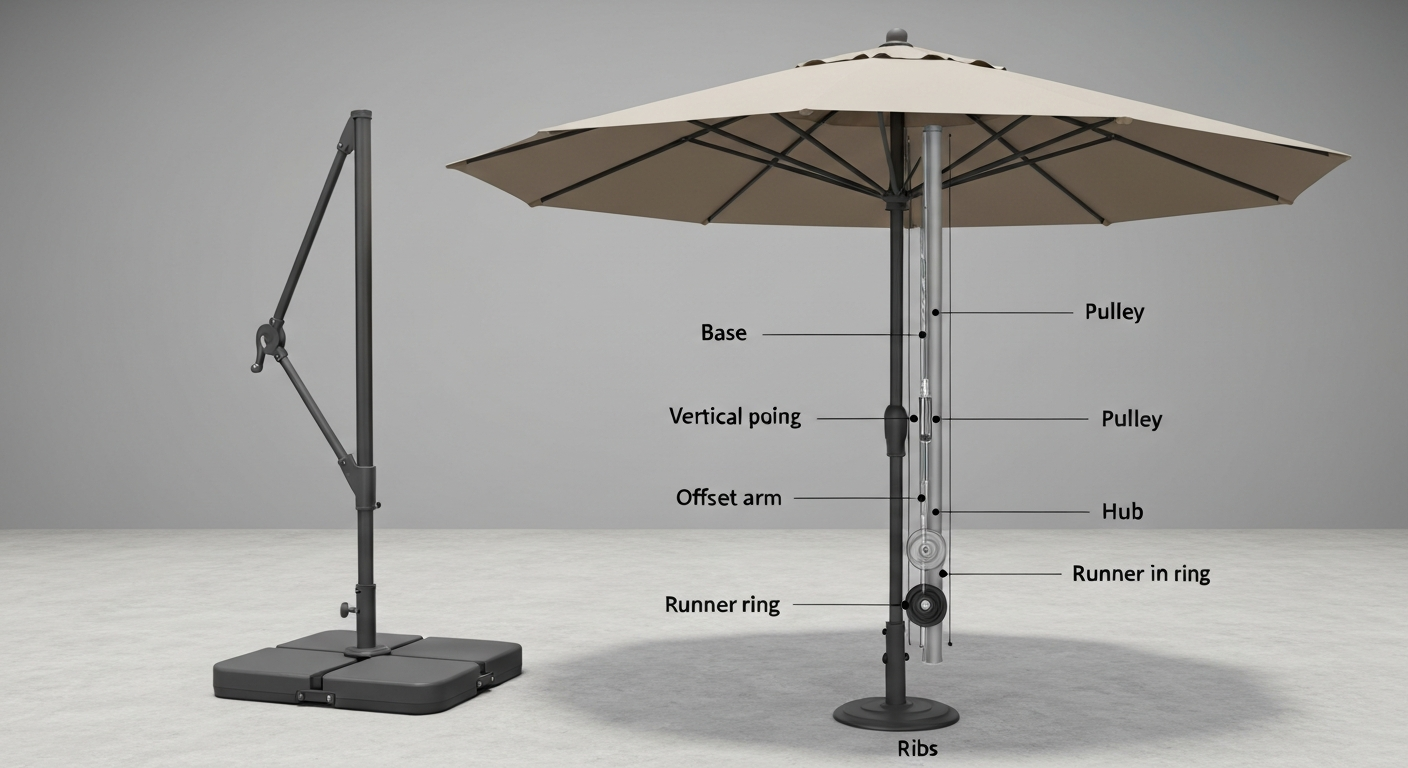
How to Repair Offset Patio Umbrella: Complete DIY Guide
How to repair offset patio umbrella: step-by-step fixes for crank, tilt, cables, ribs, fabric, bases & storage.
How to Repair Patio Umbrella Fabric Step by Step
Step-by-step guide to repair or replace patio umbrella fabric, fix tears and mildew, and reattach so it stays taut.
How to Repair Patio Umbrellas: Step-by-Step Fixes
Step-by-step fixes for torn fabric, holes, and malfunctioning patio umbrella mechanisms, including cantilever models.