A wobbly patio umbrella almost always comes down to one of four things: a loose or undersized base, a worn or missing fastener at the pole-to-stand connection, a slipping tilt or crank joint partway up the pole, or a rib/knuckle that has lost its lock. A wobbly patio umbrella almost always comes down to one of four things: a loose or undersized base, a worn or missing fastener at the pole-to-stand connection, a slipping tilt or crank joint partway up the pole, or a rib/knuckle that has lost its lock how to straighten patio umbrella. Start at the bottom and work your way up, tightening and testing as you go, and you can usually have it solid again in under an hour with basic tools.
How to Fix Wobbly Patio Umbrella: Step-by-Step Repair
Luca Morrison
18 Jun 2026
Safety check first: confirm where the wobble is actually coming from
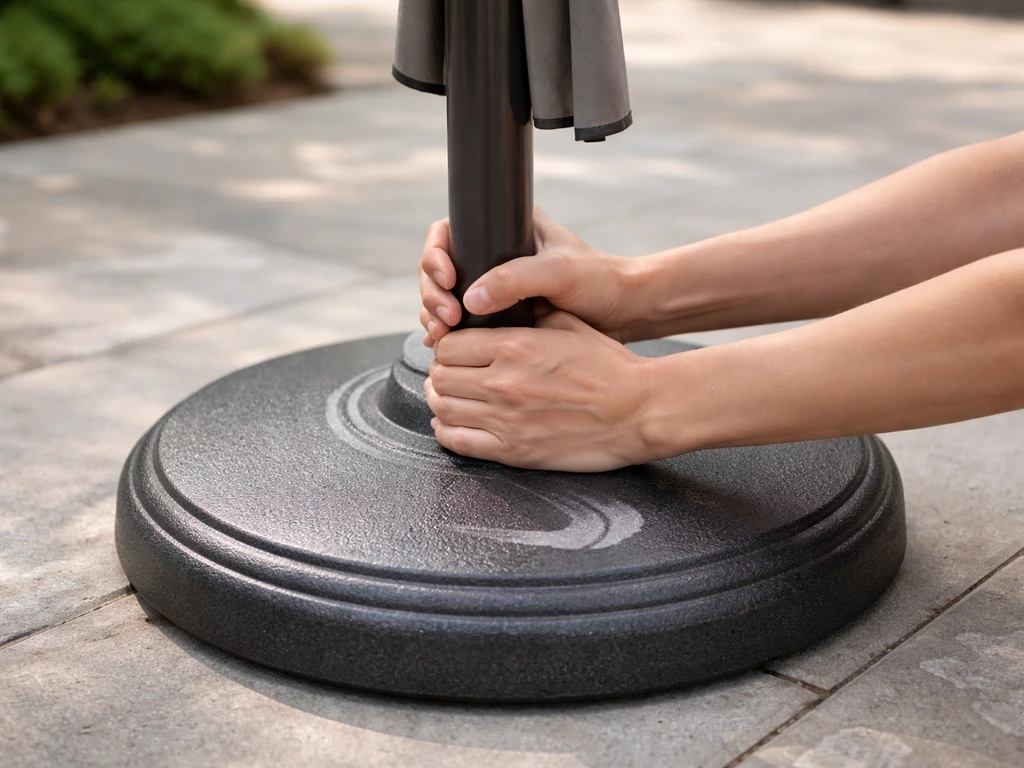
Before you grab a wrench, take 60 seconds to locate the wobble source. Close the canopy completely, then grip the pole with both hands near the base and try to rock it side to side. Then move your hands up to mid-pole and do the same. Then check near the tilt collar or crank housing. The spot where you feel the most movement is your starting point. This matters because a wobble at the base needs a completely different fix than a wobble at the tilt joint.
One caution worth calling out here: if the tilt arm or locking pin no longer holds the canopy at an angle and it drops unexpectedly, stop using the umbrella until that mechanism is fixed. A canopy dropping under its own weight can catch fingers. Keep everyone clear of the tilt zone while you work, and never force any joint that feels bound up. Go slow, especially around crank and hub mechanisms, which have pinch points during operation.
- Wobble at the very bottom (pole rocks in the base): base connection issue
- Wobble at mid-pole when you grip above the base: pole sections not fully seated or a worn joint between segments
- Wobble or slop at the tilt collar or push-button housing: tilt mechanism failure
- Canopy sags or ribs drop unevenly: rib, runner, or hub connector issue
- Crank spins freely but canopy doesn't move: stripped gear or snapped internal cord
Tighten and align the base and stand connection
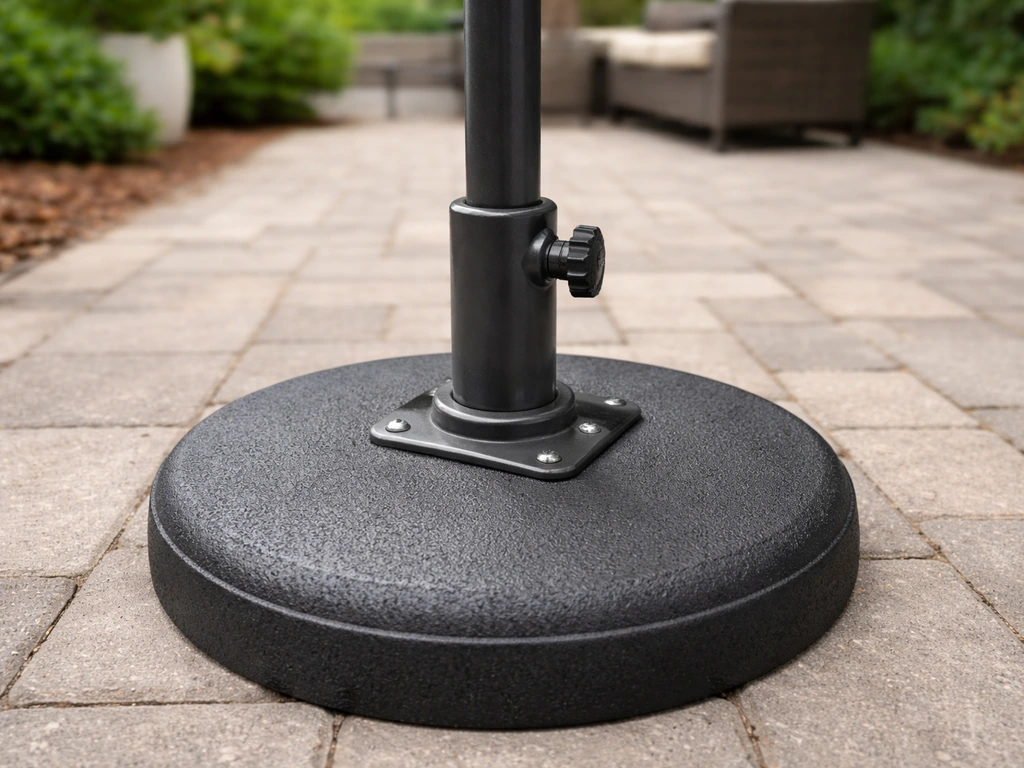
The base-to-pole connection is the number one wobble cause, and it is almost always fixable in five minutes. Start by pulling the pole completely out of the base tube. Look inside the base tube for a locking bolt, locking pin hole, or threaded bolt. Many stands use a single bolt that presses into the side of the pole to clamp it in place. If that bolt is loose, the pole will rock in any direction even though it looks seated.
- Remove the pole and inspect the inside of the base tube for a locking bolt, set screw, or pin hole.
- If there is a threaded bolt: re-seat the pole fully, then tighten the bolt snug with an Allen key or crescent wrench. Do not overtighten on aluminum poles since a single bolt bearing down hard on thin aluminum can dent and damage the pole over time.
- If the base uses a locking pin through a hole in the pole: make sure the pin is fully inserted and the clip or cotter pin is secured. A missing or bent pin is a very common cause of wobble, and a replacement pin from a hardware store (matching diameter) costs under two dollars.
- If the base uses a threaded bolt-on connection (the pole screws onto a locking bolt at the base): rotate the pole clockwise until it is fully threaded down and snug.
- Once re-seated, rock the pole again. If movement is gone, you are done at the base. If it still rocks, the base tube itself may be worn out and slightly oversized for your pole diameter, which means upgrading to a better-fitting base or using a rubber shim/sleeve inside the tube.
Also check that the base itself is not sitting on uneven ground or a soft surface. A base on a single patio stone that tilts slightly will make the entire umbrella lean, which is often confused with a mechanical wobble. Level the base, or move it to a flat, stable surface.
Check the pole joints: crank, tilt collar, and mid-pole fittings
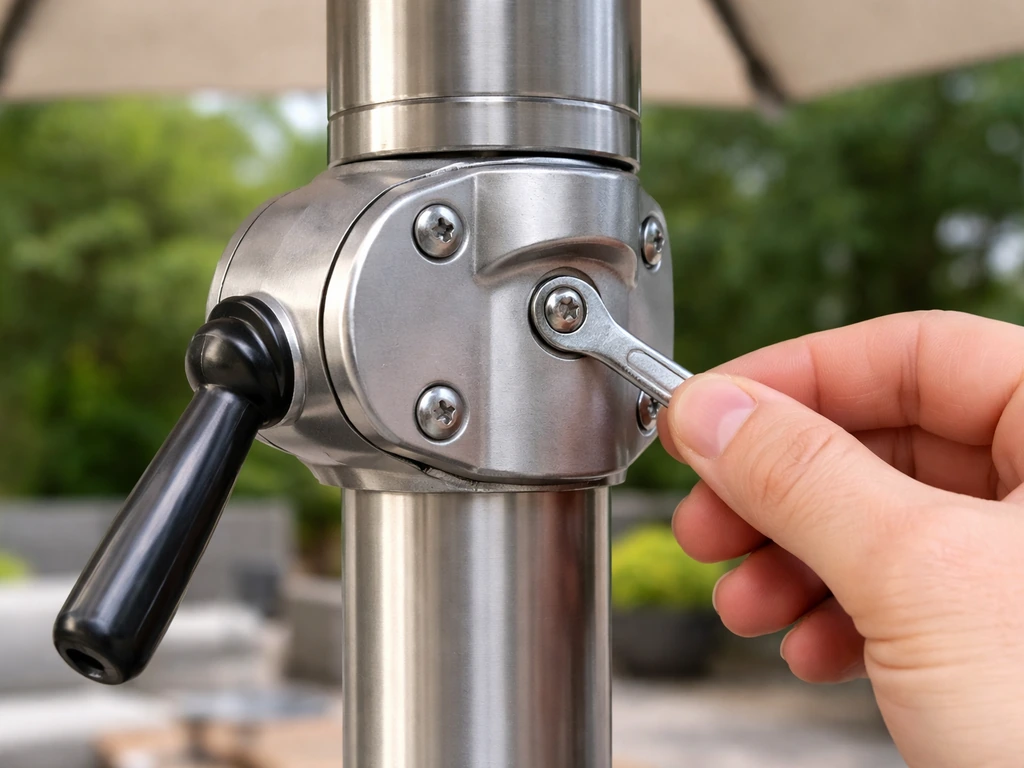
Most patio umbrella poles have at least two sections that connect somewhere near the crank housing or tilt collar. Each of those connections is a potential wobble point. With the umbrella closed and the pole seated in the base, work your hands up the pole section by section and feel for play at every joint.
Crank housing wobble
The crank housing bolts onto the pole and contains the gear that drives the cord or lifts the runner. If the housing feels loose, look for a small Phillips or hex screw on the underside or side of the housing and tighten it. If the crank handle spins freely without raising the canopy, that is a different problem: either the internal gear is stripped or the cord has snapped. Do not keep cranking hoping it will catch. You will only worsen stripped plastic gears. Jump ahead to the repair section for cranks and cords below.
Tilt collar and push-button tilt wobble
Collar-tilt and push-button tilt mechanisms (common on brands like Treasure Garden and most big-box market umbrellas) have a tilt housing that clamps around the pole at a specific point. If that housing is loose, the canopy will wobble side to side even when the base is solid. Keeping the patio umbrella straight also depends on how well the tilt collar and crank joints are clamped when the canopy is upright.
Find the tightening collar ring or the housing bolt on your tilt mechanism and snug it down. On collar-tilt models, the collar should rotate smoothly but should not have radial slop when the umbrella is upright. On auto-tilt models with a crank-through design, the canopy should hit a firm stop position at each tilt angle. If it drifts past the stop or does not hold, the stop ring or internal latch is worn.
That is a replacement job, not a tighten job.
Mid-pole section joint
Two-piece poles connect with either a friction sleeve or a bolt/screw. Separate the sections, inspect the sleeve for cracks or deformation, and reassemble firmly. If there is a bolt through the joint, make sure it is present and tight. A missing bolt here is a surprisingly common wobble source on older umbrellas.
Inspect the ribs, runner, hub, and mast connections
The hub is the central casting at the top of the pole where all the ribs connect. The runner (also called the slider or ring) is the collar that slides up and down the pole to push the ribs open. When either of these components has loose or broken connectors, the canopy will sag, rock, or refuse to lock open fully, which creates a floppy wobble at the top of the umbrella.
- Close the umbrella completely. With the pole stable, lift the canopy fabric slightly at the hub and watch the ribs. Each rib should sit in its hub connector without side play. Wiggle each rib gently: you should feel firm seating, not a clunking looseness.
- Open the umbrella about halfway and look at the runner (the sliding ring partway down the pole). Each rib attaches to the runner via a small knuckle connector. Any knuckle that is cracked, missing its pin, or sitting at a wrong angle will cause that rib section to drop or flex unevenly.
- If a rib knuckle is cracked or broken, that rib needs replacement. Trying to bend it back or tape it is a temporary fix at best. Brands like Treasure Garden publish model-specific rib replacement instructions: you remove the rib from the runner connector and hub, then reverse the process with the correct replacement part matched to your model. Check the manufacturer's website or contact their support with your model number.
- Inspect where the pole (mast) seats into the hub casting at the top. There is usually a screw or roll pin holding the hub in place. If the hub spins or wobbles on the mast, find that fastener and tighten or replace it.
Add weight, anchor the base, or upgrade for wind stability
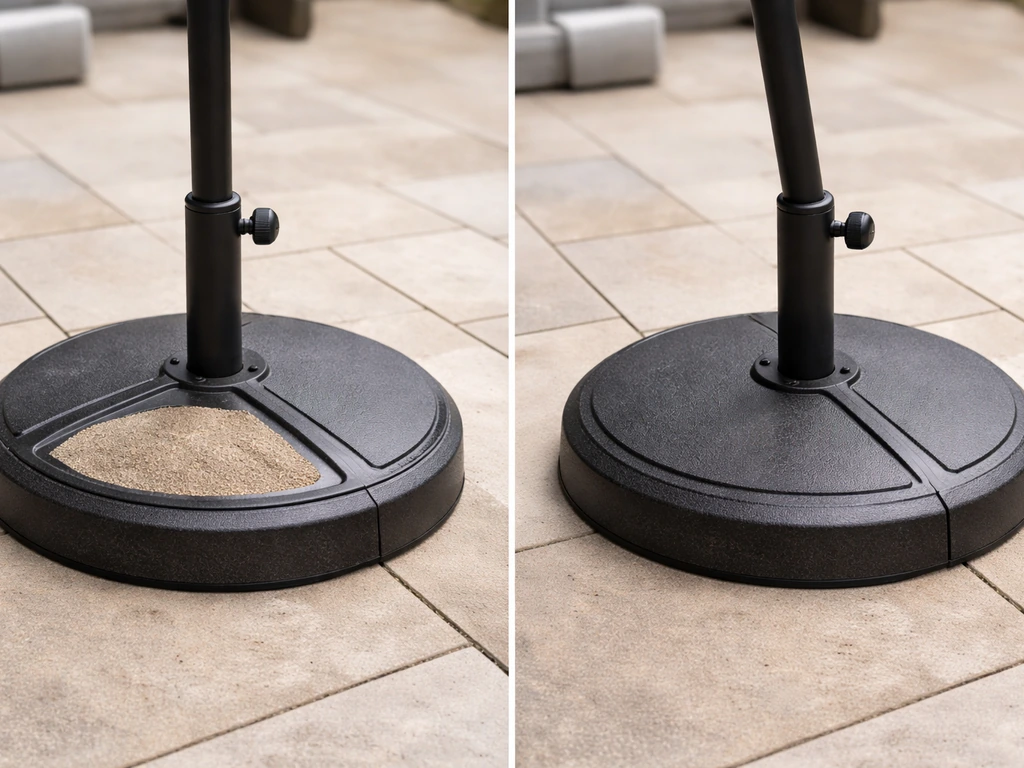
Sometimes the mechanism is totally fine but the base simply does not weigh enough to keep a large canopy stable. Wind hitting a 10-foot canopy generates real lateral torque, and an underfilled or undersized base lets the whole umbrella walk and wobble. Zoye Patio Technology also gives a rule-of-thumb stability baseline using base weight by canopy size and type, such as about 50 lb for small canopies up to around 7 ft, about 75 lb for medium around 9 ft, and 100+ lb for large canopies over 10 ft Wind hitting a 10-foot canopy generates real lateral torque. Here are the weight guidelines to use as a starting point:
| Canopy Size | Minimum Base Weight (Rule of Thumb) | Best Stability Option |
|---|---|---|
| Up to 7 ft | 50 lb | Filled resin base or weighted cross-base |
| 8 to 9 ft | 75 lb | Filled resin base, table-mount, or bolt-down plate |
| 10 ft and larger | 100 lb or more | Bolt-down base, concrete anchor, or in-ground sleeve |
If your base is a hollow resin type, fill it completely with sand or water. Sand is heavier and does not freeze or evaporate. For a more permanent fix, a bolt-down base anchored to a concrete slab with anchor bolts and washers eliminates base wobble entirely. If you are going that route, check that your slab is thick enough (most installation guides specify a minimum concrete thickness, typically at least 3.5 inches) and use the correct anchor bolt diameter for your base's mounting holes.
For renters or situations where you cannot drill into a patio, use a weighted cross-base with a fabric weight bag at each arm, or use base anchoring straps that loop under heavy furniture. These are not as solid as a bolt-down, but they dramatically reduce wobble compared to a lightweight standalone base. Regardless of base type, always close the umbrella when wind picks up.
A wind-focused guide also recommends closing umbrellas during high wind and treats base weight and anchoring as key factors for reducing wind-driven wobble, which may matter for warranty claims close the umbrella when wind picks up. No base weight compensates for a fully open canopy in a strong gust, and wind torque causes the exact mechanical wear that starts the wobble cycle in the first place.
Fix failing parts: crank gears, cords, and rusted hardware
Tightening fasteners solves maybe 60 percent of wobble cases. The rest involve a component that is actually worn or broken. Here is how to handle the most common ones.
Stripped crank gear
If the crank handle turns without resistance and nothing moves, the internal gear is likely stripped. Open the crank housing by removing the screws on its underside. Look at the gear teeth: stripped plastic gears show obvious rounded-off or missing teeth. Replacement crank gearboxes are available from umbrella parts suppliers and most manufacturer websites. Note that crank mechanisms are not universal across brands, so bring the old housing or your model number when ordering. Do not force the old gears hoping they will re-engage. You will crack the housing.
Broken or frayed cord
Many umbrellas use a cord routed through the pole that connects the crank to the runner to open the canopy. When this cord snaps or frays at the pulley contact point, the crank spins free and the canopy will not open.
To restring: remove the screws securing the crank housing at the bottom hub, thread new cord through the crank handle eyelet, route it through the pulley/track sequence inside the pole (follow the path of the old cord exactly before removing it), and tie or lock it off at the cord cleat. Use a cord rated for the load, typically 3mm to 4mm braided polyester.
When routing the new cord, keep tension even and confirm the runner reaches both the fully closed and fully open position without the cord going slack or overly tight.
Rusted or seized fasteners
Steel fasteners on aluminum umbrella poles are corrosion traps. If a bolt or set screw is frozen, apply a penetrating lubricant and wait at least 10 minutes before attempting to turn it. If it still will not move, apply heat with a heat gun briefly to expand the metal. For pivot pins with visible rust, remove them, wire-brush the contact surfaces clean, and replace with stainless steel hardware of the same diameter. Hard-water calcium buildup on aluminum poles can be dissolved with a diluted vinegar-and-water solution (about 1 part vinegar to 9 parts water). Dry everything completely before reassembling.
Worn tilt mechanism
If the tilt locking bolt sits slightly proud of the housing (not flush) or the tilt position drifts under canopy weight, the tilt latch is worn past the point of adjustment. At that point, tightening bolts will not help. Tilt mechanism replacement kits are available from brands like Treasure Garden for their collar-tilt and auto-tilt models. Match the kit to your model number for a compatible fit. The replacement process typically involves removing the housing screws, sliding the old mechanism off the pole, and reversing the steps with the new part.
Lubrication: what to use and what to avoid
Use silicone spray lubricant on moving metal joints: tilt collars, pivot pins, the runner/slider contact on the pole, and crank pivot points. Wipe off excess after application. Do not use WD-40 as a long-term lubricant (it is a water displacer, not a lasting lubricant), and do not use heavy oils on runner/slider contact areas because too much lubrication allows the runner to slide right past its latch point instead of locking. Clean off any sand or grit from mechanism surfaces before lubricating, as grit combined with lubricant acts like lapping compound and accelerates wear.
Test everything, reassemble, and keep it solid
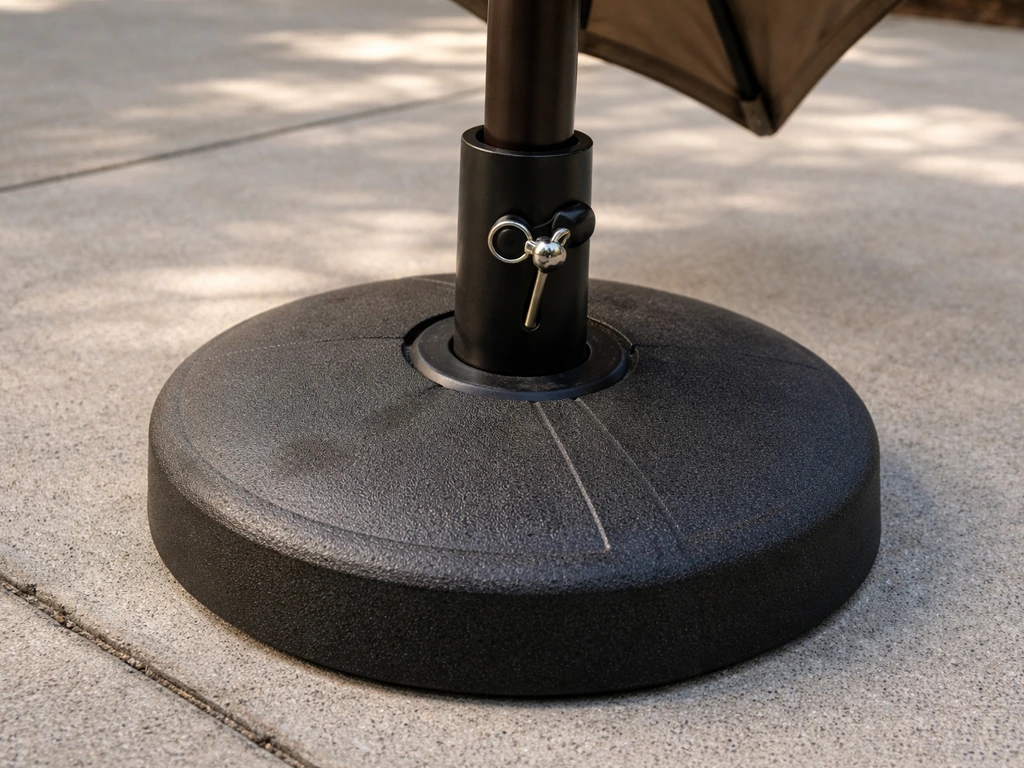
Once you have tightened, replaced, or repaired the problem area, do a proper functional test before calling it done. This is not optional: a quick open-and-close cycle will reveal whether the fix held or whether there is a secondary issue you missed.
- Seat the pole in the base and engage the locking pin or bolt. Rock the pole firmly in all four directions. There should be no movement.
- Open the canopy slowly using the crank. It should rise smoothly with resistance. If it rises with no resistance at all, the cord or gear is still not engaging.
- Crank until the canopy is fully open and the runner hits its stop. Give the canopy a firm push from the side. It should hold position without the ribs collapsing or the runner sliding down.
- If your umbrella has a tilt mechanism, engage each tilt position and push the canopy from the tilted side. The locking position should hold firm with no drift.
- Open and close the umbrella two or three times. Motion should be smooth and consistent. Any grinding, clicking, or sudden free-spinning means something is still misaligned or a part is still failing.
- Do a final wobble check with the umbrella fully open: grip the pole at the base, mid-pole, and near the hub and feel for play at each point.
Prevention checklist to stop the wobble from coming back
Loose hardware accelerates wear in a feedback loop: a small amount of wobble causes repetitive stress on nearby joints, which loosens them faster, which creates more wobble. Catching it early with a seasonal once-over breaks that cycle.
- At the start of every season: pull the pole from the base, inspect the locking bolt or pin, and re-tighten before first use
- Check all visible fasteners at the crank housing, tilt collar, and hub top for tightness every 4 to 6 weeks during heavy-use months
- Inspect pivot pins for surface rust and replace with stainless steel if any rust is found
- Check the tilt cord or strap for fraying at the pulley contact points at least once per season
- Lubricate pivot pins, the runner/slider contact surface, and tilt collar joints with silicone spray at the start of the season
- Always close the canopy during high wind or storms, even briefly unattended
- At end of season: close the canopy, remove the pole from the base, wipe all metal parts dry, and store the umbrella in a cover or indoors to prevent off-season moisture damage to fasteners and joints
One last thing worth knowing: if after all of this the umbrella still leans or lists to one side even with everything tight, the issue may be the pole itself being slightly bent, or the base not being level. Those are covered in more detail in related guides on making a patio umbrella stand straight and why a patio umbrella keeps leaning, which go deeper into pole alignment and base leveling techniques. But for the vast majority of wobbly umbrella cases, working through the steps above from the base up will solve it completely.
FAQ
How can I tell if the wobble is from the umbrella or from the stand being uneven?
Do the base check with the canopy closed, then place a level on the top plate of the stand (or on the base frame where the pole seats). If the bubble shifts, the list is from leveling. If the base is level but you still feel motion when gripping the pole near the base and mid-pole, it is a mechanical looseness at a joint or collar.
What should I do if the base bolt or locking pin hole lines up but the pole still rocks?
That usually means the clamp is not fully grabbing (wrong bolt length, worn clamp area, or the pole tube has oval wear). Try removing the bolt, inspect the hole and the pole clamp surface for deformation, then reinstall with firm tightening. If the bolt cannot sit flush or the clamp point looks rounded, the fastener or pole-side clamp may need replacement, not just more tightening.
Can I fix a wobble by using a stronger bolt or larger washer?
Sometimes, but only if the bolt size matches the stand and pole design. Using a larger bolt can bottom out incorrectly or damage the tube, and a mismatched clamp can create new play. If your stand uses a specific threaded bolt size or captive pin, stick to the original hardware dimensions and replace missing or worn parts rather than changing sizes.
My umbrella wobbles only when it is partially open. What does that indicate?
Partial-open states put load on the crank, runner, and tilt latch while not fully engaging the lock positions. If the wobble happens between stops, the tilt stop ring or internal latch may be worn, or the runner may not be seating fully on the latch point. Test at fully open and fully closed positions, if it is only unstable in the mid-range, prioritize the tilt latch and runner alignment.
Is it safe to keep using the umbrella if the tilt drops or won’t hold an angle?
No. If the canopy can drop under its own weight, stop using it until the tilt locking pin, stop ring, or latch is repaired or replaced. Besides injury risk, repeated dropping can strip internal plastic components or deform the tilt housing, making a later repair more expensive.
What if tightening the tilt collar makes it feel stiff, but it still has play?
That is a sign the housing may be worn or the collar-to-pole clamp surface has deformation. Stop over-tightening to force the fit. Clean the clamp area, then tighten to snug only. If you still feel radial slop at the collar when the umbrella is upright, you likely need a replacement tilt mechanism or worn latch parts.
How do I know whether my crank problem is stripped gears or a cord issue without disassembling everything?
First, check whether the runner reaches both end positions smoothly when you manually assist the mechanism at the hub (carefully, with the umbrella closed). If the crank handle spins but the runner never moves, suspect cord break or pulley routing. If the crank resists and you see rounded gear teeth later, suspect stripped gears. If the runner moves but stalls mid-way, suspect cord routing tension or a runner track snag.
When restringing the cord, how can I avoid slack or incorrect tension?
Use the old cord route as the exact path, then set tension so the runner hits both fully closed and fully open positions without pulling the cord taut at one end. After routing, cycle open-close several times before reassembling the housing fully. If the cord goes slack in the middle or binds at the ends, redo the routing or adjust tension at the cord cleat before you finish.
Can I lubricate plastic crank components?
Be cautious. Lubricate moving metal joints (like tilt collar pivots and pivot pins), but avoid flooding plastic gear teeth and runner locking contact areas with heavy oil. Excess lubrication can attract grit and can also allow the runner to slip past latch points. A light, controlled application is better, and wipe off excess after lubricating.
Why does my umbrella wobble again after I fix it, even though I tightened everything?
Most relapses come from an underlying root cause, like a base that is undersized for wind load, a missing bolt at a joint, or a tilt latch that is worn but not obvious. Also check for gravel or grit under the base seating point. After your first repair, inspect again after a few days, especially if you get frequent gusts.
What tools or parts should I prepare before starting the repair?
Plan for the likely fasteners first: a small Phillips and/or hex key, a wrench or socket for base clamps, penetrating lubricant, and a replacement hardware option for common missing bolts or pins. If your wobble points to the crank, have the model number ready to source a compatible crank gearbox or tilt kit, because mechanisms are not universal across brands.
Next Articles
How to Make a Patio Umbrella Stand Straight
Step-by-step fixes for a tilting patio umbrella: check base weight, tighten parts, align crank tilt, level and anchor to
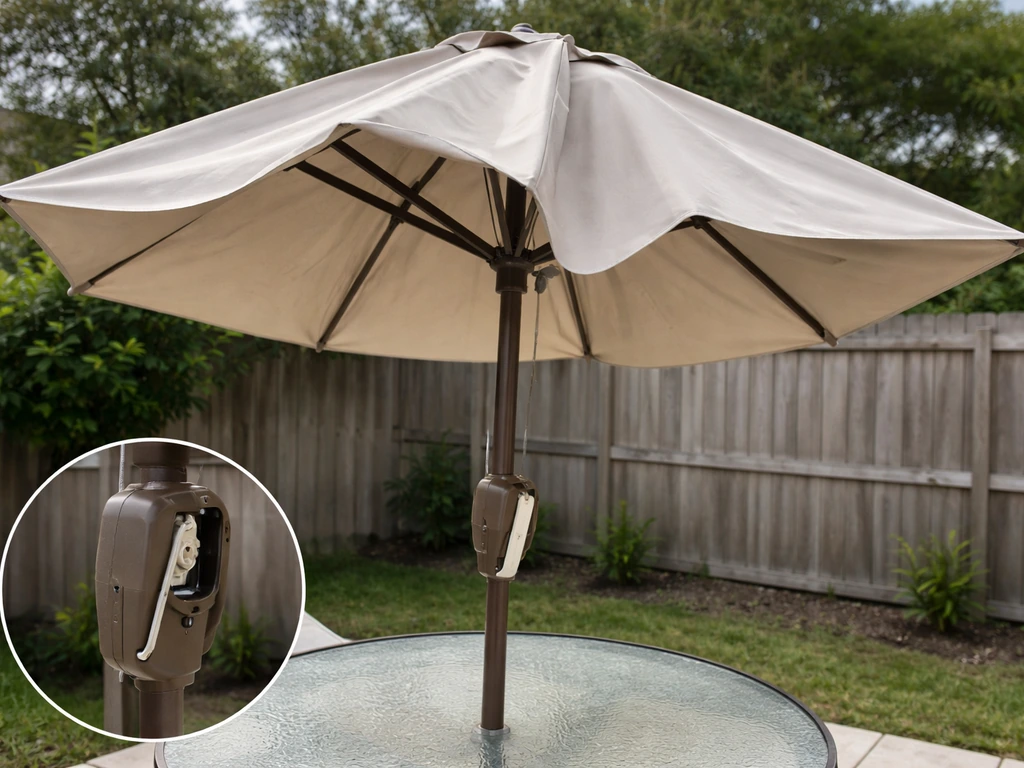
How to Fix a Patio Umbrella That Won't Open or Close
Step-by-step fixes for patio umbrellas that won’t open or close, with checks for jams, cords, latches, and lubricating t
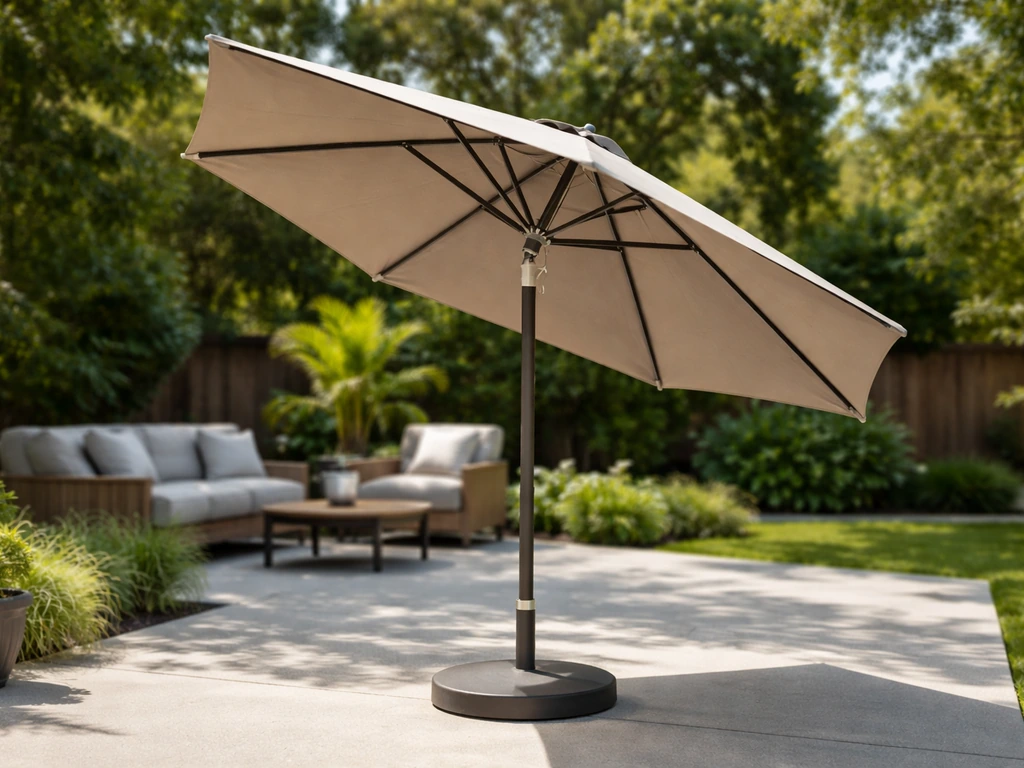
How Does a Patio Umbrella Work? Components, Use, and Fixes
Learn how patio umbrellas work: components, open close tilt, stability, and step by step troubleshooting common mechanic