
A patio umbrella that won't stand straight almost always comes down to one of three things: the base isn't heavy enough (or isn't sitting flat), something is loose or misaligned in the pole or tilt mechanism, or the parts weren't reassembled correctly after the last use. The good news is that all three are fixable without buying a new umbrella. Work through the diagnosis steps below from simplest to most involved, and you'll have it standing upright and locked in position in under an hour.
How to Make a Patio Umbrella Stand Straight
Luca Morrison
11 May 2026
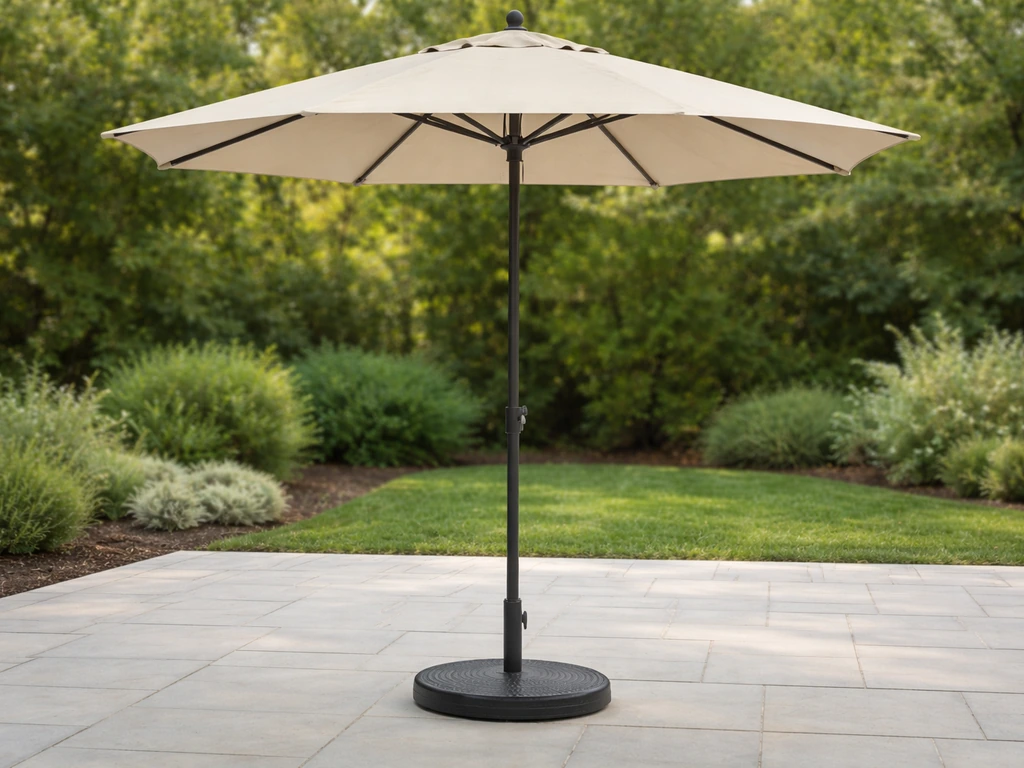
Quick diagnosis: why your umbrella is leaning
Before you grab any tools, just look at the umbrella and notice exactly where the lean is happening. This tells you where to focus. There are four main culprits, and they're easy to distinguish from each other.
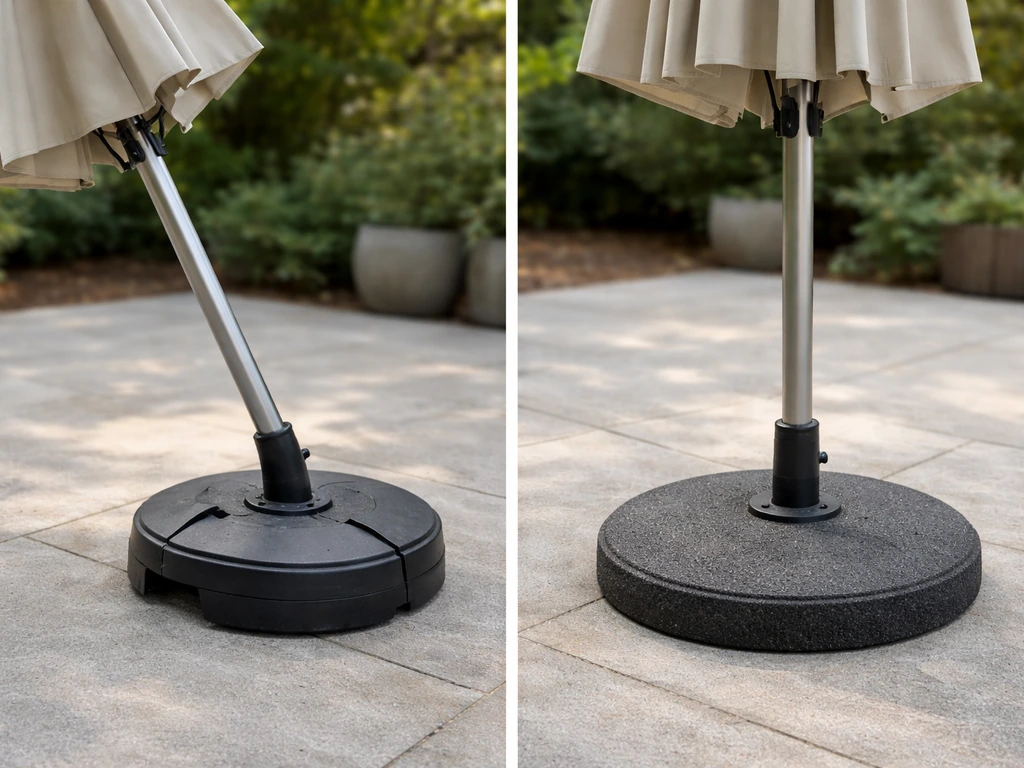
- The whole assembly leans, pole and all: your base is too light, not sitting flat, or the pole isn't fully seated in the base socket.
- The pole is straight but the canopy tilts sideways: the tilt mechanism or tilt joint is loose, worn, or locked in the wrong position.
- The umbrella opens crooked or one side sags: a rib is bent, or the rib-to-pole alignment is off.
- The umbrella leans only when the crank is used: the crank handle is loose, or there's a stripped gear or disconnected lift cord inside the crank housing.
For cantilever and offset umbrellas specifically, an undersized or underfilled base is the single most common cause of leaning. A free-standing base needs serious weight behind it: common manufacturer recommendations run from 135 lb (Wayfair's minimum of 67.5 lb per sandbag across two bags) all the way up to 220–250 lb for a four-section sand/gravel fill (per allen roth's guidance), and large cantilever rigs like Tropitone's can call for blank" rel="noopener noreferrer">429 lb of total base hardware weight. If your base is only partially filled or you're using a small decorative stand, that's almost certainly the problem. For center-pole umbrellas in a table hole, lean is more often a loose tilt joint or a pole that's not sitting all the way into its socket.
Inspect the base, pole, and tilt mechanism before doing anything else
Close the umbrella canopy first so you're working with less wind resistance and less weight shifting around. Then go through these inspection points in order.
Checking the base
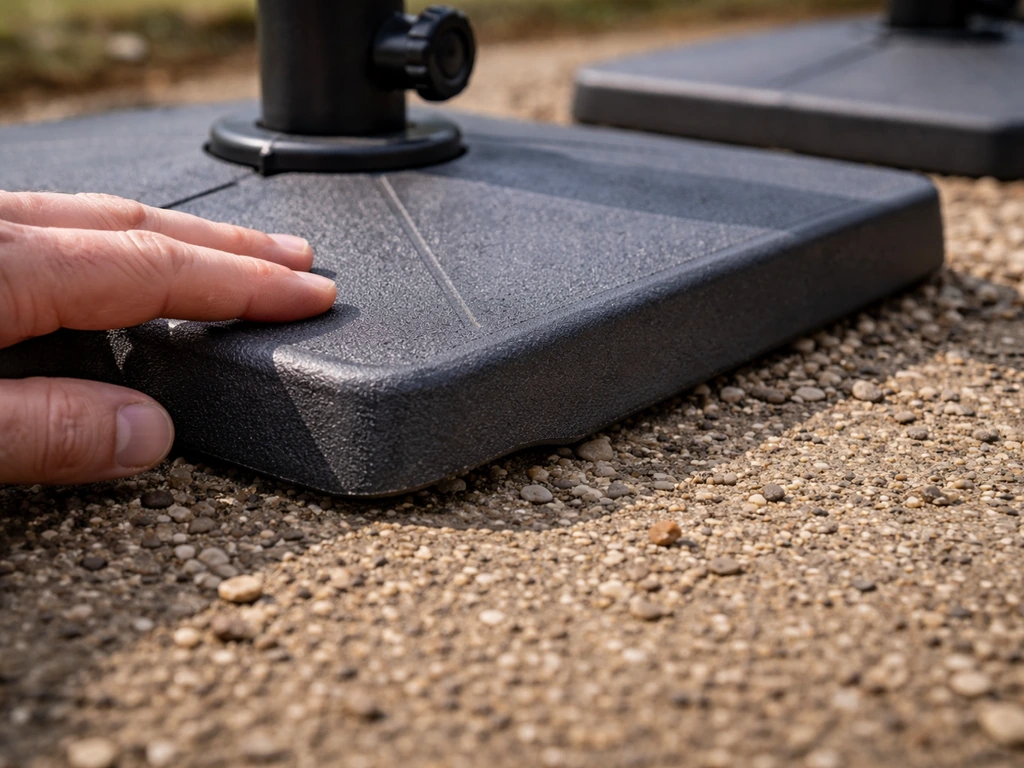
- Lift or tilt the base slightly and feel the weight. A properly filled sand/gravel base should feel immovable. If it slides when you push it, it's too light or sitting on an uneven surface.
- Look at the ground contact. All feet or base sections should be touching the surface. If one foot is raised, the base is rocking, which will always cause leaning.
- For fillable bases, open the fill caps and check the level. Sand settles over time and can compact down 10–20%, reducing effective weight significantly.
- Check the pole socket (the hole the umbrella pole drops into). Grip the pole near the socket and try to wiggle it. Any wobble means the socket collar is loose or the pole diameter doesn't match the socket size.
Checking the pole
- With the umbrella closed, sight down the pole from the top. A bent pole shows up clearly this way. Even a subtle bend of a few degrees will cause the canopy to lean noticeably when open.
- Check every joint along the pole. Multi-section poles connect with pins, bolts, or twist-lock collars. Grip each section and try to rotate or wobble it. Any play means that joint needs tightening or the locking pin needs to be reseated.
- Look at the rib connections where the ribs meet the pole hub. Ribs should radiate evenly and symmetrically. If one rib sticks out at a slightly different angle than the others, it's bent or its mounting point is damaged.
Checking the tilt mechanism
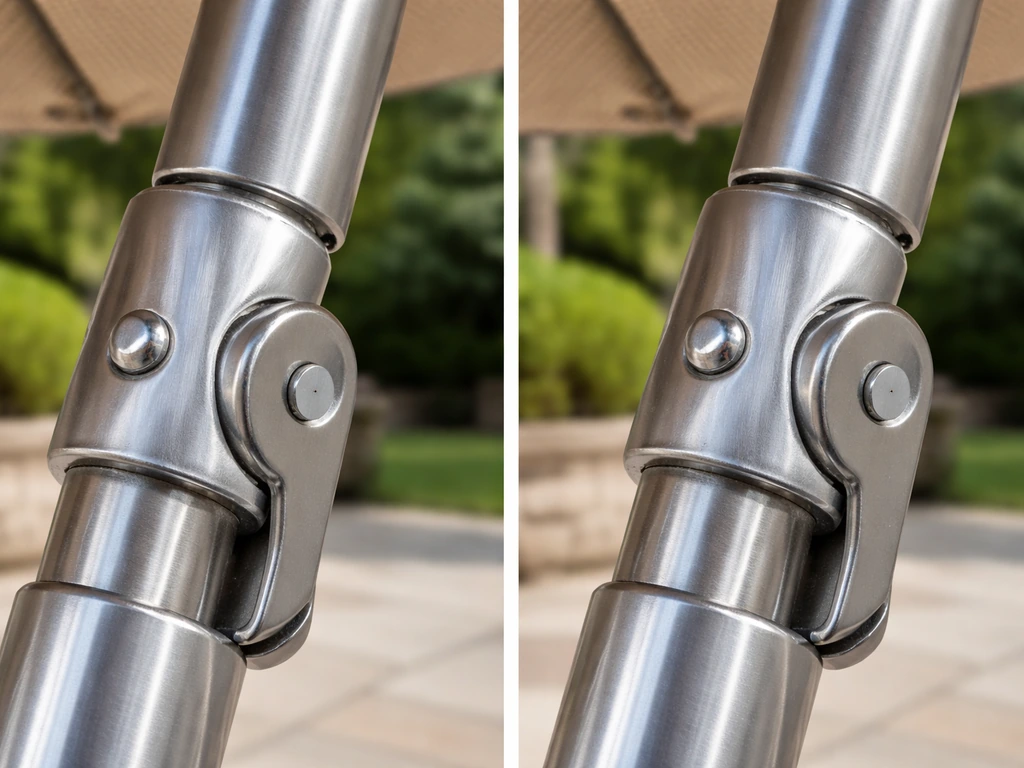
The tilt mechanism sits partway up the pole and lets you angle the canopy toward the sun. It's one of the most common leak points for a leaning umbrella. There are two main types: a push-button tilt (you push a button and rotate the upper pole) and a collar tilt (you rotate a ribbed collar on the pole). Both work by locking the upper pole section at a set angle.
- Push-button tilt: press the button and rotate the upper pole section until it clicks into a straight-up position. If it doesn't click or clicks but won't hold, the locking tab inside the button housing is worn or broken.
- Collar tilt: rotate the collar until the upper pole locks vertical. If the collar spins freely without locking, the internal locking ring is stripped.
- Infinite/auto tilt (crank-operated): this type locks by tension from the crank mechanism. If the crank isn't fully wound or the cord is slack, the tilt won't hold position.
- No matter the type, try locking it in the straight-up position and then push sideways on the upper pole with moderate force. If it gives more than a few millimeters, the locking parts are worn and need replacement.
Checking the crank
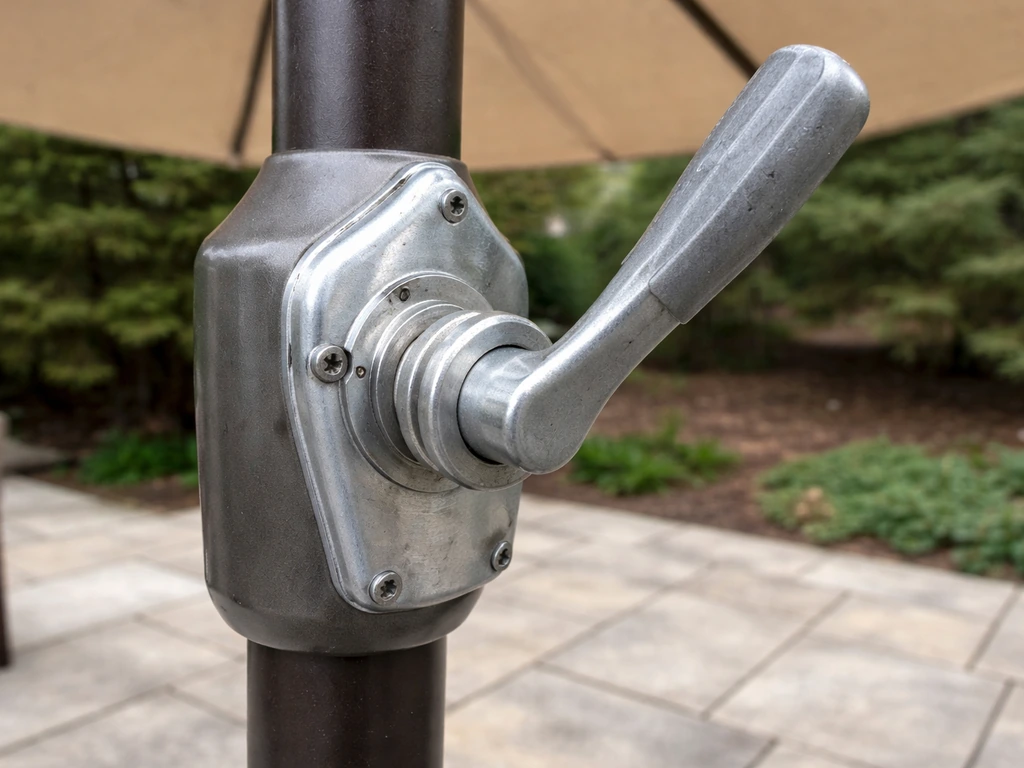
The crank handle should feel firm and turn smoothly. If the handle spins without lifting or lowering the canopy, the most likely causes are a stripped gear inside the crank housing or a disconnected/broken lift cord. Also check the setscrew (a small hex bolt on the side of the crank handle hub), if it's loose, the handle rotates on the shaft without engaging. Tighten this first before assuming you need a new crank.
Reassembling and setting the umbrella correctly
If inspection turned up loose parts or misalignment, here's how to set everything correctly from the base up. Doing this in order matters because a problem lower on the assembly makes everything above it crooked.
- Start with the base. Place it on the flattest available surface (more on this in the next section). Make sure all sections are locked together or bolted down before inserting the pole.
- Seat the pole fully in the base socket. Lower it straight down, not at an angle, until you feel it hit the bottom of the socket. Then secure the socket collar or tightening bolt finger-tight, check that the pole is vertical (use a phone level app if you have one), and then fully tighten.
- Connect any mid-pole sections. Each section should click or lock positively. If there's a locking pin, make sure it pops fully through the hole on both sides of the joint. Don't just push until it looks flush; check that you can feel and see the pin engaged.
- Set the tilt mechanism to the straight-up position before opening the canopy. On tilt models with alignment arrows (common on many Home Depot branded umbrellas), rotate the upper pole until the arrow on the upper section aligns with the arrow on the lower section. This is the 'neutral vertical' position.
- Reassemble the crank if you removed it. Slide the crank housing back onto the pole shaft, tighten the setscrew firmly with a 3mm or 4mm hex key (Allen wrench), and test by turning the handle one full rotation to confirm the mechanism engages.
- Open the canopy slowly using the crank or lift cord. Watch the ribs as the canopy opens: they should spread evenly and symmetrically. If one rib hangs or catches, stop and check that rib's connection to the hub and its stretcher arm joint.
- Once fully open, check that all ribs are locked in their open position. On most umbrellas, the canopy ring or runner (the sliding piece on the pole) locks into a notch or clicks past a detent. If it doesn't lock, the umbrella can slowly sag as the day goes on.
Balancing and securing the base for real stability
Even a perfectly assembled umbrella will lean if the base is underpowered or unbalanced. This section is worth reading even if your umbrella looks fine right now, because most casual setups are borderline for weight.
Getting the weight right
The general rule is: more weight than you think you need, placed as low and as centered as possible. Here are real-world reference numbers from manufacturer manuals to compare against your setup:
| Umbrella type / Brand | Minimum recommended base weight | Fill material noted |
|---|---|---|
| Cantilever (Wayfair/Latitude Run) | 135 lb (two 67.5 lb sandbags) | Sand |
| Cantilever (allen roth 4-section base) | 220–250 lb | Sand or pea gravel |
| Cantilever (Proshade 1500086) | 320 lb / 145.5 kg | Manufacturer base hardware |
| Cantilever (Tropitone) | 429 lb total base hardware | Manufacturer base hardware |
If you're using a fillable base and haven't topped it off recently, add more sand or pea gravel now. Both work well; pea gravel is slightly denser and doesn't clump. Fill each section to its recommended level (the allen roth manual, for example, specifies 50–60 lb per section across four sections). After filling, replace the caps tightly so water doesn't dilute the fill over time.
Centering and fitting the pole correctly in the socket
A pole that fits loosely in the base socket is a common and overlooked cause of lean. If your pole has a smaller diameter than the socket, it will sit off-center and lean toward whatever side it drifts to. The fix is a rubber sleeve or pole adapter insert, which you can find at most hardware stores for a few dollars. Cut it to length, slide it over the pole, and insert them together into the socket so the fit is snug all the way around. Also check that the socket bolt or collar clamp is threading onto the pole, not just clamping the side of a loose fit.
Using additional anchoring and weights
For cantilever umbrellas that mount to a free-standing base (not a table), adding supplemental base plate weights is the easiest upgrade. These are cast iron or weighted plastic plates that stack onto the base frame and bolt down. Many brands sell these as accessories. If you're setting up on a deck, some umbrella bases have bolt-down holes that let you lag-screw the base to the deck surface, which eliminates lean at the base entirely. For umbrellas going into a patio table's center hole, make sure you're using the right size pole sleeve for that table hole, and check that the table itself isn't wobbling (a wobbly table transmits directly to the umbrella).
Leveling the ground and choosing the right surface
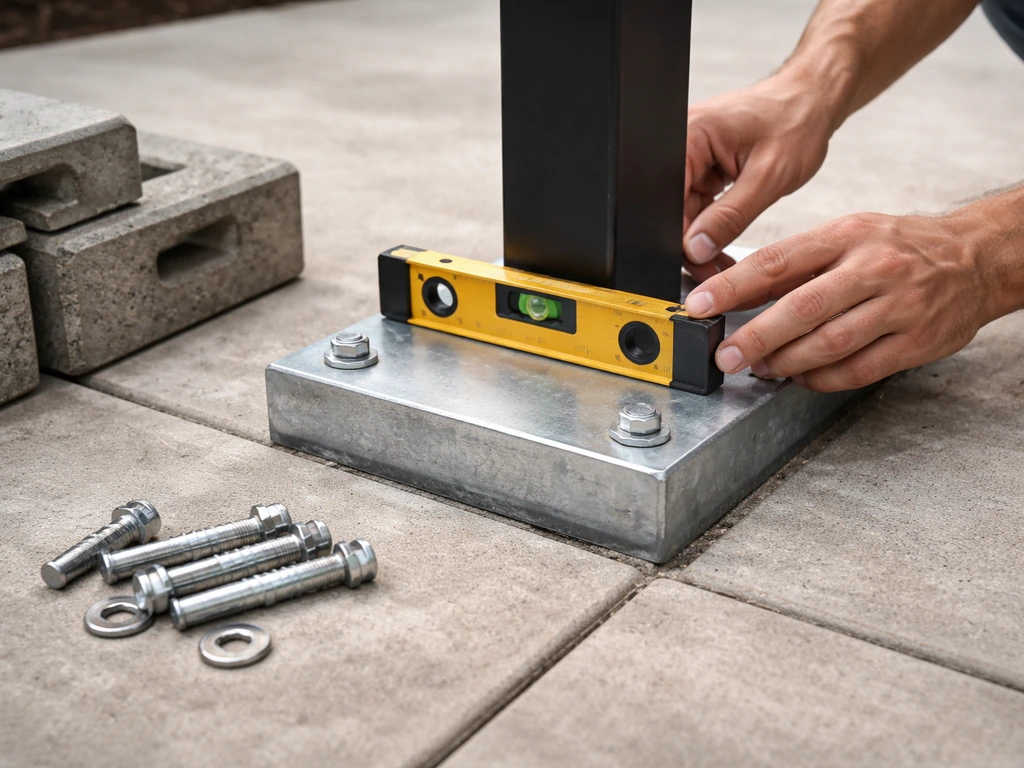
The base requires a flat, stable surface. This sounds obvious, but it's one of the most overlooked causes of a recurring lean. If you want, you can also cross-check the setup with our guidance on how to straighten patio umbrella when the base starts leaning again. If your patio has a slight drainage slope (most do, typically 1/8 to 1/4 inch per foot away from the house), a heavy base will still sit fine. But if you're placing the umbrella on grass, gravel, or uneven pavers, the base can rock or sink unevenly over days or weeks.
- Check the surface with a 2-foot level or a level app. If the slope is more than about 1/4 inch per foot in any direction, the umbrella will lean noticeably.
- On pavers, check that none of the pavers under the base are loose or sunken. A single low paver under one edge of the base will tip the whole assembly.
- On grass or dirt, the base will eventually sink under its own weight. Use a large flat paving stone or deck pad under the base to spread the load and keep it from settling unevenly.
- For concrete patios, a lag-bolt anchor or wedge anchor into the concrete is the most secure option when you need the umbrella in exactly one spot permanently. Use a masonry drill bit the same diameter as your anchor hardware and set anchors at the base bolt holes.
- If you can't level the ground, compensate with leveling shims (rubber or plastic) under the low side of the base frame. Get them snug enough that the base doesn't rock when you push it from any direction.
Handling wind, tilt, and keeping it straight long-term
Once the umbrella is standing straight, the next challenge is keeping it that way through weather changes and regular use. To keep your patio umbrella straight long-term, check the base weight, socket fit, and tilt lock before the next storm season keep patio umbrella straight. This is where most people make the mistakes that cause the problem to come back.
Wind is the real stress test
An open canopy in wind acts like a sail. When you tilt a canopy to block afternoon sun, it catches even more wind than a vertical canopy does. The Proshade manual specifically flags this: use the tilt function with caution because it increases wind load. Even an umbrella with a correctly weighted and leveled base can be shifted or toppled by a single strong gust if the canopy is open and tilted. Here's how to manage wind without just closing the umbrella every time the breeze picks up: Treasure Garden’s twist-tilt umbrella manual specifies using the crank with the counter-clockwise direction to close, and it advises checking the canopy tilt position before opening or closing use the tilt function with caution because it increases wind load.
- In light wind (under about 15 mph / a gentle steady breeze that moves leaves), a properly weighted base handles it fine. Keep the canopy vertical, not tilted.
- In moderate wind (branches moving, around 15–25 mph), close the canopy and lock it in the closed position. Don't just lower it halfway.
- In high wind, storms, or any weather where you can hear the fabric flapping, close the umbrella completely and either take the pole out of the base or use the provided tie-downs or straps to secure it to a wall or railing. Flapping fabric will eventually tear the canopy and can stress rib joints into misalignment.
- Never leave an umbrella open and unattended overnight, even if the forecast looks calm. Wind conditions change fast, and a tipped umbrella at 2 a.m. can damage furniture, fencing, or injure someone.
Routine maintenance checks to do every few weeks
- Wiggle the pole in the base socket. If any wobble has developed, tighten the collar bolt. A few seconds now prevents a lean from developing over days.
- Test the tilt lock. Push sideways on the upper pole with your hand. It should feel solid. If it gives, the tilt locking part is wearing and should be replaced before the next season.
- Check the crank setscrew. Give it a quarter-turn clockwise with a hex key every month or two. It loosens gradually from handle vibration.
- Inspect ribs for bends at the tips and at the hub connection points. Early-stage bends can be straightened by hand or with pliers if caught before they crease. A creased or kinked rib needs replacement.
- Top off the base fill once per season. Sand and gravel settle over winter. Add a few scoops to bring each section back up to its recommended fill level.
- Before winter storage, close the canopy, remove the pole from the base, dry all surfaces, and store the canopy fabric inside or under a cover. A wet canopy stored folded will develop mold in the rib pockets, which weakens the fabric and makes the canopy hang crooked the following spring.
When a part is too damaged to fix
Most of the problems covered here are fixable with tightening, filling, and repositioning. But some parts are worth replacing rather than fighting with. A visibly bent pole (not just leaning from a loose socket, but actually curved) will never stand straight and should be replaced with an exact-diameter match from the manufacturer or a hardware supplier. A tilt mechanism where the locking function is completely stripped should be replaced rather than shimmed or forced, because it creates a safety risk. Replacement tilt mechanisms are available from most umbrella brands and typically cost $15–$40 depending on the type. Replacement ribs and stretchers are similarly inexpensive and worth having one spare on hand for mid-season breaks.
To verify your fix worked, open the umbrella fully, step back about 10 feet, and look at it from the front and then from the side. The pole should appear perfectly vertical from both angles, and the canopy should be evenly circular with no side lower than another. Push the pole sideways with moderate force and release: it should spring back to center. If it stays leaning after you push it, go back and check the tilt lock and the base socket fit. Those two points are where 90% of repeat lean problems originate.
FAQ
Why does my umbrella stand straight for a day, then starts leaning again?
Even if the base feels heavy, level is what prevents gradual drift. Place the base on a level board or mat to test, then adjust the base position rather than only tightening the socket, and recheck after the first rain or a few hours on pavers, since some surfaces let the base sink unevenly.
How often should I refill a sand or gravel base to keep it from leaning?
For fillable bases, use the exact fill level for each section, then top off after long use, not after just a storm. If water has entered and reduced the fill, the base can become underpowered without looking obviously “empty,” so remove the caps, refill to the spec, and reinstall caps tightly.
What should I do if the crank feels normal but the canopy angle changes or won’t stay locked?
Do not rely on the tilt lock alone. When the crank handle feels firm but the canopy still shifts, check the setscrew on the crank hub, then inspect the lift cord or gear engagement. If the handle lifts without moving the canopy, stop and replace the broken cord or gear part before you try to re-center it.
My umbrella leans only when fully opened. Is the base still the likely cause?
If the pole looks centered when closed but leans when fully open, wind load and the canopy height are exposing an underfilled or off-center base. Close the canopy, verify the base is full and centered, then open fully and recheck the pole’s vertical alignment from two angles.
Can I straighten a bent umbrella pole instead of replacing it?
A bent pole is not fixable with tightening. If you suspect bending, roll or sight along the pole surface, remove it, and compare it to a straight reference, then replace it with the exact diameter and model match so the socket fit is correct.
How do I know whether the problem is the umbrella or my patio table when it won’t stay centered?
On table-mounted umbrellas, the table hole sleeve must match the pole and the sleeve must sit snugly in the table opening. If the table wobbles, the umbrella will transfer that movement upward, so stabilize or secure the table first, then fine-tune the sleeve fit.
What’s the easiest way to stop a base from sliding on decking or smooth pavers?
Yes, some bases shift on smooth or slightly sloped surfaces. Add a non-slip outdoor mat under the base or use an adapter plate designed for your base frame, and then bolt down if your model has deck or base mounting holes.
The setscrew on the crank hub keeps loosening. Why?
Tighten the crank setscrew and re-test, but only to the manufacturer’s intended tightness. If the setscrew repeatedly loosens, inspect the hub, threads, and the pole section seating, since a misaligned shaft can cause the screw to back out.
What’s a reliable quick test that my fix is actually secure (not just temporarily better)?
You can do a quick check by pushing the pole sideways and observing rebound, but also verify the tilt lock engages at the open angle you use most. If it doesn’t “click” firmly or the canopy sits at a slightly different angle each time, the lock or collar tilt parts likely need replacement.
Should I repair or replace the tilt mechanism parts?
It depends on damage severity. If the tilt lock is stripped or the lift cord is broken, replacement is the safe route. If it’s only misalignment or a loose setscrew, reassemble and adjust first, because replacing parts unnecessarily can still leave the underlying base or socket issue unresolved.
Next Articles
How to Fix a Patio Umbrella That Won't Open or Close
Step-by-step fixes for patio umbrellas that won’t open or close, with checks for jams, cords, latches, and lubricating t
How Does a Patio Umbrella Work? Components, Use, and Fixes
Learn how patio umbrellas work: components, open close tilt, stability, and step by step troubleshooting common mechanic
Patio Umbrella Crank Not Working: DIY Fix Guide
Fix a patio umbrella crank that won’t work with safe step-by-step jam, gear, and base troubleshooting and repair tips.