
Your patio umbrella keeps blowing over because the base is too light for the canopy size, the umbrella is positioned where it catches full wind with no buffer, or something mechanical, a broken pole section, snapped rib, or failed tilt lock, is stopping it from closing properly when gusts hit. In most cases, you do not need a new umbrella. You need the right base weight, a smarter placement, or a quick mechanical fix.
Why Does My Patio Umbrella Keeps Blowing Over, Repair & Anchor Tips
Luca Morrison
6 Aug 2026
What to do right now if your umbrella just blew over
Before you diagnose anything, get the umbrella closed and secured. An open canopy in wind acts like a sail, even a 25 mph gust can generate over 120 lbs of horizontal force on a 9-ft umbrella (based on standard wind-load calculations using the formula F = ½ρV² × Cd × A, where Cd for a flat canopy is roughly 1. ASCE 7 is the authoritative U.S. standard for calculating design wind loads on structures and is used by engineers to convert wind speed into pressure and force on exposed surfaces (ASCE: ASCE 7, Minimum Design Loads for Buildings and Other Structures) blank" rel="noopener noreferrer">ASCE: ASCE 7 — Minimum Design Loads for Buildings and Other Structures. Worked example: a 9‑ft (2.74 m) round umbrella (projected area ≈5.91 m²) in a 25 mph (≈11.18 m/s) gust gives q = 0.5·1.225·11.18² ≈ 76.5 Pa and, using Cd ≈ 1.2, yields F ≈ 76.5·1.2·5.91 ≈ 542 N (≈122 lbf); (conversion 1 mph = 0.44704 m/s) blank" rel="noopener noreferrer">Wind-load formula worked example (use q = ½ρV² and conversion 1 mph = 0.44704 m/s). 0 to 1.2). That force tips the whole assembly no matter how heavy the base is if the canopy is fully open.
- Close the canopy completely — crank it down or fold the ribs before you do anything else.
- Lay the umbrella pole flat on the ground if it cannot stand stably with the canopy closed.
- Move the base away from any hard surface (glass table, concrete edge, planters) to prevent damage if it shifts again.
- Check the base weight and fill level — a water-filled base that drained overnight is essentially useless.
- Do not reopen the umbrella until wind is consistently below 20–25 mph.
Immediate safety steps to prevent injury or property damage
A falling umbrella is genuinely dangerous. The pole is rigid aluminum or steel, and the ribs can be sharp if they snap. The base, even a light empty one, can crush a foot or crack tile. The National Weather Service advises securing all loose outdoor objects whenever a Wind Watch or Warning is issued, umbrellas are at the top of that list. Here is what I always do before a storm or even an afternoon with gusty conditions.
- Close and lower the canopy at the first sign of sustained wind above 20–25 mph.
- If your umbrella has a tilt mechanism, return it to the fully upright (neutral) position before closing so the ribs fold correctly and the stress on the pole is centered.
- Remove the canopy from the pole entirely if you are expecting storm-force winds (typically anything with a Wind Advisory, Watch, or Warning).
- Store the canopy indoors or in a protective bag — do not leave it rolled on the pole outdoors during high-wind events.
- Check that the pole is seated fully in the base receiver and that the pin or thumb-screw that locks the pole is tight.
- Keep children and pets away from the umbrella setup during windy conditions.
- If the umbrella is near a pool, glass door, or outdoor kitchen, prioritize getting it flat on the ground — a tipping umbrella near water or glass is a serious hazard.
The real reasons patio umbrellas blow over
There is almost always a specific, fixable reason an umbrella keeps going over. In my experience working through these problems, it usually comes down to one of six root causes, and most of them are not wind itself. Wind is just the final straw.
Undersized or underfilled base
This is the most common cause by a wide margin. Manufacturers like Hampton Bay recommend 50–60 lbs of base weight for a standard 9-ft market umbrella, and that is for table-assisted setups. Freestanding? You need more. A water-fillable base that holds 40 lbs when full but lost half its water to evaporation or a slow leak is now a 20-lb paperweight trying to anchor a 9-ft sail. California Umbrella's instruction manuals explicitly warn that certain commercial models need a minimum 70 lb base, and some of their heavier-duty residential lines list 50, 75, and 95 lb options depending on the umbrella class.
Bad placement, no wind buffer
Positioning an umbrella in the middle of an open patio with no fence, wall, or structure nearby means it takes the full brunt of every gust. Even 10 feet closer to a wall or privacy fence can dramatically reduce the effective wind load. Corners of properties, elevated decks, and rooftop patios are the worst spots, wind accelerates around corners and edges.
Broken or bent pole
A pole that has been bent (even slightly) from a previous fall will not sit plumb in the base receiver. The lean shifts the center of gravity off-axis, and the next gust tips it in that direction almost every time. Run your hand along the full length of the pole and sight down it from the tip, any curve at all is a problem.
Snapped or bent ribs
Steel ribs, which are standard on most budget and mid-range umbrellas, are the first thing to go. A single broken rib causes the canopy to hang unevenly, which creates an asymmetric wind profile, the canopy catches more wind on one side and the whole umbrella rotates and tips. Fiberglass ribs flex instead of snapping, which is why they perform better in wind, but they can still split at the ferrule (the metal cap at the rib tip) if they are stressed repeatedly.
Failed tilt, crank, or stay mechanism
A tilt mechanism locked in a tilted position means the canopy is angled into the wind rather than perpendicular to it. That exponentially increases the lifting force on one side of the canopy. A broken crank or frayed cord means you cannot fully close the canopy, even a half-open umbrella left unattended during a gust will go over. Stripped crank gears and jammed collar-tilt locks are among the most reported mechanical failures in product reviews and user Q&A for popular brands.
Incorrect installation or table fit
If the pole diameter does not match the table's center hole or the base receiver, the umbrella wobbles and the fit is loose. A 1.5-inch pole rattling in a 2-inch receiver will pivot sideways the moment wind hits. The same issue shows up with in-ground sleeves that were installed without a concrete footing, the sleeve shifts, the pole leans, and over it goes.
Diagnostic checklist: find the real problem before you spend money
Work through this inspection from top to bottom, literally. Start at the canopy and finish at the base. It takes about 10 minutes and will tell you exactly what is causing the tipping.
- Open the canopy fully and look at it from 10 feet away. Does it sit evenly, or does one side droop? A drooping side means a broken or disconnected rib.
- Run your hand along each rib, starting at the hub (the center connector at the top of the pole) and moving out to the tip. Feel for any bend, crack, or rib that feels loose at the hub pin.
- Check the canopy fabric at the rib tips. If the fabric has pulled away from the rib tip pocket, that rib is flapping loose in wind and acting as a lever.
- Test the tilt mechanism. If your umbrella has a push-button tilt or collar tilt, move it through its full range. It should lock positively at each position and not drift. If it slides back on its own, the lock is worn.
- Test the crank. Wind it up fully, then down fully. Listen for grinding, feel for slipping, and watch the canopy — it should move smoothly. A crank that slips under load means a stripped gear or frayed cord.
- Sight down the pole from the tip to the base. Crouch down and look straight up the pole axis. Any visible curve means the pole is bent.
- Check the pole-to-base connection. Grip the pole just above the base and try to rock it side to side. There should be almost no play. More than 1/4 inch of movement means the receiver is worn or the pole diameter is mismatched.
- Weigh the base (or check the fill level). If water-filled, drain and refill it — many bases lose water slowly. Check the manufacturer's rated weight and compare it to the recommendations in the base weight table below.
- Check the base placement. Is the umbrella freestanding in the open, near a corner, or on an elevated surface? Note whether there is any wind shelter within 15 feet.
Tools and parts you will need for DIY diagnosis and repair
You do not need a workshop for most umbrella repairs. Here is what I keep on hand for the jobs that come up most often. Replacement ribs, crank assemblies, and receiver tubes are available from third-party parts suppliers, sites like EZReplacement stock user manuals and components for most major consumer umbrella brands, which makes finding the right part much easier than calling the manufacturer.
| Item | Use | Approximate Cost |
|---|---|---|
| Tape measure | Measure pole diameter, base receiver, rib length | Already owned |
| Flathead and Phillips screwdrivers | Remove hub pins, rib fasteners, crank housing covers | $0–$10 |
| Needle-nose pliers | Reconnect rib pins, pull cords through channels | $5–$12 |
| Replacement steel or fiberglass ribs | Swap out snapped ribs — match length and diameter exactly | $8–$20 per rib |
| Replacement hub pin set | Fix ribs that detach at the hub | $5–$15 |
| Replacement crank cord or rope | Fix a broken or frayed canopy cord | $6–$15 |
| Replacement crank assembly | Fix stripped gears — often sold as a complete unit | $15–$35 |
| Rubber mallet | Seat pole into base receiver without scratching finish | $8–$15 |
| Digital luggage scale or fish scale | Weigh base when full to confirm actual ballast weight | $10–$20 |
| Zip ties (heavy duty) | Temporary rib-tip fabric reattachment while awaiting parts | $5 for a pack |
| Thread-lock fluid (medium strength) | Secure loose screws in crank housing and hub | $5–$10 |
How to get your patio umbrella to stay up and stay open
If the umbrella keeps collapsing rather than tipping, meaning the canopy folds down on its own instead of the whole thing blowing over, that is a separate mechanical problem from tipping, though both often exist at the same time. The canopy staying open depends on the crank, the cord, and the upper runner (the sliding ring that pushes the ribs out). Here is how to work through it. For step-by-step instructions on how to get patio umbrella to stay up, see the detailed guide. For step-by-step instructions on how to keep a patio umbrella open, see our guide on how to keep patio umbrella open.
Fix a slipping or broken crank
- Open the crank housing cover by removing the two small screws on the side of the pole. The cover usually pops off with a flathead screwdriver.
- Inspect the gear teeth. If they look chewed down or rounded, the gear is stripped — order a replacement crank assembly matched to your pole diameter.
- If the gear looks fine, check the cord. Trace it from the crank drum up through the pole to the upper runner. A frayed or knotted cord will slip under load.
- To replace the cord: tie the new cord to the old one before removing the old cord so it guides the new one through the pole channel. Pull the old cord out from the top and the new cord follows.
- Reassemble the crank housing and test under load — crank up fully and press down on the canopy to confirm it does not slip.
Fix a broken or bent rib
- Identify the broken rib by opening the canopy and looking for the one that droops or has a visible bend or crack.
- Close the canopy and lay the umbrella flat so you can work safely.
- Remove the hub pin that connects the broken rib to the hub — this is usually a small metal pin or bolt. Keep it in a cup so it does not roll away.
- Slide the broken rib out of its hub slot. Note the orientation — replacement ribs go back in the same way.
- Slide the new rib in, reinsert the hub pin, and secure it. If the pin is bent or worn, replace it with the new hardware from your hub pin set.
- Check the rib tip — reattach the canopy fabric pocket to the new rib tip. If the fabric hem has torn, a heavy-duty zip tie looped through the hem and around the rib tip is a workable temporary fix while you source a proper canopy or sailmaker's repair.
Fix a jammed or slipping tilt mechanism
Collar tilts (where you twist the collar on the pole to lock a tilted position) and push-button tilts are the two most common types. For a collar tilt that will not lock: unscrew the collar, clean out any grit or debris with a dry brush, and apply a small amount of silicone spray to the collar threads and locking tab. For a push-button tilt that does not spring back or locks in a bad position: the spring inside the button assembly is usually the culprit. Replacement button-tilt spring kits are available from parts suppliers for most pole diameters.
Recommended base types and what they actually need to weigh
Base weight is the single biggest factor in whether your umbrella tips over. The numbers below are based on manufacturer recommendations (Hampton Bay, California Umbrella, Ledge Lounger) and buyer-guide data for standard residential use. If you are on an elevated deck, near a pool, or in a consistently windy area, use the upper end of each range or go one size up.
| Umbrella Type / Size | Minimum Base Weight (table-assisted) | Minimum Base Weight (freestanding) | Notes |
|---|---|---|---|
| 7.5–9 ft market umbrella | 35–50 lb | 50–60 lb | Hampton Bay 9-ft models specify 50–60 lb; use the high end freestanding |
| 9–10 ft market umbrella | 50–60 lb | 60–75 lb | California Umbrella manuals cite 70 lb minimum for some 9–10 ft models |
| 10–11 ft market umbrella | 60–75 lb | 75–95 lb | California Umbrella lists 75 and 95 lb base options for this class |
| 11–13 ft cantilever / offset | 100–150 lb | 150–200 lb | Ledge Lounger rates its cantilever base at ~150 lb; large offsets may need 175–250 lb |
| In-ground sleeve (any size) | N/A — concrete footing | Concrete footing required | Footing approx. 40 cm wide × 70 cm deep; cure 2–3 days before installing sleeve |
Base types compared
| Base Type | Typical Weight Range | Portability | Wind Performance | Best For |
|---|---|---|---|---|
| Water-fillable plastic base | 30–55 lb (full) | High — drain to move | Moderate — risks partial fill and freeze damage | Occasional use, renters, seasonal patios |
| Sand or gravel-fillable base | 50–75 lb | Moderate — heavy when full | Good — denser than water, no freeze risk | Year-round use where moving base occasionally is acceptable |
| Cast iron / steel plate base | 50–150 lb | Low — fixed weight | Excellent — stable, no fill degradation | Permanent or semi-permanent setups |
| Concrete puck / ballast plate | 50–200+ lb | Very low | Excellent | Commercial or heavy-duty residential use |
| In-ground anchor sleeve | N/A (embedded) | None — permanent | Best available | Permanent installations, high-wind zones, commercial patios |
| Table-mount base (through table hole) | Table + separate weighted plate | Moderate | Good if table is heavy | Dining table setups where table adds ballast |
Portable ballast and temporary weight solutions
Sometimes you need a quick fix for today, guests are coming, the base you ordered has not arrived, or you just moved the umbrella to a new spot. These temporary ballast solutions work, but understand their limits. None of them replace a properly sized permanent base for daily use.
Water ballast
A fillable base maxes out around 40–55 lbs with water. That is marginal for a 9-ft umbrella in any kind of wind. You can supplement by setting the base inside a larger planter or tray and filling the tray with sand around the base, this increases the effective footprint and weight without buying new equipment. Important: drain water-fillable bases before the first freeze of the season. Frozen water expands and cracks the base housing, which is not a warranty repair.
Sand and sandbag ballast
Sandbags placed around the base feet are a legitimate temporary anchor. A standard 50 lb play-sand bag from a hardware store costs about $5 and can be draped over the base cross-arms or stacked around the base perimeter. For a freestanding 9-ft umbrella you want at least 50–75 lbs total, so plan on two to three bags. Keep them in place with bungee cords if they are on a sloped surface.
Concrete ballast pucks and steel weight plates
Stackable concrete umbrella weights (sometimes called ballast pucks) and steel barbell plates both work well as supplemental weight. They sit directly on the base cross-arms or on the ground around the base. A set of four 25-lb concrete pucks gives you 100 lbs in a compact footprint and is a legitimate long-term solution for a cantilever umbrella if you do not want to install a permanent concrete footing.
Placement tips for any ballast solution
- Center the weight directly under the pole — off-center ballast can make tipping worse by shifting the base's center of gravity.
- Spread weight across all base arms evenly rather than piling it all on one side.
- On a deck or hard surface, place a rubber mat under the base to increase friction and prevent sliding.
- Never stack loose heavy objects higher than the base receiver — they can fall and become projectiles in wind.
- For cantilever umbrellas, place the heaviest ballast on the side opposite the canopy overhang — that is where the tipping moment is greatest.
Quick ballast reference by umbrella size
| Umbrella Size | Minimum Total Ballast (freestanding) | Temporary Fix Options |
|---|---|---|
| 7.5–9 ft market | 50–60 lb | Filled water base + 2 × 25 lb sandbags on cross-arms |
| 9–10 ft market | 60–75 lb | Filled sand base OR water base + 3 × 25 lb sandbags |
| 10–11 ft market | 75–95 lb | Sand-filled base + concrete pucks OR steel plates |
| 11–13 ft cantilever | 150–200 lb | Dedicated cantilever base + stacked concrete ballast pucks |
| Any size, in-ground sleeve | Concrete footing | Temporary: sandbags around sleeve opening while concrete cures |
Wind thresholds and safe-use guidelines
The CPSC's beach umbrella safety guidance (updated 2024–2025, aligned with ASTM F3681) recommends looking for umbrellas and anchors rated to resist winds up to 30 mph or at least 75 lbs of upward force. That is a useful real-world benchmark for patio umbrellas too. My personal rule: close the canopy when wind is sustained above 20 mph or gusting above 25 mph. When a Wind Advisory, Watch, or Warning is issued by the National Weather Service, which specifically triggers the guidance to secure loose outdoor objects, get the canopy off the pole entirely. No base weight or rib strength will reliably hold a full canopy in those conditions.
When to repair and when to replace
Repairs are worth doing when the pole is straight, the canopy fabric is intact, and the failure is a single mechanical part. A replacement rib costs $8–$20. A new crank assembly runs $15–$35. Those repairs make total sense on a $200–$400 umbrella. Replacement starts to make more sense when the pole is bent (straightening is temporary at best), multiple ribs are broken, the canopy is torn in multiple places, or the total repair cost approaches half the price of a comparable new umbrella. Also keep in mind that manufacturer warranties typically exclude weather damage and normal wear, so a warranty claim after a blowover is usually a dead end.
| Problem | Repair or Replace? | Estimated Repair Cost | Notes |
|---|---|---|---|
| 1–2 broken ribs | Repair | $10–$40 | Straightforward DIY with matching replacement ribs |
| Broken or frayed crank cord | Repair | $6–$20 | One of the easiest fixes — 20–30 minutes |
| Stripped crank gear | Repair | $15–$35 | Order complete crank assembly for your pole size |
| Bent pole (minor) | Repair cautiously | $0–$30 for sleeve insert | A bent pole re-bends at the same spot; monitor it |
| Bent or cracked pole (severe) | Replace pole or umbrella | $40–$80 for pole replacement | Structural failure risk in next windstorm |
| Multiple broken ribs + torn canopy | Replace umbrella | N/A | Repair cost approaches or exceeds new umbrella price |
| Undersized or failed base | Replace base | $30–$150+ | Most common fix — match weight to umbrella size |
| Jammed tilt mechanism | Repair | $0–$25 | Usually cleaning + spring replacement |
Keeping the canopy closed: seasonal storage and maintenance
Most umbrella damage, bent ribs, torn canopy fabric, cracked bases, happens during storage or in the off-season, not during normal use. Here is what I do at the end of each season and before the first use of the year.
- Clean the canopy fabric with a soft brush and mild soap before storing — mildew sets in fast on stored damp fabric and weakens the fibers.
- Inspect all hub pins and rib connections before storing. A rib that is 'almost' broken will definitely finish breaking under the stress of rolling the canopy for storage.
- Drain all water-fillable bases completely before first freeze. Leaving even an inch of water in a plastic base can crack the housing.
- Store the canopy in a protective bag or indoors — UV degradation from off-season sun (even in winter in the South) shortens canopy life significantly.
- Apply a light coat of silicone spray to the crank mechanism, pole sections, and tilt collar at the start of each season to prevent corrosion and sticking.
- Check all connection points (pole-to-base receiver, hub, rib pins) for corrosion. A steel pin that has rusted tight will shear during the first high-wind stress if forced.
Dealing with bees and birds on the canopy
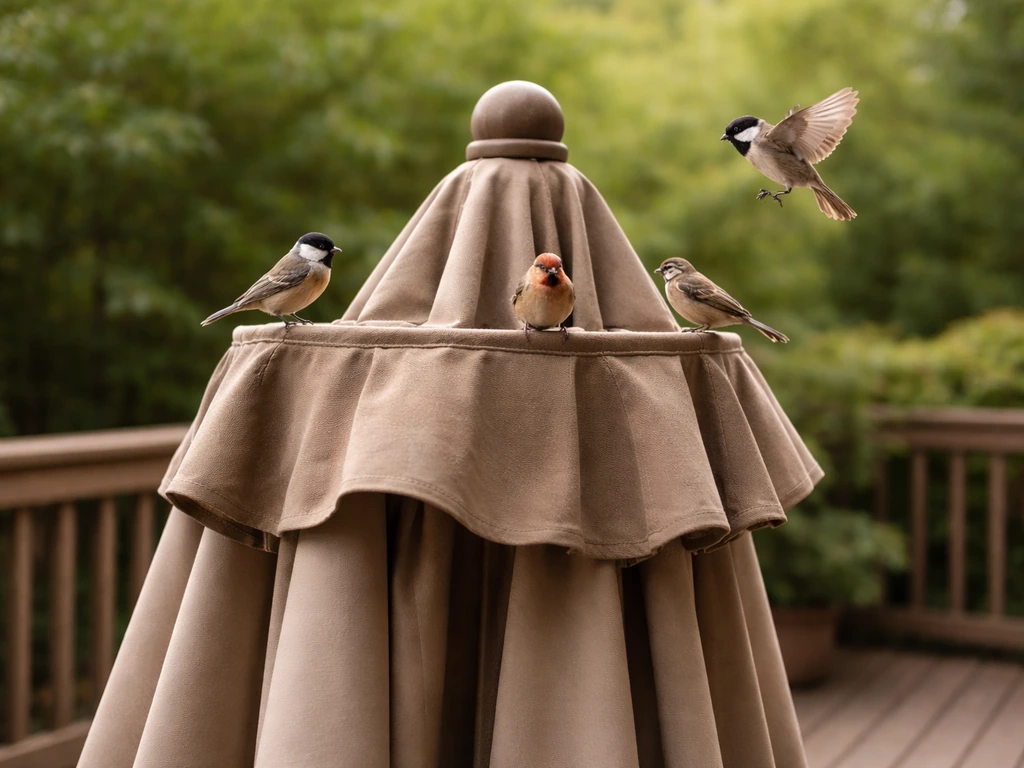
This is not directly related to tipping, but bees nesting in the folded canopy and birds perching on the ribs are two of the most common reasons people open their umbrella and immediately close it again, and that repeated open-close-open cycle is genuinely hard on the crank cord and hub pins. Preventing pests extends mechanical life. Bees are attracted to folds in the canopy where they can shelter; keeping the canopy open (not rolled tight) or storing it in a sealed bag when not in use removes that shelter. For birds, spike strips along the rib tips are effective and do not damage the fabric. Both topics are worth exploring in more depth if you are dealing with them regularly. For detailed bird-deterrent options, see our guide on how to keep birds off patio umbrella. For step-by-step guidance on how to keep bees out of patio umbrella, see our short guide with safe prevention and removal tips.
FAQ
What authoritative standards and government guidance should be cited when explaining umbrella wind-safety and when to close or secure umbrellas?
Cite CPSC safety alerts (eg. 2024 beach‑umbrella guidance referencing ASTM F3681) for consumer safety recommendations; ASTM standards (F3512 and F3681) for testing/rating umbrellas and anchors; and National Weather Service/NOAA guidance on wind watches/warnings as the trigger to secure outdoor items. These sources give consumer-facing limits, label expectations, and public-safety timing for closure/anchoring.
What engineering references are needed to explain how wind produces force on an umbrella?
Use a standard wind‑load approach: dynamic pressure q = 0.5·ρ·V² and total force F ≈ q·C_d·A. Cite ASCE/ASCE 7 for the authoritative method of converting wind speeds to design loads and exposure/gust factors; reference fluid‑mechanics texts or engineering calculators for drag‑coefficient guidance and working examples (eg. Fox textbook and wind‑load calculators). Include a worked example converting mph to m/s and computing force for a typical canopy size to give readers an order‑of‑magnitude view.
What practical parameters and test/data should inform recommended base weights and ballast guidance?
Use manufacturer spec sheets and retailer guidance (examples: Hampton Bay, California Umbrella, Ledge Lounger) and buyer guides (Cool‑Off) to derive real‑world recommended base weights by umbrella size/type. Summarize typical ranges: 7.5–9 ft market umbrellas ~35–60 lb; 9–10 ft ~50–75 lb; 10–11 ft ~70+ lb; cantilever/offset umbrellas often need 100–250+ lb. Note CPSC/ASTM label guidance such as anchors rated to resist winds up to ~30 mph or specified upward force measures where applicable.
What authoritative, practical information is needed about anchoring and in‑ground installations?
Include manufacturer/installer in‑ground sleeve instructions (typical footing diameters and depths, e.g., ~16 in/40 cm diameter by ~28 in/70 cm deep, bell bottom, concrete cure times) and vendor recommendations that permanent installations use embedded sleeves or bracket plates in concrete for best wind resistance. Cite accessory vendor manuals and installation notes that advise on sleeve dimensions and cure times.
Which reliable sources explain ballast material tradeoffs and best portable‑base practices?
Use product datasheets and buyer‑guide articles that contrast water‑fillable vs sand/gravel vs concrete/steel bases (eg. Cool‑Off, ToolsAndIdeas, retailer product pages). Summarize pros/cons: water‑fillable is portable but lighter drained and freeze‑susceptible; sand/gravel and concrete/steel give higher density and better performance but less portable. Include practical tips for winterizing/emptying and avoiding freeze damage.
What technical and empirical data are needed to give safe use wind thresholds and closure guidance?
Combine: (1) NWS/NOAA guidance to secure loose items during wind watches/warnings; (2) CPSC/ASTM consumer thresholds (eg. anchors/umbrellas labeled to resist ~30 mph as consumer guidance); and (3) order‑of‑magnitude calculations using q=0.5ρV² with a conservative drag coefficient (C_d ≈1.0–1.2) to show how forces scale with wind speed and canopy area. Present simple thresholds (example: close at sustained winds ≈15–25 mph; never leave open above ~30 mph) while explaining they depend on umbrella size, base weight, exposure, and umbrella condition.
Next Articles
How to Keep Bees Out of Patio Umbrella: Safe DIY Steps
Keep bees off your patio umbrella: safe deterrents, sealing tips, humane removal, and when to call a pro.
How to Keep Patio Umbrella Open: Fixes, Maintenance & Tips
How to keep patio umbrella open: quick fixes, repair steps, tools list, safety tips & when to replace.
How to Keep Birds Off Patio Umbrella: Step by Step
Step-by-step layered tips to keep birds off patio umbrellas, including quick deterrents, setup changes, and long-term pr