Most patio umbrella problems come down to one of five things: a jammed or stripped crank, a frayed or tangled lift cord, a stuck or broken tilt mechanism, a loose or undersized base, or wear from leaving the umbrella open in wind and weather. If your patio umbrella stuck in base feels immovable, the base is often loose, undersized, or corroded where it sits on the pole. The good news is that almost every one of these can be fixed today with basic tools and a replacement part that costs under $20, without buying a whole new umbrella.
Patio Umbrella Problems: Diagnose and Fix Common Failures
Luca Morrison
29 Apr 2026
Safety check first, and know what type of umbrella you have

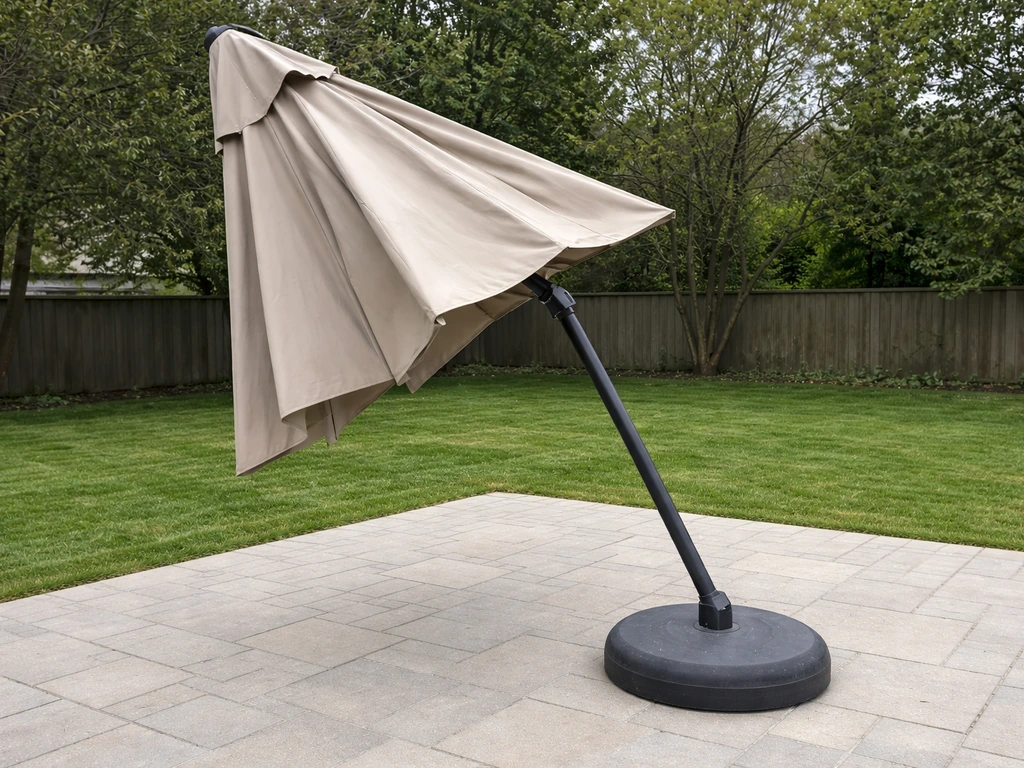
Before you touch anything mechanical, do a quick safety walkthrough. If the canopy or any rib is bent at a sharp angle, if the center pole is visibly cracked, or if the umbrella tipped over and landed hard, stop there and inspect closely before reopening it. A structurally compromised pole or rib can fail suddenly, and the canopy can act like a sail in any breeze, which turns a small problem into a dangerous one fast.
- Check every rib for bends, cracks, or broken ferrules (the small metal caps at the rib tips)
- Inspect the center pole at the hub joint, which is the ring that holds the ribs, for cracking or deformation
- Look at the base connection point to make sure the pole is fully seated and not wobbling
- Watch for finger pinch points at the hub when opening or closing, especially with kids or pets nearby
- If the umbrella is a cantilever (offset pole), check the cross-base and locking arm for any warping or loose hardware
Now identify your umbrella type, because the fix depends on it. A center-pole umbrella has the pole running straight through the middle of the table or a freestanding base. A cantilever (offset) umbrella has the pole on the side with an arm that extends over your seating area. For the opening mechanism, you either have a hand crank (a handle on the pole you rotate), a cord-and-pulley system (a rope or strap you pull), or a push-up design (you slide a collar up the pole by hand). Tilt is usually controlled by a push-button collar on the pole, a rotating collar, or a pivot knob on cantilevers. Knowing these three things, pole style, lift mechanism, and tilt type, will get you to the right fix in half the time.
Umbrella won't open: stuck mechanisms, binding, and misalignment
The most important rule here is to stop forcing it. If you crank or push harder when something is resisting, you risk stripping a gear, snapping a cord, or bending a rib. Resistance almost always has a simple cause you can fix without tools if you find it first.
For crank-operated umbrellas
- Turn the crank slowly and feel where it catches. A uniform grinding through the full rotation usually means a dry or corroded gear. A catch only at one point usually means the internal cord is tangled or knotted around the shaft.
- Lay the umbrella on its side on a flat surface. Open the crank housing (usually two screws) and look for a tangled or knotted cord wrapped around the spindle. Untangle it gently and rewind it evenly.
- If the crank spins freely with zero resistance and the canopy doesn't move at all, the cord has separated from the crank shaft. You will need to rethread or replace the lift cord (see the cord section below).
- If the mechanism is stiff but not broken, apply a silicone-based spray lubricant to the crank shaft and gear teeth. Avoid WD-40 as a long-term fix since it attracts dirt. Check your product manual for the manufacturer's exact lubrication points before applying anything.
For cord-and-pulley umbrellas
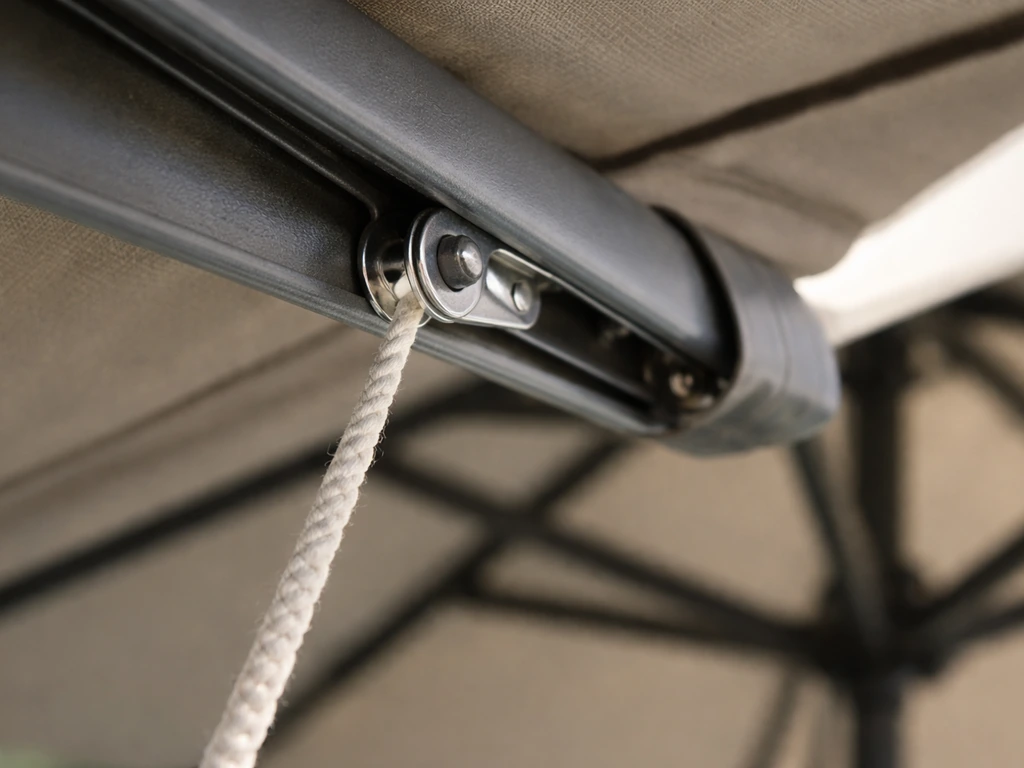
- Pull the lifting cord steadily and feel for a snag. If the rope jerks or stops, a pulley wheel is likely jammed or the cord has jumped off the pulley track.
- Look up through the pole (if hollow) or trace the cord's path to each pulley. Reseat any cord that has slipped off its pulley groove.
- If the cord is frayed near the knot that connects to the hub, it may be close to snapping. Replace it now rather than later.
For cantilever umbrellas
Cantilevers use a rotating or folding arm mechanism, and 'won't open' often means the locking pin hasn't fully released or the rotation joint is stiff from dirt or corrosion. Check that you're operating the release handle completely before trying to swing the arm. Clean the pivot joint with a damp cloth, let it dry, then apply a light machine oil. Also confirm the base cross-frame is sitting flat on level ground. An uneven surface can bind the whole opening sequence.
Umbrella won't close or crank correctly
Closing problems are more common than opening problems, and they usually come down to three culprits: a broken or slack lift cord, a stripped or jammed crank gear, or a tilt collar that's locking the canopy at an angle and preventing it from folding flat. If your patio umbrella will not close, start by checking the lift cord and the tilt collar, since those parts commonly jam in closing direction. If your patio umbrella is stuck in a tilt position, the tilt collar or locking points are usually the cause and may need cleaning or replacement patio umbrella stuck in tilt position.
Crank spins but canopy doesn't lower
If you crank in the closing direction and the handle just spins freely, the internal string or gear that pulls the canopy down has failed. Open the crank housing and check whether the cord is still attached to the shaft. If the cord is intact, the ratchet or gear pawl inside may be stripped. Replacement crank assemblies are widely available for standard market umbrellas and usually cost between $10 and $25. Make a note of your umbrella's pole diameter (typically 1.5 inches or 1.875 inches on most residential models) before ordering.
Canopy gets stuck halfway
A canopy that stops halfway down is almost always a cord tangle or a rib that has caught on the runner (the sliding ring on the pole that pushes the ribs open). Close the canopy as far as it will go, then look for any rib that's sitting crooked or hooked on the runner. Gently push that rib back into its socket. Also check whether the tilt collar is partially engaged, which can torque the whole assembly sideways and jam the runner mid-travel.
Crank is very hard to turn
A stiff crank is usually a lubrication issue or a cord that's wound too tightly because someone cranked past the stop point. If the canopy is fully open and you kept cranking, the cord may be over-tensioned around the shaft. Release pressure by gently cranking in the open direction a half turn, then try closing again. Always stop cranking the moment you feel resistance at the fully-open or fully-closed position. Continuing past that point is the most common way people damage crank mechanisms.
Tilt problems: wobble, won't stay up, and uneven tilt
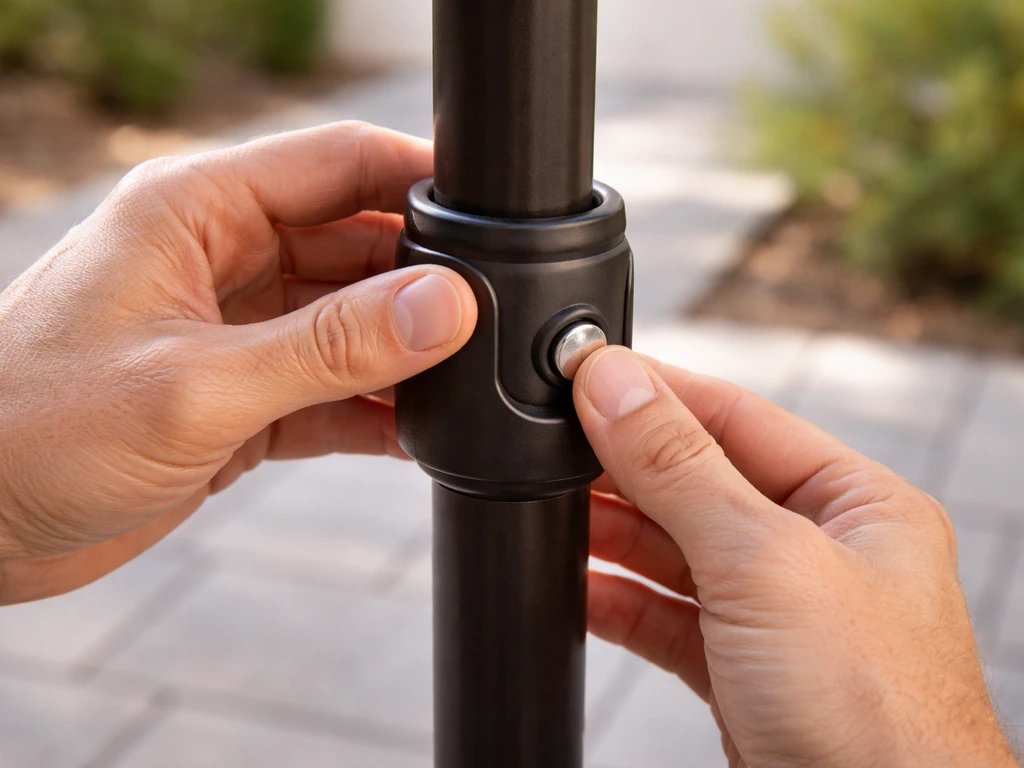
Tilt issues are probably the most frustrating patio umbrella problem because they seem mechanical but often have a simple fix. The most common type you'll encounter is a push-button tilt collar partway up the pole. If your patio umbrella tilt mechanism broken, start by inspecting the tilt collar and the locking points that hold the canopy at the angle. You press the button, tilt the canopy, and release the button to lock it in place. When that stops working, one of three things has usually gone wrong.
- The button isn't fully engaging: Press it firmly and completely before attempting to tilt. A partial press won't release the collar, and a partial release won't lock it. You should feel or hear a definite click when it locks.
- The teeth or pin inside the collar are worn: If the canopy slowly drifts out of position after you lock it, the teeth that hold the tilt angle are worn flat. Replacement tilt collars for standard poles are inexpensive and usually tool-free to swap.
- The collar is dirty or corroded: Clean the collar and the pole surface under it with a damp cloth. Once dry, apply a small amount of silicone lubricant to the pivot pin. Don't hold the button down continuously during use; it's designed to release and then lock, not to stay compressed.
If the canopy tilts unevenly or droops to one side, the problem is usually a rib that has lost its spoke fitting or a hub that's cracked on one side. Open the canopy fully and look at each rib where it meets the hub. A rib that sits lower than the others has either a broken pin or a cracked socket at the hub. Replacement hub caps and rib connectors are available for most standard umbrella sizes. If multiple ribs are damaged, it may be more cost-effective to replace the whole frame rather than individual parts.
On cantilever designs, a 'won't tilt' problem usually means the pivot bolt on the arm has loosened or the locking knob isn't being tightened enough after you set the angle. Tighten the knob firmly by hand; if it won't hold tension anymore, the threads may be stripped and the knob needs replacing.
Cord, pulley, and crank or rope system troubleshooting
The lift cord is the most commonly replaced part on a patio umbrella, and replacing it yourself is very doable in about 30 minutes. Cords fail from UV exposure, abrasion at the pulley contact points, and from being cranked too tight repeatedly.
Diagnosing cord and pulley issues
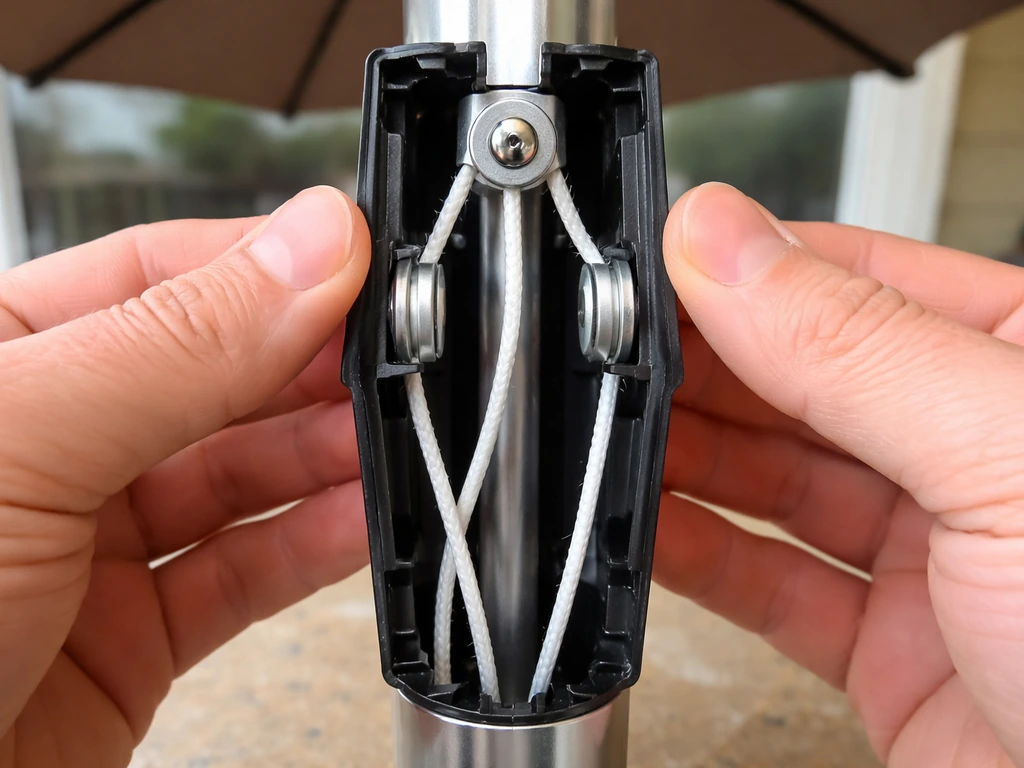
- Crank turns, nothing moves: cord has separated from the shaft or broken internally
- Cord pulls but umbrella won't open: cord has jumped off a pulley wheel inside the pole
- Cord pulls unevenly with a jerking motion: a pulley wheel is cracked or seized
- Visible fraying near the knot at the hub or at the crank entry point: replace the cord now before it snaps
How to replace the lift cord
- Buy replacement cord in the same diameter as the original (typically 3mm to 5mm braided polyester). Measure the pole height and buy at least 1.5 times that length to account for the pulley path.
- Lay the umbrella flat on a table or the ground so you can work on the pole without it falling.
- Open the crank housing by removing the two or three Phillips screws. Take a photo of the cord routing before you remove anything.
- Tie the new cord to the old cord before pulling the old one out. That way you can use the old cord to pull the new one through the pole and over each pulley in sequence.
- Thread the new cord up through the pole, over each pulley wheel (usually two or three wheels stacked inside the pole top), and back down to the crank shaft.
- Tie a secure stopper knot at the crank shaft end so the cord can't pull through. A figure-eight knot works well here.
- Wind the cord evenly onto the shaft a few times before closing the housing.
- Test by cranking fully open, then fully closed. The canopy should move smoothly with no slack and no over-tension. If it binds, check that the cord is seated in every pulley groove.
Stuck or seized pulley wheels
If a pulley wheel has cracked or seized, replacing the cord won't solve the problem. Pulley wheel kits are sold separately and usually just press or clip into the pole housing. Match the wheel diameter and axle pin size to your existing hardware. If you can't source the right pulley, contact the umbrella manufacturer directly with the model number, since many keep parts in stock even for older models.
Base, stability, and protecting your umbrella in wind
A tipping umbrella is not just annoying, it is a real safety hazard. The canopy acts like a sail, and even a moderate gust puts enormous leverage on the base and pole. Close your umbrella when winds reach around 15 to 20 mph for a standard center-pole design. Cantilever umbrellas are especially vulnerable because the offset arm multiplies the wind load, so close those even earlier, in low to moderate wind, and always close them when you walk away.
Checking and fixing base problems
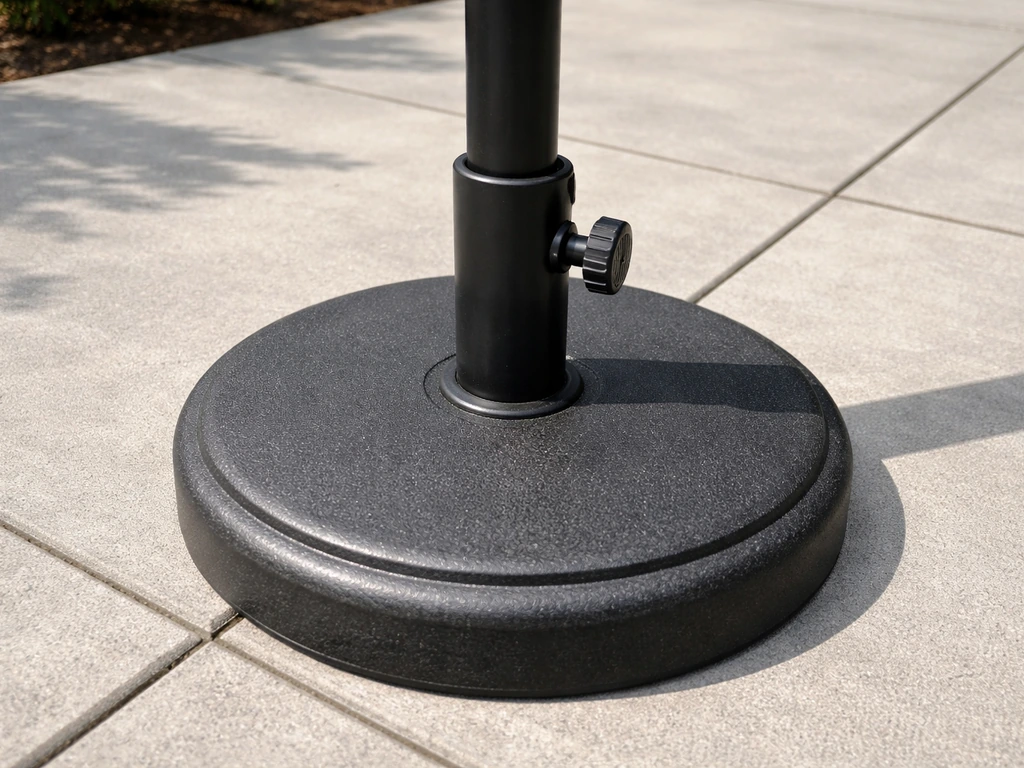
- Check that the pole is fully seated in the base socket and that any locking pin or tightening knob is fully engaged. A pole that's only partially inserted will rock in light wind.
- Weigh the base adequately. For a standard 9-foot umbrella, you need at least 50 pounds of base weight. A 10- to 11-foot umbrella needs 75 pounds or more. If your base is undersized, add a weight ring or use a base plate with anchor bolts into the deck or patio.
- For cantilever umbrellas, place the cross base on a flat, level surface. Even a slight slope lets the whole assembly shift under load. Use shim pads under the base feet if your patio isn't perfectly level.
- Tighten all bolts and hardware connections. For cantilever umbrellas especially, check every bolt at least every 90 days during the season. Hand-tight is not enough for the arm pivot and base connection bolts. Use a wrench, but stop before the bolt feels like it's about to strip. Overtightening can crack aluminum threads just as easily as leaving them loose.
After wind damage
If your umbrella blew over, do the full safety check described at the top before using it again. Look specifically at the pole for any bend near the hub, the hub itself for cracking, and every rib for kinks patio umbrella tips over. Look specifically at the pole for any bend near the hub, the hub itself for cracking, and every rib for kinks. A bent pole will fail again at the same spot, often more dramatically. If the pole is bent or cracked, replace the pole section rather than trying to straighten it. Aluminum and fiberglass poles don't reliably recover their structural integrity after a hard bend.
Seasonal maintenance, cleaning, lubrication, and storage
The easiest way to avoid most patio umbrella problems is a simple routine at the start and end of each season, plus a few minutes of attention every month in between. Most umbrella issues that feel sudden were actually building up slowly through dried-out pivots, loosening bolts, and UV-degraded cords.
Start-of-season checkup
- Open the umbrella fully and inspect every rib, the hub, and the runner for damage from winter storage.
- Check the lift cord for fraying along its entire length, paying special attention where it enters the crank housing and where it loops over each pulley.
- Tighten all external bolts and screws with the appropriate screwdriver or wrench. Don't skip the small screws at rib tips; they hold the canopy fabric in place.
- Apply silicone spray lubricant to the crank shaft, pulley axle pins, tilt button pin, and the runner sleeve on the pole. Refer to your product manual for the exact lubrication points since designs vary.
- Test the tilt mechanism through its full range before assuming it works. A tilt that feels stiff in spring will seize up completely by midsummer.
Cleaning the canopy
Use mild soap and water with a soft brush. Never use abrasive cleaners, bleach on colored fabric, or a pressure washer at close range on the seams, as these break down the UV-resistant coating and the stitching. Rinse thoroughly and let the canopy dry completely before closing it for storage. Storing a damp canopy is the fastest way to get mold that won't come out.
End-of-season storage and winterizing
- Close and lower the canopy fully before doing anything else.
- Remove the canopy from the frame if possible (most canopies detach from the ribs with fabric tabs or velcro). Store the canopy flat or rolled in a breathable bag indoors.
- Clean and dry the pole and hardware, then apply a light coat of silicone spray to all moving parts before storage.
- Store the pole and frame horizontally or in a padded carry bag to prevent the ribs from bending under their own weight if stood upright.
- For cantilever umbrellas, fully fold the arm and cover the entire assembly with a fitted cover. Store indoors if possible, or at minimum keep it covered and secured so it can't shift and tip in winter wind.
- Before putting it away, do a final bolt check so you're not inheriting a loose connection problem next spring.
When to repair vs. when to replace
Parts like lift cords, tilt collars, crank assemblies, and individual ribs are worth replacing. They're cheap, widely available, and a 30-minute job. But some problems mean the umbrella has reached the end of its useful life and pushing through a repair is either unsafe or uneconomical.
| Problem | Repair or Replace? | Typical Cost |
|---|---|---|
| Frayed or broken lift cord | Repair: replace the cord | $5 to $15 |
| Seized or cracked pulley wheel | Repair: replace the pulley kit | $10 to $20 |
| Stripped or broken crank assembly | Repair: replace the crank | $10 to $25 |
| Worn tilt collar or button | Repair: replace the collar | $8 to $20 |
| Single cracked or bent rib | Repair: replace the rib | $10 to $30 |
| Bent or cracked center pole | Replace pole section or full umbrella | $30 to $80+ for pole |
| Multiple cracked ribs or damaged hub | Replace the umbrella | Full replacement |
| Faded, torn, or moldy canopy only | Repair: buy replacement canopy | $30 to $80 |
| Structural damage after a fall | Assess carefully; usually replace | Replacement often safer |
A fair rule of thumb: if the part that failed costs less than 30 percent of a comparable new umbrella and the rest of the structure is sound, repair it. If you're stacking multiple failing parts on top of each other, or if the pole, arm, or hub is structurally compromised, put that money toward a new one. Some repairs, like a tilt mechanism that won't hold reliably after reassembly, are worth skipping entirely. An umbrella that can't lock its tilt in a gust is more dangerous than one that just won't tilt at all.
Where to find replacement parts today
Your first stop should be the manufacturer's website. Most major umbrella brands keep crank assemblies, lift cords, tilt collars, and rib sets in stock as replacement parts. Search the brand name plus your model number and 'replacement parts.' If the brand doesn't sell parts directly, Home Depot, Lowe's, and Amazon all stock universal replacement components for standard pole diameters. For cantilever-specific hardware like arm pivot bolts or locking knobs, go directly to the manufacturer since those are rarely universal. When ordering a lift cord, also pick up a spare pulley wheel so you're not waiting on a second shipment if you find a cracked one during the repair.
FAQ
Why does my umbrella still jam even after I replaced a cord or crank?
Most “patio umbrella problems” that feel like the opening mechanism actually failing are caused by the base not being solid. Tighten any base clamps first, confirm the base is centered on the pole, and check for corrosion where the pole seats. If the base is undersized or rocking, replacing only the crank or lift parts can waste money because the system binds under load.
When should I stop troubleshooting and replace the umbrella instead of repairing it?
In general, stop if you see any bending right at the hub area, a cracked hub, a rib that looks kinked, or a canopy fabric tear at a seam near the rib ends. Those signs point to structural compromise, where repeated cycling can make a hidden crack spread. A simple test is to try the tilt and lift with the canopy partially open, if it creaks, catches, or shifts position, stop.
What are the most common mistakes when fixing a crank housing or cord routing?
If the crank housing cover comes off, take a quick photo before you move anything, then recheck the cord routing around the shaft. A common mistake is reinstalling the cord slightly misrouted so it winds unevenly, causing a half-open or “stops halfway” symptom that looks like a bent runner. After reassembly, always stop cranking at the fully-open or fully-closed point, never past the stop.
My umbrella closes halfway and then gets stuck, how do I tell if it is a cord issue or tilt-collar engagement?
For stopping halfway down, check the runner path and the tilt collar engagement together. If the tilt collar is even slightly partially engaged, it can torque the assembly sideways so a rib catches mid-travel. Close the canopy fully as far as it will go, verify each rib is seated straight on the runner, then try closing again slowly to confirm the runner travels cleanly.
Can I replace only the lift cord, or do I also need to replace pulley wheels?
Yes, but only in limited cases. If a cord has UV degradation or abrasion, replacing just the cord is usually correct. If a pulley wheel is cracked, seized, or won’t spin freely, replacing the cord alone will repeat the failure. In practice, spin-test each pulley wheel by hand (with the umbrella closed) and replace the pulley kit when it drags.
What does it mean if the handle spins freely when my umbrella tries to close?
If a crank handle spins freely during closing, the usual culprits are a failed cord attachment or a stripped ratchet or gear pawl. Before buying a crank assembly, open the crank housing and confirm the cord is still secured to the shaft. If the cord is attached and still the handle spins with no movement, replace the crank assembly or pawl, and match the pole diameter when ordering.
Why are cantilever umbrellas more prone to “won’t open” problems?
For cantilever umbrellas, bind points are more likely because the offset arm increases stress. Verify the locking pin or release handle is fully operated before swinging the arm, then clean and lightly oil the pivot joint. Also check that the base cross-frame is flat on level ground, even a small slope can make the arm bind during opening.
How can I prevent my umbrella from tilting but not locking in place?
If your umbrella tilts but won’t hold the angle, focus on the lock surfaces and tightening behavior. Clean the tilt collar and locking points, then reinstall and ensure the collar engages fully. For cantilever designs, tighten the arm knob firmly by hand, if it will not keep tension after loosening and retightening, the threads may be stripped and the knob should be replaced.
My umbrella is stuck open and feels over-tensioned, what is the safest way to try closing it?
If your canopy is stuck open, the safest approach is to reduce tension before switching directions. Gently crank in the opening direction a half turn to release over-tensioned cord (if the mechanism allows), then try closing again gradually. Never force the handle when resistance begins, because over-tension can twist cords around the shaft and strip gears.
What maintenance schedule actually reduces patio umbrella problems over the season?
Use a routine check specifically at the end of breezy days and after any blowover. Wipe down pivots and wipe out grit before lubrication, then apply only light machine oil to moving metal joints. For storage, make sure the canopy is completely dry before closing it, damp storage accelerates mold and can also make fabrics harder to fold and lift.
Next Articles
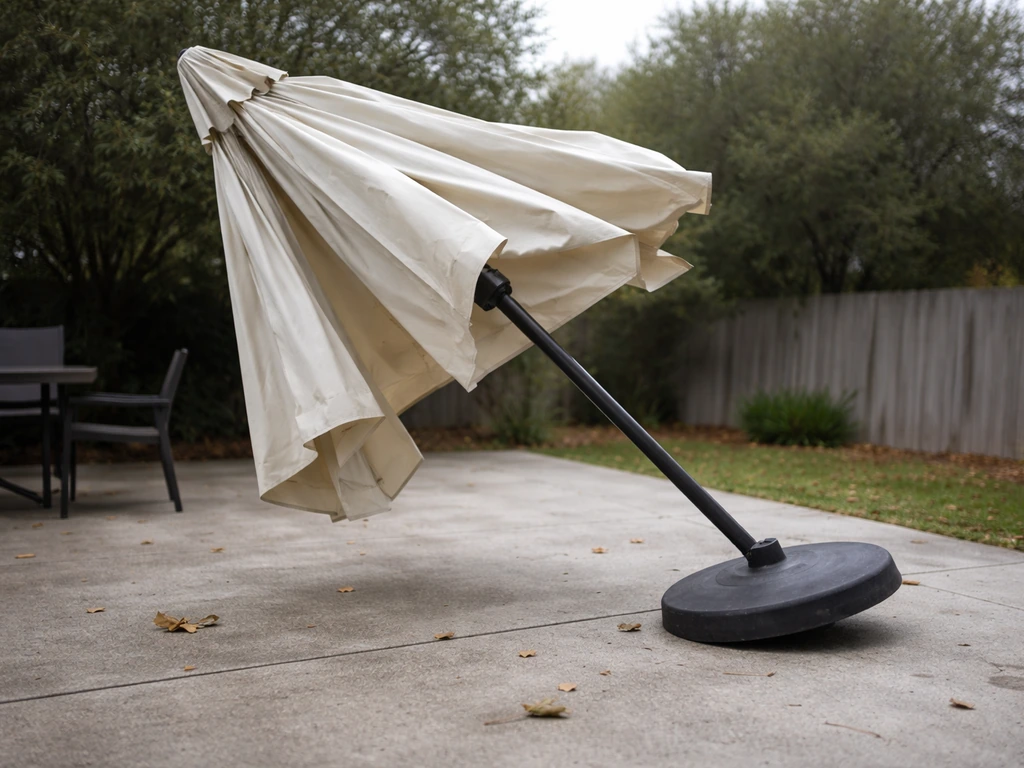
Patio Umbrella Tips Over: Fix Tilting, Base, and Wind Stability
Stop a tilting patio umbrella fast: fix base weight, wind stability, and broken tilt and crank parts step by step.
Patio Umbrella Tilt Mechanism Broken Fix in Minutes
Quick troubleshooting and DIY repair for a broken patio umbrella tilt mechanism, button, linkage, gears and seized pivot
How to Fix a Patio Umbrella That Won't Open or Close
Step-by-step fixes for patio umbrellas that won’t open or close, with checks for jams, cords, latches, and lubricating t