When a patio umbrella tips over, the immediate fix is to close it, get it back upright, and not reopen it until you've figured out why it fell. In most cases the culprit is one of three things: not enough base weight for the umbrella size, the tilt mechanism left unlocked so the canopy caught wind like a sail, or the pole wasn't seated fully in the base. Fix those three things and you'll solve 80% of tip-over problems before lunch. If you find a patio umbrella stuck in base, stop forcing it and troubleshoot the pole seating and collar/clamp first so it can move and close properly.
Patio Umbrella Tips Over: Fix Tilting, Base, and Wind Stability
Luca Morrison
29 Apr 2026
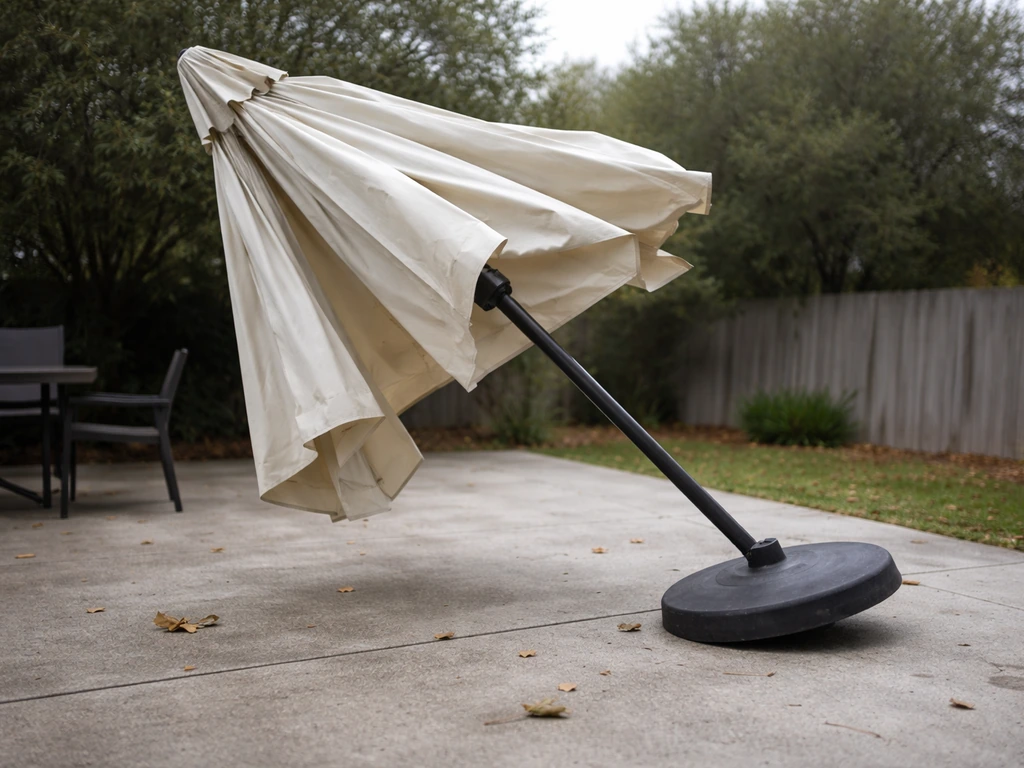
Why your patio umbrella is tipping over
Patio umbrellas are designed to block sun, not to handle wind. Manufacturers are blunt about this: one widely-used use and care manual states umbrellas should never be opened or operated in wind conditions above 5 mph (8 kph), and the tilt function should never be used in any wind at all, even a light breeze. That's a very low threshold. Most people underestimate it, and that's where tip-overs start.
Beyond wind, here are the most common root causes of a tipping umbrella:
- Underweight base: The base is too light for the size of the umbrella. A large cantilever like the Treasure Garden AG25T requires a minimum of 200 lbs. of base weight. Most people use far less.
- Wrong base type: A small in-table or pole base paired with a large or offset cantilever umbrella simply won't hold.
- Tilt left partially engaged: If the tilt button isn't fully locked in place, the canopy angle shifts in the wind and acts as a lever arm that topples the whole assembly.
- Pole not fully seated: The pole sits too high in the base, raising the center of gravity and reducing clamping pressure.
- Loose assembly hardware: Bolts, set screws, or collar clamps that worked loose over the season allow the pole to shift.
- Soft or sloped ground: Even a slight grade under the base lets the whole thing walk toward the downhill side.
- Umbrella left open unattended: Every umbrella manufacturer says to close and strap the canopy any time you walk away. An open umbrella left alone in a building breeze will tip.
- Damaged cord or crank mechanism: A worn-out crank cord causes the canopy to partially drop on one side, creating uneven wind resistance.
- Bent or broken ribs: A rib failure lets one side of the canopy collapse, which immediately shifts the load and can pull the whole umbrella over.
Safety check and immediate stabilization steps
Before you do anything else, make the umbrella safe. A tipped umbrella with an open canopy is still catching wind and can swing or slide. Here's the order of operations:
- Close the canopy first. Crank or push the canopy fully closed before you try to stand the umbrella back up. This removes wind resistance and makes the pole much easier to handle safely.
- Tie the canopy closed. Use the velcro strap, tie cord, or any soft strap you have. This keeps it from accidentally blowing open while you work.
- Get a second person if the umbrella is heavy. Cantilever models especially can weigh 30–50 lbs. or more on the arm alone. A tip-over with someone leaning over it can cause real injury.
- Check the area behind the umbrella before lifting. Cantilever arms swing wide when you set them upright. Treasure Garden's own assembly manual calls out this specific hazard.
- Stand the umbrella upright and do not reopen it yet. Get it vertical, reseat the pole fully in the base, and tighten any collar or set screw you find.
- Inspect for damage before the next use. Check ribs, the pole, the crank housing, the cord, and the tilt button. If anything is bent or cracked, stop and repair before reopening.
Wind and tilt prevention: setup that actually holds
Getting the setup right from the start is the most effective tip-over prevention there is. These adjustments take about ten minutes and make a real difference.
Height and pole seating
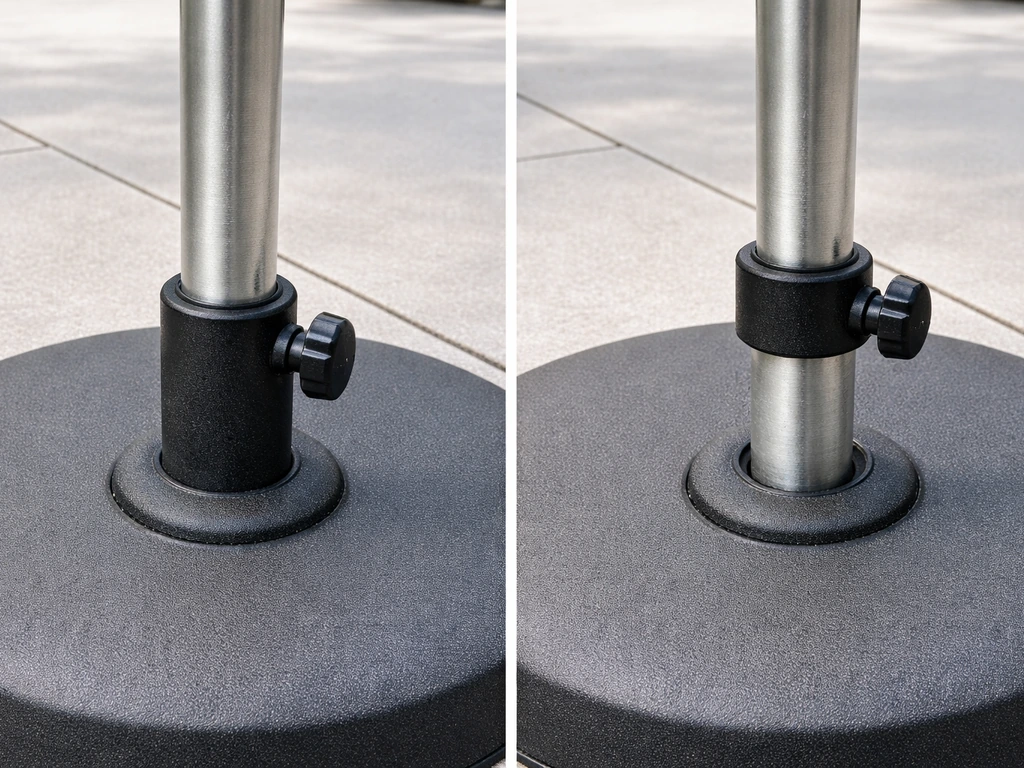
Push the pole all the way down into the base and tighten the collar clamp or set screw until it bites. A pole that floats an inch or two high has a much higher effective center of gravity and dramatically less lateral stability. If your base has a thumbscrew or hex bolt clamp, use a screwdriver or wrench on it, not just your fingers.
Tilt angle and locking
The tilt function is specifically for fine sun-angle adjustment when there's no wind, not for angling the canopy into the breeze. To set it correctly: push and hold the tilt button in, gently move the canopy to the angle you want, then release the button and confirm it clicks or locks. If the button pops back out without locking, the canopy will drift. Never leave the umbrella tilted at all if any wind is expected. If you are dealing with patio umbrella problems caused by wind and a tilt that will not stay locked, start with the opening and tilt setup steps described earlier. Even a light tilt dramatically increases the sail effect. When in doubt, tilt it back to vertical.
Opening height and procedure
Open the canopy slowly using the crank and stop if you feel unusual resistance. Unusual resistance usually means a rib is still constrained by packaging wrap (common on new setups, as Treasure Garden's assembly instructions specifically warn about this), or a rib is catching on another rib due to cord tension problems. Forcing the crank past resistance can bend a rib or snap the cord, both of which cause instability.
Closing policy when unattended
Treasure Garden puts it plainly: no umbrella, regardless of size or weight, should ever be left unattended in the open position. Close it, strap the canopy, and if you're leaving for more than an hour, consider covering it. This is the single easiest thing you can do to prevent tip-overs.
Correct assembly and crank/tilt mechanism troubleshooting
Mechanical issues with the crank or tilt are frequently connected to tip-overs, either because a partially open canopy is unstable, or because the umbrella can't be properly closed when wind picks up. If your patio umbrella tilt mechanism is broken, the safest next step is to stop using the tilt function and check the locking and button engagement before attempting any repair patio umbrella tilt mechanism broken. If the umbrella is stuck in a tilt position, make sure the button is engaging the lock correctly before you keep trying to move it patio umbrella tilt mechanism broken. Work through this diagnostic from simplest to most involved.
Umbrella won't open or close fully
- Check for packaging still attached to the ribs. On a new or recently reassembled umbrella, look under the canopy for zip ties, foam sleeves, or plastic banding around any rib. Remove all of it before operating.
- Check the crank handle for binding or damage. Turn it slowly and feel for rough spots. A bent crank arm or cracked housing will catch at the same point every rotation.
- Look at the crank cord inside the pole. On most center-pole umbrellas, the cord runs from the crank hub up through the pole and connects to the hub ring that lifts the canopy. If the cord is slack, frayed, or tangled, the canopy won't lift evenly.
- If the canopy only opens partway, check that all ribs have deployed. A stuck or bent rib will stop the canopy short. Gently push that rib outward by hand. If it won't budge or springs back, the rib itself may be bent at the hub joint.
Tilt mechanism not locking
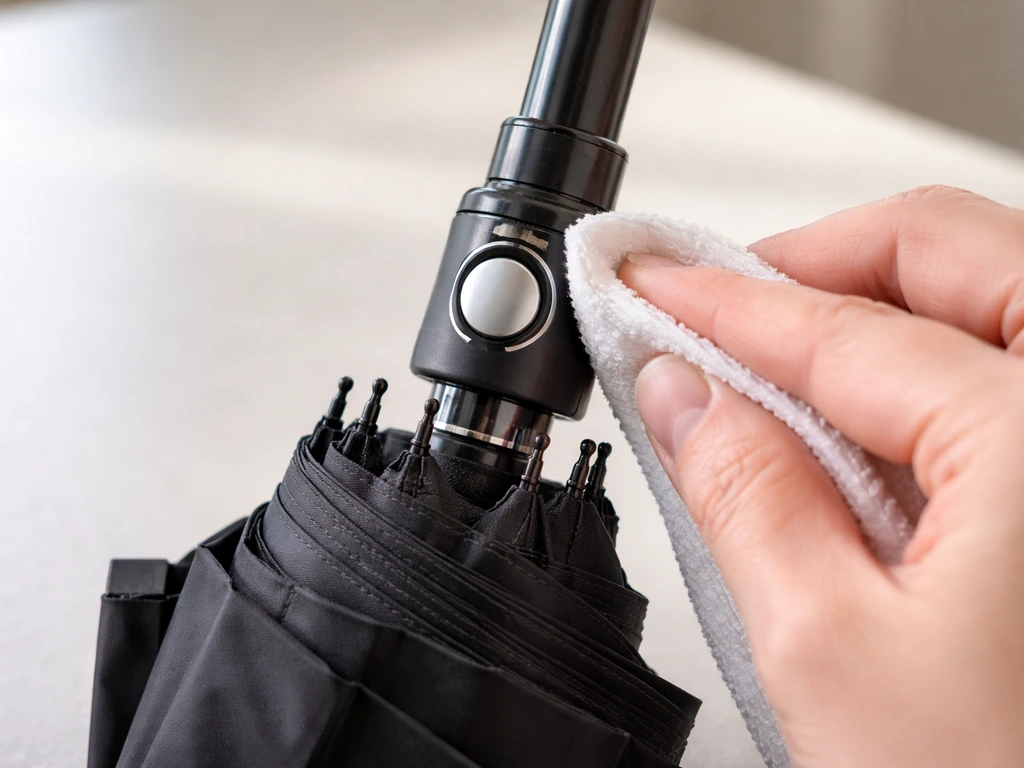
- Clean the tilt button area. Dirt, dried sap, and grit are the most common reasons a tilt button won't fully engage. Wipe around the button with a damp cloth, then test the click.
- Check for a bent button housing. If the button housing is cracked or deformed from a tip-over impact, the button may not travel far enough to engage the locking detent. This usually means replacing the tilt collar section.
- Confirm the canopy fabric isn't pulling the pole. On a tilted umbrella, if the fabric is tight due to humidity shrinkage or a taut valance, it can hold the pole at an angle that prevents the button from seating. Loosen the canopy slightly and try again.
- If the tilt works but doesn't hold under light pressure, the detent spring inside the collar is likely worn. Replacement tilt collar kits are available for most mid-range brands.
Cord replacement (when the crank spins but nothing moves)
A spinning crank that doesn't lift the canopy almost always means the cord has snapped or worked loose from the knot. On Treasure Garden UM810x and UM812x series umbrellas, the repair process is: remove the crank housing cover, rotate the umbrella so the crank mechanism faces up, straighten and remove the cotter pin that retains the cord end, thread the new cord through the hub channel, pull it taut, and tie a figure-eight knot at the anchor point. If there's slack after tying, re-tie the knot higher up the cord until it's snug. After reassembly, test open and close several times before using the umbrella outdoors. This repair applies to many other center-pole crank umbrellas, since the basic hub-and-cord design is nearly universal.
Tilt mechanism problems are closely related to tip-over stability, and if your tilt is fully broken rather than just sticky, that's a separate repair worth addressing on its own. Similarly, if the umbrella won't close at all after a tip-over, that's often a cord or rib issue that needs its own focused troubleshooting.
Base options and anchoring: what actually keeps it from falling
The base is the most important factor in tip-over prevention, and it's the most commonly underpowered piece of equipment on a patio. Here's how to think about your options.
How much weight you actually need
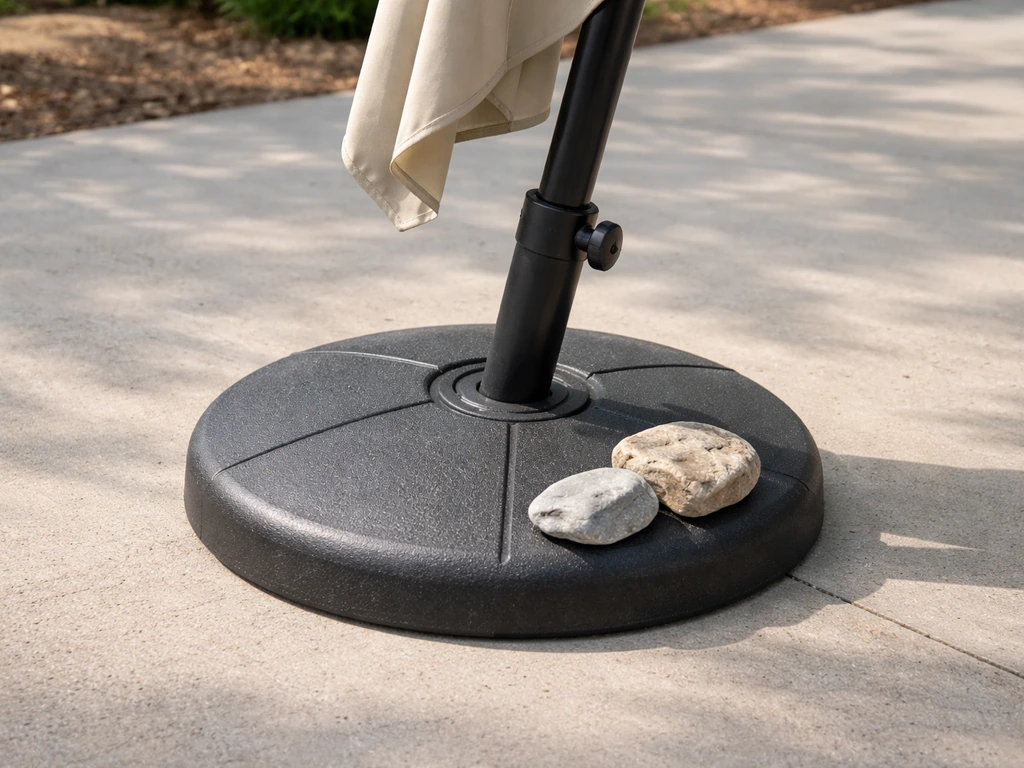
For a standard 9-foot center-pole umbrella, most manufacturers recommend at least 50 lbs. of base weight on flat, hard surfaces with no wind. For large canopies (11 feet and up), that minimum climbs fast. Cantilever and offset umbrellas need dramatically more because the arm extends the canopy far from the base, creating torque. The Treasure Garden AG25T cantilever manual states a minimum requirement of 200 lbs. of base weight for freestanding use. A common fillable cross-bar base set provides up to 200 lbs. when filled with sand, or up to 150 lbs. when filled with water. Sand is heavier and doesn't evaporate, so it's the better fill for permanent setups.
Base types compared
| Base Type | Best For | Typical Weight Range | Notes |
|---|---|---|---|
| Plastic fillable base (single ring) | Small to medium center-pole umbrellas, hard surfaces | 50–75 lbs. filled | Easy to move; water fill works but sand is heavier |
| Cross-bar cantilever base with fillable weights | Offset/cantilever umbrellas on patios | 150–200 lbs. filled | Requires all four weight sleeves filled before opening; do not use partially filled |
| Cast iron or resin umbrella stand | Any center-pole umbrella on hard surface | 40–60 lbs. solid | More stable than plastic; less adjustable for different pole diameters |
| In-ground anchor sleeve | Permanent installations in soil or concrete | Varies by concrete fill | Most stable option; requires planning but nearly eliminates tip-overs |
| Concrete footing with sleeve | Large umbrellas, windy locations | 50+ lbs. concrete fill | Permanent; best for consistently windy patios or decks |
Anchoring strategies by surface type
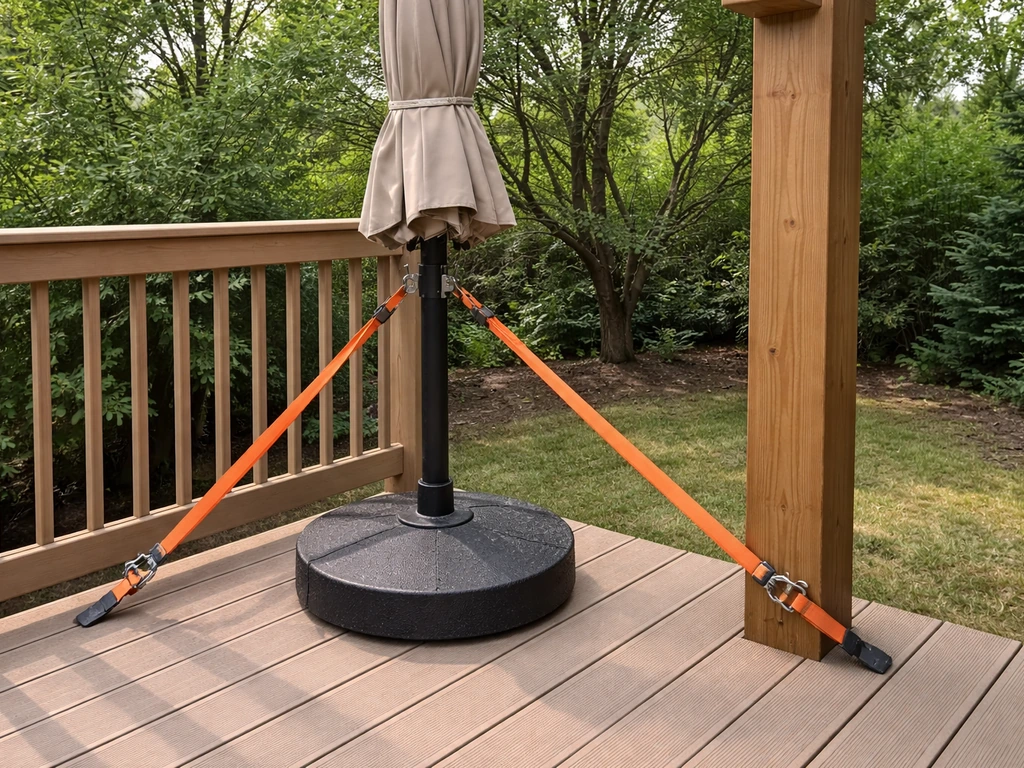
- Hard patio or deck: Use a heavy fillable base or cast-iron stand. Add tie-down straps from the pole to a fixed structure (pergola post, railing) using ratchet straps or bungee cords rated for outdoor use.
- Grass or soft ground: A standard base will sink and tilt. Drive a ground anchor stake or use an in-ground sleeve anchor to give the base a fixed point. Fill the base with sand regardless.
- Sloped surface: Level the base first using composite shims under the cross-bar feet. Treasure Garden's manual specifically warns against sloping or soft ground. If you can't get it level, move the umbrella.
- Deck with railing: Bolt a permanent pole sleeve or deck flange to the deck boards. This is far more stable than any portable base on a wooden deck surface.
- Windy exposure: Use the included tie-downs or straps that came with the umbrella to secure the closed canopy to the pole when not in use, and use the heaviest base you can reasonably install.
Brand and model-specific fixes
Most center-pole umbrellas share the same basic crank-and-cord design, so the diagnostic steps above apply broadly. But a few brand-specific things are worth knowing.
Treasure Garden (AG25T, UM810x, UM812x, TWISTUM851)
Treasure Garden is one of the most common mid-to-high-end brands, and their parts are actually obtainable. For cord issues on UM810x and UM812x models, Treasure Garden publishes a specific cord replacement procedure (summarized above in the cord section) and recommends testing function after every repair. The AG25T cantilever is a heavy-duty offset unit: if yours is tipping, the first thing to check is that all four base weight sleeves are filled with sand, not water, and that the installation surface is completely flat. The TWISTUM851 11-foot octagon model has a specific caution to tie the canopy with a string and use a protective cover when not in use, not just a strap. If a rib, tilt collar, or crank housing is broken on any Treasure Garden model, contact their customer support directly since most structural parts are available as replacements rather than requiring a whole new umbrella.
Generic and big-box store brands (Home Depot, Walmart, Target house brands)
These umbrellas use the same crank-and-cord internals as name brands, but replacement parts are rarely sold separately. If the crank housing cracks or a rib bracket breaks, your options are usually: find a generic replacement rib or crank kit on Amazon (measure the pole diameter and rib length before ordering), or accept that it's time to replace the canopy or the whole unit. The Half Plastic Umbrella Base sold at Home Depot (73 lb. version) follows the same 5 mph wind limit and tilt-in-wind prohibition as the name brands, so don't assume a heavier plastic base changes the wind rules.
When to replace instead of repair
Repair is almost always worth it when the problem is a cord, a tilt button, or a loose fastener. It gets less worth it when the main pole is bent (a bent aluminum pole will never sit straight in a base again), when multiple ribs are broken at the hub (this usually means the canopy will never open evenly), or when the base cross-bar is cracked or warped. A good rule of thumb: if the parts cost more than 60% of a new comparable umbrella, replace the umbrella.
Ongoing maintenance, seasonal storage, and winterizing
Tip-overs are much more common on umbrellas that haven't been maintained because loose hardware, worn cords, and corroded tilt mechanisms all fail under stress. A 15-minute checkup at the start of each season prevents most of them.
Start-of-season inspection checklist
- Check all pole collar clamps and set screws: tighten with a screwdriver or hex key until snug, not until they strip.
- Inspect the crank cord: open and close the umbrella twice and watch for cord fray, slack, or the canopy dropping unevenly on one side.
- Test the tilt button: push, adjust, release, and confirm it locks. If it sticks or doesn't click, clean it first, then evaluate for replacement.
- Look at every rib: open the canopy fully and look at the point where each rib connects to the hub ring. Hairline cracks at that joint are a failure waiting to happen.
- Check the base fill level: fillable bases lose water to evaporation and sand can compact. Top off as needed.
- Inspect the base feet for cracks: a cracked plastic base foot can shift unexpectedly on a hard surface.
- Lubricate the crank mechanism: a light spray of silicone lubricant (not WD-40, which attracts dirt) on the crank hub and tilt button keeps them operating smoothly.
End-of-season storage and winterizing
Storing an umbrella properly at the end of the season is the single biggest thing you can do to prevent a tip-over in the spring. Here's what to actually do:
- Close and strap the canopy, then tie the strap snug. A loosely strapped canopy will catch wind even indoors if a garage door is open.
- Remove the pole from the base entirely if you're storing it. A pole left in an outdoor base all winter is exposed to freeze-thaw cycles that can crack the base and seize the pole collar.
- Drain water-filled bases completely before freezing temperatures arrive. Ice expansion cracks plastic bases from the inside. Sand-filled bases can stay filled.
- Store the pole and canopy horizontally or hang it vertically in a garage, shed, or closet. Don't lean it against a wall at a sharp angle; this can put a permanent bow in a lighter aluminum pole.
- Cover the canopy fabric with a breathable cover or wrap loosely in a cotton sheet. Plastic bags trap moisture and cause mold on the fabric.
- In spring before the first use: re-read the start-of-season checklist above and do every item before opening the umbrella outdoors.
If you're leaving the umbrella outdoors for short periods during winter in mild climates, close it fully, strap it tight, and use a fitted weatherproof cover rated for outdoor storage. The main risk in mild winters is a surprise wind event, and a closed, covered umbrella handles those much better than an open or loosely covered one. Keep the base fully weighted even in storage position outdoors, because an empty base on a closed umbrella will still tip in a strong gust.
FAQ
How should I inspect the umbrella right after it tips over, before I try to open it again?
After a tip-over, check the pole clamp and set screw for looseness before you try opening again. Even if the umbrella looks intact, a partially seated pole or a clamp that has slipped slightly can recreate the same center-of-gravity problem the next time you use it.
What should I do if the tilt button doesn’t click or lock after a tip-over?
If the canopy will not lock when you release the tilt button, treat that as a wind-safety issue rather than a comfort issue. Set the canopy back to vertical, and avoid any tilt use until the lock engages cleanly, because a drifting tilt increases the sail effect.
Can I adjust the base or tilt while the umbrella is still open after it falls?
Yes, but only if the umbrella is fully closed and stable. Do not attempt to “adjust while open,” because the open canopy can catch gusts and swing, making the problem worse. Close first, then move to a flat area to reassess base weight and seating.
What does it mean if the crank spins but the canopy barely lifts?
If you hear a rumbling or feel the crank moving without lifting evenly, stop and inspect the cord at the hub before using it outdoors. A crank that spins freely usually means cord slack or a broken cord knot, which can lead to binding ribs and sudden instability.
Do offset or cantilever umbrellas tip for different reasons than center-pole umbrellas?
If you have an offset or cantilever umbrella, do not rely on the same base weight expectations as center-pole models. The longer arm creates more torque, so insufficient base weight or an uneven fill setup is a common reason the umbrella tips even when a center-pole model would survive.
If it’s only a light breeze, is it still unsafe to use the umbrella?
Don’t assume the wind warning only applies to “strong” wind. The practical guidance is to treat any breeze as potentially risky because umbrellas can catch gusts, and tilt increases the surface exposed to wind, so the safe move is to keep tilt at vertical and close sooner rather than later.
Is it safe to store the umbrella outdoors in winter with the base empty?
It can be, especially with closed storage in mild-winter conditions. If the base is left empty during storage, even a closed umbrella can tip in a strong gust, so keep the base weighted and use a cover that prevents the canopy from flapping.
The crank feels like it’s hitting something when opening. Should I push through?
Unusual resistance while opening is a sign of constrained ribs, cord tension issues, or leftover packaging wrap. Forcing the crank can bend ribs or snap cords, so stop opening, clear any wrap, and check that ribs move freely.
What should I troubleshoot if the umbrella won’t close after it tips over?
If the umbrella won’t close after a tip-over, the cause is often a rib constraint or cord and linkage tension issue, not just “misalignment.” Work from easiest checks first (pole seating, tilt lock position, visible cord slack) before attempting deeper disassembly.
What are the safest “temporary use” practices if I must keep the umbrella out for a short time?
If you’re forced to use it briefly in marginal conditions, keep it fully upright, fully closed when not directly attended, and do not use tilt at all. Also position it away from fences and planters that can block your ability to quickly close and secure it.
Next Articles
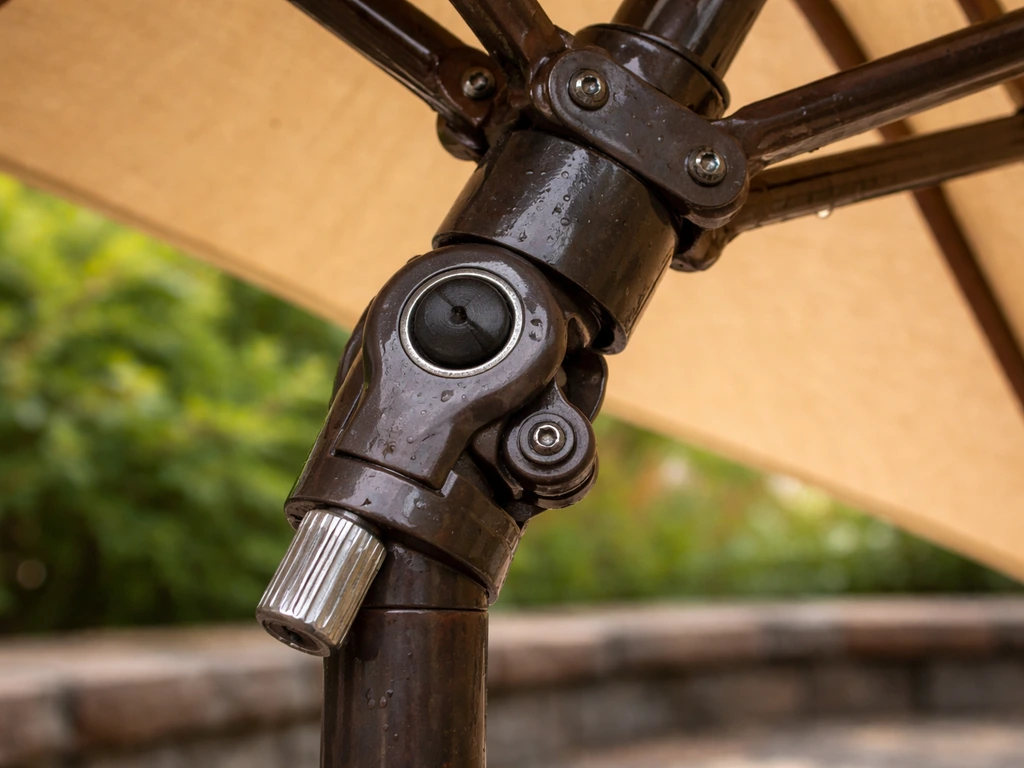
Patio Umbrella Tilt Mechanism Broken Fix in Minutes
Quick troubleshooting and DIY repair for a broken patio umbrella tilt mechanism, button, linkage, gears and seized pivot
How to Fix a Patio Umbrella That Won't Open or Close
Step-by-step fixes for patio umbrellas that won’t open or close, with checks for jams, cords, latches, and lubricating t
How Does a Patio Umbrella Work? Components, Use, and Fixes
Learn how patio umbrellas work: components, open close tilt, stability, and step by step troubleshooting common mechanic