
Most of the time, a stuck patio umbrella cord comes down to one of three things: something physical is jamming the line (debris, a knot, a frayed section catching on a guide), the internal spring or ratchet mechanism has locked up from tension or corrosion, or the cord has jumped off a pulley or roller and is now binding against the frame itself. Before you yank hard and snap the cord or strip the ratchet, take two minutes to figure out which one you're dealing with. If you want a more detailed walkthrough after you identify the cause, follow these instructions on how to fix patio umbrella cord for a step-by-step repair approach. The fix is usually simple once you know what's actually stuck.
Patio Umbrella Cord Stuck: Fix It Safely Today

Luca Morrison
29 Apr 2026
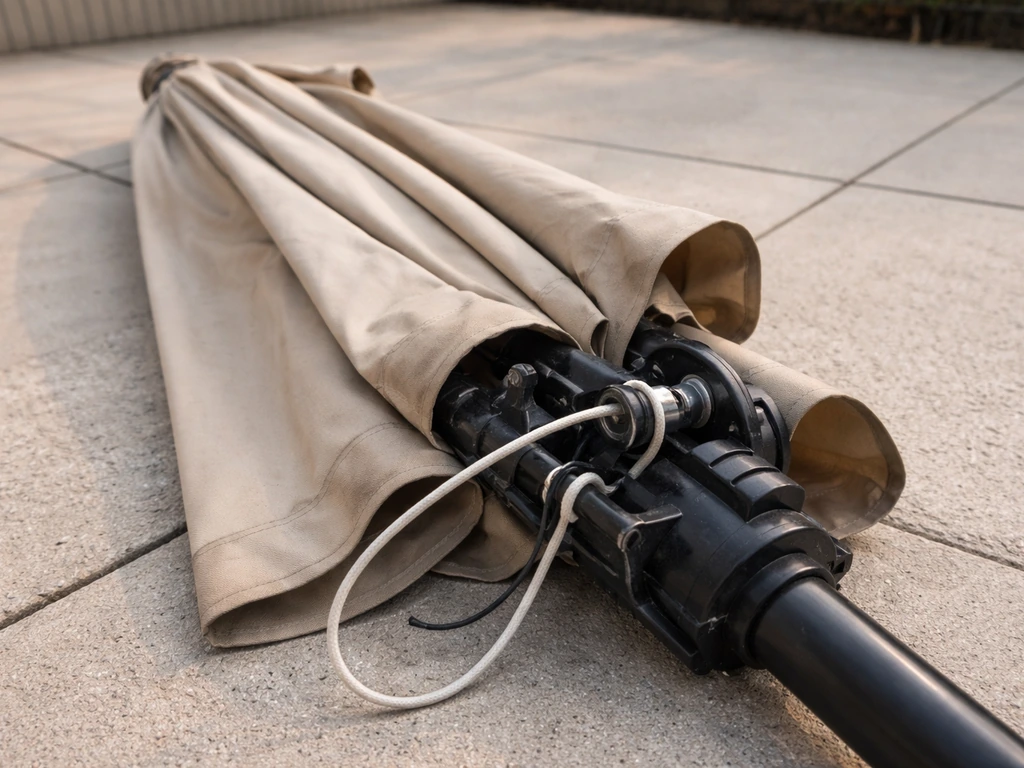
Safety check first: what kind of 'stuck' are you dealing with?
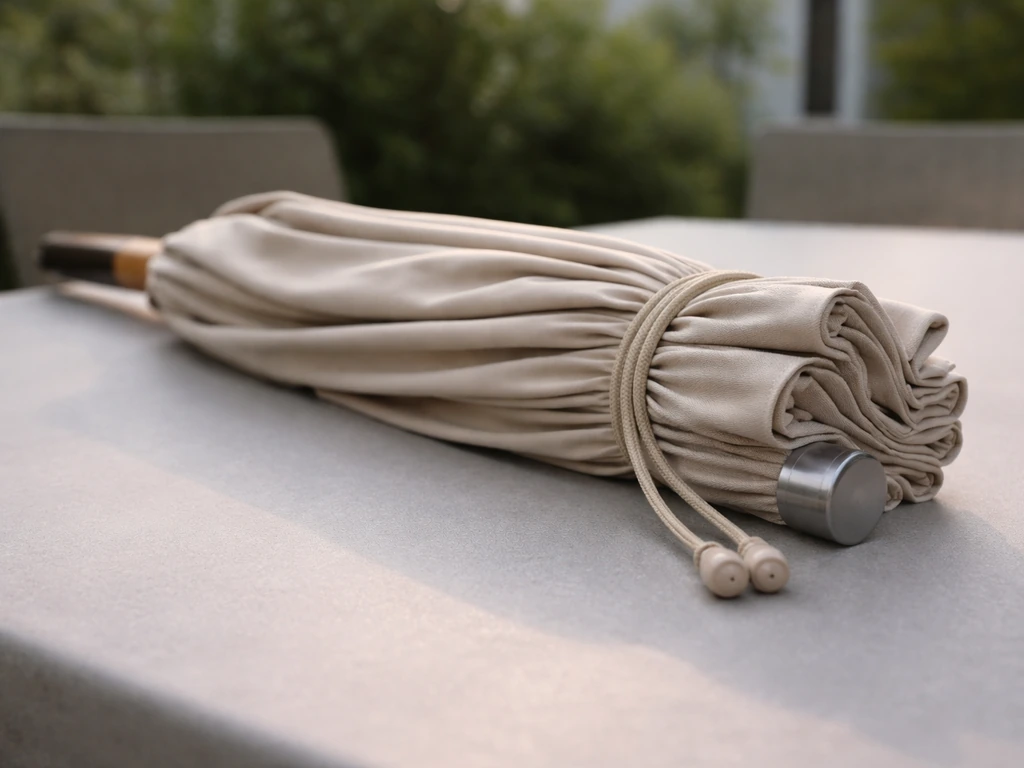
Before touching anything, close the umbrella as much as it will go and remove it from the table base or ground stand if possible. Lay it down on a flat surface like a patio table or a blanket on the ground. A horizontal umbrella is much safer to work on because there's no risk of the canopy falling or the pole spinning on you when you release tension.
Now identify exactly what 'stuck' means for your umbrella. These are the four most common presentations:
- The pull cord won't move at all in either direction (completely jammed or the cord is tied off or knotted inside)
- The cord pulls but doesn't retract or spring back (broken or unwound tension spring, or the cord has slipped off the retraction spool)
- The cord moves partway then catches (frayed section snagging on a guide, or debris in the cord channel)
- The cord feels very stiff or grinds when you pull (corroded internal mechanism, worn crank gear, or a dry/seized pulley)
Run your hand along the entire visible length of the cord from the handle down to where it disappears into the pole. Look for obvious kinks, fraying, knots, or spots where the cord is pinched against the frame. If you can see the problem right there on the outside, you may not need to open anything up. If the cord disappears into the pole and you can't locate the issue visually, you'll need to go inside the mechanism, which we'll get to below.
Why cords get stuck: the usual suspects
Knowing the cause saves you a lot of trial and error. Here are the most common reasons an umbrella cord stops working properly:
Debris and dirt buildup
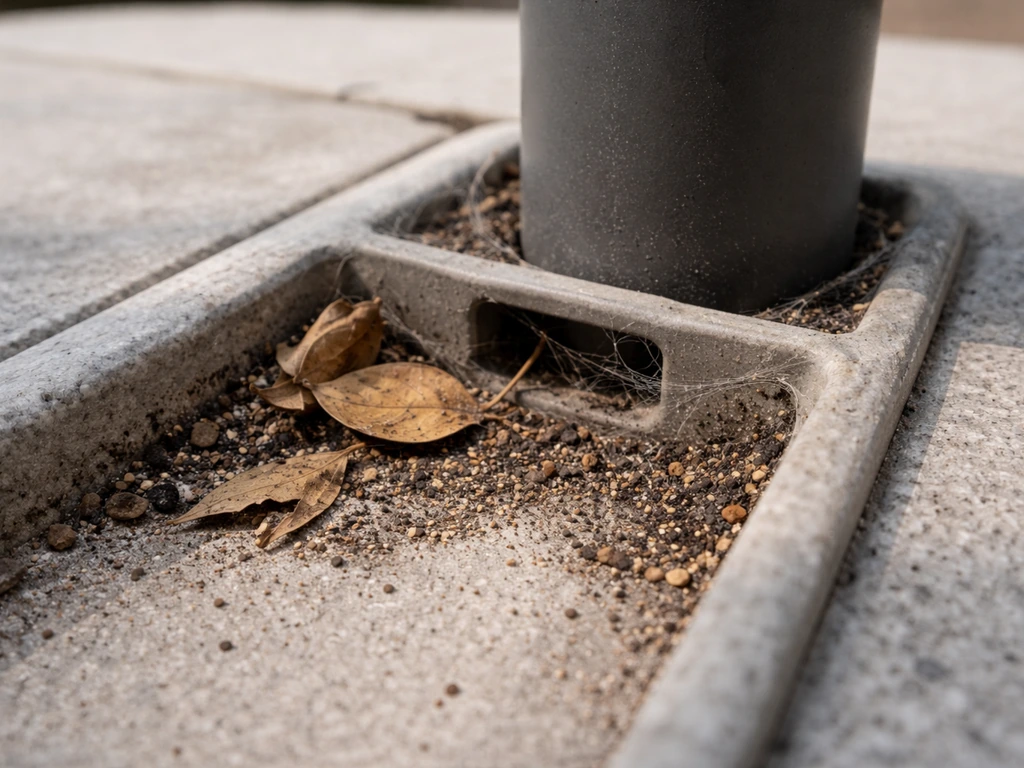
This is the most common cause by far, especially at the end of a long outdoor season. Grit, dried leaves, spider webs, and hardened mineral deposits from rain or sprinklers can pack into the cord guide holes or the channel the cord runs through inside the pole. The cord itself still looks fine but it catches on every pull.
Frayed or swollen cord
Polypropylene and nylon cords absorb moisture, and after a few seasons they can swell, fray, or develop fuzzy spots. Even a small fray can catch in a guide opening that was sized for a clean, smooth cord. If you see any fluffing, stiffness, or discoloration along the cord, that section is probably your culprit.
Locked tension spring
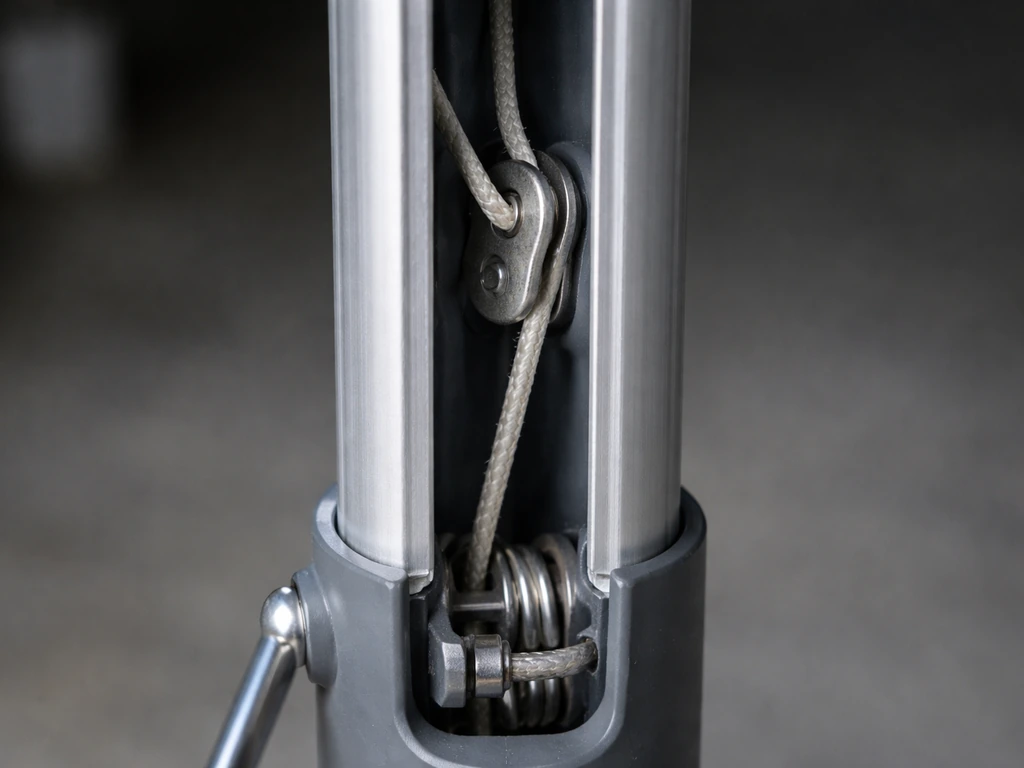
Most pull-cord umbrellas use a coil spring inside the pole to retract the cord after you pull it. If that spring loses tension (it unwinds over time), the cord won't spring back. If the spring gets kinked or corroded, it can lock up entirely and prevent the cord from moving in either direction. You'll often hear a subtle grinding or clicking when this happens.
Cord off the pulley or spool
Inside the pole there's typically a small plastic or metal pulley that the cord wraps around or passes over. If the cord jumps the pulley track, it pinches against the housing and won't move. This usually happens after the umbrella is opened too fast, after it's been stored folded tightly for a long time, or after a hard wind event.
Jammed crank or ratchet
Crank-lift umbrellas use a gear and ratchet system rather than a pure pull cord, but a secondary tilt cord or lift cord still runs through the assembly. If the crank gear is stripped, jammed with debris, or the ratchet pawl is stuck, the cord tied to that mechanism can't advance or release. You'll notice the crank handle turns freely without any resistance, or doesn't turn at all.
Clutch or push-button wear
Push-button umbrellas use a spring-loaded clutch button partway down the pole. When you press the button and push up, the canopy locks in place. When the cord attached to that clutch is stuck or the button mechanism is corroded, the cord can't release the clutch and the whole thing seizes. This is especially common on older aluminum pole umbrellas stored without covers.
Step-by-step: free the cord without breaking anything
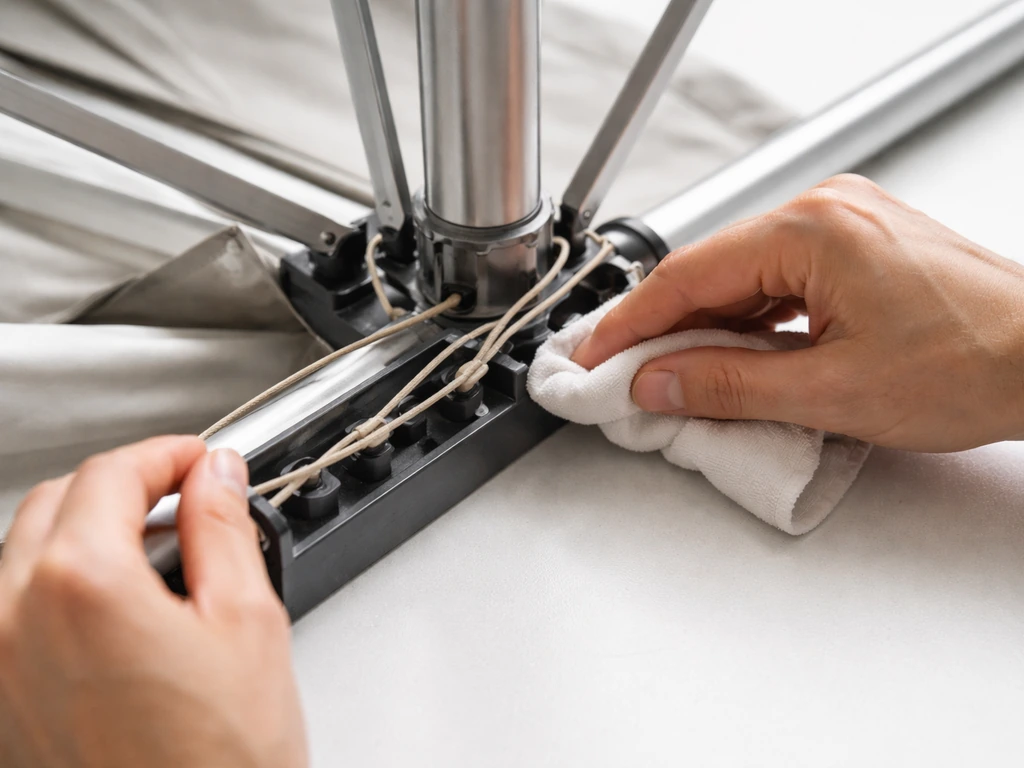
Work through these steps in order. Start with the least invasive and stop as soon as the cord moves freely again. Don't skip ahead to opening up the mechanism if a simple cleaning fixes it. If you can’t move the cord, you may need to learn how to open a patio umbrella with the cord still stuck so you can free the mechanism safely open anything up.
- Lay the umbrella horizontal on a flat surface and take the canopy off if it detaches easily. This removes weight and lets you rotate the pole freely.
- Locate all the cord guide holes in the pole (small openings where the cord enters and exits the pole). Use a toothpick or compressed air to clear any visible debris from each guide hole.
- Gently pull the cord with steady, even pressure. Never jerk or yank. If it moves even slightly, work it back and forth a little at a time to loosen whatever is catching.
- If the cord is totally rigid, spray a small amount of silicone-based lubricant (not WD-40) into each guide hole. Wait 60 seconds and try again with gentle, steady pulls.
- If the cord still won't move, look for the section of cord between the guide holes. Is there a frayed spot, a knot, or a section where the cord is visibly pinched? If yes, mark that spot with a piece of tape so you know exactly where to focus when you open the mechanism.
- If you can't see or access the problem from outside and the cord is buried inside the pole, you'll need to open the housing. This means removing the crank housing or the tilt collar, depending on your umbrella type. See the next section for instructions by mechanism.
One important caution: if the cord won't budge in either direction and you feel significant resistance, do not keep pulling. You risk snapping the cord, bending the pulley housing, or unwinding the spring so far it can't be rewound. Stop, open the mechanism, and look at what's happening inside before applying any more force.
Fixes by umbrella type
Crank-lift umbrellas
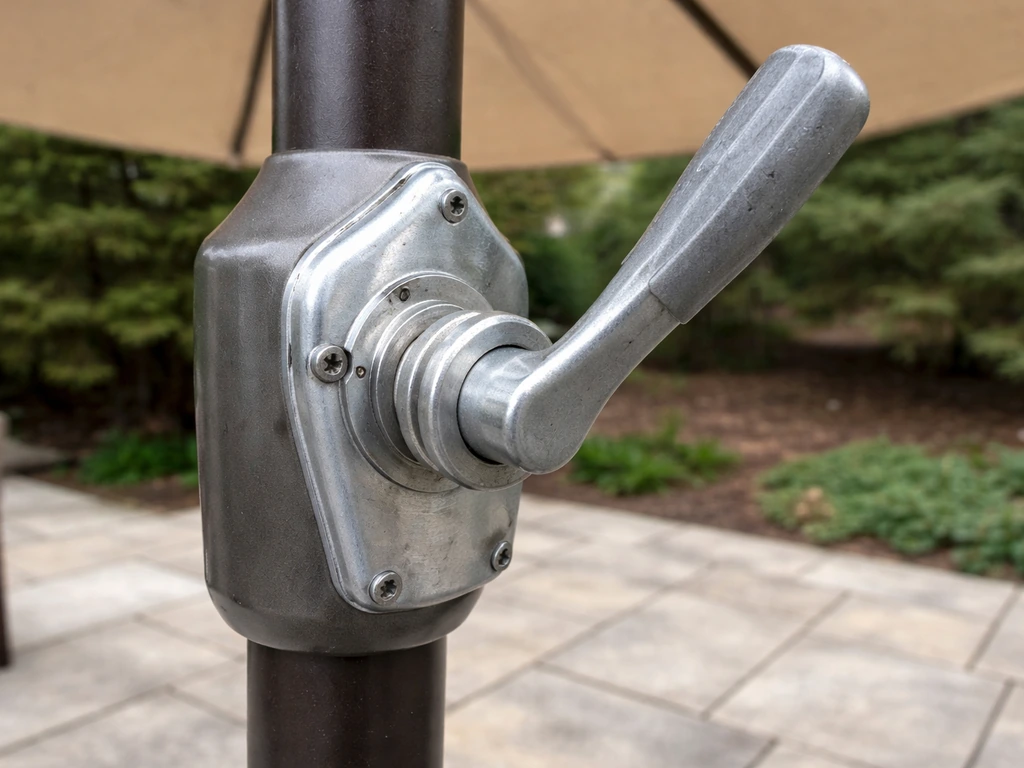
On a crank-lift umbrella, the cord that controls the tilt (if your model has auto-tilt) runs through the pole and connects to the tilt collar, separate from the crank mechanism that opens the canopy. If the crank feels loose or spins without lifting, the gear or ratchet inside the crank housing is the problem, not the cord.
If the tilt cord is stuck, unscrew the crank housing (usually two to four Phillips-head screws around the collar), remove it, and rotate the pole so the crank mechanism faces up. You'll now be able to see the internal cord path and find where it's binding.
This is the same procedure Treasure Garden recommends for their UM810x and UM812x Auto Tilt series: remove the crank housing, rotate so the mechanism faces up, then straighten and carefully remove the cotter pin to access the gear and cord anchor. A needle-nose pliers, Phillips screwdriver, and small wrench are the tools you'll need.
Push-button umbrellas
For a push-button lift umbrella (the type with a button on the pole that you press to release and push the ribs up), the cord is usually the return line that retracts the button or holds the canopy position. Check that the button itself isn't physically stuck in the pressed position from corrosion. Spray silicone lubricant directly onto the button shaft and work it back and forth. If the cord attached to the button mechanism is frayed right at the button collar, that's what's causing the jam. You'll need to disassemble the button collar (usually a single set screw or a threaded ring) to replace that short section of cord.
Manual tilt umbrellas
Manual tilt umbrellas use a collar or knob partway up the pole that you twist to lock the tilt angle. There's often a separate pull cord that helps tension the tilt. If the tilt collar is frozen, check for grit or rust at the collar joint, and apply lubricant there. The cord on a manual tilt system is generally shorter and under less spring tension, so if it's stuck, it's almost always debris or a frayed spot at the collar entry point. Disassemble the collar by unscrewing it counterclockwise (most are threaded), clear the cord path, and rethread the cord through the cleaned channel.
Pulley and retraction systems
Some umbrellas, especially larger market-style and offset cantilever models, use a pulley-and-rope system to lift the canopy. If the rope is stuck, first check every pulley in the system, including those at the top of the center pole and any pulleys on the frame arms. A single pulley with a cracked or off-track wheel will jam the whole line. Spin each pulley with your finger. It should spin freely. If one doesn't, remove the pin or bolt holding it (usually a cotter pin), inspect the pulley wheel for cracks or a cord that has jumped the groove, reseat the cord, and reinstall. If the pulley wheel itself is cracked or badly worn, replace it before retesting.
When the cord or internal parts are actually damaged
Sometimes freeing the cord reveals that the cord itself, or a component it runs through, is past the point of just cleaning and lubricating. Here's how to assess each situation honestly.
| What you find | Repair or replace? | Difficulty |
|---|---|---|
| Cord is frayed in one spot, rest is intact | Replace the cord | Easy to moderate |
| Cord is frayed in multiple spots | Replace the cord | Easy to moderate |
| Cord is snapped or cut | Replace the cord | Easy to moderate |
| Pulley wheel cracked or worn groove | Replace pulley wheel (part) | Moderate |
| Spring has no tension or is kinked | Replace tension spring | Moderate to hard |
| Crank gear is stripped (turns freely, no lift) | Replace crank assembly | Moderate |
| Pole is bent at the cord guide hole | Replace pole section or full umbrella | Hard / consider replacement |
| Cotter pin is bent or broken | Replace cotter pin (inexpensive) | Easy |
For cord replacement specifically, the process involves threading a new length of cord (match the diameter and material of the original, usually 3mm to 4mm braided nylon or polyester) from the handle end, through every guide hole and pulley, down to the anchor point. Treasure Garden's Auto Tilt manual is explicit about one important prerequisite: if the cord is not visible outside the umbrella frame at the point of the break, the replacement cannot be completed without full disassembly. That's a good rule of thumb for any brand. If you can't trace the full cord path with your eyes, stop and get a clearer picture of the routing before you try to thread anything new through.
Before you start a cord replacement, gather the right tools: a Phillips-head screwdriver, needle-nose pliers, a small wrench, a needle and thread (useful for pulling the new cord through tight channels), and scissors to trim the new cord cleanly. Read through the full process for your specific model before starting. The Treasure Garden UM810x/UM812x manual is available as a PDF on their official site if you have one of those models. The Treasure Garden UM810x/UM812x assembly and operation manual is available as a PDF download on Treasure Garden's official site (TGAutoTiltManual122823) available as a PDF on their official site. SunSetter owners can access their model-specific manuals through the SunSetter Owners Corner support page.
When is replacement smarter than repair? If the umbrella frame itself is bent, the pole has a crack near a cord guide, or the crank assembly requires parts that cost more than half the umbrella's replacement price, it's worth pricing out a new umbrella. But for most stuck-cord situations, a $5 to $15 replacement cord and an hour of work will fully restore the umbrella.
Test it before you call it done
After any repair, don't skip a proper test before putting the umbrella back in its base and loading the canopy with wind. Here's a quick post-repair checklist:
- With the umbrella still horizontal, pull the cord slowly through its full range of motion. It should move smoothly with consistent resistance, no jerking or catching.
- If the cord is spring-retracted, release it gradually and confirm it retracts fully without bunching or jamming.
- Reattach the canopy and stand the umbrella upright in its base. Open it fully, then close it fully at least twice before leaving it unattended.
- Check the tilt function if your model has it. The cord should lock and release the tilt angle without sticking at any position.
- Look at all cord guide holes from the outside. The cord should run cleanly through each one with no fraying visible at the entry points.
Keep it from getting stuck again
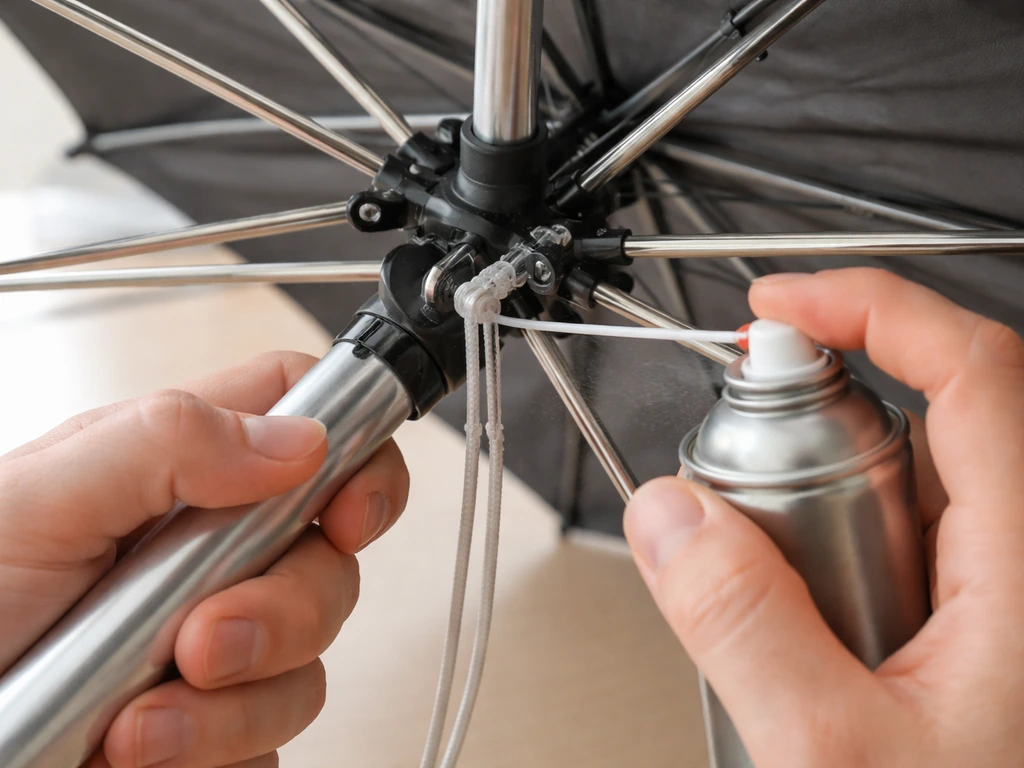
A few simple habits will extend the life of the cord and mechanism significantly. Most stuck-cord problems are caused by neglect over a season or two, not by any manufacturing defect.
- Use silicone spray lubricant on cord guide holes and pulley wheels once a season. Avoid WD-40 and petroleum-based lubricants because they attract grit and can degrade cord material over time.
- Close and cover the umbrella before any storm. Wind-whipped open umbrellas put extreme stress on cords and can pop the line off pulleys.
- Before winter storage, open and close the umbrella twice to make sure the cord is fully retracted and not bunched inside the pole. Store with the canopy off or in a breathable cover.
- Clean the cord guide holes with a toothpick or soft brush at the start of each season to remove any debris that accumulated during storage.
- Inspect the cord visually every spring. If you see any fuzzing, stiffening, or discoloration, replace it before the season starts. A fresh cord at the beginning of the season is much easier to deal with than a snapped one in July.
- Open and close the umbrella slowly and deliberately. Fast pulls put shock loads on the spring and pulley and are the main cause of cords jumping off pulleys.
Brand and model-specific notes
If you can identify your umbrella brand and model, you'll save a lot of guesswork. Here are a few specific callouts for popular brands.
Treasure Garden (UM810x / UM812x Auto Tilt)
Treasure Garden's Auto Tilt umbrellas are one of the most common premium patio umbrella series in North America, and their cord replacement process is well-documented. The official Auto Tilt Cord Replacement Manual (Manual 714) is available as a PDF on Treasure Garden's website.
The procedure requires you to remove the canopy and bottom pole first, then remove the crank housing by unscrewing it, rotate the mechanism so the crank faces up, and remove the cotter pin before accessing the cord and gear. One critical note directly from their manual: if the cord is not visible outside the umbrella frame at the break point, the replacement cannot be completed. Do not try to force cord access if you can't trace where the break is.
The required tools are a Phillips-head screwdriver, pliers, wrench, needle and thread, and scissors.
SunSetter retractable awnings and umbrellas
SunSetter products have model-specific cord routing that can differ significantly between generations. Their Owners Corner support portal gives you access to the exact manual for your model. For stuck cords on SunSetter units, always pull your manual before disassembling anything because the internal spring tension on some models is high enough to be a pinch/snap hazard if released improperly.
Generic market umbrella and offset umbrella pulley systems
If you have a market umbrella or a large offset cantilever umbrella without a brand name, check the pulley hardware at the very top of the pole first. These pulleys are usually held by a single cotter pin or a small bolt, and they're the most common failure point on generic models. Replacement pulley wheels for standard 3/8-inch rope diameter are widely available at hardware stores for under $5.
What if you still can't find your model?
If you can't match your umbrella to a specific brand or manual, follow the manufacturer guidance from a comparable product in the same category (crank-lift, push-button, or pulley style). The general mechanical principles are the same across most brands. For more detailed guidance on the actual cord replacement process once you've freed the stuck line, the full restringing walkthrough and cord fix instructions in the related guides on this site will walk you through it step by step. For a complete restringing walkthrough, follow the step-by-step guide on how to restring patio umbrella cords actual cord replacement process.
FAQ
What should I do if my patio umbrella cord is stuck and won’t move either direction?
If the cord feels jammed in both directions, don’t keep testing with repeated pulls. Stop, open the mechanism (or remove the crank housing/button collar for that type), then check whether the cord has jumped a pulley track or whether the spring is binding from corrosion. A cord that only moves one direction often indicates a guide clog, while zero movement usually points to pulley mis-track or a locked spring.
Can I open the mechanism to free a patio umbrella cord safely without fully disassembling the umbrella?
Yes, but only after you confirm the umbrella is fully closed and the canopy cannot fall or spin. Work with the umbrella horizontal on a stable surface, and if your model has high spring tension, avoid loosening any housing until you can see where the cord is routed. If you can’t trace the cord path visually, that’s a sign you may need full disassembly before rethreading, not just a local fix.
What lubricant should I use for a stuck patio umbrella cord, and where should I apply it?
Use silicone lubricant sparingly on the moving shafts and buttons, not on the cord itself. Oily sprays can attract grit and make the next jam worse. If you already sprayed around the mechanism and the cord still binds, wipe off excess lubricant, then clean the cord guide/channel area so the cord can move dry and smooth.
Do I have to replace the entire cord if only one section is damaged?
If the cord is frayed only at one spot, replace just that section when the design allows it (for example, at a button collar or at an accessible anchor) rather than replacing the entire cord in every case. However, if the fray is near where the cord disappears into the pole and you cannot trace the break point externally, plan for full disassembly or a complete restring so the routing stays correct.
My crank handle turns, but the canopy won’t lift. Is it the cord or the crank mechanism?
If your crank handle spins or feels loose but the canopy won’t lift, the crank assembly is likely stripped or jammed, not the cord. The quickest diagnostic is to compare crank movement to tilt movement (if you have auto-tilt) and then remove the crank housing to inspect the gear, pawl, and internal cord anchor point for binding or missing tension.
How can I tell whether the problem is a stuck rope/pulley system versus a cord inside the pole?
A “rope” system is different from a push-button or pure pull cord, so check every pulley for free rotation before touching the cord. Spin each pulley by finger, and if one won’t spin freely, inspect the wheel for cracks and confirm the rope is seated in the groove. If the rope jumped a track once, it can happen again after reassembly if the wheel is worn.
What’s the safest way to test the umbrella after I fix a stuck cord?
After any cleaning or cord work, do a cord-only function test first: pull or operate the cord in small increments with the umbrella still lying down and unloaded. Then open and close the canopy slowly two to three cycles before putting it back into service. This helps you catch a misrouted cord or a partially seated pulley before it becomes a full jam.
How do I choose the right replacement cord size and material so it won’t get stuck again?
If you have a model-specific manual, match the cord diameter and material, braided nylon or polyester around the commonly used 3 mm to 4 mm range for many umbrellas. Don’t reuse a stretched cord, even if it looks intact, because it can swell or bind in guides after a few seasons. If the new cord doesn’t move freely through every guide during restringing, stop and re-check the routing before closing the pole.
What if the cord still jams after replacing it, does that point to a bigger problem?
If you feel unusual resistance even after cleaning, check whether the internal cord is pinched against the frame where the rope or cord path changes direction, especially near pulley housings and guide entries. Bent frames and misaligned guide holes can cause repeated binding even with a brand-new cord, so it’s worth inspecting for a bent pole section or cracked guide near where the cord first stops moving.
Next Articles
How to Fix a Patio Umbrella That Won't Open or Close
Step-by-step fixes for patio umbrellas that won’t open or close, with checks for jams, cords, latches, and lubricating t
How Does a Patio Umbrella Work? Components, Use, and Fixes
Learn how patio umbrellas work: components, open close tilt, stability, and step by step troubleshooting common mechanic
Patio Umbrella Crank Not Working: DIY Fix Guide
Fix a patio umbrella crank that won’t work with safe step-by-step jam, gear, and base troubleshooting and repair tips.