
To untilt a patio umbrella, you press or release the locking mechanism specific to your tilt type, manually swing the upper pole back to vertical, and re-engage the lock. The exact steps depend on whether your umbrella uses a push-button, crank gear, pulley cord, sliding collar, or gas-spring system, and I'll walk you through each one below, including what to do when the mechanism is stuck or damaged.
How to Untilt a Patio Umbrella: Step-by-Step Fix & Tips Guide
Luca Morrison
12 Aug 2026
What this guide covers and who it's for
If your umbrella is stuck at an angle, won't return to upright, or the tilt mechanism feels jammed, this guide is for you. I've worked through all five common tilt systems, so whether you have a basic push-button market umbrella from a big-box store or a cantilever model with a gas-spring auto-tilt, you'll find the right procedure here. I'll also cover troubleshooting for stuck or broken mechanisms, point you toward replacement parts, and give you an honest take on when a repair is worth the effort versus when it's time to buy new.
Safety first before you touch anything
Before adjusting or disassembling any tilt mechanism, run through these precautions. A tilted canopy catching a gust of wind while you're leaning over it is a real hazard, and prying open a pressurized gas spring can be genuinely dangerous.
- Never adjust the tilt while the umbrella is in wind. Close or furl the canopy first, then work in calm conditions.
- Make sure the base is secure and won't tip. Use a base rated for your pole diameter and filled with sand or water as directed.
- Keep bystanders, especially children and pets, clear of the canopy arc during adjustment.
- Never attempt to open, heat, or drill into a gas spring (gas strut). These are sealed nitrogen-filled pressure devices. Stabilus and other gas-spring manufacturers warn explicitly that tampering can cause injury from sudden pressure release.
- If your umbrella is under warranty, check the manual before disassembling the tilt housing. Treasure Garden, for example, states that tampering voids the warranty.
- Use work gloves when handling metal pole sections and rusted fasteners to avoid cuts.
How to figure out which tilt system you have
Most umbrellas have one of five tilt designs. Identifying yours takes about thirty seconds and saves you from following the wrong set of instructions. Here's how to spot each one.
| Tilt Type | Where to Look | What You'll See or Feel |
|---|---|---|
| Push-button | Upper pole section, just below where the canopy hub sits | A small plastic or metal button you press inward to release the hinge |
| Crank tilt (crank-through) | Side of the pole, mid-height | A crank handle; continued cranking past full-open engages the tilt |
| Pulley / cord | Inside the pole or at the runner (the ring that slides up the pole) | A cord or rope threaded through pulleys; pulling or releasing the cord tilts the top section |
| Sliding / twist collar | A separate rotating collar ring above or below the crank housing | A collar you twist or slide to release a hinge, then manually tilt the upper pole |
| Gas spring / auto-tilt | Usually on cantilever / offset umbrellas; look for a metal strut alongside the upper arm | A gas strut (looks like a small shock absorber) or a lever-assisted tilt that moves with light pressure |
If you're not sure, pull up the manual for your model. Hampton Bay umbrellas sold at Home Depot always have a model number on the tag near the pole base, and Hampton Bay posts PDF manuals with exploded parts diagrams on the Home Depot product pages. Treasure Garden labels their mechanism type on the product PDF and in their parts catalog. For Costco SunVilla models, the Costco product page includes a 'Manuals and Guides' link that specifies the tilt type.
Push-button tilt: how it works
The push-button tilt is the most common design on mid-range market umbrellas, including many Treasure Garden UM920x series models. Inside the upper pole there's a spring-loaded detent pin. When you press the external button, it retracts that pin, freeing an internal hinge that connects the upper and lower pole sections. The upper section can then pivot forward or back through roughly 30 to 45 degrees. When you release the button, the pin pops back into a corresponding hole in the upper section, locking the angle. There are typically two or three locking positions: upright, one notch of tilt, and sometimes a second, steeper tilt angle. The mechanism is simple and reliable, but the button can seize from corrosion, the plastic housing can crack, or the detent holes in the upper pole can wear oval over time, causing the lock to slip.
Step-by-step: untilting a push-button umbrella
- Secure the base. Confirm the umbrella is in a weighted base that won't tip. If the canopy is currently open and angled into wind, close it by turning the crank in reverse before touching the tilt.
- Fully open the canopy. Crank the umbrella all the way open so the canopy is taut and the runner (the sliding ring on the pole) is at the top stop. You need full canopy tension off the tilt joint to move it cleanly.
- Locate the push-button. It sits on the upper pole, usually within 12 to 18 inches below the hub (the central spoke connector). It's typically a small oval or round button, often black or silver plastic.
- Press and hold the button firmly. Use your thumb or two fingers. You should feel a slight click or give as the internal pin retracts. If the button feels seized, spray a small amount of penetrating oil (such as WD-40) around the button housing, wait two minutes, and try again.
- While holding the button in, use your other hand to grasp the upper pole above the hinge and swing it back to vertical. Move slowly. You'll feel it align with the lower pole.
- Release the button. The pin should snap into the upright-lock hole. Give the upper pole a gentle side-to-side shake to confirm it's locked. If it wobbles, press and release the button one more time to reseat the pin.
- Check the lock before reopening. If the umbrella is indoors or in storage, you're done. If you're putting it back outside, reopen the canopy and verify the upper section doesn't drift under the canopy's weight.
A common gotcha here: some push-button umbrellas have the tilt button on both sides of the pole (two buttons that both need to be pressed simultaneously to release). If pressing one side does nothing, check the opposite side of the pole for a second button.
Crank tilt: how the gear and ratchet system works
Crank-tilt umbrellas, sometimes called crank-through designs, use a single crank handle to do two jobs: raise the canopy and tilt the upper section. The crank drives a spool and gear train inside the pole housing. When you crank the umbrella open, the runner climbs the pole until it hits the top stop. At that point, continued cranking disengages from the lift function and instead drives a cam or secondary gear that rotates the upper section of the pole on its hinge pivot. Cranking forward tilts the top away from you; cranking backward (reversing) brings the upper section back to vertical. Hampton Bay's crank-and-tilt cantilever models, including several of the 11-foot LED offset umbrellas, use this architecture and their assembly manuals include exploded diagrams of the crank housing and gear train. The failure points in this system are stripped gear teeth (usually plastic), a worn crank spool, and corrosion inside the housing that prevents the secondary cam from engaging.
Step-by-step: untilting a crank umbrella
- Confirm the canopy is fully open. If the canopy is half-open and the pole is tilted, crank forward until the canopy is taut at the top stop before attempting to adjust tilt. Forcing the tilt while the runner is mid-pole can jam the gear train.
- Identify the tilt direction. Stand facing the tilt (the direction the top is leaning). You'll crank in reverse (the opposite direction from opening) to bring the top back to vertical.
- Crank slowly in reverse. After a few turns you should feel a slight resistance change as the lift mechanism passes neutral and the tilt cam engages. The upper section will begin to rotate back toward vertical.
- Stop when the upper section is upright. Most crank-tilt systems have a built-in stop or click that indicates the upright position. Don't over-crank past the vertical stop or you'll tilt the canopy the opposite direction.
- If the crank turns but nothing moves, stop. This usually means stripped gears or a disengaged cam. See the troubleshooting section below before applying more force, which can strip what's left of the gear teeth.
- If the mechanism is stiff but moving, apply a small amount of silicone spray lubricant to the crank shaft and into the housing vents, then try again. Avoid WD-40 inside plastic gear housings as it can degrade some plastics over time.
For Hampton Bay crank-tilt models specifically, the manual PDF (available via Home Depot's product page using your model number) contains the exact crank sequence and an exploded parts diagram with part numbers for the crank assembly. If you have a Costco model, the same principle applies: locate the manual via the Costco product page and look for the crank housing parts illustration.
Pulley and cord tilt: components and what fails
Pulley and cord systems use a rope (or flat webbing) routed through one or more sheaves (small grooved wheels) inside the pole. When the crank raises the runner, a secondary cord path shifts to pull the upper section into a tilt angle. See the U.S. patent application: Umbrella with hub reinforced tilt coupling (diagram & cord/pulley description) for an illustrated example of a pulley‑and‑spool tilt mechanism using rope and sheaves. Returning to vertical means releasing tension on that cord path, allowing the upper section to drop back to upright, usually assisted by the canopy's own weight. The cord feeds around a spool that's driven by the crank in many designs, while simpler versions use a pull-cord with a cleat or knot lock.
These systems are elegant when new but they have several well-known failure points. Here's what to check first if your pulley-cord umbrella is stuck in a tilted position or won't tilt at all.
- Frayed or broken cord: the most common failure. Inspect the visible cord length for fraying, thinning, or a clean break. Replacement cord kits are available from parts dealers like UmbrellaSpecialist and ShadeUSA.
- Knotted or jammed cord: the cord can bunch inside the pole if it slips off a sheave. Open the crank housing cover (usually two or three Phillips screws on the housing cap) and look for cord piled up on the spool or wedged against the housing wall.
- Seized sheave bearing: if the cord is intact but the mechanism is stiff, the sheave may have corroded bearings. Spin each pulley wheel by hand through the access opening; it should spin freely. A seized wheel shreds cord quickly.
- Cord off the sheave groove: the cord can jump out of the sheave channel, especially if someone cranked hard against a jam. Reseating it requires accessing the housing and guiding the cord back into the groove.
- Spool engagement failure: the spool that winds the tilt cord is often engaged by a cam at the top-of-travel position. If the crank's lift cord slips or the runner doesn't fully reach the top stop, the tilt cord spool may never engage.
To untilt a pulley-cord umbrella that's working normally, crank the canopy fully open to the top stop, then continue cranking in reverse one or two turns to release tension on the tilt cord. The upper section should rotate back to vertical under its own weight. If it doesn't, gently assist it by hand while continuing to reverse-crank. If the cord is broken or jammed, you'll need to access the housing to address the cord before the tilt can reset. Treasure Garden and Oasis model manuals include rib and cord path diagrams that are invaluable here. If you're tracking down a cord replacement or trying to understand the exact routing, those diagrams are your best starting point.
Sliding collar and twist-collar tilt
Collar tilt systems place a separate rotatable or sliding ring on the pole, typically above the crank housing or just below the canopy hub. You twist or push the collar to disengage the hinge lock, tilt the upper section by hand to the angle you want, and then twist or release the collar to re-lock. To untilt, you simply twist the collar to release, swing the upper pole to vertical, and re-engage. The physical steps are straightforward, but the collar itself is a common failure point. Many collars are two-piece plastic covers retained by screws hidden under snap tabs. Those screws corrode, the snap tabs break, and the plastic collar housing can crack under lateral load. If your collar feels like it's not gripping properly after you release and re-engage, the internal clamp or spring clip inside the collar housing has likely worn or broken and needs replacement.
When disassembling a collar to access the internal clamp, look carefully for hidden fasteners before forcing anything. A thin flathead screwdriver run around the seam of the collar will reveal whether the two halves are screwed together or snapped. Be gentle: cracking the collar housing means a parts order before you can use the umbrella again.
Gas spring and auto-tilt systems
Auto-tilt and gas-spring systems are most common on premium cantilever and offset umbrellas. A gas spring (gas strut) is a sealed cylinder filled with pressurized nitrogen. It provides resistance or assistance to movement, so the upper section of the umbrella feels like it glides to any angle and holds there without a locking mechanism. For a detailed explanation of how auto-tilt patio umbrellas work and the role of gas springs in those systems, see our guide on how to auto tilt patio umbrellas work (internal link). Some designs use the gas spring purely as a damper while a separate locking lever holds the position; others rely on the gas spring's internal friction to hold the angle. To untilt one of these umbrellas, release the locking lever if there is one, then manually push or pull the upper section back to vertical. The gas spring provides enough resistance that you don't need to hold it: just guide it upright, re-engage the lever lock if present, and you're done.
When the gas spring weakens or fails, the umbrella won't hold its angle. It will slowly drift or drop under the canopy's weight. Replacement is the only fix because gas springs cannot be recharged at home. To find a replacement, measure the extended length center-to-center at the mounting ball joints, the compressed length, the stroke (the difference between those two), and the rod and cylinder diameters. You'll also want to check the force rating in Newtons, which is sometimes stamped on the cylinder body. Gas spring cross-reference suppliers like DK Gas Spring maintain dimensional tables that let you find a compatible replacement even if the OEM part number is worn off. Do not attempt to open, heat, or drill into a gas spring under any circumstances.
Troubleshooting a stuck or jammed tilt mechanism
If the standard untilt procedure for your mechanism type didn't work, here's a systematic way to diagnose what's actually going on.
| Symptom | Likely Cause | First Fix to Try |
|---|---|---|
| Button won't press in | Corrosion or debris around button shaft | Penetrating oil, wait 2 min, try again |
| Button presses but pole won't pivot | Detent holes worn oval, or upper pole bent at hinge | Check if hinge pivot pin is intact; inspect for bent pole |
| Crank turns but umbrella won't untilt | Stripped plastic gear teeth or disengaged cam | Open crank housing and inspect gear teeth; replace housing if stripped |
| Crank is completely seized | Corroded spool shaft or internal rust | Apply penetrating oil to crank shaft; if no movement after 10 min, remove housing to inspect |
| Cord hangs loose and tilt is floppy | Broken or detached cord | Replace cord kit; re-route per parts diagram |
| Cord is tight but tilt won't move | Cord jammed in housing or sheave seized | Open housing, free jam or replace seized sheave |
| Collar won't twist to release | Corroded internal clamp or broken snap tab | Remove collar cover screws, inspect and replace internal clamp |
| Gas spring umbrella drifts from any position | Gas spring pressure lost | Measure strut dimensions and replace gas spring |
| Upper pole wobbles after locking | Worn detent hole or broken lock pin | Replace push-button assembly or tilt housing |
One thing I see repeatedly: people keep cranking or forcing a jammed mechanism trying to break it free. That almost always strips the last intact gear teeth or snaps a cord that was only partially frayed. If something feels wrong after two or three attempts, stop and open the housing to look before you apply more force.
Brand-specific notes: Hampton Bay and Costco umbrellas
Hampton Bay
Hampton Bay umbrellas are sold exclusively through Home Depot and cover a wide range of mechanisms, including push-button, crank-through tilt, and gas-spring cantilever models. The most useful thing you can do before any repair is locate your model number (printed on the label near the base of the pole or on the packaging) and pull the corresponding PDF manual from the Home Depot product page. For step‑by‑step instructions specific to Hampton Bay models, see our guide on how to tilt Hampton Bay patio umbrella. Hampton Bay manuals include exploded-view parts diagrams with part numbers and a customer service contact for ordering replacement components. The YJAF052-C series, for example, documents the full crank-open and tilt sequence and calls out the crank housing and gear components by part number. If you're dealing with a Hampton Bay tilt mechanism, that manual is worth having open on your phone while you work.
Costco / SunVilla models
Costco has commonly stocked SunVilla-branded umbrellas, including auto-tilt market umbrellas in 9-foot and 10-foot sizes, as well as cantilever models. Costco's product pages include a 'Manuals and Guides' section where you can download the care and assembly guide for the specific model year. For step-by-step, model-specific instructions, look for a 'how to tilt patio umbrella Costco' guide or similar phrase in the Manuals and Guides section on the product page. SunVilla also provides a customer service line for parts inquiries. Auto-tilt Costco models typically use a crank-through or gas-spring system, so the procedures in those sections above apply. If you're specifically sorting out a Costco auto-tilt model, the tilt mechanism section of the manual will clarify whether you have a crank-cam or gas-spring design.
Where to find replacement tilt parts
Before ordering anything, write down your umbrella's brand, model number, and the specific part name from your manual's parts list. Using the OEM part number gives you the best chance of getting an exact fit. Here are the most reliable sources I've found. If you need a broken patio umbrella tilt mechanism replacement part, search suppliers using your umbrella's OEM part number or the model plus key measurements (e.g., gas-spring lengths or screw patterns) to ensure a compatible match. Where to source replacement parts: specialty online parts dealers and OEM/dealer networks commonly used by pros/homeowners include Umbrella Specialist, patio umbrella parts & canopies (retailer/supplier), ShadeUSA/PatioFurnitureSupplies, Casual Furniture Solutions/CasualFS and dealer parts programs (Treasure Garden dealers) Umbrella Specialist — patio umbrella parts & canopies (retailer/supplier).
- UmbrellaSpecialist.com: stocks crank handles, tilt collars, cord kits, push-button assemblies, ribs, and canopies. Good cross-reference help from their customer service team.
- ShadeUSA / PatioFurnitureSupplies: carries a wide range of OEM and aftermarket parts, including replacement spool and gear components for common crank-tilt systems.
- Casual Furniture Solutions (CasualFS): specializes in Treasure Garden and similar branded parts; useful if you have a Treasure Garden umbrella outside its dealer warranty period.
- Treasure Garden authorized dealers: for warranty replacement parts on Treasure Garden umbrellas, contact an authorized dealer through Treasure Garden's website and reference the parts catalog illustrations.
- DK Gas Spring and similar gas-spring suppliers: for gas-spring replacement on auto-tilt and cantilever models; provide your measured dimensions to get a matched replacement.
- Home Depot customer service (for Hampton Bay): Home Depot can source Hampton Bay replacement parts using the model number and part number from the manual PDF.
Repair versus replace: an honest cost assessment
Most small tilt component repairs are genuinely worth doing. A replacement push-button assembly runs roughly $8 to $20. A cord kit is typically $10 to $25. A new crank handle and housing assembly for a mid-range umbrella is usually $25 to $50. A replacement gas spring, depending on size, costs $20 to $60 from a cross-reference supplier. For a quality umbrella that originally cost $150 or more, those repair costs make obvious sense.
The picture changes when structural damage enters the equation. A bent or crushed upper mast section, three or more broken ribs, a heavily corroded tilt joint where the spline has rusted into the hinge housing, or widespread cracking of the main pole sections are signs that repair is no longer practical. At that point you're looking at costs that approach or exceed a comparable replacement umbrella, and the repaired assembly will still be weaker than a new one. Treasure Garden's own warranty guidance notes that tampering (disassembling beyond small component replacement) voids the warranty, which is also a signal about what the manufacturer considers a reasonable repair boundary.
| Situation | Recommended Action | Approximate Part Cost |
|---|---|---|
| Seized push-button (corrosion) | Clean and lubricate; replace button if still stuck | $8–$20 |
| Stripped crank gear (plastic teeth) | Replace crank housing assembly | $25–$50 |
| Broken or frayed tilt cord | Replace cord kit | $10–$25 |
| Failed gas spring (won't hold angle) | Replace gas spring (measure and cross-reference) | $20–$60 |
| Cracked or broken collar housing | Replace collar assembly | $15–$35 |
| Bent upper mast or multiple broken ribs | Replace umbrella assembly | Cost of new umbrella |
| Heavily corroded tilt joint / spline | Replace umbrella assembly | Cost of new umbrella |
Maintenance tips to keep the tilt working smoothly
Most tilt mechanism failures I see are caused by two things: wind damage from leaving the umbrella open when it shouldn't be, and corrosion from leaving metal hardware wet season after season. Both are preventable.
- Close the umbrella whenever wind exceeds about 15 mph. Canopy drag in wind puts enormous lateral stress on the tilt hinge and can bend the upper mast or strip gear teeth in a single gust.
- Lubricate the tilt mechanism at the start and end of each season. Use silicone spray (not WD-40) on plastic gear housings and a light machine oil on metal pivot pins. Avoid greases that attract grit.
- Inspect the cord on pulley-cord systems once a year. Look for fraying at the spool and at each sheave contact point. A $15 cord replacement done proactively beats a mid-season jam.
- Store the umbrella in a protective cover or bring it inside (or to a dry garage) for winter. Moisture trapped under a patio umbrella cover that isn't breathable is one of the fastest routes to corrosion on the tilt housing screws and gear components.
- Check collar screws every spring. A loose collar screw allows the collar to flex and crack under use. Tighten snugly but not so tight you risk cracking the plastic housing.
- If you live in a coastal environment, rinse the pole and hardware with fresh water monthly. Salt air accelerates corrosion on aluminum and steel hardware dramatically.
FAQ
How do I identify which tilt mechanism my patio umbrella uses?
Look at the upper pole and the runner area: push-button tilt has a visible metal or plastic button on the upper pole; crank-and-tilt has a crank handle and a gearbox on the pole; pulley/cord systems have a rope or cord running through a pulley or covered housing; sliding/twist-collar tilt has a rotating collar near the runner or crank; gas‑spring/auto‑tilt has a metal cylinder (gas strut) or an enclosed mechanism on offset/cantilever arms. Check the umbrella manual or model tag if unsure.
What is the safe, step‑by‑step method to untilt a push‑button (manual) tilt umbrella?
1) Place umbrella firmly in a heavy base on level ground and ensure no one stands under it. 2) Fully open the canopy (if applicable) to relieve tension. 3) Press and hold the push button on the upper pole. 4) With one hand supporting the upper pole/canopy, gently swing the upper pole back to vertical until the button engages a hole. 5) Release the button and test lock. If it’s stuck, stop and inspect the button area for debris/corrosion before forcing it.
How do I untilt a crank‑and‑tilt umbrella safely?
1) Secure umbrella in base. 2) Fully open the canopy using the crank to move the runner to its normal stop. 3) If it’s a crank‑through design, continue cranking per manual until the tilt disengages and the pole straightens. 4) If tilt is controlled by a secondary lever/collar, operate that control while supporting the canopy and return pole upright. 5) If runner or gears are locked, stop, remove the crank housing cover per manual and inspect gears/cord/spool for jams or stripped teeth before applying more force.
What’s the proper procedure for untilting an umbrella with a pulley/cord (rope & sheave) system?
1) Anchor umbrella in a heavy base. 2) Open canopy so the runner is at a safe position. 3) Inspect visible cord route and pulley covers—look for knots, frays or seized sheaves. 4) If runner is stuck, remove access screws/covers to inspect the spool and pulleys. 5) Free any jammed cord or replace a frayed/knotted rope with the correct diameter/type per parts list, then re‑route the cord and crank or pull gently to return pole to vertical.
How do I untilt a sliding/twist‑collar umbrella?
1) Support the canopy and locate the collar above or below the runner. 2) Remove any decorative cover or hidden screws (careful prying may be needed). 3) Twist or slide the collar per the model’s operation instructions while lifting/tilting the upper pole back to vertical. 4) If the collar is stuck from corrosion or debris, apply penetrating lubricant to fasteners and carefully free the collar to avoid breaking plastic covers.
How do I handle an auto‑tilt (gas spring) umbrella that won’t return upright?
1) Do not attempt to open or disassemble the gas spring; they are high‑pressure sealed units. 2) Support the canopy and visually inspect gas‑spring mounts and ball joints for separations or broken brackets. 3) If the gas spring is weak or damaged (no resistance, leaks, bent rod), replace the gas spring with a proper drop‑in unit—measure center‑to‑center length, stroke, rod/cylinder diameters and force (N) or use OEM part number. 4) If unsure, consult a pro or authorized service—do not puncture the gas spring.
Next Articles
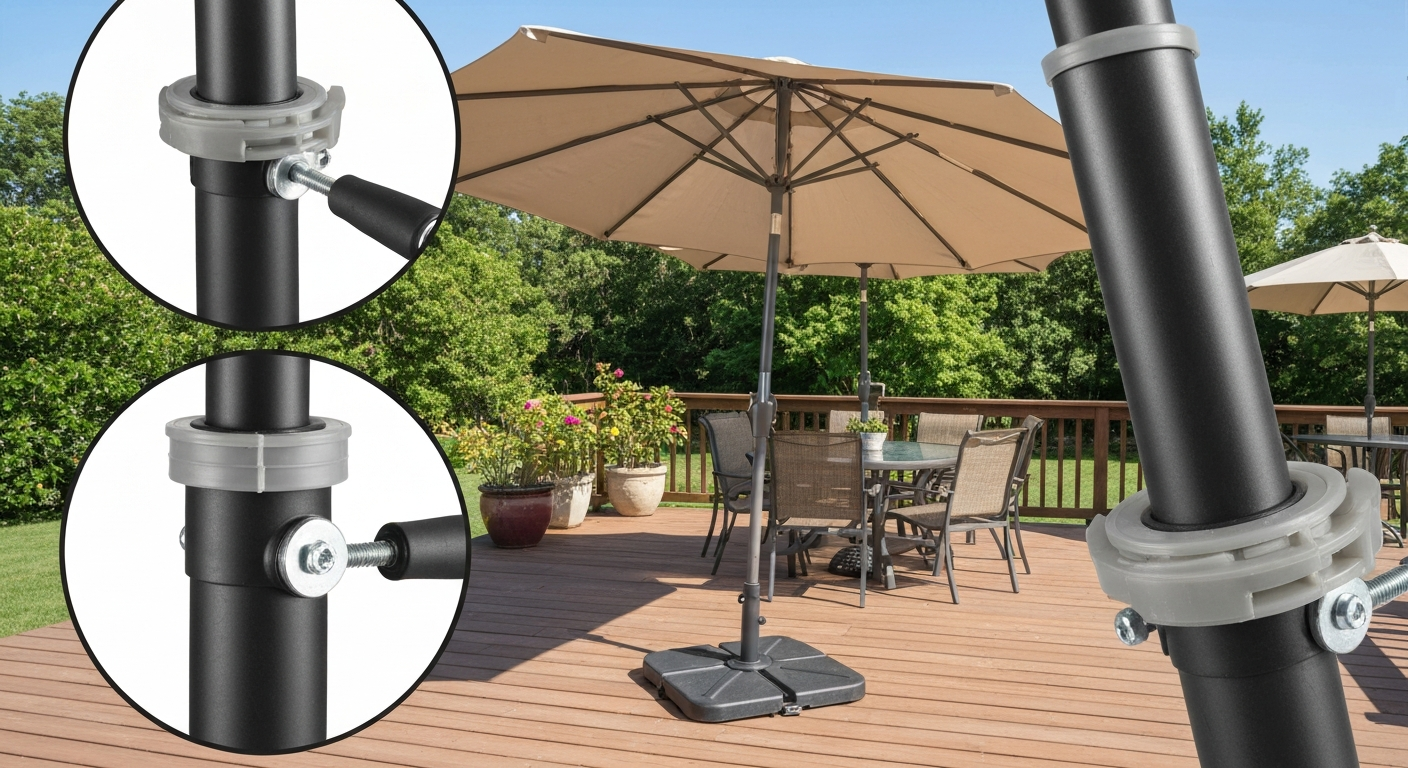
How to Tilt Patio Umbrella Costco: Tilt & Repair Tips
How to tilt patio umbrella Costco: step-by-step tilt/untilt, ID, fixes, parts & safety
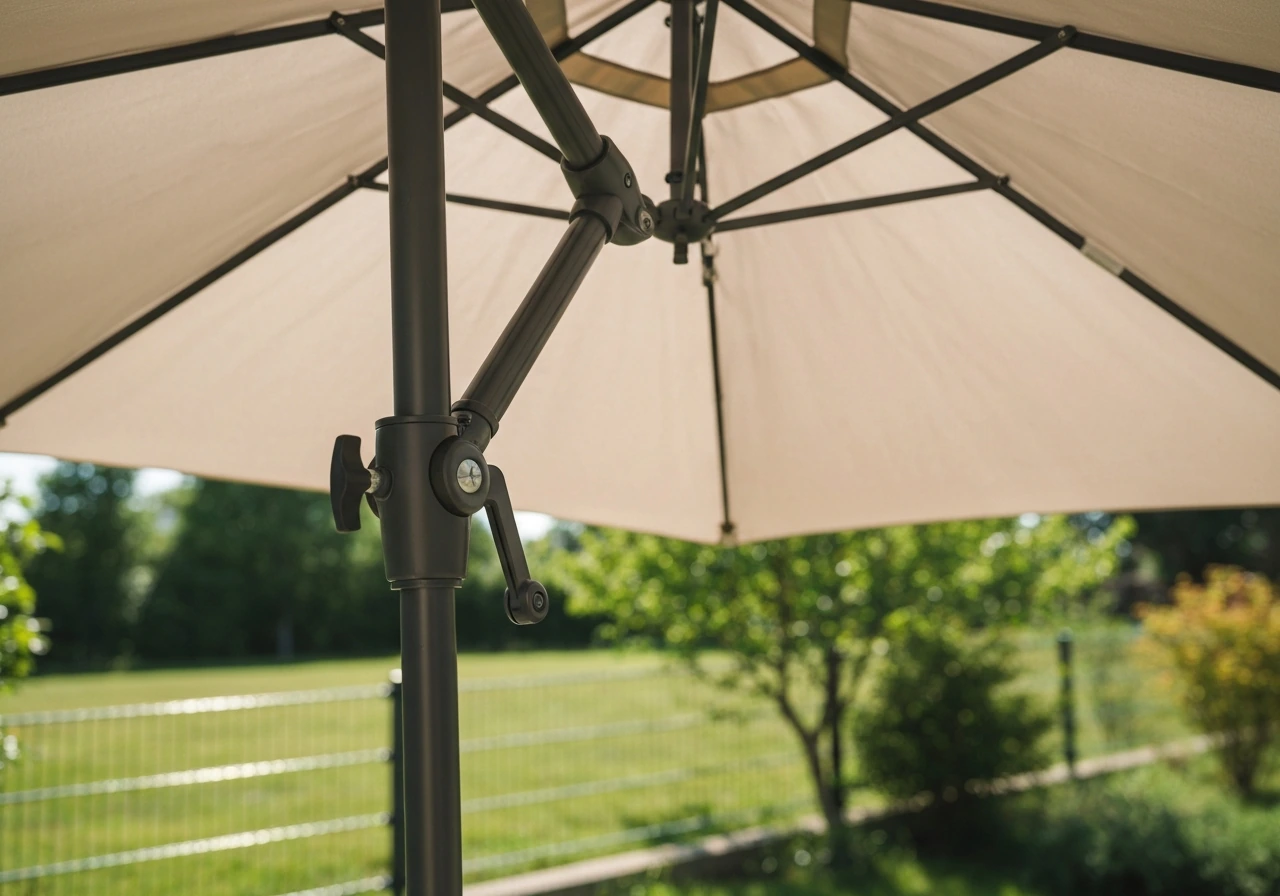
How to Auto Tilt Patio Umbrellas Work and Use Them
Learn how auto-tilt patio umbrellas work and how to use, troubleshoot, and maintain the tilt crank, cord, and joints.
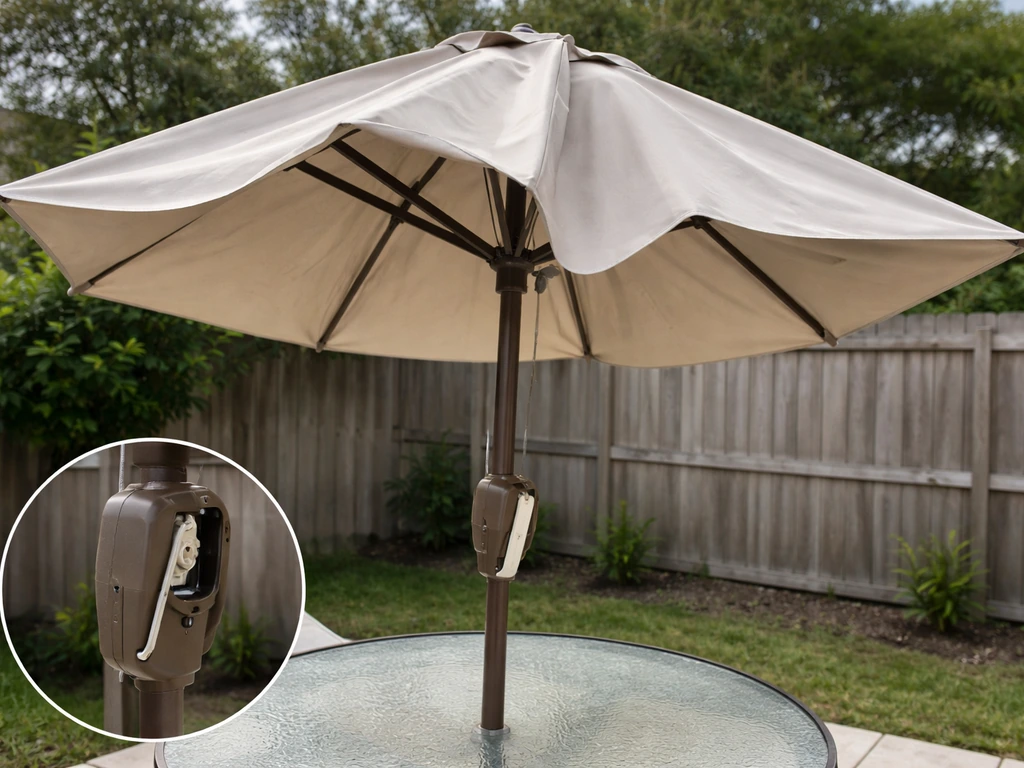
How to Fix a Patio Umbrella That Won't Open or Close
Step-by-step fixes for patio umbrellas that won’t open or close, with checks for jams, cords, latches, and lubricating t