
To tip or tilt a patio umbrella, locate your tilt mechanism first: most market umbrellas use either a crank-through auto-tilt (keep cranking after the canopy is fully open), a push-button tilt collar on the pole, or a sliding housing like Treasure Garden's Glide Tilt (press down on the housing to angle the canopy). Once you know which type you have, the actual adjustment takes about ten seconds. The tricky part is diagnosing a stuck or broken mechanism before you force something and snap it, and knowing when wind is making your umbrella lean in a way that's a safety problem, not a tilt problem.
How to Tip a Patio Umbrella Safely Step by Step
Luca Morrison
10 Jul 2026
What does 'tip' actually mean on a patio umbrella?
When people search 'how to tip a patio umbrella,' they usually mean one of two very different things, and mixing them up leads to real problems.
The first meaning is intentional tilting: angling the open canopy toward the sun so it blocks low-angle light during morning or evening hours. This is a designed feature built into the umbrella's pole or hub, and it's what the rest of this guide focuses on.
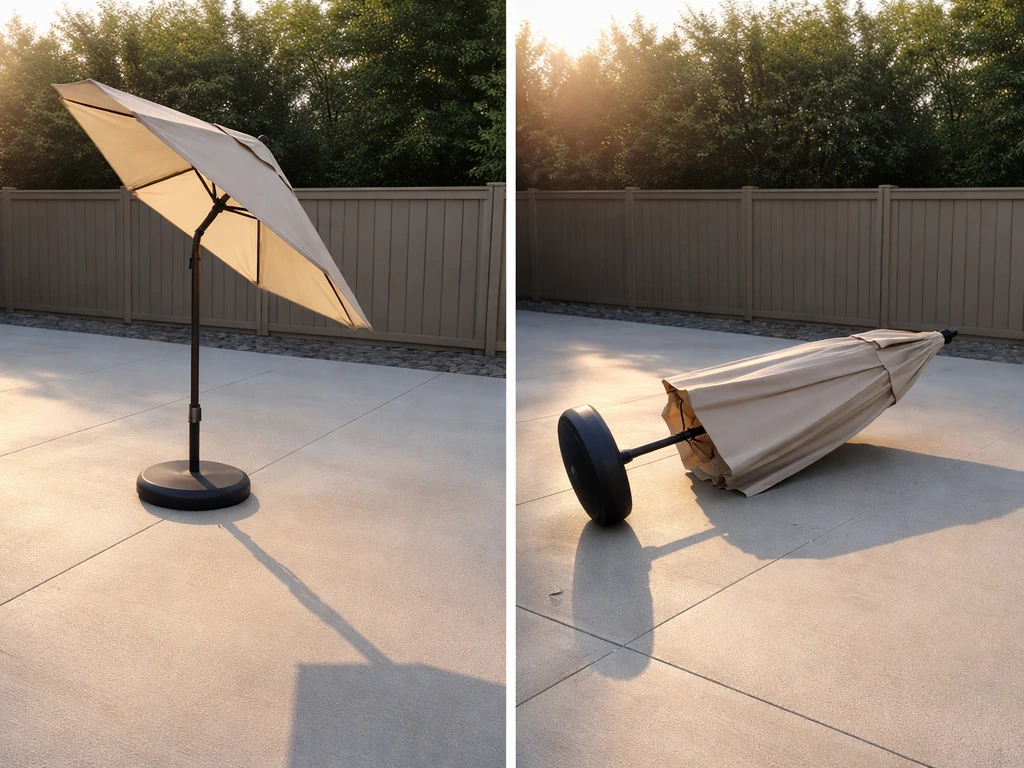
The second meaning is unintended tipping: the umbrella leaning, wobbling, or falling over because of wind, an undersized base, or a loose pole fit. This isn't a tilt adjustment. This is a stability failure, and it needs to be treated as a safety issue, not a mechanical tweak. The CPSC is clear: if your umbrella becomes unstable in wind, close it immediately. Do not try to tilt it into a 'better' position and leave it. Manufacturers like Tropitone and Sun Garden USA set their own close-and-remove thresholds at around 20 mph, and for good reason: a windblown umbrella can injure someone nearby.
So before you touch anything, ask yourself: is my umbrella leaning because I want shade from a low sun angle, or is it leaning because something is wrong structurally? If it's the latter, close the canopy first, then investigate the base and pole fit.
The main tilt mechanism types and how to identify yours
Patio umbrellas use a handful of tilt systems. Most fall into one of these categories:
| Mechanism Type | How You Activate It | Common Brands/Styles |
|---|---|---|
| Crank-through auto-tilt | Open fully with crank, then keep cranking to tilt | SunVilla auto-tilt, many big-box market umbrellas |
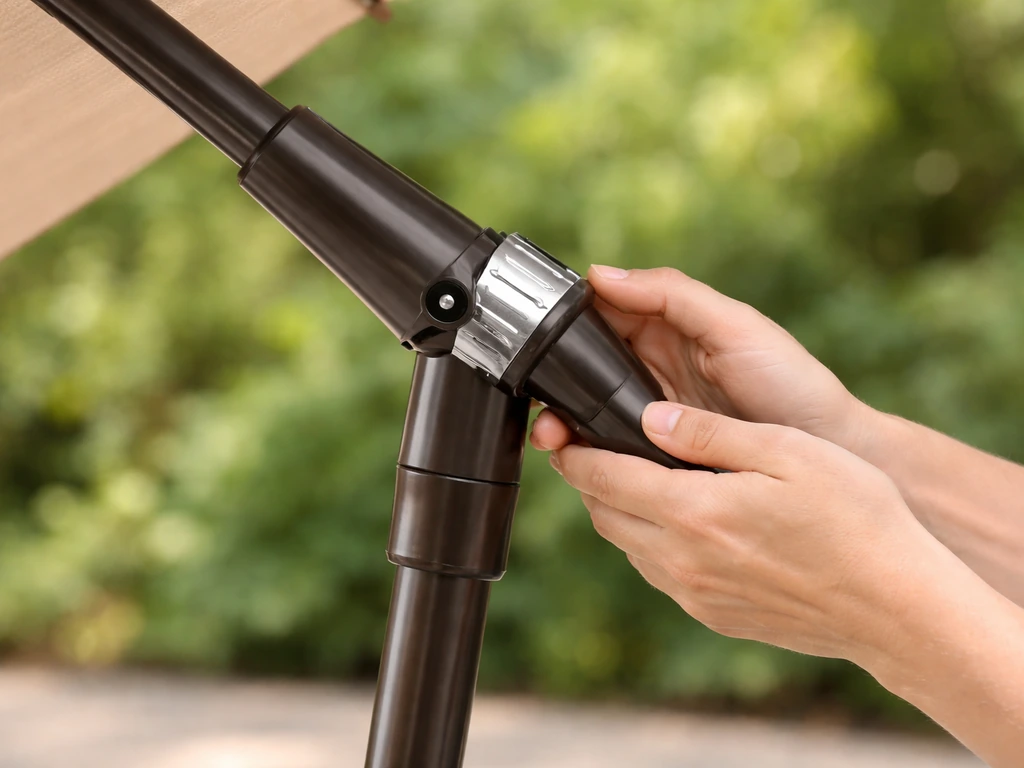
| Push-button tilt collar | Press button on pole collar, angle canopy by hand, release | Treasure Garden UM920x and similar, widely used |
| Tilt lever (engage/disengage) | Move lever left or right to disengage, push forward to re-engage | Treasure Garden AKZP series |
| Glide Tilt / sliding housing | Press down on the housing (collar) to slide it along the pole | Treasure Garden Glide Tilt series |
| Hinge/rail tilt | A hinged joint midway on the pole that locks into preset angles | Various mid-range market umbrellas |
| Cantilever rotation/tilt | Crank plus pin and chain assembly at the base for rotation and angle | Tropitone cantilever, offset umbrellas generally |
To identify your type: look at the pole between the canopy hub and your hand when the umbrella is open. If you see a collar or housing that can slide or rotate, that's your tilt control. If there's a button on the pole, press it and see if the top section pivots. If cranking past 'fully open' causes the canopy to angle, you have auto-tilt. Cantilever umbrellas are the outlier: the offset arm tilts through a separate control at the base, not at the pole collar.
Tools and safety prep before you touch the mechanism
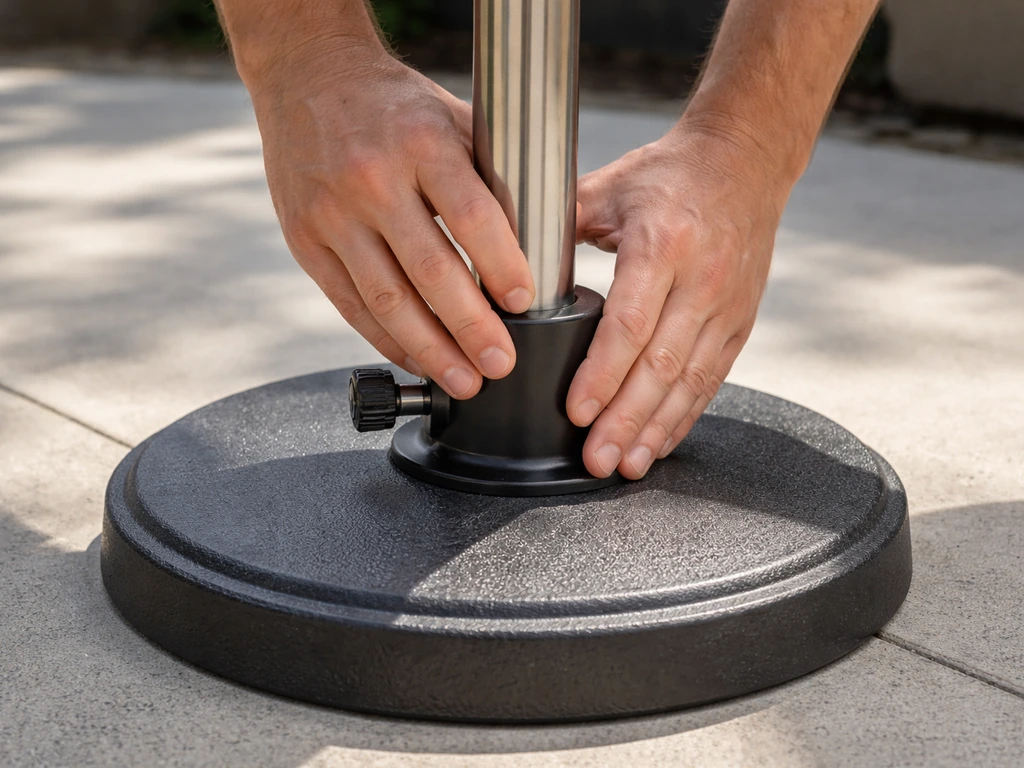
Most tilt adjustments need zero tools. But getting into position safely is the part people skip, and it's where things go wrong. Here's what to do before you start:
- Stabilize the base first. Confirm the umbrella pole is seated fully in the base tube and that any tightening bolt or collar is snug. A wobbly pole means you're working on an unstable structure.
- Check wind conditions. If it's gusting, close and wait. Trying to tilt an umbrella in wind increases the risk of the canopy catching air and the pole swinging unpredictably.
- Stand on the ground. Do not stand on a chair, table, or improvised platform to reach a tilt mechanism. If your umbrella is over 9 feet and the collar is out of reach, try adjusting from the side with the pole tilted slightly toward you first, then re-seat it in the base.
- Watch your fingers. Tilt collars, hinges, and sliding housings can pinch fingers if the canopy snaps back. Keep your grip on the control surface, not between moving parts.
- Have a helper for large cantilever umbrellas. A 10-to-13-foot offset canopy is heavy enough that adjusting the tilt solo can torque the arm in unexpected directions.
Optional tools that are worth having nearby: a step stool (proper one, not a chair) if your collar is slightly above comfortable reach, a silicone spray lubricant for stiff mechanisms, and the umbrella's manual. CDC/NIOSH ladder safety guidance highlights fall-causation categories, including unsafe leaning or incorrect angles when adjusting mechanisms, reinforcing the need to avoid standing on furniture or positioning yourself unsafely while you work on the umbrella. If you don't have the paper manual, search the brand name plus your model number and 'manual PDF.' Most major brands including SunVilla, Treasure Garden, and Tropitone host these on their sites.
How to tip and tilt your patio umbrella: step by step
Crank-through auto-tilt (like SunVilla 10' auto-tilt models)
- Open the umbrella fully by turning the crank handle clockwise until the canopy is completely spread and ribs are taut.
- Keep cranking in the same direction. After the canopy reaches full open, continued cranking engages the tilt mechanism and the canopy will start to angle.
- Stop cranking when you reach the angle you want. There are usually one or two preset click positions.
- To return to upright, crank in the opposite direction (counter-clockwise) until the canopy snaps back to vertical.
- Never force the crank past resistance. If it locks up mid-tilt, stop and troubleshoot (see the next section).
Push-button tilt (like Treasure Garden UM920x)
- Open the umbrella fully with the crank (counter-clockwise to open on most Treasure Garden models, clockwise to close).
- Locate the tilt collar on the pole, roughly at chest-to-shoulder height when the pole is mounted in the base.
- Press and hold the button on the collar. This disengages the locking pin.
- While holding the button, use your other hand or lean into the pole to push the top section of the pole (and canopy) in the direction you want the canopy to face.
- Release the button when the canopy is at your desired angle. You should feel or hear the pin click into the next preset position.
- If the canopy drifts back or won't hold the angle, the pin isn't fully seated. Press and re-engage.
Tilt lever (Treasure Garden AKZP style)
- Open the umbrella fully.
- Find the tilt lever on the collar. Move it to the left or right (opposite the direction you want the canopy to tilt) to disengage the tilt gears.
- With the gears disengaged, push the top of the pole forward in the direction you want the canopy to angle.
- Push the lever forward to re-engage the tilt lock and hold the position.
- To return to upright, reverse: disengage lever, push the top back to vertical, re-engage.
Glide Tilt / sliding housing (Treasure Garden Glide Tilt series)
- Open the umbrella fully.
- Place your hand on the housing (the collar that surrounds the pole near the top).
- Press down on the housing. This slides it along the pole, which pivots the canopy in the corresponding direction.
- Release pressure to lock the housing in position. Treasure Garden describes this as a smooth, effortless slide.
- To return to upright, press down on the opposite side of the housing.
Cantilever umbrella tilt (Tropitone and similar offset designs)
- Open the canopy fully by slowly turning the crank. Tropitone specifically instructs slow crank operation, not fast spinning.
- For rotation, locate the pin and chain assembly at the lower base where the arm connects to the stand. Engage or disengage the pin to rotate the canopy position.
- For vertical tilt angle, consult your specific model's instructions. Many cantilever designs have a separate locking knob or lever on the arm.
- Make any angle adjustments slowly and with a helper if the canopy is large.
- Re-secure the pin assembly before leaving the umbrella unattended.
When the tilt won't work: troubleshooting common failures
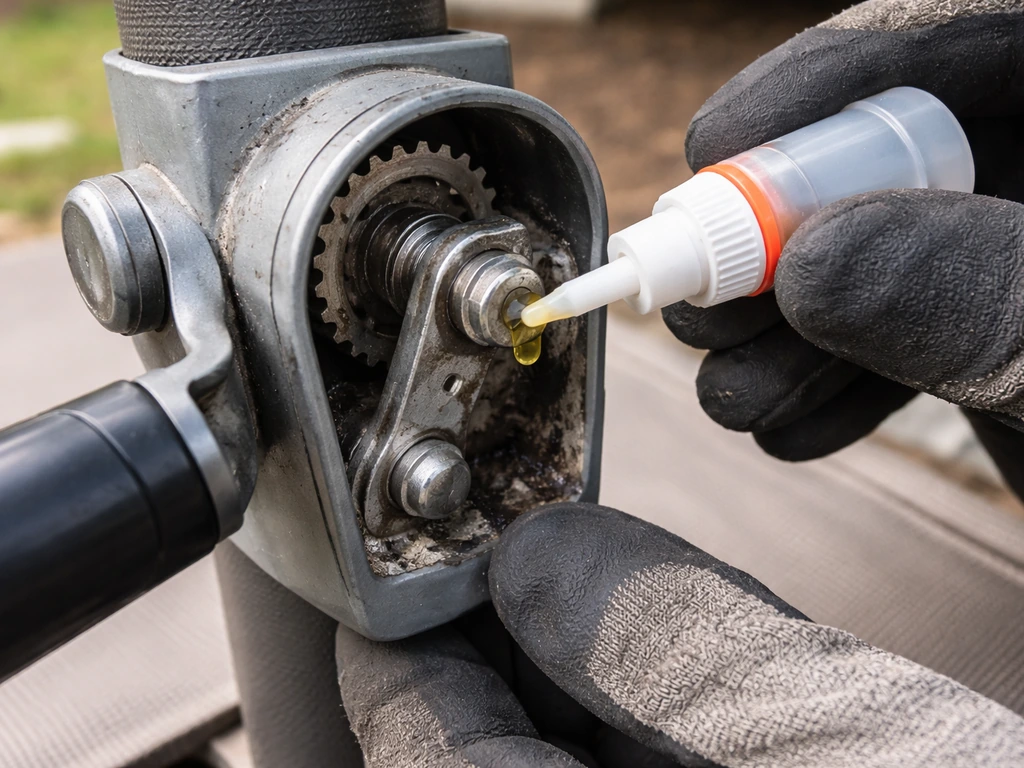
Work through these from simplest to most involved. Most stuck tilt problems have a simple cause.
Crank is hard to turn or feels gritty
This is almost always corrosion or debris in the crank gear housing or the tilt mechanism itself. Do not force it. Close the umbrella, spray silicone lubricant into the crank gear housing and the tilt collar joint, wait five minutes, then try again with gentle pressure. If you still struggle to fix patio umbrella tilt after lubrication, recheck that the tilt is fully disengaging and re-engaging at its lock positions. Silicone spray is better than WD-40 here because it doesn't attract dirt afterward. If the crank turns freely but the canopy doesn't move, the crank cord or rib cord may have jumped the pulley inside the hub, which is a more involved repair.
Crank-through auto-tilt reaches full open but won't tilt
First, confirm the canopy is actually at full-open before the tilt engages. If you stop cranking early, the tilt won't kick in. If your tilt won’t engage or the canopy won’t hold its angle, use the troubleshooting steps for repairing the patio umbrella tilt mechanism. Continue cranking slowly. If the crank suddenly has no resistance and the canopy doesn't tilt, the tilt cord inside the pole may have snapped or jumped its pulley. This is repairable but requires disassembly of the tilt mechanism collar.
Push button won't depress or pin won't seat
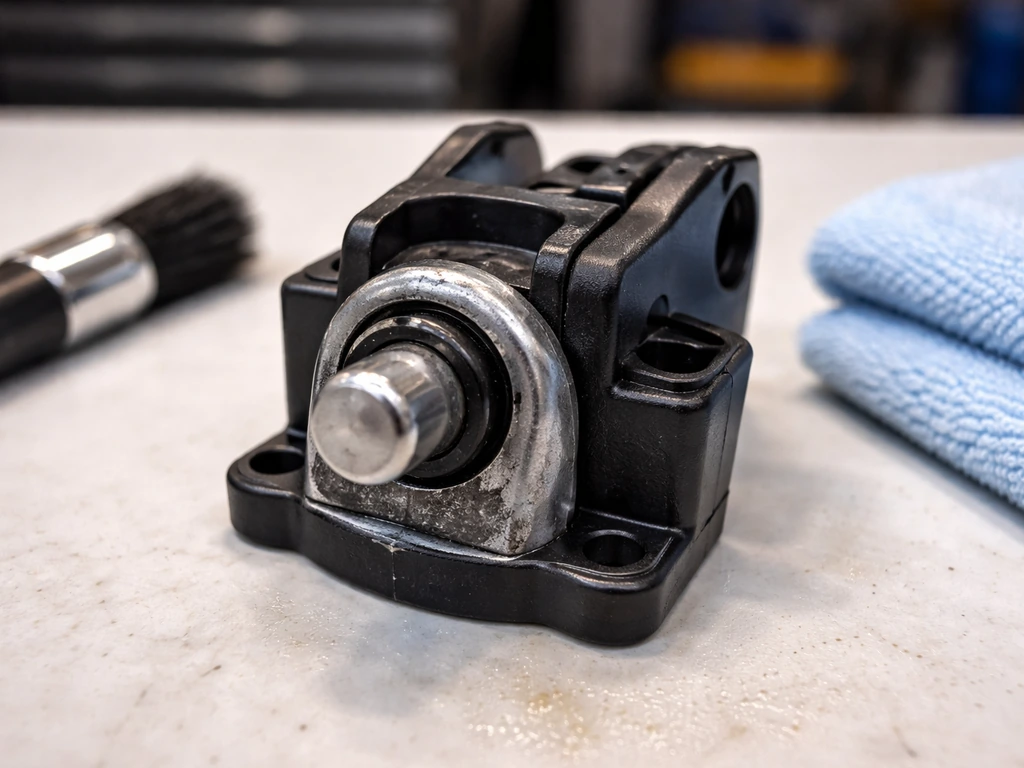
A sticky button is usually dirt or minor corrosion around the pin sleeve. Clean the collar area and apply a drop of silicone spray around the button. If the button depresses but the pin won't click into the next position, check whether the two pole sections are aligned well enough for the pin hole to line up. Sometimes the canopy weight pulls the upper pole slightly off-axis and the pin can't find its hole. Lift the canopy weight slightly while pressing the button.
Glide Tilt housing won't slide or is stuck in one position
The most common cause is grit in the housing rail groove. Wipe the pole section the housing rides on with a damp cloth, let it dry, then apply silicone spray to the rail. If the housing has physically cracked or the internal locking mechanism has bent, you'll need a replacement housing from Treasure Garden's parts line.
Umbrella won't hold the tilt angle and keeps slipping back
This usually means the locking pin, clip, or gear is worn. On push-button tilts, the pin detent groove can wear down so the pin skips rather than locks. On lever-style tilts, the gear teeth may be worn or the lever spring is fatigued. Check whether simply re-engaging more firmly solves it. If not, a tilt collar rebuild kit or a replacement tilt section is the fix. Replacement is often cheaper than you think and is worth pursuing before giving up on the umbrella.
Tilt lever is jammed (AKZP style)
If the lever won't move left or right, the gear engagement may be under load. Try taking some canopy weight off the pole by supporting the hub briefly, then moving the lever. Dirt in the lever pivot is also common. Spray silicone into the lever joint and work it back and forth gently. Do not use pliers on the lever; it will snap before it bends.
Cantilever pin/chain assembly is missing or broken
Stop cranking. A missing rotation pin on a cantilever base means the arm can swing freely and unpredictably under the canopy's weight. This is a stop-and-fix situation, not a push-through-it one. Contact the manufacturer for a replacement pin assembly before using the umbrella again.
Staying safe after tilting: wind, weight, and alignment
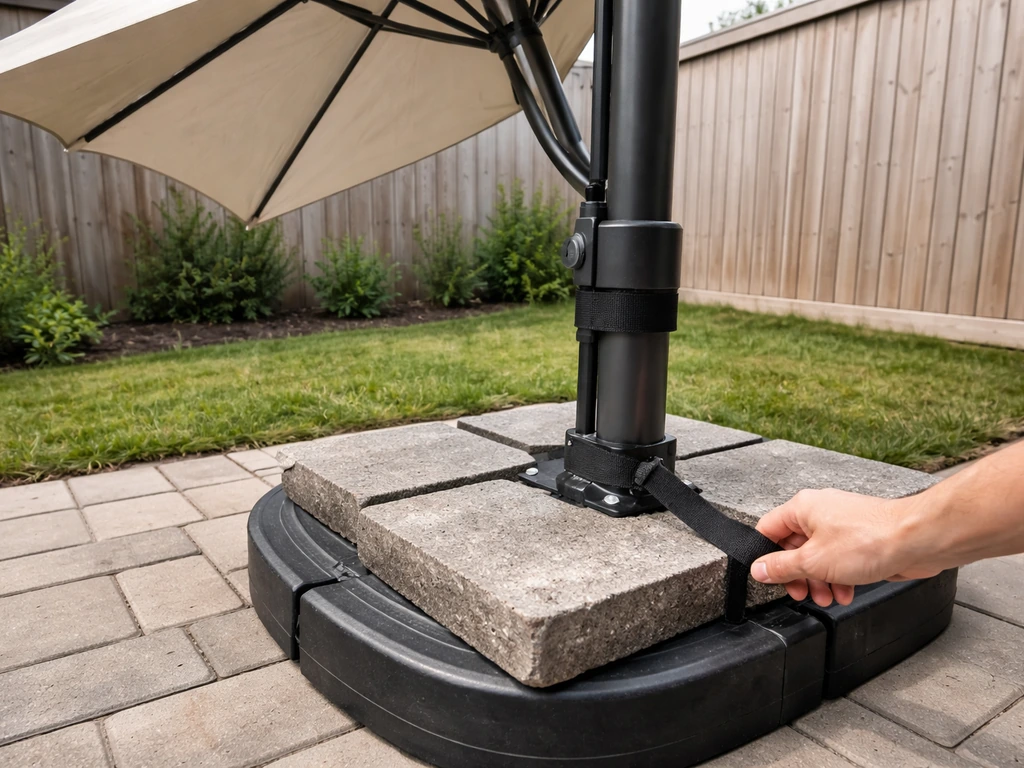
A tilted canopy catches significantly more wind than a vertical one. Once you've set the tilt, take a few minutes to confirm everything is secure before walking away.
- Check your base weight. Most manufacturers specify minimum base fill weights by umbrella diameter. A 9-foot umbrella typically needs at least 50 pounds of base weight, and a tilted canopy raises that threshold. If you're using a base filled with sand or water, confirm it's at capacity.
- Align the tilt away from the wind direction. Tilt the canopy so the low edge is on the leeward (downwind) side. This reduces the sail effect and is the single most effective thing you can do to reduce tip-over risk.
- Use the manufacturer's strap or tie-down if provided. Sun Garden USA, for example, includes a canopy strap specifically for security when the umbrella is in use near the edge of a gusting threshold.
- Know your close threshold. Sun Garden recommends closing at 20 mph sustained winds. Tropitone says to close and remove from service in any windy conditions that create instability. When in doubt, close it.
- Never leave a tilted umbrella unattended during changing weather. A tilted canopy left open when a storm rolls in is much more likely to topple than an upright closed one.
- Do not try to tilt your way out of a stability problem. If the umbrella is leaning because the base is too light or the pole fit is loose, tilting it won't fix that. It will make it worse.
Keeping the tilt mechanism working all season
The number one enemy of smooth tilt operation is moisture getting into a mechanism and drying into mineral deposits or rust. A little seasonal maintenance prevents most of the stuck-mechanism calls.
- At the start of each season, wipe down the tilt collar, housing, and any exposed pole sections around the mechanism with a damp cloth. Remove any dried salt, pollen, or grit.
- Apply a light coat of silicone spray lubricant to the tilt collar joint, the push-button sleeve, or the housing rail (whichever type you have). Avoid petroleum-based lubricants because they can degrade plastic components and attract grit.
- Check the crank handle and gear box for any grinding sensation. If it grinds, spray lubricant into the gear housing through the vent hole if one is present.
- Inspect the tilt cord if your umbrella has one (you'll see a thin cord running through the pole). Look for fraying at the points where it contacts any edge. A fraying cord will break mid-season if not replaced.
- Check all pole section joints and set screws. A loose pole fit means the tilt mechanism takes extra stress every time the canopy is adjusted.
- At the end of the season before storage, clean and lubricate again, then close the canopy fully. Storing an umbrella tilted open puts permanent stress on the locking mechanism.
Brand-specific notes and how to use your manual
Every major brand encodes their own direction-of-motion conventions in their manuals, and ignoring those details is how mechanisms get broken. Here's what to know by brand, and how to find the right guidance for your exact model.
Treasure Garden
Treasure Garden makes several distinct tilt systems, so the model number matters more than the brand name alone. The UM920x series uses a push-button tilt and crank with a counter-clockwise open convention. The AKZP series uses the lever-engage system. The Glide Tilt line uses the press-down housing slide. Treasure Garden’s Glide Tilt manual explains that the tilt operation is done by pressing down on the housing and that the umbrella should be closed afterward. Their manuals are available as PDFs on their site and through third-party manual hosts. If you're not sure which system you have, look at the collar: a button indicates push-button, a sliding housing with no visible button is likely Glide Tilt, and a protruding lever indicates the AKZP-style engagement.
SunVilla
SunVilla's auto-tilt umbrellas use the crank-through method. The key instruction from their manuals is explicit: after the umbrella is fully open, continue cranking to activate the tilt. If you stop at full-open and try to push the canopy manually, you'll be fighting the mechanism rather than using it. SunVilla hosts instruction PDFs by model on their site. Search your model number on their manual index page.
Tropitone
Tropitone's cantilever umbrellas have a pin and chain assembly at the base that controls rotation, separate from the canopy angle tilt. Their instructions consistently emphasize slow crank operation. They also have one of the clearest close-in-wind policies of any major brand: close and remove from service in windy conditions, full stop. Their care, maintenance, and warranty documentation is downloadable directly from the Tropitone site and is worth reading once before you start using a new umbrella.
How to get your manual if you don't have it
Most manuals are a Google search away. Search for your brand name, the model number (usually on a sticker on the pole or base), and the word 'manual PDF.' Sites like Manualzz and Manuals.plus host a wide range of umbrella manuals if the brand's own site doesn't have it. When you find the manual, look specifically for: the tilt operation section, the direction-of-motion for your crank, and any maintenance or lubrication recommendations. Those three sections answer 90% of the questions people run into with tilt mechanisms.
If you've confirmed your tilt mechanism is working but the umbrella still isn't performing the way you expect, the issue is often with the broader tilt mechanism assembly rather than the user-facing control. A seized internal hinge, a broken tilt pole section, or a worn collar are all repairable with the right parts, and they're worth addressing rather than replacing a whole umbrella. Those deeper mechanical repairs are covered in detail in guides focused on repairing tilt mechanisms and fixing stuck tilt assemblies specifically.
FAQ
What should I do if the tilt works once, but then slips back immediately?
If the canopy moves but the tilt will not stay engaged, do not “hold it” by pressing harder on the button or cranking longer. Instead, check that the canopy is at the fully open stop before engaging, then look for alignment issues between the pin and the next lock hole (even a slight off-axis shift can prevent the detent from catching).
How can I tell whether my umbrella is leaning due to wind or because I’m using the tilt wrong?
If the umbrella leans in wind, treat it as stability failure, not an intended tilt. Close the canopy right away, then only reattempt tilting after wind conditions improve. If you see movement with the canopy closed, focus on base size, pole fit, and tightening rather than adjusting tilt.
Can I use WD-40 or another lubricant to fix a stiff tilt mechanism?
Use silicone spray for the tilt collar, crank gear housing, and lever joints, especially when the mechanism gets gritty or damp. Avoid general-purpose oils like WD-40 as a primary fix because they can leave residues that trap dirt over time, making the tilt stick again.
How long should I wait after lubricating, and how do I know if it’s a deeper internal problem?
After lubrication, give it a short soak window before testing, typically about five minutes as a first attempt, then retry with gentle, steady pressure. If it suddenly turns with no resistance but the canopy does not tilt, stop, because that usually points to a cord or internal pulley issue rather than a minor jam.
My push-button tilt collar clicks, but it won’t lock. What’s the best next step?
If the button depresses but the pin does not lock, check both alignment and canopy load. Lift the canopy weight slightly while pressing so the pole sections line up enough for the pin hole to meet, then try again without forcing the button.
What if I’m not sure which direction or sequence my umbrella expects for the tilt to engage?
First confirm you are using the correct motion for your system (for example, crank past the fully open stop for auto-tilt models). If you cannot identify the motion, don’t guess, check the model number on the pole or base and find the tilt section in the manual so you follow the exact direction-of-motion conventions.
My lever-style tilt won’t engage fully. Should I force it harder?
If the lever moves but will not engage left or right under load, temporarily reduce the canopy weight on the pole by supporting the hub briefly, then move the lever. If dirt is suspected at the lever pivot, silicone spray into the pivot area and gentle back-and-forth movement usually helps, but do not use pliers.
Why does my cantilever umbrella feel loose or unpredictable, and can I still use it while fixing it?
For cantilever bases, a missing rotation pin is a safety stop condition. Do not keep using the umbrella to “test” whether it will rotate predictably, contact the manufacturer for the pin assembly or replacement part first.
What preventive maintenance should I do before the summer season to keep the tilt from sticking?
Yes. Even if the tilt mechanism is working, moisture in the crank and rails can lead to corrosion and mineral deposits. Do a quick seasonal inspection, wipe the pole housing rail, and apply a light silicone treatment before weather season rather than waiting for the mechanism to fail.
If I set the tilt correctly, why does the umbrella still feel unstable in breeze?
If the tilt seems correct but the umbrella still catches excessive wind, confirm you have the canopy fully seated in its locked position and then check base stability and any loose pole connections. A tilted canopy increases wind exposure, so if it is windy, close and service it later instead of leaving it partially adjusted.
I lost my umbrella manual. How do I find the right instructions for my exact model?
If you are missing the manual, find the model number and search for “manual PDF” for that exact model, then locate the specific tilt operation section. The direction-of-motion and lubrication guidance are model-specific, and following the wrong convention is a common reason mechanisms get damaged.
Next Articles
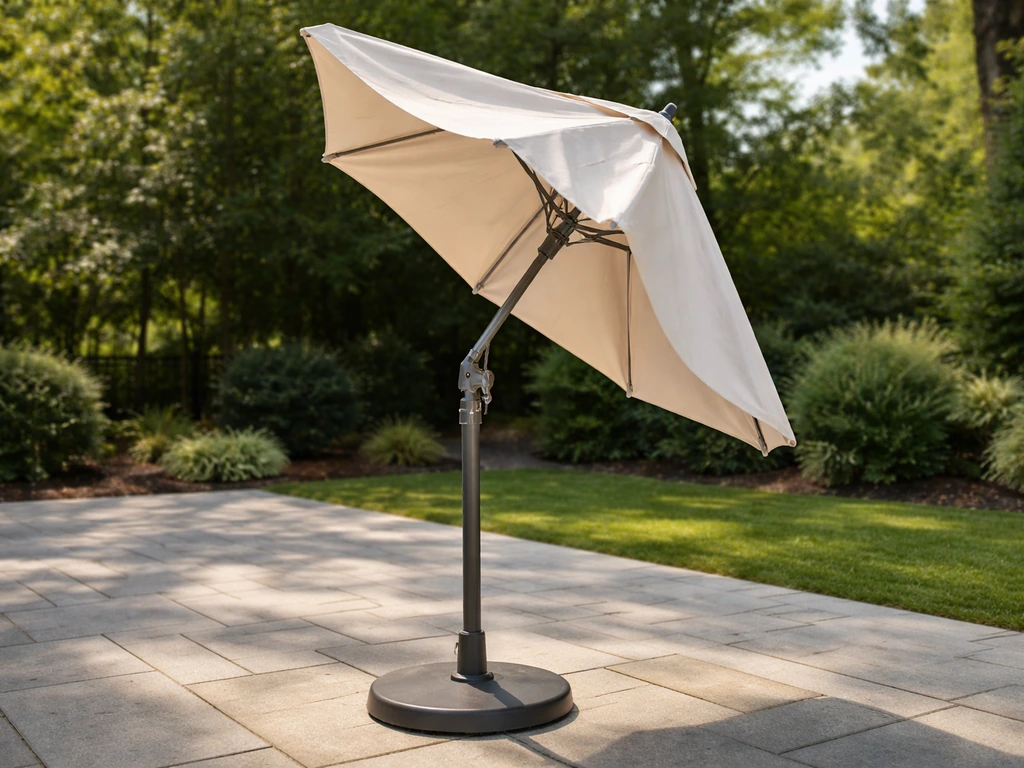
Fix Patio Umbrella Tilt: Diagnose and Repair Steps
Step-by-step guide to fix patio umbrella tilt: diagnose mechanism issues, repair or replace parts, lubricate, and test s
What Does Auto Tilt Mean on a Patio Umbrella?
Auto tilt lets a patio umbrella adjust angle automatically with controls and motors, plus tips to fix tilt issues safely
How to Repair Patio Umbrella Tilt Mechanism Fast
Step-by-step guide to diagnose and repair a patio umbrella that won’t tilt right, including button, linkage, and parts.