To adjust a patio umbrella, start by identifying exactly what's off: height, tilt angle, rotation position, crank tension, or pole alignment. Each one has a different fix. For a stuck tilt, make sure the canopy is fully open first before trying to engage the tilt mechanism. For a stiff or slipping crank, check the cord for fraying or slack before assuming the gear is broken. For wobbling or a pole that won't lock, re-seat the pole in the base and check the collar or pin. Most adjustments take five minutes once you know what you're dealing with.
How to Adjust a Patio Umbrella: Height, Tilt, Crank, More
Luca Morrison
28 Jun 2026
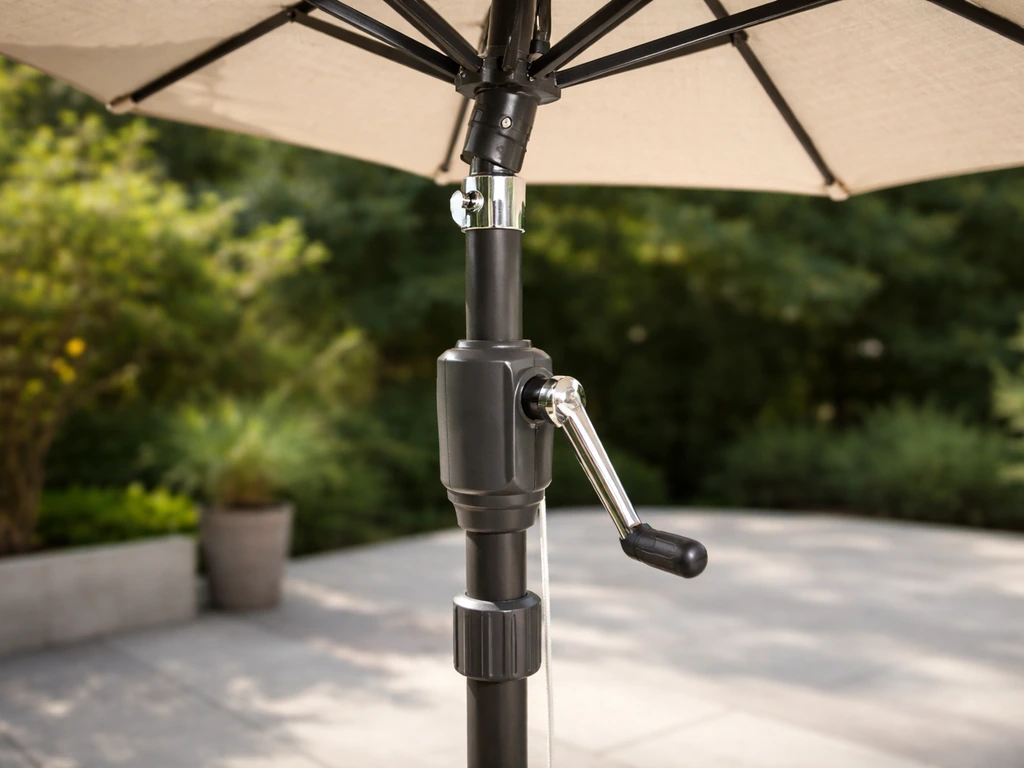
Figure out which adjustment you actually need
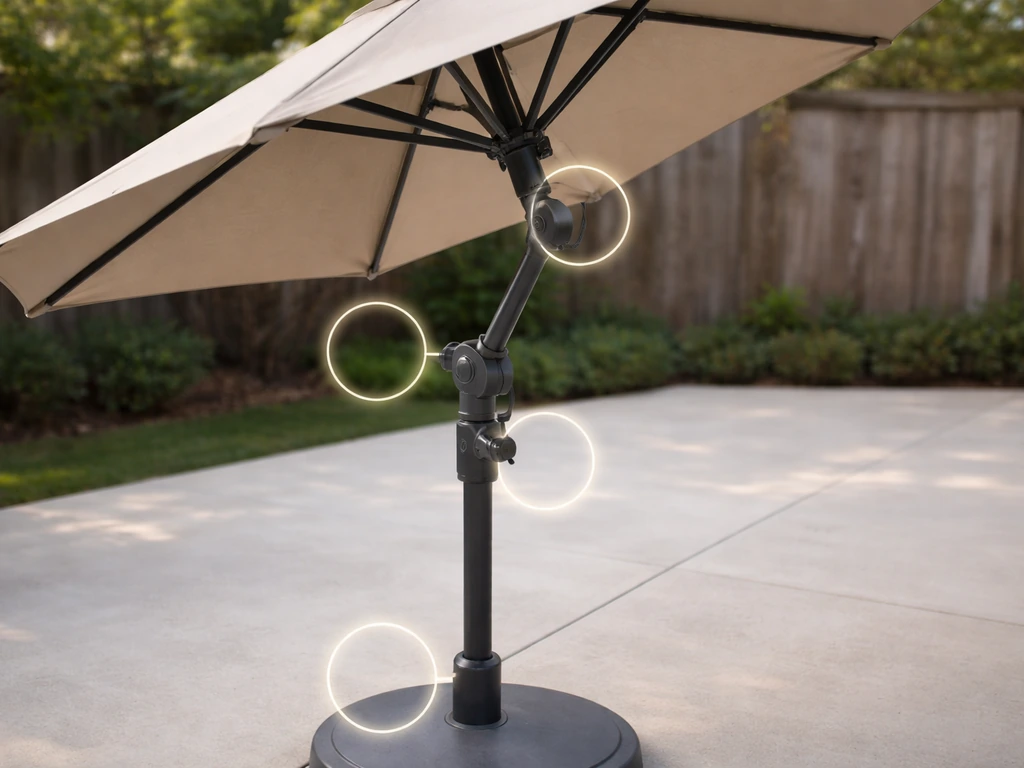
Before grabbing any tools, spend thirty seconds diagnosing the problem. Patio umbrella issues fall into five categories, and mixing them up leads to wasted effort. Here's how to sort out what you're dealing with.
| Symptom | What it usually means | Section to jump to |
|---|---|---|
| Umbrella sits too low or too high on the pole | Height adjustment needed (collar, pin, or sleeve position) | Height and tilt section |
| Canopy points straight up, won't angle toward the sun | Tilt mechanism needs to be engaged or unlocked | Height and tilt section |
| Canopy tilts but locks unevenly or won't hold position | Tilt hinge loose, tilt knob not fully tightened, or wrong open state | Troubleshooting section |
| Crank turns but umbrella doesn't open or close | Cord/cable slipped off spool or has too much slack | Crank and cord section |
| Whole umbrella rotates freely when you don't want it to | Rotation lock knob needs tightening | Rotation section |
| Pole leans or wobbles even when locked | Base too small, pole mis-seated, or collar worn | Securing section |
One thing I see people get wrong constantly: they try to tilt the umbrella before it's fully open. On most crank-operated models, including Treasure Garden's Glide Tilt and AKZP lines, the tilt mechanism won't engage at all until the canopy reaches its fully open stop position. If you're fighting the tilt and the umbrella is only halfway up, [crank it all the way open first](/how-to-open-a-patio-umbrella). Same goes for cantilever styles like the Axis: open completely, then adjust the slider to the tilt position you want, then tighten the knob clockwise to lock it there.
What you need before you start (tools and safety)
Most adjustments need no tools at all, just your hands and some patience. But for mechanical repairs or cable tension adjustments, have these nearby.
- Adjustable wrench or a 1/2-inch open-end wrench (for cable tension nuts on manual crank shades and some umbrella crank housings)
- Phillips and flathead screwdrivers (for accessing crank housing covers)
- Pliers (for gripping a stuck tension knob or re-routing a cord)
- Silicone spray lubricant or a dry PTFE lubricant (better long-term than WD-40 for umbrella hinges and tracks, though WD-40 works in a pinch to free a seized joint)
- A soft cloth or brush
- Replacement cord or cable if yours looks frayed (standard braided polyester cord works on most crank models)
Safety comes first, especially if you have an offset or cantilever umbrella with a heavy base. Make sure the base is stable and weighted before you start cranking or repositioning. Always close the canopy before you move the umbrella or try to re-seat the pole. If your canopy will not close smoothly, follow the steps in how to close patio umbrella before forcing the mechanism.
Never adjust the tilt or rotation while wind is picking up: a partially open canopy catches air like a sail, and the torque can snap a rib or tip the whole assembly. If you have a market-style or center-pole umbrella in a table hole, confirm the table itself is on level ground before doing anything.
How to adjust height and tilt on common umbrella types
Center-pole umbrellas with a push-button or pin lock
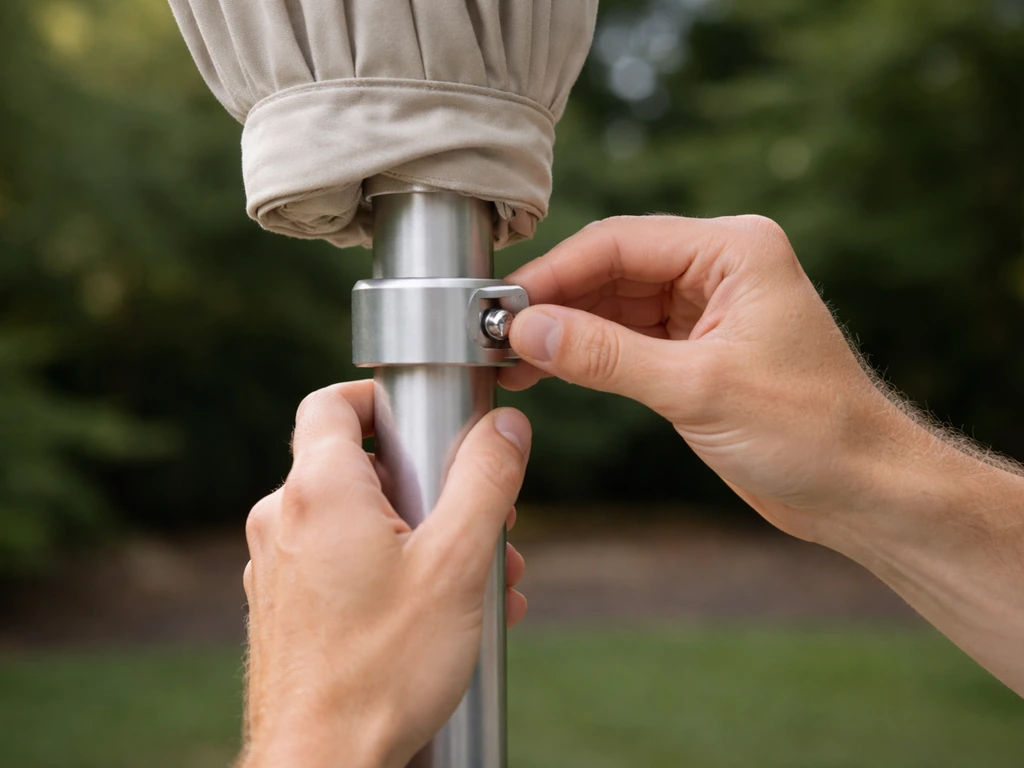
- Close the canopy fully before adjusting height. Trying to slide the pole with an open canopy puts stress on the ribs and runner.
- Locate the height collar: it's the ring or sleeve partway up the pole with a spring-loaded button or thumbscrew on the side.
- Press the button in (or loosen the thumbscrew) and slide the pole to the height you want. You'll feel or hear the button click into the next hole in the pole.
- Release the button and tug the pole down gently to confirm it's locked in the hole, not sitting between holes.
- Open the canopy. The umbrella should now sit at the new height.
Tilt adjustment on crank-operated center-pole umbrellas
Crank-tilt models (the most common type sold at big-box stores) combine the crank handle with a built-in tilt pivot near the top of the pole. Here's how to use it correctly and avoid the most common mistake.
- Turn the crank clockwise to open the canopy. You should feel only light resistance as the canopy rises. If there's heavy tension right away, stop: that's a sign of a cord, rib, or runner problem, not a normal adjustment feel.
- Keep cranking until the canopy is completely and fully open. On most models this takes 10 to 20 full turns. You'll feel a distinct stop. Do not keep cranking past this point.
- Once fully open, engage the tilt. Depending on the model: push the tilt lever down (on a button-tilt), rotate the pole collar (on a collar-tilt), or continue cranking one or two more clicks past the open stop if your model uses crank-actuated tilt. The Treasure Garden AKZP, for example, requires you to push the pole handle slightly forward after reaching full open to re-engage the tilt gear.
- The canopy should now angle to one side. Many models offer three or four tilt positions. Stop at the angle you want.
- To return to upright, reverse the tilt engagement before cranking the umbrella closed. On Treasure Garden Glide Tilt models, the position and timing of tilt engagement is described in the model-specific manual, so it's worth having that out if yours isn't responding as expected.
Tilt adjustment on cantilever and offset umbrellas
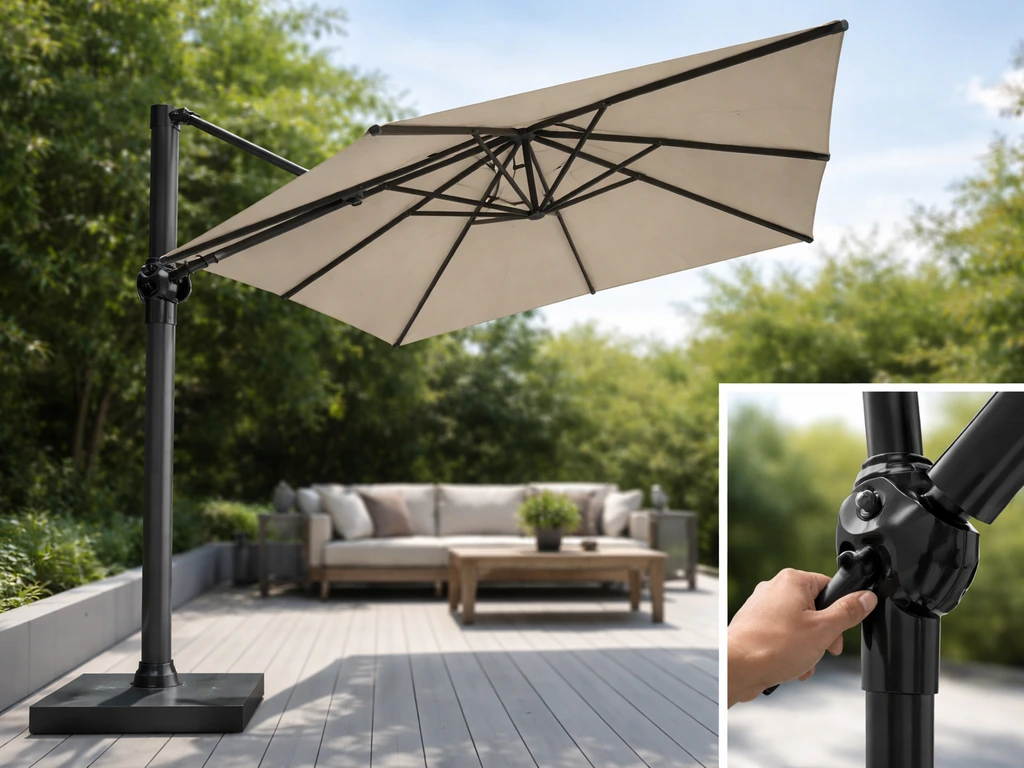
Cantilever umbrellas (where the pole stands to the side and the canopy hangs over your space) handle tilt differently. For cantilever patio umbrellas, learning how to open the canopy correctly is the key first step before you troubleshoot tilt, crank, or lock issues cantilever umbrellas. On models like the Axis cantilever or the AG19-style units sold at Home Depot, the process has a specific sequence you need to follow or the lock won't seat properly.
- Open the canopy fully using the crank. The AG19 and similar models have a tilt degree handle: open until the canopy is at full open position and the hub is at its open stop.
- Locate the slider car knob or tilt adjustment knob on the arm or hub. On the Axis, this is a sliding cart that moves along a track.
- Slide or move the knob to the tilt position you want. Most cantilevers offer positions at 0, 15, 30, and 45 degrees.
- Tighten the knob clockwise until it locks firmly. Do not force it past the stop. The key habit here: tighten at the chosen position rather than cranking the mechanism past its travel limit.
- Test by gently pushing up on the canopy edge. It should not give. If it drops, the knob isn't tight enough or the tilt slider isn't fully seated in its track.
One important note on closing cantilever umbrellas after tilt adjustment: when you go to close, the canopy must be returned to a horizontal (flat) position before you operate the close mechanism. If you try to close it while it's still angled, you risk damaging the ribs or the tilt joint. This is called out specifically in the AG19 manual and it's a real failure point I've seen in the field.
Fine-tune rotation, open/close alignment, and crank or cord operation
Adjusting rotation position
Most center-pole umbrellas rotate freely in the table hole or base, which means you can just turn the pole by hand to point the canopy where you need it. But on offset/cantilever models with a rotation lock, there's a specific process. On the Home Depot offset-style units: loosen the rotation knob counterclockwise, extend or rotate the umbrella arm until it reaches the stop at the angle you want, then tighten the knob clockwise firmly.
For offset patio umbrellas with a rotation lock, you usually open the canopy first, then follow the model’s sequence to unlock and spread the arm so the canopy fully opens how to open offset patio umbrella. The crank handle also needs to be in the correct position (usually tucked in or stowed) before you operate the rotation on these models, so check your manual for the exact starting position.
Fixing crank tension and cord alignment
If your crank turns but the canopy doesn't move, the most likely culprit is a cord or cable that's slipped off the internal spool. This is not a crank gear failure in most cases. What you're probably seeing is the spool spinning free without gripping the cord. Here's how to diagnose and fix it.
- Open the crank housing cover (usually two screws on the side of the crank box). Look at the spool and cord inside.
- Check whether the cord is still wound on the spool or has slipped off. If it's piled up loose inside the housing, the cord has jumped the track.
- Re-wind the cord onto the spool by hand, making sure it sits in the grooves and doesn't overlap. The wire needs to route through the tube the way it originally came from the canopy hub downward.
- For cable tension specifically (on manual crank shade systems), use a 1/2-inch wrench to loosen the upper tension nut, adjust the cable tautness, then re-tighten. There should be no significant sag in the cable but it also shouldn't be guitar-string tight.
- On models with a belt inside the crank (some use a reinforced belt instead of cord), check that the belt sits flat and tight in its channel. A loose or twisted belt causes the exact same free-spinning symptom.
- Before closing the housing, confirm the crank handle locks into its starting position and that there's slight but consistent resistance when you turn it clockwise from the beginning. Per Barco's guidance, you should feel only slight tension at the very start of opening. Anything more than that points to a binding issue inside, not a tension adjustment.
One more thing on alignment: if your umbrella opens but the canopy ends up off-center, with one side of ribs lower than the other, the cord has probably routed unevenly around the hub. Close the umbrella, open the hub cap if accessible, and check that the cord feeds through the center hole evenly. The Umbrella Specialist wire replacement guidance makes the point clearly: when you re-thread or re-tension a replacement cord, only crank the canopy open until the hub just touches the tube the cord feeds through. Going past that point during reassembly creates the uneven tension that makes the canopy open lopsided.
Troubleshoot the problems that feel like adjustment issues but aren't
Tilt won't engage at all
This is almost always a sequencing issue, not a broken part. The tilt mechanism on crank-operated umbrellas is designed to be unreachable until the canopy is at full open. If you're pushing or pulling the tilt lever and nothing happens, crank the umbrella the rest of the way open. On Treasure Garden's AKZP, specifically, you need to push the handle slightly forward after full open to re-engage the tilt slider. If the tilt still won't engage after the canopy is fully open, the tilt hinge pin may have worked loose or the gear teeth may be stripped. In that case, remove the crank housing and inspect the tilt gear for missing teeth.
Tilt locks but then slowly droops or goes uneven
This usually means the tilt knob or hinge bolt isn't tight enough, or the tilt joint is worn. On cantilever umbrellas, this is the same issue reported in several community threads: the umbrella won't stay open and starts closing when wind hits. The fix is to tighten the tilt lock knob more firmly (clockwise, hand-tight plus a quarter turn with pliers if needed), or replace the tilt friction pad if your model uses one. On center-pole collars, try wrapping the joint with two layers of plumber's Teflon tape to add friction before re-tightening.
Crank spins freely, umbrella won't move in either direction
This is the classic slipped cord or broken internal connection. The spool is spinning but not pulling the cord. See the crank tension section above for the fix. If the cord itself is frayed or snapped, you'll need to replace it. Standard braided polyester cord is sold at most hardware stores and online in the correct diameter for umbrella use. It's a straightforward repair that usually takes about 20 minutes.
Canopy is stuck open and won't close at all
This is the rope spool engagement issue. The spool inside the crank housing isn't moving, which means the cord has jammed or the spool is stuck. Open the crank housing, find the spool, and manually push or rotate it to free it. In some cases the cord has wrapped over itself on the spool, creating a jam. Unwind the excess wrap, re-route the cord properly, and try again. On cantilever umbrellas, also check the release knob: you typically need to press or turn a release knob while physically guiding the arm back toward the pole as it closes. If you're just cranking without guiding, it can bind.
Canopy won't open and the vent is folded over the ribs
If wind has knocked the umbrella over or pushed hard on a closed canopy, the top vent can get pushed over the top joint of the ribs, blocking them from spreading. This looks like a mechanical failure but it's just a repositioning issue. Close the canopy further, pull the vent back to its correct position over the top cap, and then open the umbrella again. ARTiculatedshade specifically recommends using the umbrella tie to secure the canopy when it's closed, to prevent this from happening again. It's a simple tip that saves a lot of frustration.
Pole wobbles even when the collar is tightened
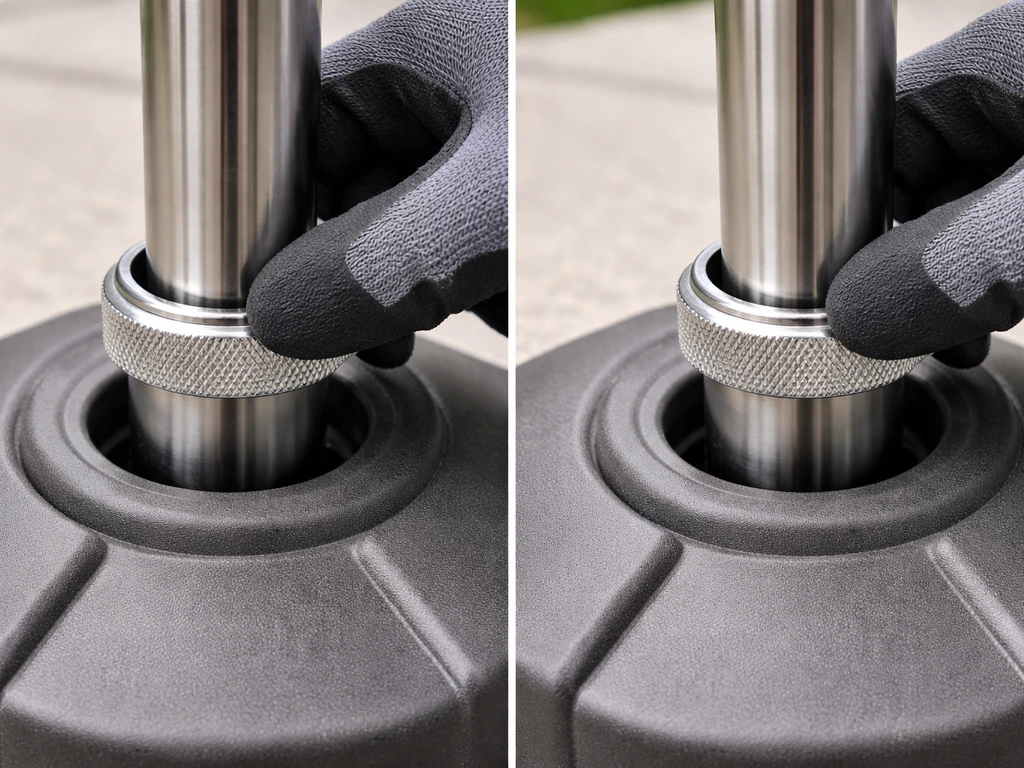
A wobbling pole usually means one of three things: the base is too light for the umbrella size, the pole isn't fully seated in the base socket, or the collar or sleeve is worn. For a table-mounted umbrella, check that the pole is fully through the table hole and into the stand below. For a freestanding base, confirm the base is filled with water or sand to the recommended weight (typically 50 pounds or more for a 9-foot umbrella, more for offset models). If the pole sleeve inside the base is cracked or has worn out, that plastic insert can be replaced without buying a new base.
Lock it in and position it safely after adjusting
After any adjustment, do a quick walk-around before you sit down under it. If you want to learn how to operate patio umbrella controls safely, use this same check every time you adjust tilt, rotation, or open and close After any adjustment, do a quick walk-around before you sit down under it.. Push up on the canopy edge with moderate force. Push on the pole side. If anything moves that shouldn't, tighten it before leaving the umbrella unattended. Then think about wind positioning.
The best wind-safe position is straight up, canopy level, tilted as little as possible. Every degree of tilt increases the sail area the canopy presents to the wind. If you're expecting breezy conditions (say, 15 mph or higher), return the tilt to neutral and consider whether to close the umbrella entirely. Market Umbrella use and care guidance is straightforward on this: always lower the umbrella during windy conditions and when not in use. That advice sounds obvious but it's the number one thing people skip, and it's the number one reason umbrellas end up damaged or tipped over.
If your umbrella gets knocked over by wind, don't just set it back up and reopen it. First, close it over the runner (guide the canopy fabric back around the runner as you close), check the ribs for bends, check the tilt joint for looseness, and then reopen it. EuroSchirm's operating guidance specifically describes this recovery procedure: close it over the runner, then reopen over the runner. It takes an extra minute but prevents you from cranking an already-compromised rib structure into a worse position.
For rotation positioning in wind: always orient the canopy so the solid back faces the prevailing wind direction, not the open underside. The canopy is significantly more stable when wind pushes on the top of the fabric rather than catching underneath it.
Keep it working: maintenance that prevents adjustment problems
Lubricate hinges, knobs, and moving joints
Once a season, apply a dry silicone or PTFE spray to the tilt hinge, the runner ring, the rib pivot points, and the crank housing gear. Avoid WD-40 as a long-term lubricant on umbrella mechanisms: it loosens corrosion well in the short term, but it evaporates quickly and can attract grit that accelerates wear. Silicone spray leaves a dry film that doesn't collect dirt. If a hinge is already seized, soak it with WD-40 first to free it, wipe it clean, then apply silicone spray to protect it going forward.
Clean the tracks, collar, and cord regularly
Grit and pollen are the main enemies of smooth operation. A stiff crank is often just a dirty cord with debris packed around the spool. Every few months, wipe down the pole, the runner, and any exposed cord with a damp cloth. For the fabric, follow the manufacturer's cleaning tag. Consumer Reports recommends checking those tags first before using any cleaner, since some umbrella fabrics (especially Sunbrella and similar acrylic fabrics) require specific mild soap solutions and will be damaged by bleach-based cleaners or harsh degreasers.
Check hardware at the start and end of every season
- Inspect all tilt knobs, collar bolts, and rib pivot screws. Tighten anything that's worked loose over winter.
- Look at the cord or cable for fraying, especially where it feeds through the crank housing and around the hub. A frayed cord is close to failing. Replace it before the season starts rather than mid-summer.
- Check the runner ring for cracks or deformation. A cracked runner is what causes uneven canopy opening.
- Inspect the base for cracks, especially if it's a plastic-shell base that was left filled with water over winter (water expansion cracks these). Refill or replace as needed.
- Confirm all rib tips and ferrules are intact. Missing rib tips cause the fabric to tear at the hem over time.
Store it right at the end of the season
Close and tie the canopy before storing. If you have a cover, use it. Store the pole and canopy horizontally or in a protective bag, not leaning against a wall where the pole can develop a bow. If you live somewhere that freezes, drain any water-fill base completely before the first freeze: water expansion is enough to crack most plastic bases. For cantilever and offset umbrellas, disassemble the arm from the pole if possible and store the pieces flat. These models have the most joints and the most hardware to corrode, so keeping them dry and stored out of the elements extends their life significantly.
If you're also working through how to open, close, or assemble your umbrella for the first time (especially if it's an offset or cantilever type), those are closely related topics that cover the operational steps in more detail. For a step-by-step walkthrough on assembling an offset patio umbrella, follow the specific assembly sequence for the arm, pole, and base hardware how to open, close, or assemble your umbrella for the first time. The adjustment steps here assume the umbrella is already assembled and installed: if yours is still in the box or needs to go back together after repair, the assembly and operation sequence matters before any of the adjustment steps above will work correctly.
FAQ
How can I tell if my problem is adjustment sequencing or a real mechanical failure?
Use a “neutral start” test: close and tie the canopy, then open it fully to the built-in open stop. If the tilt lever works only after the canopy hits the stop, your issue is almost always sequencing or a blocked open stop, not a broken tilt gear.
What should I check first if the tilt knob feels loose but the umbrella still won’t stay open?
Try a two-step check before tightening anything. First, confirm the pole is fully seated and the pin or collar is aligned in its hole. Then check the tilt lock or hinge bolt while the umbrella is fully open (not half open), since tightening with the canopy at an angle can keep the mechanism slightly misaligned and cause binding.
Is it safe to keep cranking if the handle feels stuck or gritty?
Don’t force the crank against resistance. If you feel grinding or the handle stops mid-turn, stop, close the umbrella, then inspect the crank housing cord routing and the tilt/rotation stops for blockage. Forcing can strip gear teeth or re-wrap the cord on the spool.
My crank turns but the canopy barely moves. How do I know if it is a cord slip versus a gear issue?
A cable that slipped off the spool often shows as “handle moves, canopy doesn’t” or inconsistent movement. Look inside the crank housing for the cord sitting off the spool groove, then re-seat it and re-route it through the center hub evenly before retesting with the canopy opened only until the hub just touches the tube.
Why does my cantilever umbrella feel harder to close after I adjust the tilt?
For cantilever models, make sure the canopy is returned to horizontal before you operate the close mechanism, then close slowly. If you close while still angled, the ribs or the tilt joint can get forced out of alignment, which then makes reopening feel uneven.
What should I do if my canopy opens unevenly, one side lower than the other?
If the canopy is opening but ends up off-center, do not try to “pull it straight” while open. Close the umbrella, access the hub cap if possible, and confirm the cord runs through the center hole evenly. Uneven cord routing creates uneven tension and can permanently distort how the ribs seat.
How should I position my umbrella for wind after adjusting tilt and rotation?
In wind, the best safe position is canopy level with as little tilt as possible. If you need to change direction, adjust rotation to face the prevailing wind with the solid back toward it, then secure only if your model has a tie or lock built for windy conditions.
If my umbrella got knocked over, should I just reopen it after I set it back upright?
Yes, but do it in a “recover then retry” order. Close it over the runner, check ribs for bends and check the tilt joint for looseness, then reopen over the runner. This prevents cranking a canopy that may already be partially mis-seated.
What’s the correct way to lubricate after adjustments, and can I use WD-40 long-term?
Before applying silicone or PTFE, wipe off visible grit and dry the mechanism. Then apply a light amount to the tilt hinge, runner ring, rib pivot points, and crank housing gear. If the hinge is seized, loosen with WD-40 first, wipe clean, then switch to silicone to reduce future grit buildup.
My pole wobbles after I adjust things. How do I diagnose the cause quickly?
If the pole wobbles, start with weight and seating, not the tilt. Confirm the pole is fully through a table-mounted hole (if applicable), or refill the base to the recommended weight. If wobble continues, inspect the pole sleeve or collar for wear, a cracked sleeve can cause play even if all knobs are tight.
What if my rotation knob won’t loosen or feels like it’s binding during adjustment?
If a rotation knob won’t budge, close the canopy first and ensure the canopy is fully open or fully closed depending on your model’s rotation sequence. Then loosen counterclockwise to the stop and retighten firmly clockwise after setting the arm position, because forcing rotation while the arm is under load can damage the lock.
Next Articles
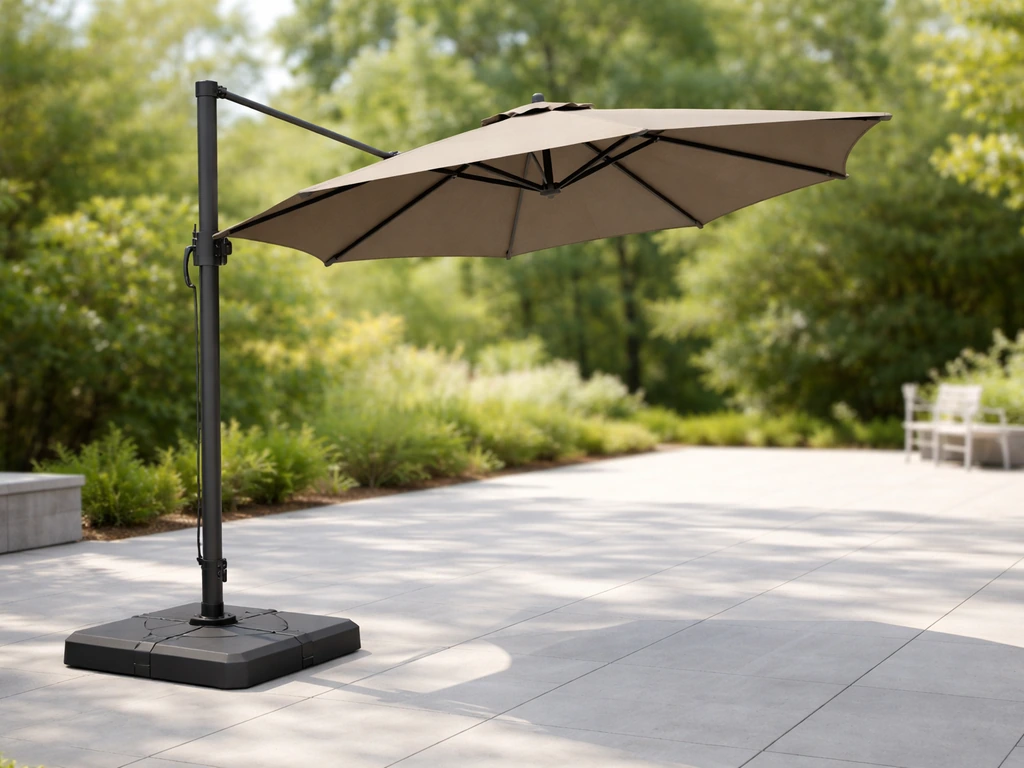
How to Assemble an Offset Patio Umbrella Step by Step
Step-by-step guide to assemble an offset patio umbrella base, mast, canopy, and crank, plus stability and quick troubles
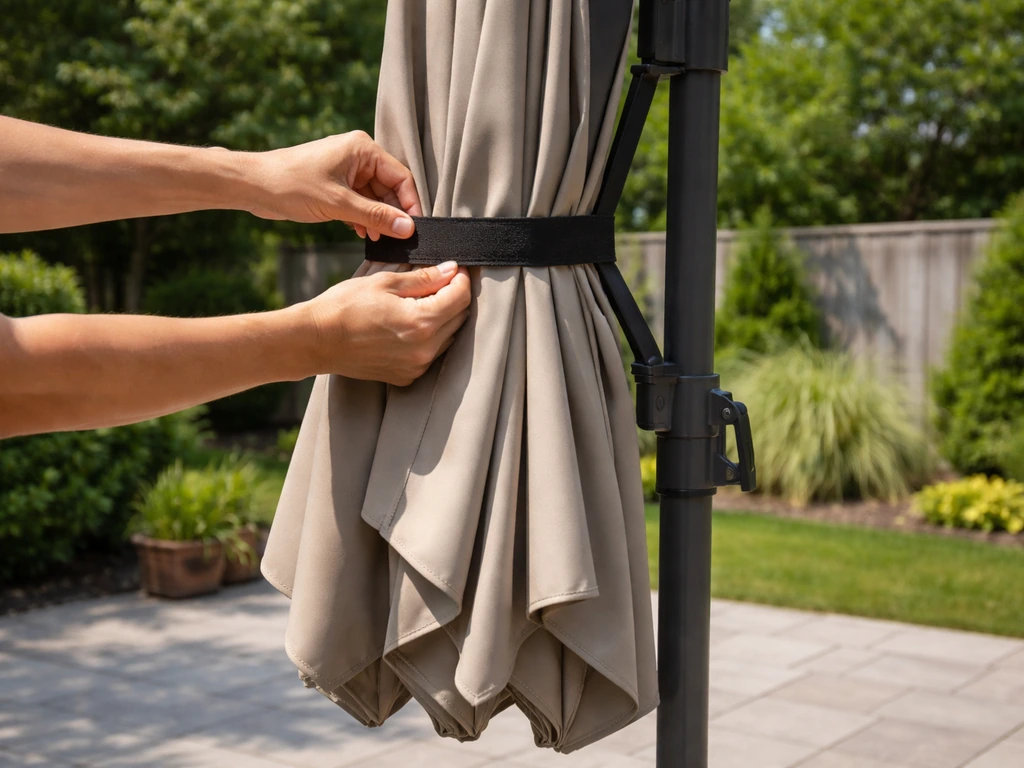
How to Close a Patio Umbrella Safely Step by Step
Step-by-step guide to safely close patio and cantilever umbrellas, troubleshoot jams, and secure so it stays closed.
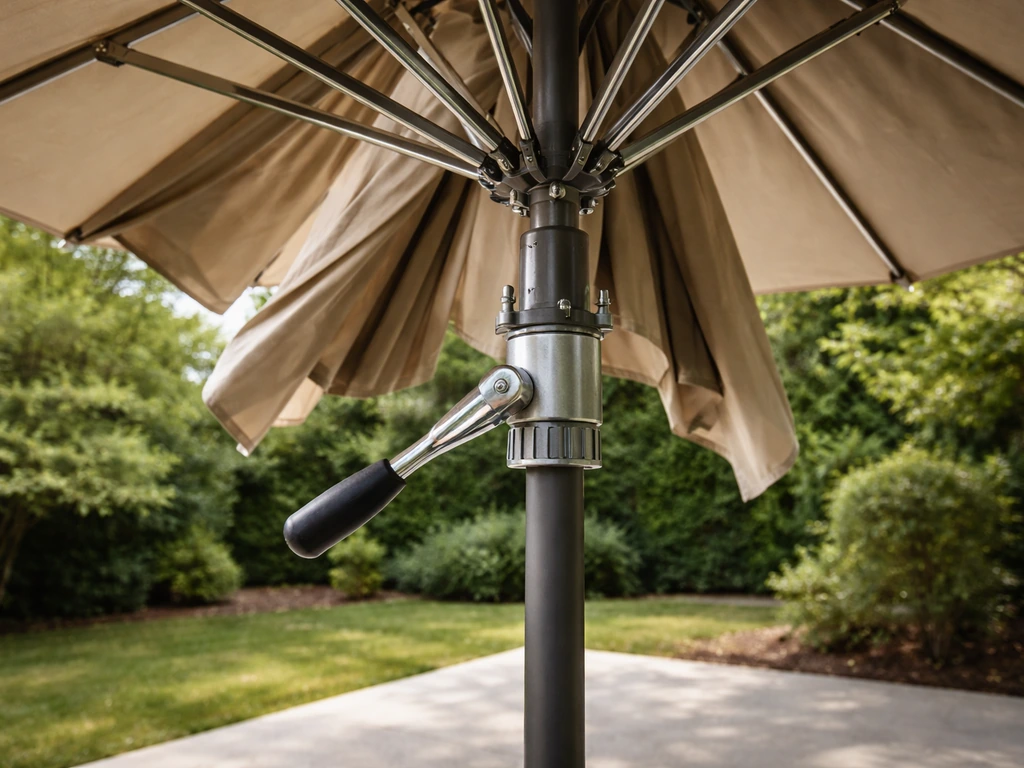
How to Open a Patio Umbrella Fast, Even If It Sticks
Step-by-step how to open a patio umbrella fast, including stuck umbrellas, big models, crank or tilt, plus troubleshooti