
Yes, you can put a patio umbrella canopy in the washing machine, but only under specific conditions: the canopy must be removable, the care label or manufacturer manual must permit machine washing, your washer must be large enough (at least 4.5 cubic feet), and the fabric needs to be a machine-wash-tolerant material like solution-dyed acrylic. If any one of those conditions fails, you are better off hand washing or hosing it down. Getting this wrong risks shrinkage, delamination, broken grommets, and a voided warranty.
Can You Put a Patio Umbrella in the Washing Machine?
Luca Morrison
18 Jul 2026
What this guide covers and who it's for
This guide is for homeowners and patio owners who want to clean a patio umbrella canopy thoroughly, either as part of regular maintenance or before putting the umbrella away for the season. I'll walk you through a clear decision framework so you know immediately whether machine washing is even an option for your canopy. Then I'll cover the full machine-wash procedure if it is, and solid alternative cleaning methods if it isn't. You'll also get drying and re-waterproofing steps so your canopy comes out of the process performing the way it should. If you're thinking about seasonal storage after cleaning, this guide pairs well with guidance on how to store your patio umbrella for winter and whether to leave it outside at all.
When you can (and can't) machine wash a patio umbrella canopy
Think of this as a quick four-question test. If you answer yes to all four, machine washing is likely safe. One no and you should skip to the hand-wash alternatives below.
- Is the canopy removable from the frame? If you can't take it off, the answer is no — you are not putting a whole umbrella frame in a washer.
- Does the care label or manufacturer manual explicitly allow machine washing? Brands like Sunbrella, Outdura, California Umbrella, and Treasure Garden do permit it under specific conditions. Brands like La-Z-Boy Outdoor explicitly warn 'Never machine wash umbrella covers' and cite shrinkage and warranty exclusions. If the label says nothing or says dry clean only, treat that as a no.
- Is your washer large enough? You need at least 4.5 cubic feet of drum capacity, and 5.0 cubic feet is more practical for a full-size canopy. A canopy that can't tumble freely won't clean well and will trigger imbalance errors or stop mid-cycle.
- Does the canopy have minimal or removable hardware? Metal grommets, sewn-in stiffeners, exposed zippers, and plastic fittings can corrode, snag, or deform under machine agitation. If you can't remove or adequately protect this hardware, hand washing is the safer call.
| Canopy type / brand guidance | Machine washable? | Notes |
|---|---|---|
| Solution-dyed acrylic (e.g., Sunbrella, Outdura) | Yes, with conditions | Cold water, delicate cycle, air-dry only — confirm on product tag |
| California Umbrella Newport series | Yes, explicitly | Manual states 'Machine wash cold and air dry only' |
| Treasure Garden removable canopy | Yes, with conditions | Cool water, mild soap, air-dry — check specific product manual |
| La-Z-Boy Outdoor umbrella covers | No | Manufacturer explicitly prohibits it; shrinkage and warranty risk |
| Polyester with a vinyl or PVC coating | Usually no | Heat and agitation can crack or peel the coating |
| Canvas or cotton-blend | Check label | Often shrinks; most manufacturers recommend hand wash or hose down |
| Unknown fabric / no care label | No | Do not attempt; risk of irreversible damage |
Manufacturer-check checklist before you touch the washer
Before you do anything, pull the manual or look up the model online. Here's exactly what you're checking for.
Fabric type
Solution-dyed acrylic (SDA) is the most machine-wash-tolerant outdoor fabric on the market, and it's what most reputable umbrella manufacturers use. Sunbrella and Outdura are both SDA fabrics, and both brands permit cold-water machine washing of removable items on a delicate cycle. Polyester, canvas, and coated fabrics are far less forgiving, check the label specifically, not just the brand.
Removable canopy
Most mid-range and premium umbrellas have canopies that detach from the ribs and pole via a sleeve, Velcro, or snap system. If yours doesn't detach, cleaning in a machine is simply not possible. Check your manual's assembly section for removal steps, manufacturers like California Umbrella include explicit canopy-removal instructions alongside their cleaning guidance. California Umbrella Newport Series Instruction Manual (how to remove canopy + cleaning prep guidance) provides step-by-step canopy removal instructions and recommended pre-wash preparation.
Washer capacity
Whirlpool classifies large-capacity residential washers at 4.5 cubic feet and above, with 5.0 cubic feet front-loaders being a common large-capacity option. A patio umbrella canopy is a bulky, single-piece item. If it can't tumble freely in your drum, it will bunch to one side, trigger an unbalanced load error (LG machines throw a 'UE' code, for example), or simply not get clean. When in doubt, take it to a laundromat with a large front-loading commercial machine.
Hardware and frame risks
Metal grommets, zipper pulls, Velcro strips, sewn-in plastic stiffeners, and any decorative trim are all potential problem points in the wash. Machine agitation and spin can corrode metal fittings, weaken stitched reinforcements around grommets, snag Velcro on drum surfaces, and crack rigid plastic inserts. Identify every piece of hardware on your canopy before it goes anywhere near a washer.
Preparing the canopy before any wash method
This step applies whether you're machine washing or hand washing. Skipping prep is how people end up with a clean canopy that has a broken grommet or a set stain they made worse.
- Remove the canopy from the frame. Follow your manufacturer's removal steps carefully. Most SDA canopies slide off the rib tips once the umbrella is closed and flat.
- Shake out loose debris. Bird droppings, dry leaves, pollen, and grit act as abrasives under agitation. Get rid of them first with a stiff dry brush or a light vacuum on low suction.
- Close and fasten all zippers, snaps, and Velcro. This prevents snagging in the drum and reduces wear on the closures themselves.
- Detach or protect hardware. Remove any pieces that unclip or unscrew. Sewn-in grommets that can't be removed should be padded with a folded piece of cloth held in place with a rubber band, or the whole canopy placed in a mesh laundry bag.
- Spot-test for colorfastness. Dab a small amount of your intended detergent solution on an inconspicuous inner seam, wait 5 minutes, and blot dry. If color transfers to the cloth, don't machine wash — hand wash instead.
- Pre-treat visible stains. Apply a small amount of mild liquid detergent directly to stains and work it in gently with a soft-bristle brush. Let it sit for 10 to 15 minutes before washing. For mildew spots, see the mildew treatment notes in the alternatives section below.
Step-by-step machine-wash procedure
If you've confirmed machine washing is permitted and your prep is done, here's how to do it without damaging the canopy or your washer.
- Load the canopy loosely into the drum. Don't cram it in — fold it as flat as possible, then place it in without compressing it into a tight ball. For a large canopy, a front-loader is preferable because it tumbles without an agitator that can stress seams.
- Add a balancing load if needed. Washing a single bulky item often causes imbalance. Add two or three clean towels to help the drum balance the load. This is a standard recommendation from washer manufacturers for bulky single items.
- Use a mild liquid detergent. Liquid detergents dissolve better in cold water than powder. Use the amount recommended on the bottle for a small or medium load — do not overdose, as residue left in SDA fabric can reduce its water repellency. Good options include Sunbrella Clean (for Sunbrella fabric), Outdura TEXGARD cleaner (for Outdura), or any fragrance-free, non-enzymatic, mild liquid detergent. Do not add fabric softener. It coats the fibers and strips the DWR (durable water repellent) finish.
- Set the washer to a cold, delicate or hand-wash cycle. Cold water is non-negotiable — warm or hot water causes shrinkage and can damage coatings. Use the Delicate, Hand Wash, or Bulky/Bedding cycle setting. Bulky/Bedding cycles use reduced spin speed, which is gentler on seams and hardware. Avoid any cycle with high-speed spin or heated pre-soak.
- Start the cycle and check in after 5 minutes. Make sure the canopy isn't balling up on one side. If you hear heavy thumping or the machine pauses with an error code, open the lid, redistribute the canopy manually, and restart.
- Run a second rinse if your machine allows it. Detergent residue left in the fabric is a genuine problem for outdoor fabrics. An extra rinse cycle costs nothing and protects the water-repellent finish.
- Remove immediately after the cycle ends. Don't leave the canopy sitting in a damp drum — it encourages mildew growth in the very fabric you just cleaned.
Protections and precautions for machine washing
Even when machine washing is technically permitted, a few protective steps go a long way toward preventing the most common damage.
- Use a large mesh laundry bag for smaller canopies or canopies with exposed hardware. The bag reduces mechanical abrasion against the drum and prevents grommets or zipper pulls from catching on drum holes or door gaskets.
- Pad metal grommets with folded cloth secured with rubber bands if no mesh bag is large enough. A grommet smashing against a stainless drum repeatedly is how you crack the fabric reinforcement around it.
- Remove all detachable plastic or metal fittings before the canopy goes in. If a plastic clip snaps off inside the drum, it can damage the pump or drainage system.
- Never use a top-loader with a central agitator for a large canopy. The agitator can wrap the canopy around it tightly and tear seams. An impeller-style top-loader or a front-loader is the right choice.
- Skip the dryer entirely. No manufacturer of solution-dyed acrylic outdoor fabric permits machine drying. Heat causes irreversible shrinkage and can melt the fabric's DWR coating. Air dry only, always.
- Do not add bleach unless the product care label specifically permits it and instructs a dilution ratio. Undiluted bleach or bleach used on non-bleach-safe fabrics weakens fibers rapidly.
- Do not use dry-cleaning solvents, steam, or enzyme-based stain removers unless the manufacturer explicitly approves them for your specific fabric.
Safe alternatives when machine washing isn't an option
Machine washing is actually not necessary for most routine canopy cleaning. These methods work just as well for general grime and are safer for anything where you're uncertain about machine compatibility.
Hose-down and soft brush (best for routine cleaning)
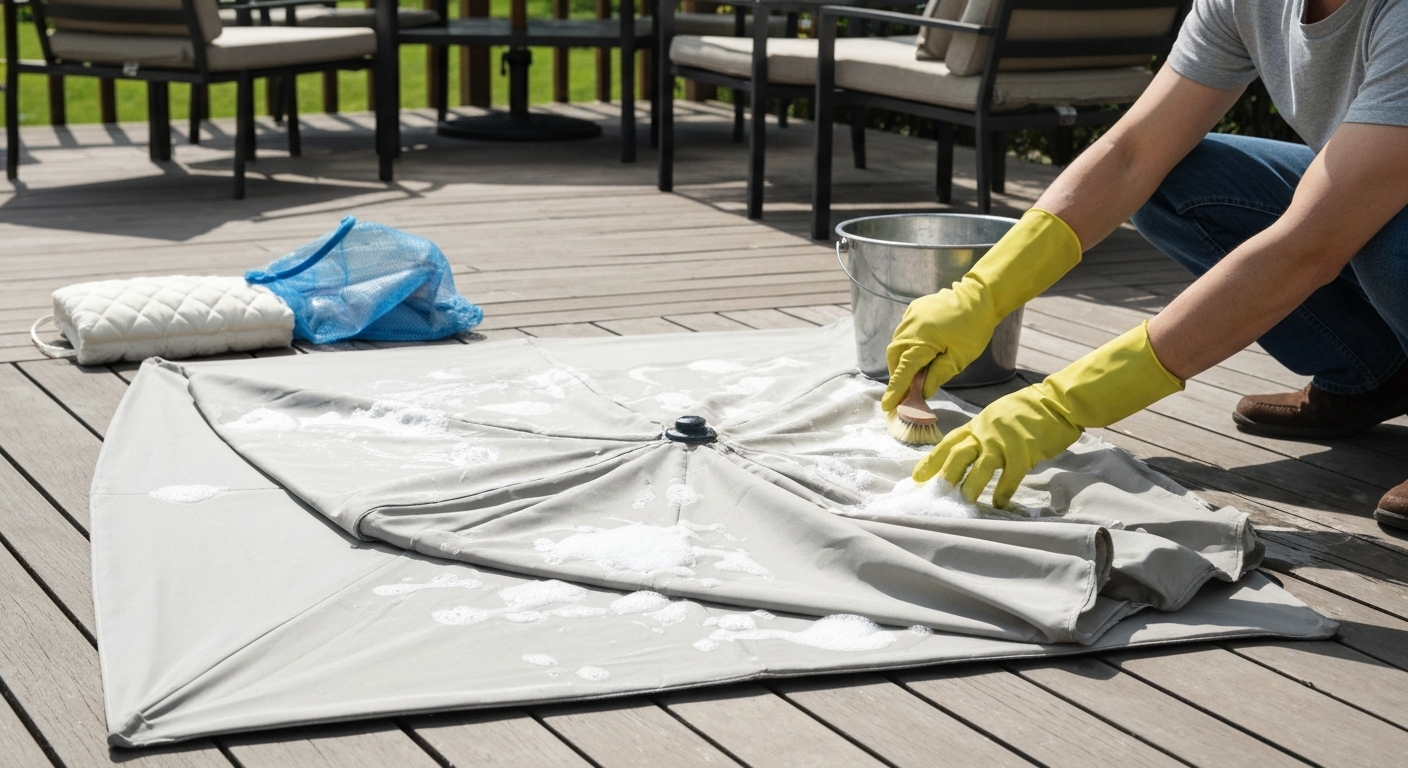
Lay the canopy flat on a clean surface or drape it over a table. Wet it thoroughly with a garden hose, then work in a solution of mild dish soap and cold water using a soft-bristle brush in gentle circular motions. Rinse completely until the water runs clear. This is Treasure Garden's recommended baseline approach and works on virtually any outdoor fabric type without risk.
Hand washing in a bathtub or large basin
Fill a bathtub with cool water and a small amount of mild liquid detergent. Submerge the canopy and work the fabric with your hands, focusing on soiled areas. Drain, refill with clean water, and rinse two to three times until no soap remains. This gives you full control over agitation and rinse quality, and it's what I recommend for canopies with lots of sewn-in hardware or any fabric where you're not 100 percent sure of the care instructions.
Spot cleaning for isolated stains
Mix a teaspoon of mild liquid detergent with a cup of cold water. Apply to the stain with a clean white cloth using a blotting motion, working from the outside edge of the stain toward the center to avoid spreading. Rinse the area with clean water and blot dry. This is the right approach for bird droppings, food spills, and rust marks caught early.
Mildew treatment
Mildew is the most common serious cleaning issue on outdoor canopies, and it needs more than soap and water. For solution-dyed acrylic fabrics like Sunbrella, the manufacturer's own guidance permits a bleach-based treatment for stubborn mildew: mix one cup of household bleach per one gallon of water along with a small amount of mild soap. Apply to the affected area, let it sit for up to 15 minutes, then rinse thoroughly. Wear waterproof gloves and eye protection, work in a ventilated area, and follow blank" rel="noopener noreferrer">CDC guidance on safe bleach handling. For non-SDA fabrics, check your specific care instructions before using any bleach, it can degrade and discolor many fabrics permanently. Branded mildew cleaners like Sunbrella Clean or Outdura TEXGARD are formulated specifically for these fabrics and are often a safer first choice before going to straight bleach.
Drying, placement, and re-waterproofing after washing
How and where to air dry
Air drying is the only approved drying method for virtually every outdoor canopy fabric, including all solution-dyed acrylics. Rehang the canopy on the umbrella frame in the open position, or drape it over a clean railing or a couple of lawn chairs so air can circulate underneath and over the top. For guidance on timing and weather rules about closing and securing your umbrella, see when should I close my patio umbrella. If you need tips on storing your umbrella in winter or between uses, see our guide on how to store patio umbrella in garage. Choose a spot with good airflow and indirect sunlight. If you’re wondering whether you should leave your patio umbrella outside, see our guide on 'should I leave my patio umbrella outside' for advice on storage and seasonal care. For guidance on whether to leave the umbrella open while drying or to close it for storage and safety, see should i leave my patio umbrella open or closed. Direct harsh sun on a wet canopy for hours can degrade the DWR coating over time, so partial shade is preferable. Most canopies dry completely in two to four hours on a warm, breezy day.
Heat to avoid
- No tumble dryer, even on a low or air-only setting — heat causes shrinkage and coating damage
- No direct placement near a space heater, heat gun, or clothes dryer exhaust vent
- No leaving the canopy folded or rolled while still damp — this traps moisture and creates mildew exactly where you started
Re-waterproofing the canopy
Washing, even gentle washing, gradually strips the DWR (durable water repellent) finish from outdoor fabrics. You'll notice water soaking in rather than beading up on the surface. Once the canopy is completely dry, it's worth reproofing it, especially if you've washed it due to heavy mildew or as part of seasonal maintenance.
Use a spray-on DWR reproofing product designed for outdoor fabrics, options like 303 Fabric Guard or Nikwax Outdoor Fabric Proof are widely available and work well on SDA fabrics. Spray an even coat over the clean, dry canopy from about 6 inches away, covering all panels. Wipe off any excess pooling in seams with a clean cloth. Allow it to cure for the time specified on the product label, usually 24 hours at room temperature. Do not fold or store the canopy until it has fully cured. One application typically lasts through a season of regular use.
Reassembly and final inspection
Once the canopy is dry and reproofed, reattach it to the frame following the reverse of your removal steps. Before you do, take a minute to inspect the fabric for any damage the wash may have revealed: look for stress cracks around grommets, loose stitching at the rib pockets, or any thinning at fold lines. Catching a small seam separation now is a quick repair job. Missing it and putting the umbrella back in service means a larger tear by mid-summer. This is also a good moment to check the frame hardware, open and close the umbrella a couple of times to confirm the crank, tilt mechanism, and spreader arms are all working correctly before you declare the job done.
Quick maintenance checklist to keep your canopy clean longer
- Close the umbrella whenever it's not in use — an open canopy collects pollen, bird droppings, and debris continuously
- Brush off dry debris weekly with a soft-bristle brush before it bonds to the fabric
- Spot-treat stains as soon as they happen — fresh stains lift in minutes; set stains may need aggressive treatment
- Rinse the canopy with a garden hose once a month during heavy-use periods
- Apply a DWR reproofing spray once per season or after any thorough washing
- Store the umbrella closed and covered (or indoors) during extended periods of non-use and during winter — proper storage dramatically reduces mildew growth and UV damage
Troubleshooting common problems
| Problem | Likely cause | Fix |
|---|---|---|
| Mildew returns quickly after cleaning | Fabric was stored or folded while damp | Ensure completely dry before storing; apply DWR coating; store in dry location |
| Fabric feels stiff or rough after washing | Detergent residue not fully rinsed out | Re-rinse thoroughly with cold clean water; run an extra rinse cycle if machine washing |
| Water soaks in instead of beading | DWR finish worn off | Apply a spray-on reproofing product like 303 Fabric Guard after next cleaning |
| Canopy shrank or puckered | Exposed to heat during washing or drying | Prevent: always cold water, always air dry — shrinkage is usually irreversible |
| Grommet pulled loose or fabric tore around it | Agitation stress or hardware damage in washer | Repair with a grommet repair kit; if large tear, assess whether patch repair is viable |
| Stubborn dark stains that won't lift | Set-in organic stains or deep mildew | Use manufacturer-approved bleach solution (SDA fabrics only, correct dilution) or branded cleaner; repeated treatments may be needed |
| Color faded or blotchy after cleaning | Wrong detergent or bleach used on non-SDA fabric | Non-SDA fabric color loss is often permanent; consult manufacturer for specific fabric care guidance |
FAQ
Can you put a patio umbrella canopy in a household washing machine?
Maybe. Some removable outdoor canopies (especially solution‑dyed acrylic types) are machine‑washable if the manufacturer’s care label/manual explicitly permits it. Others—canopies with glued linings, sewn‑in stiffeners, non‑removable hardware, delicate coatings, or vendor warnings—should NOT be machine washed. Always check the product tag or owner’s manual first; if it’s not stated, assume machine washing is not safe.
Decision framework: how do I decide yes or no to machine washing?
Follow this quick flow: 1) Check the care label/manual — if it says machine wash cold/delicate and air dry, you may proceed. 2) Confirm the canopy is fully removable from the frame. 3) Inspect fabric type — solution‑dyed acrylic and similar outdoor fabrics are the most likely to tolerate machine washing. 4) Check for hardware (grommets, snaps, zippers, piping, glued liners) — if present and non‑removable, avoid the washer. 5) Verify washer capacity (large drum that allows tumbling) and use a gentle/bulky cycle. If any item above fails, choose a non‑machine method (hand wash, hose, professional cleaning).
Manufacturer‑check checklist (what to verify before washing)
Confirm: 1) Care label or owner’s manual instructions (machine wash allowed?). 2) Fabric type (solution‑dyed acrylic, polyester, canvas, etc.). 3) Canopy detachable from ribs and pole. 4) Presence of metal grommets, sewn‑in stiffeners, zippers or glued linings. 5) Washer size and drum type (front‑load or large top‑load). 6) Any warranty exclusions for machine cleaning. 7) Colorfastness (test a small hidden spot). If unsure about any item, do not machine wash.
How should I prepare the canopy before machine washing?
Steps: 1) Remove canopy from frame following manufacturer steps. 2) Brush or vacuum off loose dirt, leaves, debris. 3) Close or fasten all zippers, snaps and Velcro; remove or pad any removable hardware. 4) Remove sewn‑in stiffeners if possible. 5) Spot‑treat stains with mild soap and water and test colorfastness on a hidden area. 6) Fold or roll loosely — do not cram into the drum. 7) Place canopy in a large nylon mesh laundry bag or pillowcase for extra protection if it fits.
Detailed machine‑wash procedure (if label permits)
1) Washer type: use a large‑capacity front‑loader or large top‑loader without an agitator. 2) Load: canopy alone, or with a few towels to balance. 3) Detergent: mild liquid detergent (no fabric softener or harsh solvents). 4) Cycle: Delicate/Hand‑Wash or Bulky/Bedding with cold water and low agitation. 5) Spin: low or no‑spin setting to reduce stress on seams and hardware. 6) Additives: follow manufacturer guidance; some brands permit mild bleach ratios for mildew—only use bleach if the care guidance allows and use PPE. 7) Pause to inspect mid‑cycle if safe to do so. 8) Remove promptly at cycle end to air dry.
What protections reduce damage risk during machine washing?
Use a mesh laundry bag or pillowcase, secure fasteners, pad or remove sharp hardware, avoid high spin speeds, wash the canopy alone or balanced with towels, and ensure the drum has room to tumble. Do not machine‑dry.
Next Articles
Should I Leave My Patio Umbrella Outside? Yes/No Guide
Yes or no on leaving a patio umbrella outside, plus storage, drying, wind safety, winterizing, and mildew fixes.
Can You Leave a Patio Umbrella Outside in Winter?
Learn when you can leave a patio umbrella outside in winter and how to prep, protect, and fix it before spring.
How to Store a Patio Umbrella for Winter: Step-by-Step
Step-by-step winter storage to keep patio umbrella fabric, frame, and crank mechanisms safe from moisture, rust, and mil