To assemble and operate a Grand Patio cantilever umbrella, you start by identifying your model (usually an Amazon-style SKU code on the box or manual), fill the weighted base with sand and water to the required weight (anywhere from 264 to 420 lbs depending on your model), attach the pole and canopy, then open the canopy by turning the crank clockwise. The manuals.plus PDF for the Grand Patio 10x10 ft double-sided cantilever model (ASIN B0D2XFK75D) describes a crank lift opening mechanism and a manual tilt blank" rel="noopener noreferrer">crank lift opening mechanism and manual tilt. If you need step-by-step patio umbrella instructions for your exact Grand Patio model, use the model code and follow the setup and operating steps that match it. Tilt is handled by a separate button or lever that locks the canopy at angles up to 90 degrees. That covers the core process, but the details matter a lot, especially for cantilever models where the base stability and tilt mechanism do most of the heavy lifting. Here is the full picture.
Grand Patio Umbrella Instructions: Cantilever Setup, Use, Fix
Identify your Grand Patio cantilever umbrella model and parts
Grand Patio uses Amazon-style SKU codes as their model numbers. You will find the code on the side of the box, on the front page of the instruction manual, or sometimes on a sticker on the pole itself. Common codes include B0D2XFK75D (the 10x10 ft double-sided cantilever), B0D3W45Y76 and B08CVTKRRR (11 ft cantilever with base), and B0FN46WKW5 (11 ft with pedal rotation). If you bought it from Amazon, the order page will also list the model code. Knowing your exact code matters because the base fill weights, tilt system, and crank type differ between models.
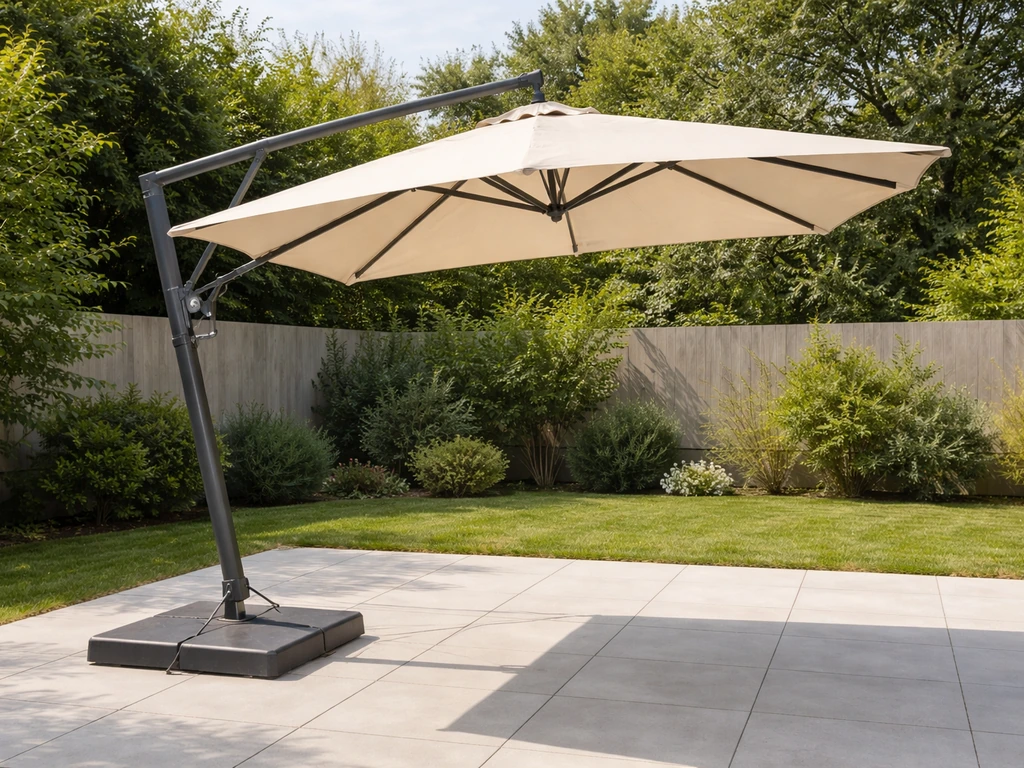
Once you have the code, cross-reference it to figure out which variant you have. The main differences across Grand Patio cantilever lines are the canopy size (10x10 ft double-sided vs. 11 ft single), the base type (sandbag-filled mobile base with wheels vs. fill-in-place base with a plastic cap), and the tilt system (auto-lock tilt-and-lock lever vs. pedal-controlled 360-degree rotation with tilt). These details determine which setup steps apply to you.
Here are the core parts shared across most Grand Patio cantilever models. Getting familiar with these names before you start will make the rest of this guide much easier to follow.
- Main pole (aluminum, offset to one side so the canopy hangs over your space)
- Cross base with wheels (steel frame, filled with sand/water for ballast)
- Plastic fill cap (labeled 'Plastic Cap E' in some manuals, seals the base after filling)
- 8 heavy-duty steel ribs (attach to the canopy hub at the top of the pole)
- Crank handle (extends from the pole, turned clockwise to open)
- Tilt button or lever (separate from the crank, engages the tilt-and-lock mechanism)
- Locking pin or P-strap (secures the umbrella in closed position when not in use)
- Bolts, nuts, and washers (hardware pack included in the box, used during pole and canopy assembly)
Tools and safety before you start
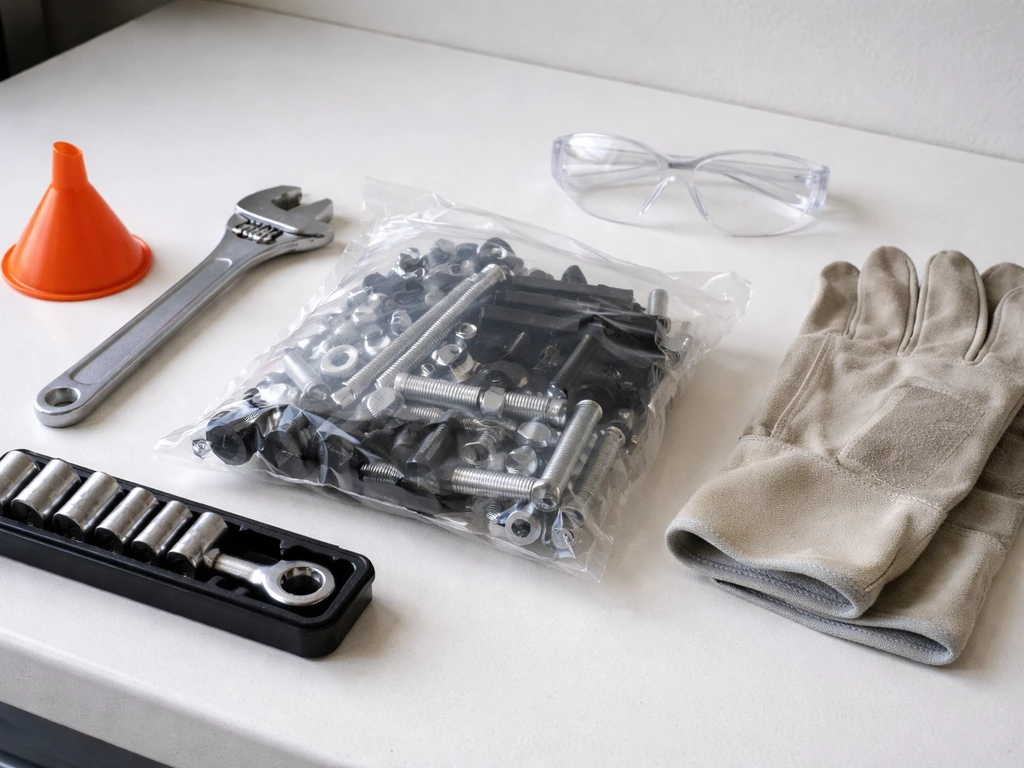
Grand Patio includes most of what you need in the hardware pack, but you will want a few things on hand before you begin. An adjustable wrench or the correct socket size (usually 13mm or 17mm) makes tightening the pole bolts much easier than using the included spanner alone. You will also need a source of sand and water for the base, and a funnel helps a lot if your base has a narrow fill opening.
- Adjustable wrench or socket set (13mm–17mm range covers most Grand Patio hardware)
- Funnel (for filling the base with sand and water without spilling)
- Sandbags or bagged play sand (check your model's fill weight requirement before buying)
- Silicone-based lubricant spray (for the crank and tilt mechanism, not WD-40 which attracts dirt)
- A second person (the canopy is large and unwieldy during attachment)
- Flat, stable ground (cantilever umbrellas will sway if the base sits on uneven pavers)
Safety basics: never assemble or adjust the umbrella in wind above about 20 mph. The canopy acts like a sail and can tip the base before it is fully weighted. Keep the canopy closed and secured with the locking pin or P-strap any time you are not actively using it. The manual is explicit that torn fabric and broken ribs caused by leaving the umbrella open in bad weather are not covered under warranty.
Step-by-step setup: base, mast, and canopy
Step 1: Position and fill the base
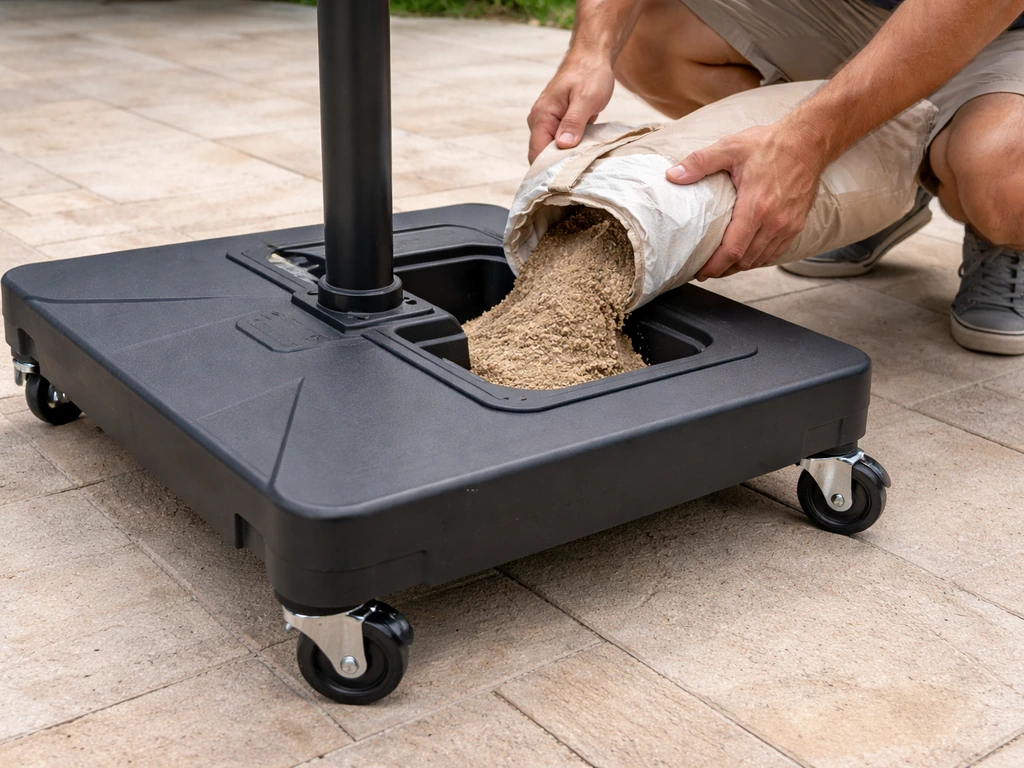
Roll the base (it has wheels) to the spot where you want the umbrella to live. The canopy will hang offset from the pole, so position the base so the pole side is away from where people will sit. Choose a flat, hard surface if possible. Sand or grass that shifts will undermine stability over time.
Now fill the base. The fill weight varies by model, so check yours before you start hauling sand:
| Model | Sand fill | Water fill | Total target weight |
|---|---|---|---|
| 11 ft cantilever (B08CVTKRRR) | 330 lbs | 44 lbs | 374 lbs |
| 10x10 ft double-sided (B0D2XFK75D) | 4 sandbags | To fill capacity | 420 lbs |
| 11 ft cantilever with base (B0D3W45Y76) | Sand + water to full | To fill capacity | 264 lbs minimum |
Add sand first using a funnel, then top off with water. On models with the screw-in plastic cap (labeled Cap E), tighten it fully by hand and then snug it with a wrench. The manual specifically warns that the cap must be fully tightened. If it is loose, the base loses ballast over time and the umbrella will sway. Once filled, lock the wheels so the base does not roll.
Step 2: Attach the main pole
Slide the main aluminum pole into the base socket. Most Grand Patio models have a sleeve in the base that the pole drops into, followed by a bolt-and-washer assembly that clamps the pole in place. Thread the bolt through the side of the base sleeve and the pole collar, then add the washer and nut on the other side. Hand-tighten first, then use your wrench to snug it down firmly. Do not overtighten to the point of stripping the threads, but it should have zero wobble when you give the pole a shake.
Step 3: Attach the canopy and ribs
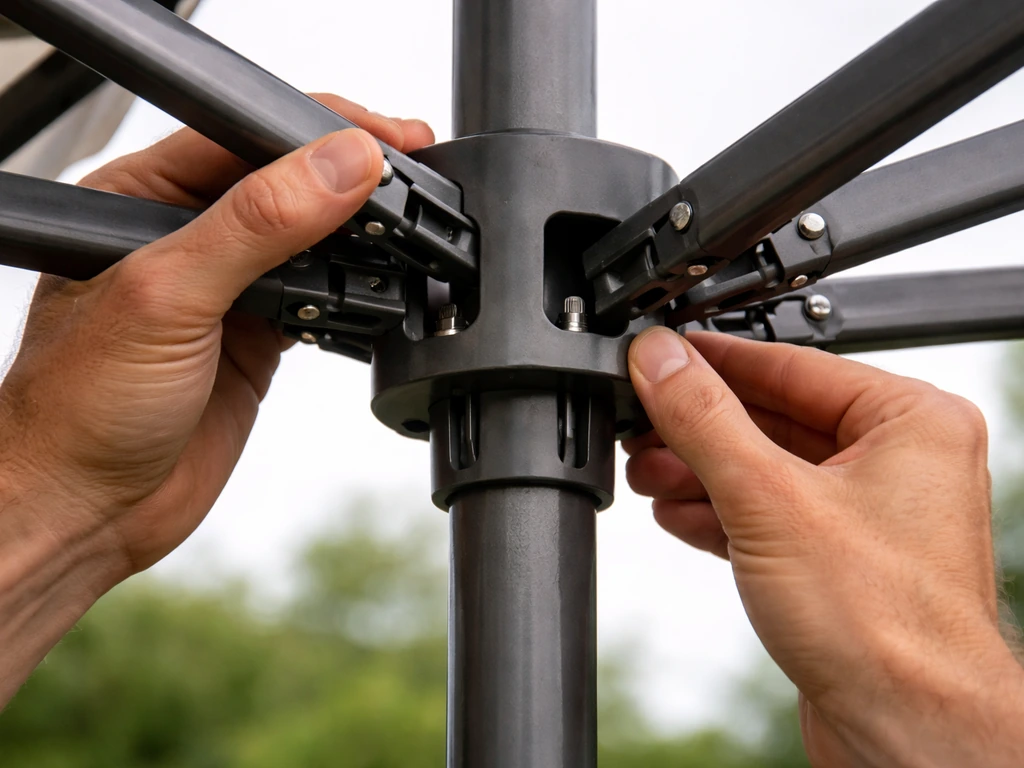
This is the step where a second person really earns their keep. The canopy hub at the top of the pole has slots where the rib ends insert and bolt or clip into place. With one person holding the canopy up and the other guiding each rib into its slot, work around the hub in a star pattern (opposing ribs, not adjacent) so the tension stays even. Secure each rib connection with the provided bolt and nut. Once all 8 ribs are attached, give the canopy a gentle shake. If it shifts or droops on one side, one of the rib connections is not fully seated.
How to operate it: crank, tilt, and locking
Opening and closing the canopy
Locate the crank handle on the pole. Turn it clockwise to open the canopy. Keep cranking until the ribs are fully extended and taut. Do not stop halfway, because a partially open canopy puts uneven stress on the ribs and the crank gear. To close, turn the crank counter-clockwise until the canopy is fully retracted and the ribs are folded in. Once closed, engage the locking pin or wrap the P-strap around the canopy to keep it from catching wind.
Adjusting the tilt
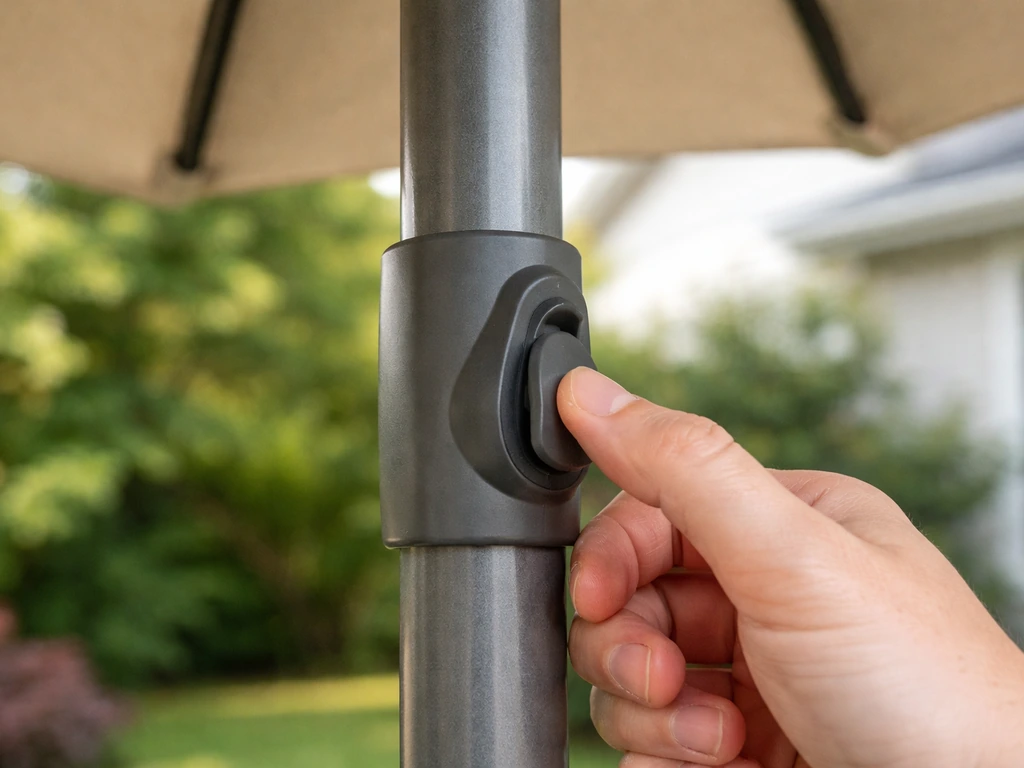
The tilt and the crank are separate systems. After you have fully opened the canopy, locate the tilt button or lever on the pole (it is usually a push button or a small pull-up handle near the crank). Press or engage it, then gently push the canopy to your desired angle. The tilt can go up to 90 degrees, meaning you can angle the canopy almost horizontal to block low-angle afternoon sun. Release the button and the tilt locks in place automatically. On models with the pedal-controlled 360-degree rotation system, you press the foot pedal at the base to unlock rotation, swing the canopy to the direction you want, then release the pedal to lock it. Always return the canopy to an upright position before closing it, otherwise the ribs and crank mechanism bind up.
Locking it for wind and overnight
When you are done for the day or a storm is rolling in, close the canopy fully and put it in the deadlock position. The manual describes this as fully retracting the canopy and engaging the locking pin so the crank cannot be accidentally turned. If your model includes a P-strap, wrap it around the folded canopy and clip it to the pole. This prevents the fabric from catching wind gusts and acting as a sail, which is one of the most common ways the ribs get bent.
Troubleshooting common problems
Umbrella sways or feels unstable
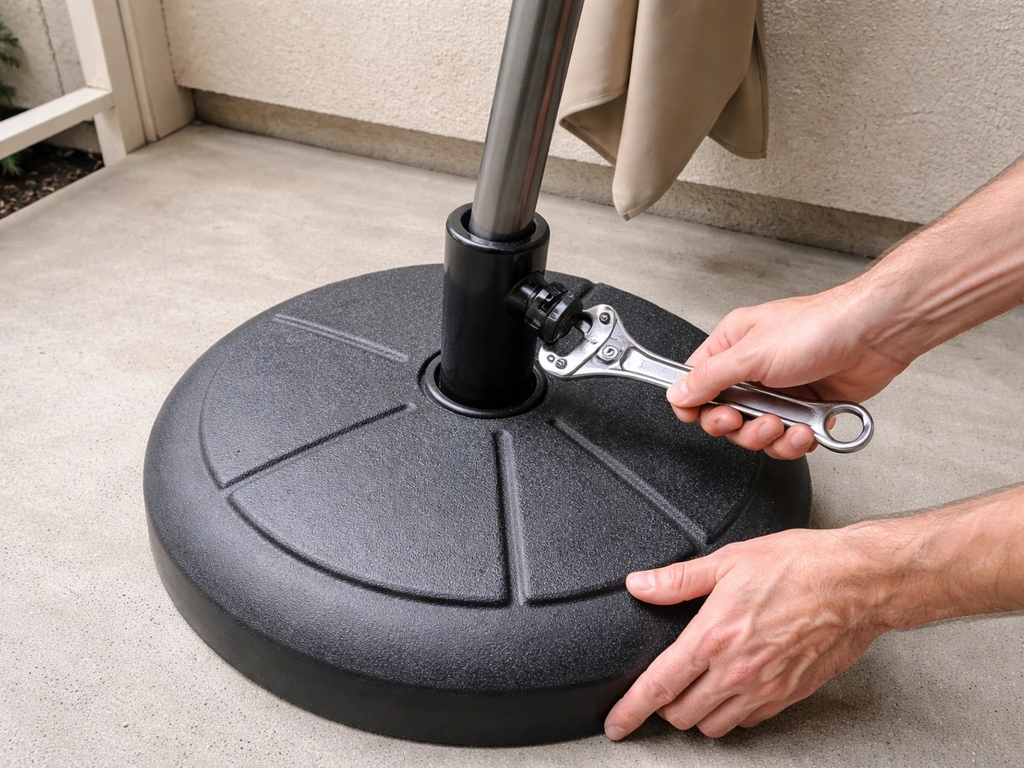
This almost always comes back to the base. Check that the base is filled to the weight your model requires (see the table above). If you filled it and it still sways, check that the base is sitting on flat, hard ground and that the wheels are locked. Also check the pole-to-base bolt. If that bolt has worked loose even slightly, the whole pole will rock. Tighten it down and the sway will often disappear immediately.
Crank feels stiff or won't turn
A stiff crank is almost always dirt or a lack of lubrication in the gear housing. Start by cleaning around the crank assembly with a dry cloth to remove debris. Then apply a small amount of silicone-based lubricant to the gear mechanism. Avoid WD-40 or oil-based products, as these attract grit and make the problem worse over time. Work the crank back and forth a few times to distribute the lubricant. If the crank is stiff because the canopy is partially open and the ribs are binding, close the umbrella fully before attempting to open it again cleanly.
Canopy won't open or close smoothly
Run your hand along each rib and check for fabric that has bunched up, twisted, or caught on a rib joint. This is the most common cause. Smooth out the fabric by hand, making sure each panel hangs evenly from its rib, then try the crank again. If a rib itself is bent, it will catch on adjacent ribs during opening. A bent rib usually needs to be replaced rather than straightened, because aluminum ribs that have been bent once are structurally weakened.
Tilt mechanism is stuck or won't lock
If the tilt button or lever will not engage, check that the canopy is fully open first. The tilt mechanism on most Grand Patio models is designed to only engage when the canopy is at full extension. If it is still stuck, inspect the tilt collar on the pole for visible dirt or debris and clean it with a dry cloth. Apply a small amount of silicone lubricant to the collar joint and work the button several times. If the tilt engages but will not lock (the canopy drifts back to vertical on its own), the auto-lock spring inside the collar may be worn or the button is not fully depressed before you release it. Press firmly and hold for a half-second after you reach your desired angle.
Canopy tilts unevenly or looks crooked
A crooked tilt usually means one of two things: either one or more rib connections at the hub are not fully seated, or the canopy fabric is attached unevenly to the ribs. Close the umbrella, go around each rib bolt at the hub and check that they are all tightened to the same tension. Then open the umbrella and look at the canopy from below. If one panel is drooping more than the others, that rib's connection or the fabric attachment point at that rib tip is loose. Re-secure it and the tilt should level out.
Seasonal maintenance and winterizing
End-of-season hardware check
Before you store the umbrella for winter, do a full hardware inspection. Go around every bolt at the base, the pole collar, and the rib hub and check for looseness or rust. Tighten anything that has worked loose. If you see surface rust on steel ribs or the base frame, clean it off with a wire brush and apply a rust-inhibiting spray before storage. Aluminum pole sections will not rust but can oxidize, which shows up as a chalky white coating. Wipe it down with a damp cloth and a mild soap.
Cleaning the canopy fabric
Grand Patio canopies are typically polyester or solution-dyed acrylic. Clean the fabric with a mild soap solution and a soft brush, working along the weave of the fabric rather than scrubbing in circles. Rinse thoroughly with a garden hose and let the canopy dry completely while open before folding it for storage. Storing damp fabric is the fastest way to get mildew stains that will not come out.
Lubricating moving parts for next season
Apply silicone-based lubricant to the crank gear, the tilt collar, and the rotation pedal mechanism (if your model has one) before you close it up for the year. This prevents the mechanism from seizing over winter, which is a very common complaint when people pull their umbrella out in spring and find the crank will barely turn. A little silicone spray now saves a lot of frustration in April.
Winterizing and storage
Close the canopy fully and secure it with the P-strap. If your model came with a storage bag or cover, use it. Store the folded canopy and pole in a dry, sheltered location like a garage or shed. Do not leave it outdoors through freezing temperatures with water in the base, because water expands when it freezes and can crack the base casing. If you cannot drain the base, displace the water by topping it off with sand instead, or add a non-toxic antifreeze solution to the water portion. Leave the wheels unlocked during storage so the base can be moved easily next spring.
Securing against wind before storms
If a storm warning comes in, close the umbrella and engage the deadlock position. Do not trust the base weight alone to hold the canopy in a gust, even with 374 lbs of fill. Wind can get under a partially open canopy and generate enough lift to tip the whole assembly. The P-strap and locking pin are there for exactly this reason. Use them every single time, not just in storms.
What to check first if something goes wrong
If you are troubleshooting a problem today, start with the base. Most Grand Patio cantilever issues trace back to inadequate fill weight or a loose pole-to-base connection, and both take five minutes to fix. If the crank or tilt is the problem, silicone lubricant and a thorough cleaning resolve the majority of cases before you need to think about replacing parts. If a rib is visibly bent or the tilt collar is cracked, those parts are worth replacing rather than working around, because a compromised rib or collar will fail completely in the next storm.
If your situation involves a specific Grand Patio model like the Napoli variant, the operating steps for the tilt and rotation system can differ slightly from the standard cantilever lineup described here. If you need exact Jearey patio umbrella instructions, follow the same open, tilt, and rotation sequence listed for your specific model operating steps for the tilt and rotation system. Follow these grand patio Napoli umbrella instructions for the tilt and rotation steps that match your exact model Napoli variant. Similarly, if your umbrella is a non-cantilever center-pole style rather than an offset cantilever, the base and mast setup process is different. And if you are dealing with a more serious mechanical failure like a stripped crank gear or a broken rib runner, dedicated patio umbrella repair guidance will walk you through part-level fixes that go beyond routine maintenance. For step-by-step patio umbrella repair instructions, use the part-level guidance that matches your specific failure. The key is always to identify your exact model code first so you are working from the right reference.
FAQ
How do I confirm I’m filling the correct amount of sand and water for my exact Grand Patio model?
Find your model code first, then use the fill-weight range for that specific code before adding anything. If you are unsure between two nearby variants, start by filling to the lower end, then re-check for wobble with the canopy fully opened. If you still get sway, top off sand first, then add water to the correct level, since sand tends to settle and water helps ballast only after the base is level.
What should I do if the base won’t stay put after I lock the wheels?
Verify the surface is truly hard and flat, not firm-looking grass or compacted soil with a soft top layer. Put a thin rigid board (for example, a piece of outdoor plywood) under the wheel area only if it sits flat, then lock the wheels again. Also re-check that the pole clamp bolt is snug, because pole motion can feel like base movement.
My canopy opens but feels uneven or lopsided. Is it a rib issue or fabric attachment?
Do a quick two-check: with the umbrella fully closed, inspect each rib where it connects to the hub for full seating and even bolt tightness. Then open and look from below at panel spacing. If only one panel droops after ribs are secured, the fabric attachment point at that rib tip is likely loose or twisted, smooth it by hand, and re-open slowly to confirm it tracks evenly.
Can I lubricate the crank or tilt with WD-40 or regular oil?
Avoid WD-40 and oil-based products on the crank gear, tilt collar, and rotation mechanism. Use a small amount of silicone-based lubricant only, and wipe off any excess. Oil and WD-40 attract grit, which usually makes the crank feel worse within weeks, especially on exposed outdoor sites.
What’s the safest way to open the umbrella if the ribs are slightly binding?
Close the umbrella fully first, confirm the fabric panels are not bunched at a rib joint, then open by turning the crank steadily until the ribs are fully extended. If you stop halfway or try to force the crank, ribs can stay partially misaligned, making the next opening harder and increasing the chance of bending a rib.
How can I tell if the tilt lever is failing versus the canopy not being fully extended?
If the tilt will not engage, the most common cause is that the canopy is not at full extension. Fully crank open, then try the tilt button or lever while the canopy is fully taut. If it still will not lock, inspect and clean the tilt collar on the pole, then reapply a small amount of silicone lubricant and test again with the canopy in the fully open position.
Why does my tilt drift back toward vertical even after I set it to an angle?
This usually points to the auto-lock not catching. Confirm you press the tilt control firmly enough to fully depress it before releasing, then hold briefly for about half a second after reaching your angle. If it still drifts, the lock spring inside the collar may be worn, which is when inspection or replacement is the right next step rather than repeated forcing.
When rotating a 360-degree cantilever, what’s the correct sequence to avoid binding?
Unlock the rotation using the pedal (or the model’s rotation control), rotate the canopy to the target direction, then release to lock. Make sure the canopy is upright before closing and avoid rotating while the umbrella is partially closed. If rotation feels gritty, clean around the rotation mechanism first, then use silicone lubricant sparingly.
What should I do if a rib is bent after a storm or misuse?
If a rib is visibly bent, replace it rather than trying to straighten it. Aluminum ribs that have been bent once are structurally weakened and can jam adjacent ribs during opening, which increases the chance of a lockup or repeated bending. Before replacing, also check for fabric snagging so the new rib does not experience the same stress point.
How do I store the umbrella during freezing weather without cracking the base?
Drain the water portion if possible, or prevent freezing by adding only a model-appropriate method. Do not leave water in the base during freezing temperatures because expansion can crack the base casing. If your manual allows it for your model, store after displacing water with sand instead of leaving liquid, and keep the umbrella covered in a dry, sheltered location.
What’s the best way to clean the canopy so I don’t damage the fabric or stains?
Use mild soap and a soft brush, clean along the weave, and rinse thoroughly. Let the canopy dry completely while open before folding it for storage. If mildew spots appear, treat them as early as possible, because stains that set while damp are much harder to remove later.
My crank is stiff after winter. What’s the fastest troubleshooting path?
Start with cleaning around the crank assembly to remove debris, then apply silicone lubricant to the gear area. Work the crank back and forth gently a few times to distribute the lubricant. If it still feels jammed, fully close the umbrella and inspect for any fabric bunching or partially bound ribs, since a binding rib can force the gear to work against tension.
Should I ever adjust or re-tighten bolts while the umbrella is open?
No. Only tighten or inspect hardware with the umbrella fully closed and secured (deadlock position and strap/pin engaged). Tightening while open increases risk of shifting rib tension and can also lead to uneven seating, which later shows up as crooked tilt or uneven panel droop.
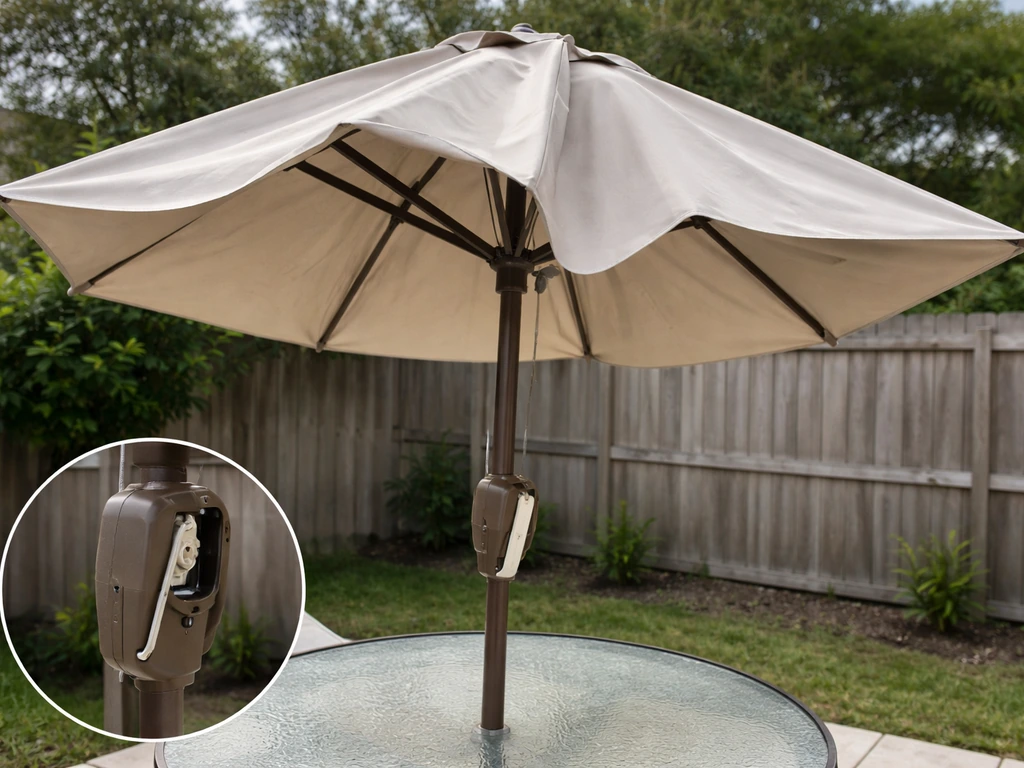
Step-by-step fixes for patio umbrellas that won’t open or close, with checks for jams, cords, latches, and lubricating t
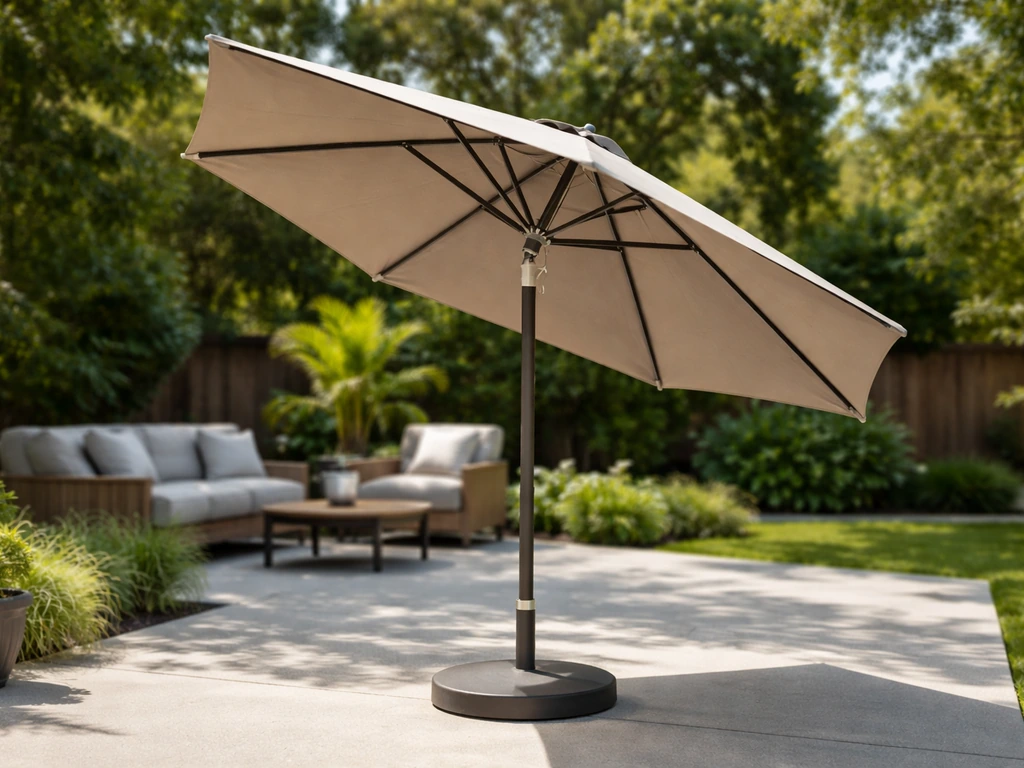
Learn how patio umbrellas work: components, open close tilt, stability, and step by step troubleshooting common mechanic
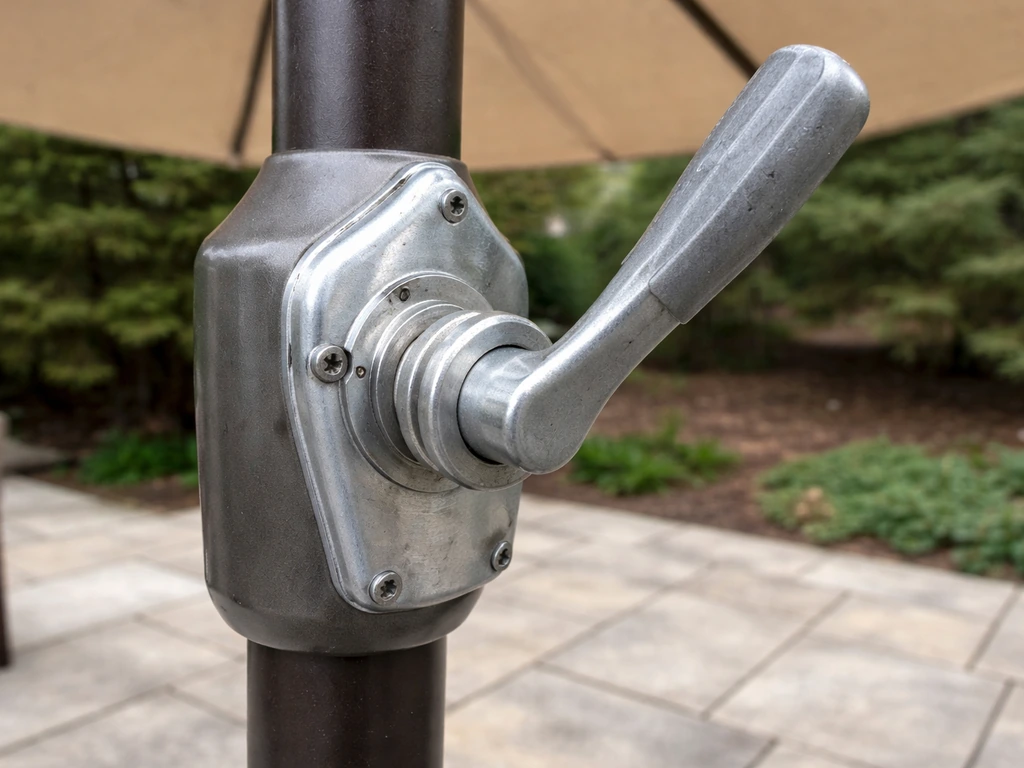
Fix a patio umbrella crank that won’t work with safe step-by-step jam, gear, and base troubleshooting and repair tips.